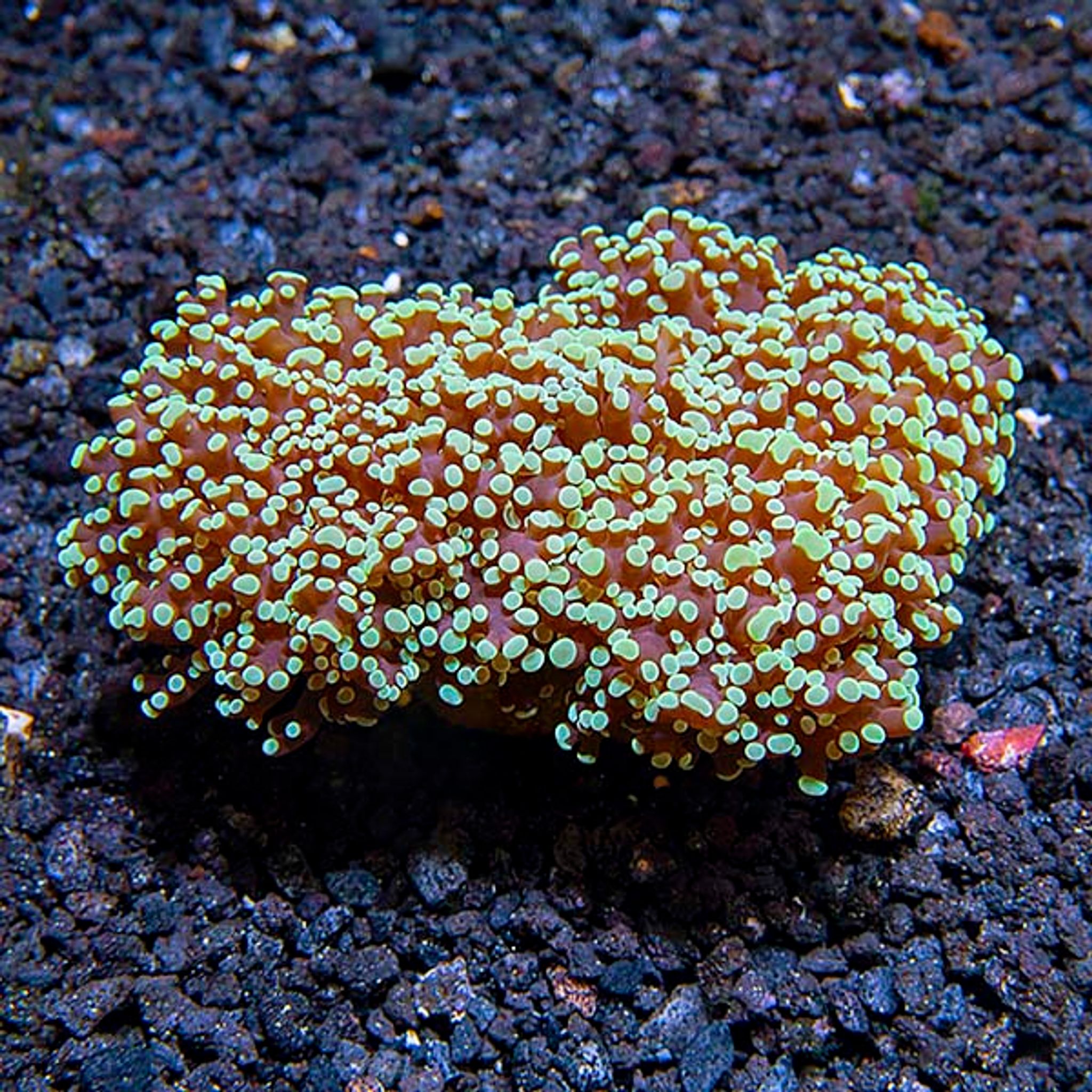

Frogspawn Coral Care Guide: Lighting, Flow, Feeding and Placement
Frogspawn coral is one of the most forgiving large-polyp stony corals a reef keeper can start with, but it still fails when light, flow, feeding, or spacing are guessed at rather than measured. This guide walks through each of those four pillars with concrete numeric targets, then covers the placement rules and troubleshooting steps that separate a thriving frogspawn colony from one that bails out or melts.
What Is Frogspawn Coral?
Frogspawn is the common name for Euphyllia divisa (some taxonomists classify it as E. paradivisa), a large-polyp stony (LPS) coral in the Euphylliidae family. It gets its name from branching, multi-tipped tentacles that resemble clusters of frog eggs when fully extended. It's a close cousin of hammer coral and torch coral — same genus, similar care, but different aggression levels (more on that below). A related branching variant sometimes labeled "octospawn" is often sold under the same care sheet as standard frogspawn; the guidance here applies to both, though octospawn tends to grow in tighter, more compact branches.
Where Frogspawn Fits Among Coral Types
Understanding the broader coral categories explains why frogspawn is considered an easy pick:
- Soft corals — no rigid skeleton, flexible bodies (leathers, mushrooms, zoanthids). Generally the most forgiving group for total beginners.
- Small-polyp stony (SPS) corals — hard skeleton, tiny polyps, fast growth, but demanding on stability (e.g., Acropora). These punish parameter swings quickly.
- Large-polyp stony (LPS) corals — hard skeleton, larger fleshy polyps, more tolerant of swings than SPS. Frogspawn, hammer, torch, and bubble coral all fall here.
Frogspawn sits in the middle: pickier than most soft corals, but far more forgiving than SPS, which is exactly why it's routinely recommended as a first stony coral.
Is Frogspawn Coral Good for Beginners?
Yes, with one caveat: the tank needs to be established, not brand-new. Frogspawn tolerates minor parameter drift better than most Euphyllia relatives, but it still needs a cycled reef system with stable rock and a maintenance routine already in place. Dropping a frag into a tank that's only a few weeks old is a common recipe for early failure, regardless of how hardy the species is on paper.
Lighting Requirements
Frogspawn does best under low-to-moderate PAR, roughly 75–150 (a full range of 50–250 shows up across different sources, but the middle of that band is the safer target). Under LED fixtures, keep intensity moderate or place the coral in a shaded or lower position in the tank rather than directly under the most intense point of the light.
Watch for these light-related warning signs:
| Sign | Likely cause | Fix |
|---|---|---|
| Polyp deflation or retraction | Light too intense | Move lower in tank or reduce intensity |
| Bleaching or fading color | Sustained overexposure | Shade temporarily, ramp light back slowly |
| Tissue never fully extends | Light or flow too high | Test both variables separately |
New frags should be acclimated to display lighting gradually — over 1–2 weeks — rather than placed straight under full intensity. A PAR meter or an LED fixture with a built-in light meter setting makes this measurable rather than guesswork; browse LED lighting options built for reef PAR ranges on FishyHub.
Flow Requirements
Frogspawn wants low-to-moderate, indirect or turbulent flow — never a direct laminar blast from a powerhead. The goal is gentle, constant tentacle movement without visible retraction.
Sources aren't unanimous here. Most recommend low-to-moderate flow, but one line of thinking pushes for moderate-to-strong flow, arguing it produces faster growth and a more compact colony. The practical resolution: start on the low-to-moderate end and increase gradually while watching how the polyps respond. Full, swaying extension is the target; retracted, ball-like polyps mean the flow is too strong and needs to be dialed back.
Two flow-tuning notes most care sheets skip: wavemaker pattern matters as much as strength (pulse or random modes mimic natural surge better than a single constant-speed pump aimed directly at the coral), and placement relative to return outlets changes effective flow more than a pump's rated output does — a frag sitting in a direct return line's path gets far more force than the dial suggests. Too much direct flow over time causes chronic retraction, torn tissue, and a coral that stops responding to food.
Feeding Frogspawn Coral
Frogspawn is primarily photosynthetic, meeting most of its energy needs through the zooxanthellae algae living in its tissue. It is not an aggressive feeder, but occasional supplemental feeding supports faster growth and richer color.
- What to feed: mysis shrimp, brine shrimp, coral pellets, or an amino acid/coral-specific blend.
- How often: roughly once every 1–2 weeks.
- How to feed: broadcast feeding (dosing food into the water column near the coral) or gentle target feeding with a pipette both work.
Sources disagree on how necessary this actually is — some frame feeding as essentially optional since photosynthesis covers most nutritional needs, while others recommend a consistent weekly-to-biweekly schedule for noticeably better growth and color. The practical middle ground: feeding isn't required for survival, but it measurably helps growth, so offer small meaty foods every 1–2 weeks and skip a session if the coral isn't accepting food that day. Avoid large food particles or overfeeding — both can trigger polyp retraction and feed nuisance pests in the tank. A gel or pellet coral food sized for LPS mouths is easier to dose precisely than a large frozen cube.
Placement and Spacing
Frogspawn does best in the lower-to-middle water column, positioned on rockwork rather than sitting directly on bare sand. Guides differ slightly on strictness here — some say avoid sand entirely, others note it tolerates sitting near sand if propped up on rubble — but the safest default is a rock ledge or cradle that elevates the base slightly above the substrate.
This is the placement detail most beginners underestimate: frogspawn carries potent stinging cells (nematocysts) and extends long sweeper tentacles at night that reach well beyond its daytime footprint. Leave at least 6–8 inches of clearance in every direction — including above — from any other coral. Frogspawn can go in tanks as small as roughly 20 gallons (76 L), but budget space for growth and that full sting buffer before deciding where it goes.
Compatibility With Other Corals and Livestock
Frogspawn is semi-aggressive. It generally coexists with other Euphyllia (hammer, additional frogspawn) given generous spacing, but reports conflict on hammer/torch pairings — one view says hammer and frogspawn often share space fine, another warns against keeping frogspawn near torch or hammer at all since torch tends to overpower it. The sensible approach: same-genus Euphyllia can be kept together, but only with 8+ inches of spacing and close monitoring in the first few weeks — relocate if one colony is clearly losing ground.
Keep frogspawn away from soft corals and slower, more sensitive species. Watch for fish that nip at fleshy polyps, including some butterflyfish and angelfish, and avoid coral-eating invertebrates like certain ornamental shrimp. When stocking a mixed reef, review compatible LPS corals and soft corals before finalizing rockwork layout, since spacing is easier to plan before everything is glued down.
Water Parameters
Stability across these ranges matters more than hitting an exact number — a coral held steadily at the edge of a range outperforms one bounced between "ideal" readings.
| Parameter | Target range |
|---|---|
| Temperature | 76–82°F (24–28°C); some tolerate down to 72°F (22°C) if stable |
| Salinity | 1.023–1.026 SG (~35 ppt) |
| pH | 8.0–8.4 |
| Alkalinity (KH) | 8–12 dKH |
| Calcium | 350–450 ppm |
| Magnesium | 1250–1350 ppm |
| Nitrate | 1–10 ppm (some colonies tolerate up to ~40 ppm, but low single digits give better color) |
| Phosphate | Under ~0.1 ppm |
Why alkalinity and calcium matter more than the numbers alone suggest: frogspawn builds its calcium carbonate skeleton continuously as it grows and buds new heads. A dosing routine that swings alkalinity up and down — even within the "acceptable" 8–12 dKH range — stresses skeletal deposition more than sitting at a slightly lower but rock-steady number. Pick one point in the range and dose consistently rather than chasing the top of it.
Signs Your Frogspawn Is Happy
Most care guides only list stress symptoms. A positive baseline is just as useful for spotting problems early:
- Full extension of tentacles for most of the daylight period, not just briefly after lights-on
- Vibrant, consistent tentacle color rather than dull or translucent tissue
- Gradual increase in polyp heads over weeks to months (a sign of active budding)
- Quick response to food — tentacles curling toward a food source within a minute or two
Growth and Propagation
Frogspawn grows by branching and by producing pedal buds — small new heads that form at the base and eventually detach naturally. It can also be frag-cut deliberately with a bone cutter, saw, or shears, cutting cleanly between polyp heads. After cutting, dip both the frag and the mother colony in an iodine-based coral dip and let both heal in a low-flow, low-light area before returning either to the display.
Acclimation: The Step Most Losses Trace Back To
Shipping stress is a leading cause of early bailout, so new frags and colonies need a slow drip acclimation followed by a quiet settling-in period of several days to a couple of weeks under reduced light and flow before moving to their final spot. Quarantining and dipping any new coral before it touches the display is also worth building into routine — the same preventive step that stops Aiptasia, flatworms, and nudibranchs from hitching a ride in, all of which show up later as pest problems blamed on other causes.
Common Mistakes and Troubleshooting
Overcrowding, direct flow, and rushed light acclimation (covered above) account for most preventable losses. Two failure modes deserve their own explanation because they progress fast once started:
Polyp Bailout
This is an extreme stress response — tissue detaches from the skeleton — triggered by transport shock, parameter swings, poor water quality, or fresh fragging cuts. If it starts, move the coral to a stable, low-flow, low-light spot immediately, check parameters, and consider a coral dip. Survival isn't guaranteed once bailout begins, which is why prevention through gentle acclimation and stable parameters is the real fix.
Brown Jelly Infection
Rapid tissue liquefaction, often starting at a wound site, needs immediate action: remove affected tissue with a turkey baster or careful siphon during a water change, isolate the coral if possible, and improve flow and water quality to keep it from spreading to neighboring corals.
Not Opening or Staying Closed
A closed frogspawn isn't necessarily a dead one. Check for pests (flatworms, nudibranchs, nearby Aiptasia), parameter drift, or aggressive neighbors before assuming the worst — LPS corals can look fully melted and still recover once the underlying stressor is removed.
Frequently Asked Questions
Is frogspawn coral good for beginners?
Yes — it's one of the most commonly recommended first LPS corals for its hardiness and tolerance for minor parameter swings, as long as the tank is already cycled and stable rather than brand-new.
How much light does frogspawn coral need?
Low-to-moderate lighting, roughly 75–150 PAR. More isn't better here — excess intensity causes bleaching, retraction, or color loss rather than faster growth.
Does frogspawn coral need to be fed?
Not strictly. It gets most of its nutrition from zooxanthellae through photosynthesis, but small meaty foods every 1–2 weeks can boost growth rate and color over time.
How much space does frogspawn coral need from other corals?
At least 6–8 inches in every direction, including above, because its sweeper tentacles extend further and more aggressively at night than they appear to during the day.
Why is my frogspawn coral not opening or extending?
Usually stress — a new arrival adjusting, a flow or light change, or a parameter swing — or an early disease signal. Check water quality and give it time in a calmer, lower-flow spot before assuming it's dying.
Can frogspawn coral sting other corals or fish?
Yes. Its nematocysts can kill nearby sessile invertebrates, and it defends its space aggressively, though it's typically considered less aggressive than torch coral.
What causes polyp bailout in frogspawn coral?
An extreme stress response — from poor acclimation, shipping stress, unstable parameters, or fresh fragging cuts — where tissue detaches from the skeleton. Prevention through stable parameters and gentle acclimation beats trying to treat it after the fact.
How do you propagate or frag frogspawn coral?
Cut cleanly between polyp heads with a bone cutter or saw, dip both the frag and the mother colony in an iodine-based coral dip, and let both heal in low-flow, low-light conditions before moving them back to display.
Ready to add frogspawn to a reef tank? Browse available LPS hard corals on FishyHub to compare frags and colonies before planning tank placement.


