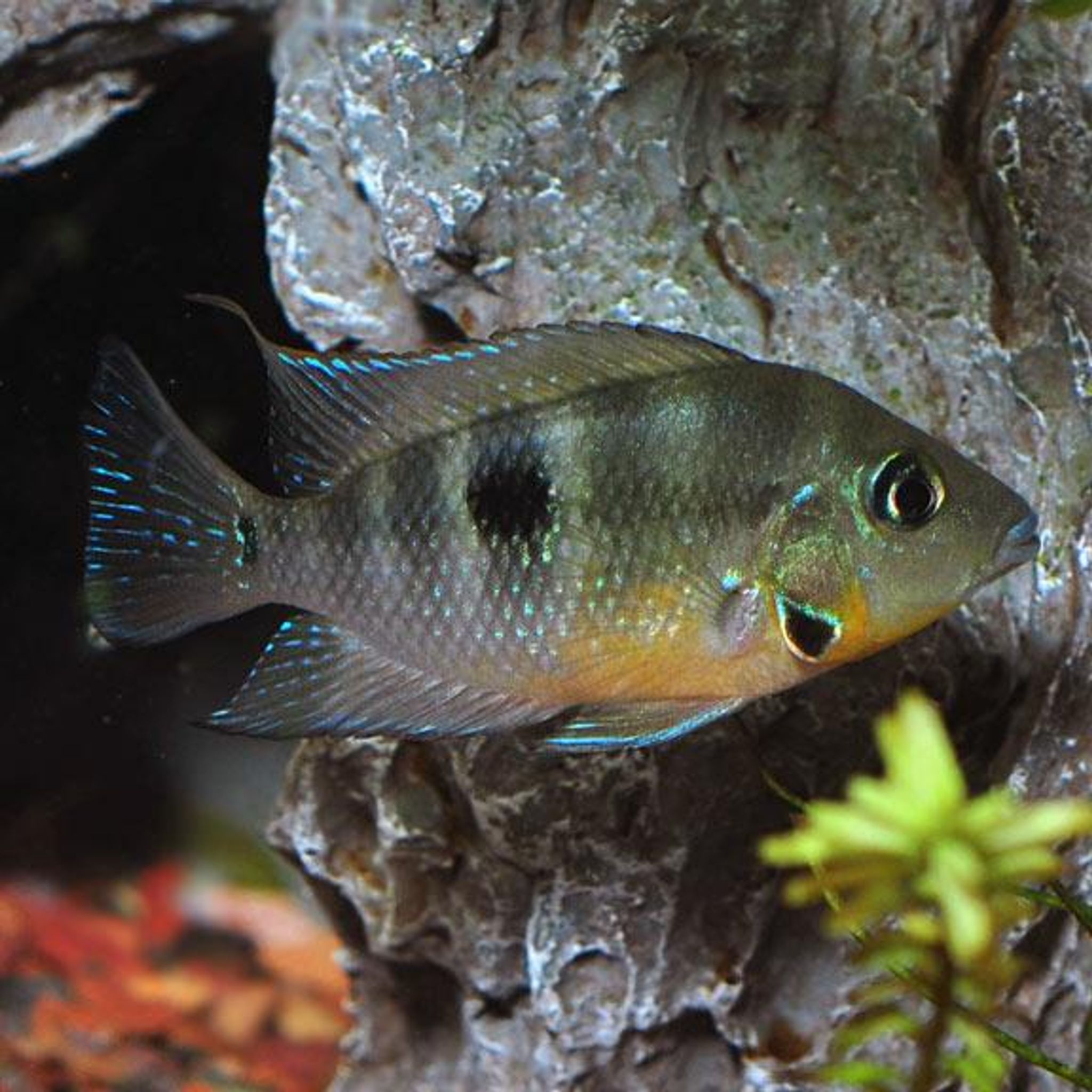
Firemouth Cichlid Care Guide: Tank Size, Diet, Water Parameters and Temperament
The firemouth cichlid (Thorichthys meeki) is one of the most forgiving Central American cichlids for a first-timer, tolerating the moderately hard tap water common across the US and rarely needing chemical adjustment. It is mostly bluff and display rather than a true brawler, but it still digs, uproots loose plants, eats anything small enough to swallow, and turns genuinely fierce once a pair starts spawning. This guide covers realistic tank sizes in gallons, water parameters, feeding, temperament, and which tank mates actually work.
Species Snapshot
Firemouths were once lumped into the broad Cichlasoma genus before taxonomists placed them in Thorichthys. In the wild they inhabit slow, shallow, often clear water across the Yucatan Peninsula in Mexico and into northern Belize and Guatemala — cenotes, streams, and roadside ditches, sometimes even slightly brackish water.
- Size: males reach about 6 inches (15 cm), occasionally to 6.7 in (17 cm); females stay smaller at 4-5 in (10-13 cm).
- Lifespan: typically around 10 years, with reports ranging from 8 to 15 years depending on water quality and diet.
- Signature trait: a red-orange throat and belly, and a gill-flaring display that exposes dark eye-like spots on the gill plates alongside red coloring — an intimidation bluff aimed at rivals, not usually a prelude to real fighting.
Tank Size and Setup
Territory in a cichlid tank is floor space, not water volume, so a long, low footprint beats a tall, narrow one. Use these as realistic US-gallon starting points:
| Tank Size | Stocking |
|---|---|
| 29 gal (110 L) | One firemouth alone |
| 30-40 gal breeder (114-151 L) | A single fish or an established pair |
| 55 gal (208 L) | A pair plus a few robust dither fish or catfish |
| 75+ gal (284+ L) | A community with other similarly sized cichlids |
As a rule of thumb, add roughly 5-10 gallons of capacity for each additional tank mate beyond the core pair. A 30-gallon floor is the safer minimum for a single fish or pair; a 29-gallon works fine for one firemouth kept alone.
Substrate and Decor
Fine sand or smooth fine gravel is best — firemouths sift mouthfuls of substrate looking for food, and sharp gravel can damage gills and mouths over time. Sand also shows off the natural sifting behavior most clearly.
Build the hardscape before adding sand: anchor rock caves, clay pots, and driftwood directly on the glass bottom so digging fish can't topple a stack later. Flat stones make good spawning sites. Aim for enough rockwork and driftwood to break sight lines — this reduces chasing and gives a stressed or subordinate fish somewhere to hide.
Plants
Keep planting sparse; firemouths are diggers, not plant-friendly community fish, and their wild habitat is algae-dominated rather than heavily planted. Epiphytes tied to wood or rock — anubias, java fern — survive being bumped and can't be uprooted. Potted, hardy rooted plants are a second option. Skip anything delicate planted directly in substrate; it will get dug out.
Water Parameters
Firemouths are adaptable, but consistency matters more than chasing a perfect number.
| Parameter | Range |
|---|---|
| Temperature | 75-82°F (24-28°C) sweet spot; tolerates 70-86°F (21-30°C) |
| pH | 6.5-8.0, ideally 7.0-7.8 |
| General hardness | ~8-15 dGH (roughly 140-270 ppm) |
| Ammonia / Nitrite | 0 ppm, always |
| Nitrate | Under 20-40 ppm |
Sources disagree somewhat on temperature: some list up to 86°F as normal, others cap the everyday range at 82°F. A practical compromise is to run the tank at 76-80°F day to day and reserve the upper 84-86°F range specifically for ich treatment, raised gradually rather than all at once.
Wild firemouth habitat is naturally hard and slightly alkaline, which is a close match to much of the moderately hard tap water found across the US — many keepers don't need to buffer or soften at all. Test first rather than assuming, but this is one of the few cichlids where typical municipal tap water is often already suitable.
Only add firemouths to a fully cycled tank; ammonia and nitrite must read zero before livestock goes in.
Filtration and Maintenance
Firemouths come from slow-moving water, so they want strong biological filtration without a harsh current. A canister filter or an oversized hang-on-back unit rated for roughly twice the tank's volume gives solid capacity while keeping flow gentle to moderate. Browse filtration options in FishyHub's filters category when sizing equipment to your tank.
Weekly water changes of 25-30% are the safer default for a stocked cichlid tank, since these are heavy waste producers; some keepers stretch to biweekly in lightly stocked setups, but weekly is the more reliable habit.
Diet
Firemouths are unfussy omnivores and natural bottom sifters. Build meals around:
- A quality sinking cichlid pellet as the daily staple
- Frozen brine shrimp, mysis shrimp, and bloodworms (sparingly, since bloodworms are rich) for protein
- Daphnia as an occasional treat
- Vegetable matter — blanched spinach, peas, or a spirulina-based food — to round out the diet
Feed once or twice daily, offering only what the fish clean up within 2-3 minutes. Overfeeding is one of the most common mistakes with this species and drives both nitrate spikes and bloating.
Temperament and Tank Mates
Temperament descriptions for firemouths swing between "peaceful" and "semi-aggressive" depending on the source, and both are partly right: this is genuinely one of the mildest Central American cichlids day to day, but aggression spikes sharply once a pair forms or starts guarding a spawn. Treat it as context-dependent rather than fixed.
Good Tank Mates
Pick fish that are too large to be eaten and too tough to be bullied out of a home range:
- Larger, robust tetras — Colombian, diamond, Buenos Aires
- Giant danios, rainbowfish, silver dollars
- Severums, blood parrots, and convicts (only in larger tanks)
- Yoyo or clown loaches, plecos, larger corydoras and other bottom-dwelling catfish
- Swordtails and other Mexican livebearers, useful for a regional biotope
FishyHub's freshwater livestock section and its American cichlids category are good places to browse compatible species by size and origin.
Fish to Avoid
- Shrimp and snails — treated as food, not tank mates
- Any fish small enough to fit in the mouth
- Slow, long-finned fish like angelfish and bettas — fins get targeted
- Dwarf cichlids — easily bullied
- African rift-lake cichlids — mismatched water chemistry and higher baseline aggression
- Very large, aggressive cichlids — the firemouth will lose that fight
A Biotope Approach
Central American cichlid diversity actually stretches from Mexico down through Costa Rica and Panama, and firemouths represent the northern, Yucatan-Belize end of that range. For a biotope-style tank, pair firemouths with other fish native to the same region — Mexican livebearers such as swordtails and mollies make an easy, realistic match, since they share both geography and water chemistry preferences.
Related Central American Cichlids
Two species commonly show up in "can I keep them together" questions:
Jewel cichlid: More aggressive and a persistent fin-nipper, running 4-6 in and preferring 75-80°F with pH 6.5-7.5. It's often suggested as a tank mate, but the firemouth is usually the one getting bullied — only attempt this in a large tank with heavy sight-breaking decor, and even then it's a gamble.
Salvini cichlid: Considerably more aggressive still, reaching 6-9 in and needing roughly 75-90+ gallons, 72-79°F, pH 7-8. In shared tanks the salvini nearly always dominates. Between the two, the firemouth is the gentler, more beginner-appropriate choice.
Other reasonable companions or alternatives within the same general group include convicts, other Thorichthys species like T. ellioti and T. aureus, rainbow cichlids, and Honduran red points — though the smaller, mellower ones can still get pushed around once a firemouth pair starts spawning.
What "Cichlid" Actually Means
Cichlidae is one of the largest families of freshwater fish, with more than 1,700 described species; the name traces to a Greek word for a type of fish. Two anatomical quirks separate cichlids from most other freshwater fish: a single nostril on each side of the head (rather than two) and a lateral line split into two offset segments. Temperament varies enormously across the family, from placid dwarf species to outright predators, but nearly all cichlids share strong territoriality and dedicated parental care — and most will eat shrimp given the chance.
Building a Cichlid Tank That Actually Works
A few principles carry across most cichlid setups, firemouths included:
- Match species by region and aggression level rather than just size
- Provide sand or fine substrate, rockwork, caves, and enough sight breaks that no fish is visible from every angle
- Oversize the filtration relative to the bioload
- Keep temperature stable — swings stress cichlids more than a slightly-off number held steady
- Give every fish enough personal floor space to claim a territory
- Add new fish in groups, or rearrange decor when introducing them — this resets existing territory claims and spreads out aggression
Sexing and Breeding
Telling Males from Females
Males run larger and brighter, with longer, more pointed extensions on the dorsal and anal fins. Females are smaller and rounder-bodied, with shorter fins. At spawning time the breeding tube shape also differs — the female's is broader and blunt.
Breeding Basics
Firemouths are monogamous, open-substrate spawners. The most reliable way to get a real pair is to raise six or more juveniles together, let a natural pair form, then rehome the rest before pressure builds.
Encourage spawning with warm water in the upper 70s to low 80s°F, rich feeding, and frequent water changes. A pair will lay 100-500 eggs on a cleaned flat stone; eggs hatch in about 2-3 days, and fry become free-swimming another 4-5 days after that. Both parents guard the brood, dig small pits, and herd the fry as a school. Feed fry baby brine shrimp or microworms at first, moving to crushed flake as they grow.
Young pairs commonly eat their first clutch or two — this is normal and usually improves with reduced disturbance and a few more spawning attempts.
Growth Rate and Buying Tips
Juveniles sold in stores are typically just 1-2 in long but reach near-adult size within about a year given good, consistent feeding. Look for a fish with full fins, steady color (even if a young fish isn't showing bright red-orange yet), and active, alert swimming rather than clamped fins or hiding in a corner.
Health and Common Problems
Firemouths are generally hardy, but a few issues come up regularly:
- Ich: the most common ailment. Raise temperature gradually toward the mid-80s°F alongside appropriate treatment.
- Hole-in-the-head disease: linked to poor water quality and nutrient gaps. Prevention centers on consistent water changes, nitrate control, and a varied diet with vitamin-rich foods — there's no solid evidence that activated carbon use is a cause, despite that claim circulating among hobbyists.
- Bacterial and fungal issues: almost always trace back to declining water quality.
- Quarantine every new fish for 2-4 weeks before adding it to an established tank.
Troubleshooting Common Mistakes
- Fish disappearing from a small-fish community or shrimp tank: the firemouth ate them. This is expected behavior, not illness.
- Mixing with African cichlids or larger aggressors like a Jack Dempsey, or keeping a salvini in a small tank: mismatched water needs or overwhelming aggression.
- Sharp gravel or unsecured rock stacks: injury risk from a digging fish.
- Sudden aggression: usually signals a pair forming or an active spawn. Add sight breaks, install a divider, or rehome extra fish.
- Pale color or hiding: a stress signal — check nitrates and evaluate whether tank mates are too aggressive or too numerous.
- Uprooted plants: switch from rooted plants to epiphytes or potted arrangements.
- Overfeeding: drives nitrate spikes and bloating; stick to the 2-3 minute rule.
Once fry reach roughly 1 inch, many keepers pull them into a grow-out tank to relieve pressure on the parents and reduce aggression toward other residents.
Frequently Asked Questions
Are firemouths good for beginners?
Yes. They're among the easiest true cichlids to keep, tolerant of typical US tap water and forgiving of minor mistakes — as long as tank mates and tank size are planned around their territorial habits.
Can a firemouth live alone?
Yes, and a single fish is often calmer than a pair, since there's no spawning-driven aggression to manage. A 29-gallon tank is adequate for one fish kept alone.
Can I keep two males together?
Only in large tanks with plenty of sight-breaking decor. Two males will likely spar over territory, and a smaller tank gives the loser nowhere to retreat.
Can firemouths live with angelfish, goldfish, or guppies?
No to all three. Angelfish and guppies get bullied or eaten outright, and goldfish are a poor match on both temperature (goldfish prefer it cooler) and waste output.
Why is my firemouth flaring its gills?
It's a territorial display, not usually true combat — normal behavior unless it escalates into sustained chasing or actual injury, which signals overcrowding or a bad tank-mate match.
Do firemouths need a heater?
Yes, in most US homes. A heater is needed to hold the water reliably in the mid-to-upper 70s°F, since room temperature alone rarely stays warm and stable enough.
How fast do firemouth cichlids grow?
Juveniles are typically sold at 1-2 inches and reach close to adult size within about a year given consistent feeding and good water quality.
How do I tell a male from a female firemouth?
Males are larger with brighter color and longer, pointed dorsal and anal fin extensions; females are smaller, rounder-bodied, and shorter-finned. At spawning time, the breeding tube shape also differs between the sexes.
For firemouths and other Central American species ready to ship, browse FishyHub's American cichlids selection to compare available stock and plan a tank around the right mix of size and temperament.

