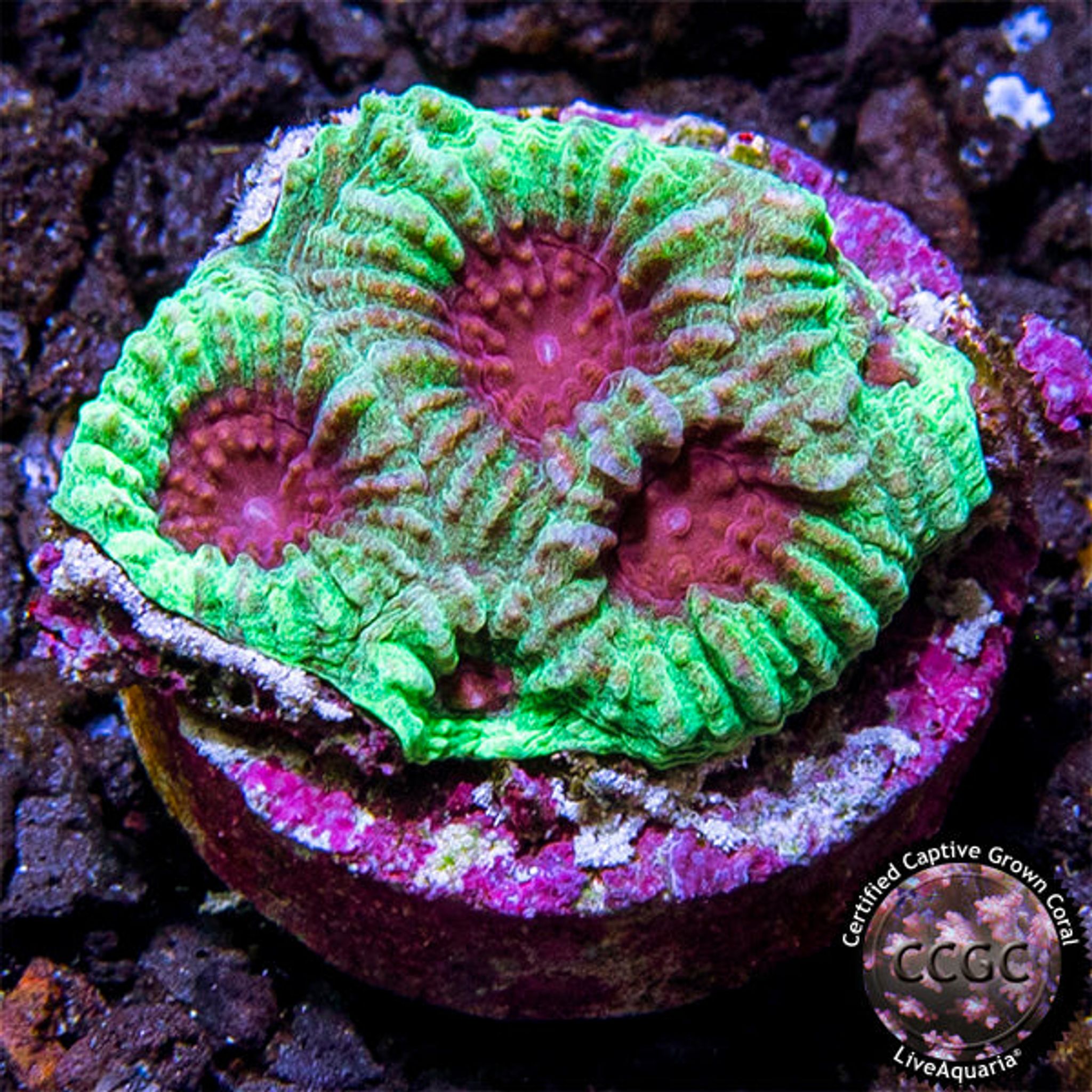
Favia Coral Care Guide: Lighting, Flow, Feeding and Placement
Favia coral is one of the more forgiving large-polyp stony (LPS) corals for a reef tank, but it has one habit that catches new keepers off guard: it stings. This guide covers the light and flow ranges to dial into your gear, a realistic feeding routine, and — most importantly — how much room to give it so it doesn't quietly damage the coral next door.
What Is Favia Coral?
Favia is a large-polyp stony coral sold under a pile of common names — brain coral, closed brain coral, moon coral, pineapple coral, and even war coral. In the wild it grows across Indo-Pacific reef flats and lagoons, including waters off Japan, Australia, East Africa, and the Red Sea, usually in shaded, current-protected spots rather than blasted by direct sun.
Colonies form encrusting mats or dome-shaped mounds made of individual, fleshy-walled corallites that give the surface its classic "brain" texture. Given enough time and stable water, a single colony can spread to a substantial footprint, so it's worth planning for a mature size rather than just the frag size you're buying today.
Difficulty: Favia is widely rated beginner-to-intermediate — one of the hardier LPS choices once your basic reef parameters are stable. It's a common recommendation for a first LPS coral.
Lighting: Aim Low-to-Moderate, Not Intense
The consensus range for Favia is roughly 50–150 PAR, with most experienced keepers centering around 50–100 PAR and treating 100 PAR as a safe target. This matches the coral's natural habitat in shaded lagoons and reef flats rather than open, high-light reef crests.
Favia tends to pale or bleach under high light (above roughly 150–200 PAR) — the opposite problem from SPS corals, which often need more intense light to thrive. If you've read older material claiming faviid corals need "very intense light" or strong actinic-heavy setups above 100+ PAR, treat that as outdated or as referring to a different, faster-growing relative — it doesn't match how most Favia specimens actually respond in captivity.
A few practical notes:
- Acclimate gradually. When moving a Favia to a new fixture or a brighter spot, step up intensity over 2–3 weeks rather than all at once, to avoid shock and bleaching.
- Spectrum matters less than intensity. An actinic-leaning spectrum (roughly 10,000K and bluer) tends to bring out fluorescent greens, blues, and purples in the tissue, but the coral's base color doesn't shift dramatically just by changing the light's color temperature.
- On a typical LED fixture, this usually means running well below your SPS-focused intensity channel — many keepers place Favia on lower rockwork or the sand bed specifically to stay in the lower-PAR zone of the tank rather than fighting the dial-in with shading.
You can browse LPS Hard Corals to compare Favia against other LPS options with similar light needs before you buy.
Water Flow: Gentle, Turbulent, Never Direct
Favia wants gentle-to-moderate, indirect (random/turbulent) flow — not the smooth, laminar stream of a powerhead pointed straight at it. Most care guides agree on this; a minority recommend moderate-to-high flow, but the safer default is turbulent flow that moves around the colony rather than blasting it.
Why it matters both ways:
- Too much direct flow causes chronic polyp retraction, tissue damage, and can actually prevent the coral from feeding, since extended polyps get knocked closed.
- Too little flow lets detritus settle into the fleshy valleys between corallites, which can lead to tissue recession over time.
If you run a gyre-style pump or a wavemaker, aim it so it hits nearby rockwork and disperses before reaching the Favia, rather than pointing it directly at the colony. During target feeding, turn pumps down or off for 15–30 minutes so food doesn't get swept away before the polyps can capture it.
Feeding: Not Required, But Worth Doing
Favia gets a significant share of its energy from the zooxanthellae (symbiotic algae) living in its tissue, so it can survive without ever being fed directly. That said, supplemental feeding measurably improves growth rate and color — it's one of the more common differences between a Favia that just survives and one that visibly fills out.
Feeding frequency: aim for 2–3 times per week as a baseline. Some keepers feed as little as once a week and still see decent results; others feed daily in lightly stocked, well-filtered tanks without issue. If you're unsure, start at 2–3x weekly and adjust based on nitrate and phosphate trends.
Good foods include:
- Mysis shrimp and brine shrimp
- Chopped meaty seafood (shrimp, silverside, etc.)
- Zooplankton blends
- Commercial pellet or powder foods, including reef-roid-style pellets and phytoplankton
How to feed: target-feed with a turkey baster or pipette directly onto extended polyps, ideally at night or dusk when the polyps are naturally extended, with flow paused. FishyHub carries a range of freeze-dried foods that work well for this kind of direct target feeding.
Placement and Aggression: The Most Important Section
This is the single most emphasized care point across every source, and for good reason. At night, Favia extends sweeper tentacles — specialized, elongated tentacles tipped with stinging nematocysts, commonly reaching 2–6 inches (5–15 cm), sometimes described simply as "several inches." These tentacles can damage or kill the tissue of any coral they reach.
Spacing rules of thumb:
| Situation | Recommended clearance |
|---|---|
| Favia next to soft coral or non-stinging neighbors | Several inches minimum |
| Favia next to another LPS with its own sweeper tentacles | More than several inches; treat as high-risk |
| Small frag today | Plan for mature colony size, not current size |
| Growing colony | Re-check clearance every few months as it spreads |
Place Favia on lower-to-mid rockwork or directly on sand or rubble at the bottom of the tank, ideally somewhere you can periodically check with a flashlight at night for tentacle extension. Because colonies can eventually reach a substantial size — up to roughly a meter across in nature, though captive colonies are usually far smaller — always plan the long-term footprint, not just where the frag looks tidy today.
Risky neighbors to keep well clear of: other LPS corals with their own long feeder or sweeper tentacles, most notably frogspawn, hammer, and torch corals (euphyllids), elegance coral, and acan-type corals. Mutual sting range between two aggressive LPS corals is a common cause of overnight tissue loss on both sides.
Compatible tankmates: most reef-safe fish — clownfish, blennies, tangs, damsels, cleaner wrasses — coexist fine with Favia, as do most reef-safe shrimp and feather dusters. Favia can sting sensitive coral tissue, but it generally doesn't bother fish; the bigger fish-related risk is the reverse, since some butterflyfish and other LPS-nipping species may pick at exposed polyps.
Water Parameters
Favia does best with stable, reef-standard parameters. Consistency matters more than hitting an exact number on any single day.
| Parameter | Target range |
|---|---|
| Temperature | 75–82°F (24–28°C), many center on ~78°F (25.5°C) |
| pH | 8.0–8.4 |
| Specific gravity | 1.023–1.026 |
| Alkalinity | 8–12 dKH |
| Calcium | 350–450 ppm |
| Magnesium | 1,200–1,350 ppm |
| Nitrate | Under 10–20 ppm ideal; some tolerate 30–40 ppm with reduced color/growth |
| Phosphate | Roughly 0.03–0.1 ppm |
On nitrate specifically, sources split: some recommend staying under 10 ppm, others say Favia tolerates 30–40 ppm without dying. The practical middle ground is to aim low (under 10–15 ppm) for the best color and growth, while not panicking over a brief spike — Favia is noticeably more nitrate-tolerant than SPS corals, just not indifferent to it.
A tank with some biological maturity — coralline algae coverage on the rock, an established pod population — tends to give Favia an easier start than a freshly cycled system, even though the coral itself isn't especially demanding.
Growth Rate and Fragging
Favia is a slow grower, typically adding only a few millimeters up to about half an inch to three-quarters of an inch (roughly 1–2 cm) per year under good conditions. Don't expect the rapid tissue spread you'd see from a fast SPS or zoanthid colony.
Fragging is moderate difficulty:
- Cut through the skeleton between corallites using a wet tile saw, band saw, or Dremel, keeping the cut lubricated with tank water to avoid heat damage to the tissue.
- Dip the freshly cut edge in an iodine-based coral dip to reduce infection risk.
- Rest the frag on a frag disc while the tissue heals over the exposed skeleton — recovery can be slow, so patience matters more than technique here.
Favia vs. Favites and Other Lookalikes
Favia and Favites are frequently confused in the trade because both form similar brain-like mounds. The reliable way to tell them apart is the corallite walls:
- Favia: individual, tooth-like corallites, each with its own separate wall (a structure called plocoid).
- Favites: corallites share walls with their neighbors (cerioid), usually with smaller polyps and somewhat faster growth.
A quick visual test: look closely at where two adjacent "cells" meet. If there's a distinct wall shared between them, it's likely Favites; if each corallite has its own separate rim, it's more likely Favia.
Why "Favia" Isn't Really Favia Anymore
Genetic studies have reclassified almost the entire old Favia genus. True Favia is now restricted to two Caribbean/Atlantic species, both protected and unavailable in the aquarium trade. Nearly everything sold as "Favia" today is actually an Indo-Pacific species now placed in genera such as Dipsastraea, Goniastrea, or Coelastrea, all within family Merulinidae.
In practice, this doesn't change how you keep the coral. Hobbyists and shops still use "Favia" as a catch-all common name because husbandry is essentially identical across these genera — the tag on the frag just doesn't reflect current taxonomy.
Platygyra (Maze/Brain Coral)
Platygyra is a related, similarly hardy faviid-type coral, but instead of separate round corallites it has a maze-like (meandroid) skeleton pattern. Care is comparable — moderate light, moderate indirect flow, similar reef parameters to Favia — and it's commonly mixed up with Favia and Favites on store tags, so don't assume the label is precise; check the skeleton pattern if the exact species matters to you.
Oulophyllia (Moonstone Coral)
Oulophyllia is another close relative with large, fleshy valleys, generally kept under similarly low-to-moderate light (about 50–100 PAR) and low-to-medium indirect flow, with comparable feeding needs. The key difference: Oulophyllia is notably copper-sensitive. Copper-based medications used to treat fish disease can harm or kill it — and this sensitivity generalizes across the wider faviid/Merulinidae family, including Favia and Favites, not just Oulophyllia. Always quarantine and treat fish separately from any tank housing these corals.
Common Mistakes to Avoid
- Placing it too close to neighbors and waking up to stung or dead coral tissue from unnoticed nighttime sweeper tentacles — the most commonly reported mistake.
- Blasting it with direct powerhead flow, causing chronic polyp retraction and tissue recession.
- Assuming it needs SPS-level light and burning or bleaching it under a high-PAR fixture.
- Never target-feeding it, resulting in a coral that survives but grows slowly and stays dull.
- Skipping acclimation when moving a specimen to a brighter tank or different spectrum, causing shock or bleaching.
- Ignoring future growth footprint — a colony placed with tight spacing today can outgrow its space in a year or two and start stinging neighbors.
- Using copper-based medication in a display tank that houses faviid-family corals.
- Overfeeding, which tends to spike nitrate and phosphate rather than actually speed up growth.
New Frag Quarantine Checklist
Before adding a new Favia frag to your display, it's worth a short dip-and-inspect routine to catch pests and flatworms early:
- Dip the frag in a coral-safe dip solution per the product's instructions.
- Inspect the base and skeleton crevices with a flashlight for flatworms, nudibranchs, or small crustacean pests.
- Quarantine the frag on its own for at least a couple of weeks if you have the tank space.
- Watch for polyp extension and normal coloration before moving it to the display.
Normal vs. Concerning Tentacle Behavior
Because sweeper tentacles are a normal nightly behavior, it helps to know what's expected versus what signals stress:
- Normal: tentacles extend at night, retract during the day; polyps puff up and reach toward food during feeding; slow, steady coloration.
- Concerning: polyps stay retracted for days, tissue looks receded or stringy, pale/bleached patches appear, or tentacles extend constantly even during the day — these point to flow, light, water quality, or a stinging neighbor as the likely cause.
Frequently Asked Questions
Is Favia coral easy for beginners?
Yes. Favia is generally considered one of the hardier, more forgiving LPS corals once your basic reef parameters are stable, which is why it's a common "first LPS" recommendation.
Do I have to feed my Favia coral?
No. It can survive on zooxanthellae alone, but feeding it roughly 2–3 times per week noticeably improves growth rate and color over time.
How far should I space Favia from other corals?
Leave several inches of clear space at minimum, and more as the colony grows, because nighttime sweeper tentacles can extend multiple inches and sting neighboring coral tissue.
What lighting/PAR does Favia need?
Roughly 50–150 PAR, with most keepers targeting the lower-to-middle part of that range (50–100 PAR). Avoid strong, direct high-intensity lighting, which tends to bleach or pale the coral.
Why did my Favia's polyps stay retracted?
Usually it's too much direct flow, shock from a new light, a water quality issue, or a stinging neighbor. Check flow and spacing first before assuming it's a health problem.
Is "Favia" still the correct scientific name for this coral?
Not really. Most aquarium "Favia" specimens are now classified under other genera, such as Dipsastraea or Goniastrea, within family Merulinidae. The trade name has stuck around for convenience, and it doesn't affect how you care for the coral.
Can Favia sting fish or get eaten by fish?
It can sting sensitive coral tissue through its sweeper tentacles, but most reef fish are unaffected. A few species, like certain butterflyfish, may nip at LPS polyps, so fish selection matters more than any direct threat from the coral itself.
How fast does Favia coral grow, and can I frag it?
Growth is slow — typically a few millimeters up to under an inch per year. Fragging is moderate difficulty: cut between corallites with a wet saw or Dremel, dip the cut edge in iodine, and let it heal on a frag disc.
Ready to add a Favia to your reef? Browse current LPS hard corals on FishyHub to compare available specimens and plan your placement before you buy.

