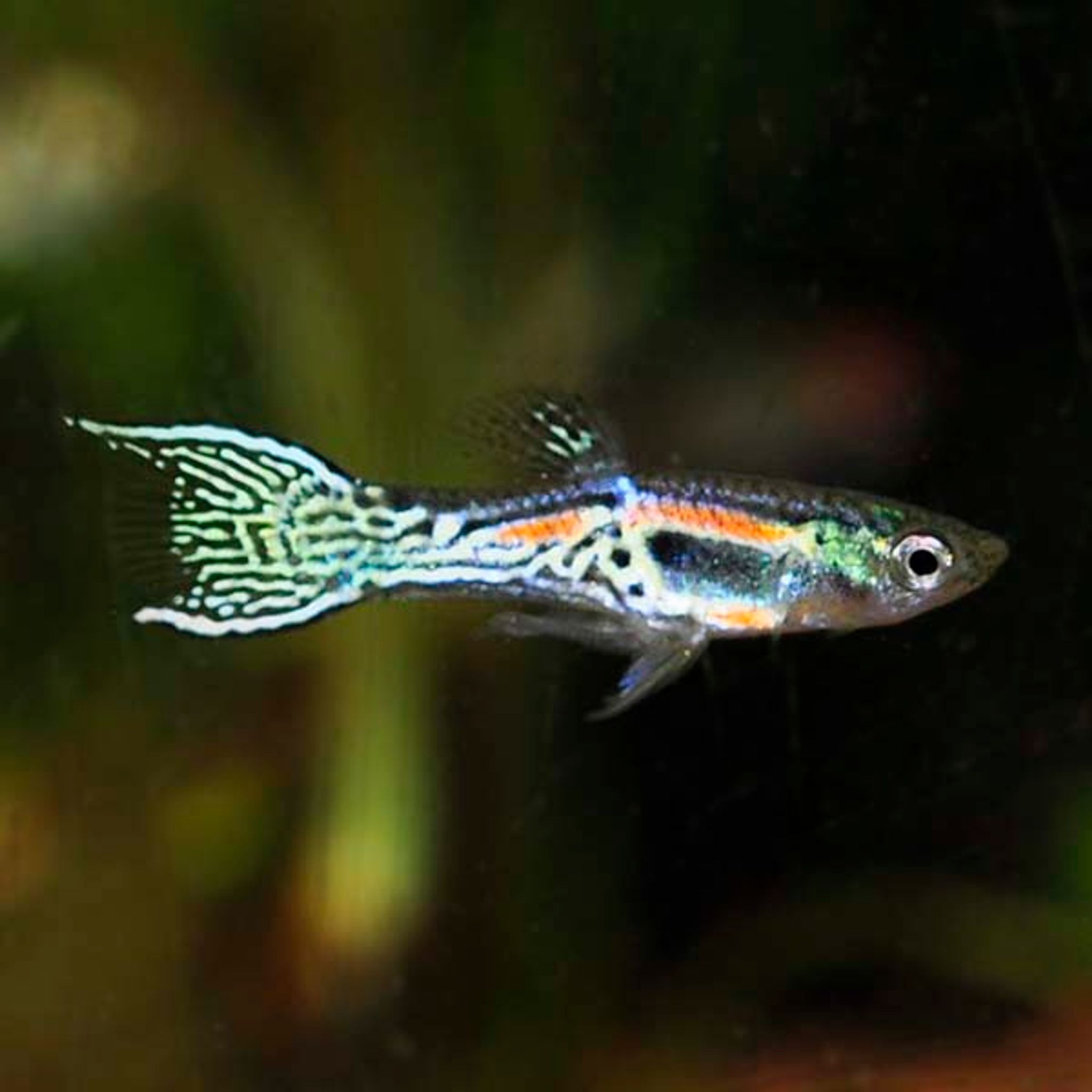
Endler's Livebearer Care Guide: Tank Size, Diet, Water Parameters and Temperament
Endler's livebearers are hardy, peaceful nano fish that do well in a 10 gallon (38 L) tank for males only or a 20 gallon (76 L) tank for a breeding colony, kept at about 72–78°F (22–26°C) in neutral to alkaline, moderately hard water. They eat small portions of crushed flake, tiny pellets and live or frozen foods. The two things that trip keepers up are how fast they breed and how easily they hybridize with guppies, and both are covered below.
Quick Facts
| Trait | Details |
|---|---|
| Scientific name | Poecilia wingei (family Poeciliidae) |
| Origin | Coastal lagoons of northeastern Venezuela (Laguna de Patos, near Cumaná) |
| Adult size | Males up to about 1 in (2.5 cm); females up to about 1.8 in (4.5 cm) |
| Lifespan | Usually 2–3 years |
| Minimum tank | 10 gal (38 L) males only; 20 gal (76 L) for mixed sexes |
| Temperature | 64–84°F (18–29°C); ideal about 72–78°F (22–26°C) |
| pH | Tolerates 6.5–8.5; best 7.0–8.0 |
| Hardness | 10–30 dGH (about 180–540 ppm) |
| Temperament | Peaceful, active, jumpers |
| Diet | Omnivore with a small mouth |
Species Profile
The Endler's livebearer is a very close relative of the common guppy, close enough that the two interbreed freely. Its wild home is a small lagoon system on Venezuela's northeastern coast, and that habitat is under threat. Aquarium lines that stay true to wild stock have real conservation value.
Males are tiny and loud: blocks of metallic orange, green, black and neon blue on a slim body with a short tail. Females are larger, plain tan-silver, and look a lot like female guppies.
Most live 2–3 years. Longer lifespans are occasionally reported but are rare. Females often die sooner because they are nearly always pregnant and constantly chased by males.
Tank Size and Setup
How big a tank?
Recommendations range from 5 to 20 gallons, and the right answer depends on whether you keep both sexes.
- Males only: a 10 gallon (38 L) comfortably holds a small group. A 5 gallon (19 L) is only reasonable for an all-male trio.
- Mixed sexes: go 20 gallons (76 L) or larger. Numbers climb within a couple of months, and a small tank fills fast.
Equipment and décor
- Tight-fitting lid. Endlers jump.
- Sponge filter or guarded intake. Fry get pulled into unguarded hang-on-back intakes. Keep flow gentle.
- Dense plants and floating cover. Water sprite, hornwort, Java moss and floating plants with dangling roots give fry places to hide. In a community tank, this is how fry survive.
- Substrate: anything works. Fine sand or planted soil is fine.
- Heater (usually): see the temperature section below.
Water Parameters
Temperature and heaters
Endlers handle roughly 64–84°F (18–29°C), and many keepers run them without a heater. Stability matters more than the exact number. In cooler US homes, set a heater to about 74–76°F (23–24°C). Going unheated is fine if the room stays at 68°F (20°C) or above year-round.
pH and hardness
Stated minimum pH values range from 5.5 to 7.0. The safer target is 7.0–8.0, and long stretches of acidic water should be avoided. Low pH combined with high nitrate leaves Endlers prone to bacterial and fungal infections.
They prefer moderate to hard water, about 10–30 dGH (180–540 ppm). Much US municipal tap water is already moderately hard and in range, so test GH and KH once to confirm. If your water is very soft, use a mineral supplement.
Maintenance
- Cycle the tank before adding fish. Ammonia and nitrite should read 0.
- Change 20–30% of the water weekly.
- Keep nitrate low, under about 20–40 ppm.
Diet and Feeding
Endlers are omnivores with very small mouths. Food that is too big for them is one of the most common mistakes, so crush flakes and pick micro or nano sizes.
- Staples: crushed flake, micro or nano pellets, or a gel food.
- Protein treats: frozen or live daphnia, baby brine shrimp, chopped bloodworms and blackworms.
- Greens: they graze algae, and spirulina-based foods or blanched vegetables round out the diet.
Feed small amounts once or twice a day, only what they finish quickly. You can browse fish foods, including freeze-dried options, in the Food & Supplements category.
Temperament and Stocking Ratio
Endlers are peaceful and active, and they use the whole tank. Males spend most of the day displaying to females and sparring with each other. It looks busy, but they rarely do real damage.
Harassment is the real problem in mixed groups:
- Keep 1 male to 2–4 females so no single female takes all the attention.
- Never keep a single pair. The lone female gets chased constantly and tends to die young.
- An all-male tank is the simplest setup and produces no fry.
Tank Mates
Good companions are small, peaceful fish that cannot swallow an Endler:
- Corydoras and otocinclus
- Small tetras such as neons and embers
- Celestial pearl danios, cherry barbs and honey gouramis
- Nerite and mystery snails
- Adult shrimp. Shrimplets may be eaten, so keep a separate shrimp tank if you want to breed them.
Avoid fin-nippers and anything large enough to eat a 1-inch fish. Bettas are an uncertain choice. Some keepers report success, but a betta may attack the bright males, so only try it in a large, heavily planted tank. Most importantly, do not keep Endlers with guppies if you care about keeping the line pure. Good candidates can be found in the Small Community Fishes category.
Endlers vs Guppies, Mollies and Platies
| Fish | Size and shape | Water notes | Keep in mind |
|---|---|---|---|
| Endler | Smallest, slim, short tail, blocky metallic colors | Neutral to alkaline, moderately hard | Hybridizes with guppies |
| Guppy | Larger, flowing tails | Similar to Endlers | Many fancy lines are more fragile |
| Molly | Much larger | Hard or slightly brackish water | Needs more space |
| Platy | Chunky, deeper body | Likes cooler water | Very forgiving |
Endlers and guppies produce fertile hybrids, so a mixed tank will blur both lines within a few generations. Both do well in the same hard, alkaline-leaning water.
Breeding and Population Control
How breeding works
No special setup is needed. Gestation is about 23–30 days. Brood sizes range from 1 to roughly 30 fry, smaller than typical guppy broods, and young females drop fewer. Females store sperm, so a female moved away from males can still produce several more broods.
Signs a female is pregnant: a dark gravid spot near the vent, a boxy belly, and a new drop about every 3–4 weeks.
The population math
A single female can have hundreds of descendants within about six months, since her daughters start breeding at roughly 2 months old. Plan before you buy:
- Males only if you just want color.
- A dedicated breeding or grow-out tank: a 10 gallon (38 L) with a sponge filter, a heater and moss or floating plants works well. A breeder box isn't necessary.
- Keep 2–3 or more females per male in the breeding group.
- A hobbyist tip, not a guarantee: some keepers report that warmer water, around 78–79°F (26°C), skews broods toward males and slows breeding. This is anecdotal.
Ethical rehoming
Extra fish can go to local fish clubs or to stores that offer credit for trades. Never release Endlers into the wild. In warm US states, released livebearers can establish themselves and become invasive.
Raising Fry
Fry are born free-swimming and big enough to eat right away, so they can skip infusoria. Good first foods:
- Baby brine shrimp
- Microworms
- Vinegar eels
- Powdered flake or crushed micro pellets
Males start showing color at about 4–6 weeks and are sexually mature at around 2 months, so separate sexes early if you're controlling numbers. Adults eat some fry, but dense plants save most of them.
Simple live food cultures
- Infusoria (for smaller-mouthed species you may keep later): fill a jar with tank water, add a vegetable scrap, set it in a lit spot with gentle aeration, and it's usable in 3–7 days.
- Vinegar eels: mix apple cider vinegar and water with a few apple slices. Harvest by letting the eels pass through filter floss or collect in the neck of a narrow bottle. They survive hours to days in fresh water, so fry have time to find them.
Buying Pure Endlers
Many fish sold as "Endlers" are unlabeled hybrids. Two labels are worth knowing:
- N-class: documented pure lines of wild origin.
- K-class: known guppy hybrids.
Popular named strains include black bar, tiger, cobra, lime or green, and scarlet. If purity matters to you, ask the seller for lineage records and skip tanks labeled vaguely as "Endler guppy." Keeping pure lines also supports the conservation of a species whose wild habitat is shrinking.
Health and Disease
Endlers are hardy, but mass-bred livebearers can arrive stressed or carrying parasites. Sudden deaths shortly after purchase usually come from shipping stress or parasites.
- Quarantine new fish for 2–4 weeks.
- Acclimate slowly to match your pH and GH.
- Ich: white, salt-grain spots. Treat with a gradual temperature increase plus medication.
- Fin rot: ragged, fraying fins, often linked to poor water.
- Columnaris and internal parasites: watch for wasting, clamped fins or odd patches.
- Whirling or spinning: usually points to stress, parasites, poisoning or swim bladder trouble. Test the water first, then isolate the affected fish.
Common Mistakes
- Putting a mixed-sex group in a small tank and getting overrun. Go males only or plan for rehoming.
- Keeping Endlers with guppies and losing the pure line.
- Keeping one male with one female.
- Soft, acidic water or neglected nitrate, which leads to fungus, clamped fins and wasting.
- Feeding food that is too big.
- Leaving filter intakes unguarded.
- Skipping the lid.
- Adding new fish without quarantine or slow acclimation.
Other Livebearers Worth a Look
If Endlers win you over, a few less common livebearers are worth researching:
- Least killifish (Heterandria formosa): a tiny native of the southeastern US that lives in weedy, slow, shallow water. Females give birth to a few fry at a time over several days.
- Goodeids: from Mexico's central highlands. Many are rare or extinct in the wild, and hobbyist "ark" breeding programs help keep them going. They like cooler water and produce a few large fry nourished in the womb by structures called trophotaenia.
- Merry widows (Phallichthys): peaceful, modestly sized livebearers from Central America.
- New Mexican species: new livebearers are still being described, so keep an eye out for additions to your wish list.
Frequently Asked Questions
Can Endlers live without a heater?
Yes, as long as the room stays at 68°F (20°C) or warmer. The bigger concern is swings, so keep the temperature steady. In cooler homes, a heater set to 74–76°F (23–24°C) is the safer choice.
How many Endlers can go in a 10 gallon tank?
About 6–8 males is a comfortable all-male group. You can also start a trio of one male and two females, but expect to thin out the fry regularly.
Can Endlers and guppies breed together?
Yes. They interbreed readily, and the hybrids are fertile. Keep them apart if you want to maintain a pure Endler line.
Do Endlers eat their fry?
Adults will eat some fry. Dense plants such as Java moss, hornwort and floating plants give most of them enough cover to survive.
How do I stop Endlers from breeding?
Keep one sex only. Remember that females store sperm, so females moved from a mixed tank can still give birth for several broods. Warmer water may reduce female births, but that's anecdotal.
Are Endlers good for beginners and shrimp tanks?
Yes. They're hardy, small and peaceful, and adult shrimp are safe with them. Baby shrimp may be eaten.
Start Your Endler Tank
Endlers reward a modest setup: a lidded, planted tank, hard-leaning water, small meals, and a plan for population before you buy. Browse livebearers and related fish in the Guppies category on FishyHub to plan your next nano tank.

