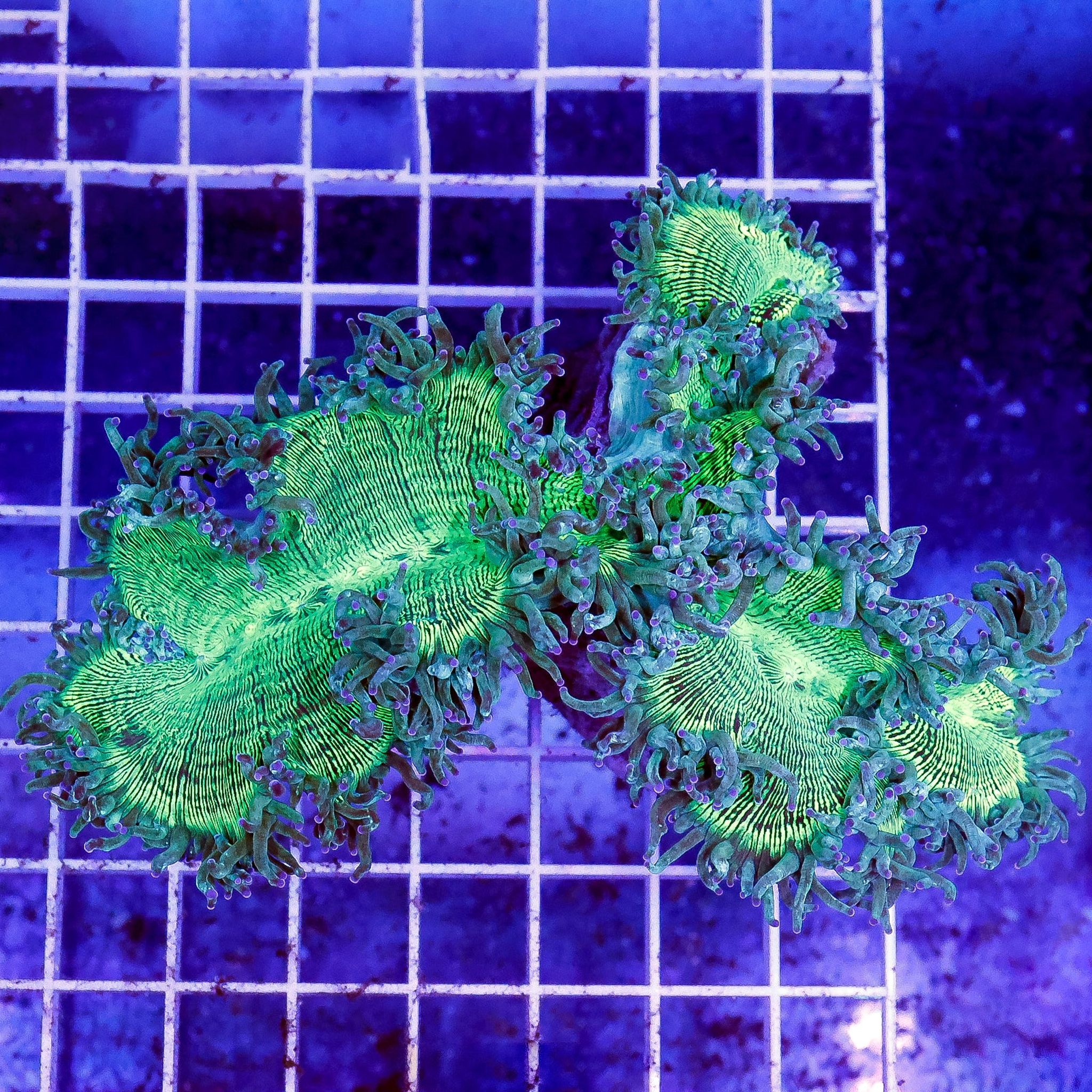
Elegance Coral Care Guide: Lighting, Flow, Feeding and Placement
Elegance Coral (Catalaphyllia jardinei) is a striking large-polyp stony coral that looks easy to keep but punishes shortcuts in lighting, flow and placement. This guide lays out the exact parameter ranges, a week-by-week acclimation ramp, and the placement rules that keep this coral from becoming one of the most common early-decline stories in a reef tank.
What Is Elegance Coral?
Also called Ridge Coral, Catalaphyllia jardinei is a large-polyp stony (LPS) coral with a skeleton similar to open-brain corals. Its long, fleshy tentacles carry colored tips — commonly green, pink, purple or cream — and sway freely because the animal is not permanently cemented to rock the way many other LPS corals are.
Care level: moderate to moderately difficult. Despite being marketed to beginners because of its low price and dramatic look, Elegance Coral needs stable, mature reef parameters and is not a true first-coral choice. It does best in tanks that have already successfully hosted an easier LPS such as torch, hammer, or frogspawn coral for several months.
Tank Size and Setup
A single small frag can start in a tank as small as 15 gallons (57 L), but this coral is slow-growing and long-lived, so plan ahead. A mature colony realistically needs 30–90 gallons (114–340 L) once you account for its eventual size and the "swing radius" of its extended tentacles.
- Mature colonies can reach 10–12 inches (25–30 cm) across.
- Growth is slow: roughly 1 inch (2.5 cm) of skeletal growth per year.
- Build spacing into the aquascape from day one rather than trying to relocate a large, established coral later.
Lighting: Finding the Sweet Spot
This is one of the most debated parameters for Elegance Coral. Some guides recommend a tight PAR band, others a much wider one. The practical answer is to treat 50–150 PAR as the full acceptable range, but aim your actual placement at 80–100 PAR as the safe starting point.
- Use moderate, diffused light — avoid intense direct light or metal halide fixtures.
- Polyp extension and coloration are your feedback loop: if tentacles stay shrunken or the coral looks pale, dial intensity down; if it never fully extends and coloring looks washed out over time, you can nudge it up slowly.
- Corals can adapt to a range of intensities, but only when the change happens gradually — never move a specimen from a dim holding tank straight into full display lighting.
Choosing a Light for a Mixed LPS Reef
For a tank housing Elegance Coral alongside other LPS and mixed reef species, a mid-to-high-end programmable LED fixture is the practical choice because it lets you dial in a low starting intensity and adjust spectrum without buying new hardware. You can browse programmable options in FishyHub's LED lighting selection.
The universal best practice, regardless of fixture brand, is a slow intensity ramp: start any new light at roughly 30% of target intensity and step up about 10% per week until you reach your target PAR. This applies whether the light is new to the tank or the coral is new under an established light.
Water Flow
Flow guidance for Elegance Coral is often oversimplified as just "moderate." In practice, this coral evolved on turbid, sediment-influenced sand flats, so it benefits from moderate, indirect, randomized (turbulent) flow rather than a single strong laminar jet aimed at it.
- Target roughly 20–40x tank volume per hour in total system turnover.
- Flow should be strong enough to sway the tentacles and carry food particles to the coral, and to keep debris and waste from settling on its tissue.
- Flow that is too weak allows detritus to sit on the coral and stresses it just as much as flow that is too strong.
- Flow that is too strong can tear tissue, cause the coral to retract fully, or even topple a top-heavy specimen off its sand perch — sometimes described as the coral "parachuting" away from its spot.
Randomized flow from multiple smaller powerheads generally works better here than one high-output pump pointed directly at the coral.
Water Parameters
Stability across all of these matters more than hitting an exact number.
| Parameter | Target Range |
|---|---|
| Temperature | 74–83°F (23–28°C) |
| Salinity | 1.023–1.026 specific gravity |
| pH | 8.1–8.4 (avoid swings) |
| Alkalinity | 8–12 dKH |
| Calcium | 400–450 ppm |
| Magnesium | 1200–1350 ppm |
| Nitrate | Under 20 ppm, ideally 5–10 ppm |
| Phosphate | Near 0 ppm |
The Nutrient Balancing Act
Elegance Coral wants near-zero phosphate and low nitrate, but it is also a heavy feeder that thrives on regular meaty foods. Feeding drives nutrients up while the coral's own health depends on nutrients staying low, so the two goals pull against each other.
The practical fix is targeted feeding rather than broadcast feeding — deliver food directly to the coral's mouth instead of dosing food across the whole tank — paired with export capacity such as a protein skimmer, a phosphate-reactor, or occasional carbon dosing to absorb the extra nutrient load without cutting back on feeding.
Placement: Sand Bed, Never Rock
Placement mistakes are one of the fastest ways to lose this coral.
- Always place Elegance Coral on the open sand bed. Never wedge it directly against or on top of live rock.
- The base of the skeleton is fragile; contact or abrasion against rock invites tissue damage and infection.
- Place it low in the tank where light and flow are naturally gentler, matching the moderate parameters above.
- Because it is not attached to a fixed rock like many LPS corals, an Elegance Coral can shift position over time — check periodically that it hasn't drifted against rockwork or a tank wall.
Leaving Room in Your Aquascape
Most home reef tanks are rock-dominated, which leaves little open sand. Before adding Elegance Coral, plan a clear sand patch at least 6 inches (15 cm), and ideally more, away from any neighboring coral in every direction the tentacles can reach — this coral's tentacles extend several inches and carry strong stinging cells (nematocysts). Build rockwork as a border around an open sand "island" rather than trying to squeeze a placement spot in after the aquascape is finished; it is one of the most sting-aggressive common LPS corals and can damage or kill neighbors that are too close.
Feeding
Elegance Coral is photosynthetic and draws energy from the zooxanthellae living in its tissue, but it grows larger and colors up noticeably better with direct feeding.
- Target 2–3 times per week of chopped meaty foods for the best growth and color.
- The coral can survive on 1 feeding per week or less through photosynthesis alone, but it will stay smaller and paler without direct feeding.
- Suitable foods: mysis shrimp, brine shrimp, krill, chopped fish, shrimp or squid, copepods, daphnia, and prepared reef foods such as a pellet or paste reef blend.
- Chop or mince larger foods into pieces small enough for the coral's mouth to manage — overfeeding whole, oversized pieces is a common mistake.
How to Target-Feed
- Wait until the tentacles are fully extended, which most often happens at lights-off or dusk, or once the coral has settled in and feels safe extending.
- Use a turkey baster or a feeding stick to place small, chopped pieces directly onto the tentacles or near the mouth.
- Feed slowly and in small amounts rather than dumping food all at once — this limits nutrient spikes and reduces waste that flow has to carry away.
- Turn off any obstructive flow briefly during feeding if your pump layout blasts food away before the coral can capture it, then restore normal flow afterward.
Acclimation: A Week-by-Week Ramp
Sudden bright light or strong flow right after shipping is one of the leading causes of early decline in newly purchased Elegance Coral. Drip acclimate for salinity and pH as you would any coral, then follow a combined light-and-flow ramp:
| Week | Light Target | Flow Target |
|---|---|---|
| Week 1 | ~50% of target PAR (low end of range) | Low, gentle flow only |
| Week 2 | ~65–70% of target PAR | Light-moderate flow |
| Week 3 | ~85% of target PAR | Moderate, randomized flow |
| Week 4 | Full target PAR (80–100) | Full target flow (20–40x turnover) |
Watch polyp extension at each stage before moving to the next. If tentacles retract or the coral looks stressed after an increase, hold at the current stage — or step back — for another week before trying again.
Sourcing Matters: Origin and Disease Risk
Origin has a real effect on this coral's hardiness. Australian-collected Elegance Corals are generally considered hardier and more disease-resistant, while Indonesian imports have historically shown higher rates of an unexplained wasting condition sometimes called Elegance Coral Syndrome.
Signs include persistent partial retraction, white mucus, and a swollen oral disc. There is no confirmed cause or cure, so prevention is the main defense:
- Quarantine every new specimen before adding it to the display.
- Favor Australian-sourced specimens where origin is disclosed.
- Isolate any coral showing early symptoms immediately rather than waiting to see if it improves.
Tank Mate Cautions
Elegance Coral actively captures and eats small snails, so expect losses if snails wander within tentacle reach — this is one of the most common surprises for new keepers. Also use caution with:
- Peppermint shrimp
- Cleaner shrimp
- Hermit crabs
- Bristleworms
Clownfish occasionally host Elegance Coral, but this is not a natural pairing. Clownfish forcing their way into the tentacles can bruise the coral, so success is inconsistent and shouldn't be counted on.
Pest Watch: Gall Crabs and Boring Crabs
Small crabs, including so-called gall crabs, can burrow into the skeleton and create pits or tunnels over time. Inspect the coral during lights-on periods and remove any crabs manually with tweezers or a fine pin as soon as you spot them.
Common Mistakes to Avoid
- Placing the coral directly on or against live rock instead of open sand.
- Running new lighting or flow at full intensity immediately after purchase instead of ramping up gradually.
- Placing it too close to neighboring corals, leading to sting damage on both sides.
- Skipping direct feeding — the coral survives on photosynthesis but stays small and pale without it.
- Ignoring early warning signs (mucus, swollen oral disc, non-expansion) instead of isolating the coral right away.
- Assuming "bailing out" — the coral detaching from its skeleton — means it is dead. This can be a stress response to poor flow or nutrition; check water quality and flow before giving up on it.
- Not quarantining new arrivals, missing a chance to catch pests or disease before they reach the display.
- Feeding whole, oversized pieces instead of chopping food down first.
A Related Sand-Bed Coral: Plate Corals
Plate corals (Fungia and related genera) share a similar lifestyle with Elegance Coral: both are free-living, sand-dwelling LPS-type corals with moderate-to-high light and low-to-moderate flow needs, and both eat larger meaty foods well. The key difference is that plate corals are usually solitary and are not good candidates for fragging at home — cutting one tends to be fatal — while Elegance Coral can bud and grow new heads naturally over time without being cut. If you're weighing sand-bed LPS options, both are worth researching side by side before choosing a spot in your aquascape. You can browse current stock in FishyHub's LPS coral selection, and stock up on chopped or freeze-dried feeding options in the freeze-dried food category.
Can Elegance Coral Be Fragged?
Fragging is not recommended in home tanks. Cutting an Elegance Coral risks high mortality, so it's better to let a healthy specimen grow and bud new heads naturally, or leave deliberate fragging to experienced propagators with the right tools and aftercare setup.
Frequently Asked Questions
Is Elegance Coral reef safe or aggressive?
It's reef-compatible in the sense that it won't harm fish, but it is highly sting-aggressive toward neighboring corals. Give it generous spacing — at least 6 inches, and more where possible — from any coral its tentacles could reach.
Do clownfish host Elegance Coral?
Occasionally, but it isn't a natural host relationship. Clownfish forcing their way into the tentacles can bruise them, so hosting success is inconsistent and shouldn't be relied on.
Why is my Elegance Coral not opening or staying closed?
The most common causes are flow that's too strong, light that's too intense or was recently increased too fast, poor water quality, or early disease stress. Check your recent changes first, since sudden light or flow increases are the leading trigger.
What is Elegance Coral Syndrome and can it be treated?
It's a wasting condition marked by a swollen oral disc, mucus production, and failure of the polyp to expand normally, seen mostly in Indonesian-origin corals. There is no confirmed cause or cure, so prevention through quarantine and choosing Australian-sourced specimens is the main defense.
How often should I feed my Elegance Coral?
Aim for 2–3 times per week with chopped meaty foods for the best growth and color. It can survive on less thanks to photosynthesis, but it will stay smaller and paler without regular direct feeding.
What tank size do I need for an Elegance Coral?
A single frag can start in a tank as small as 15 gallons, but plan for 30–90 gallons long-term. Growth is slow, but a mature colony can eventually span up to about a foot across.
Why did my snails disappear after adding an Elegance Coral?
This coral actively captures and eats snails with its tentacles, so losses are expected if snails wander within reach. Keep snails and this coral on opposite sides of the tank if you want to keep both.
Ready to add an Elegance Coral to a stable, mature reef tank? Browse current availability in FishyHub's Corals category and match it with the right lighting and feeding supplies before it arrives.

