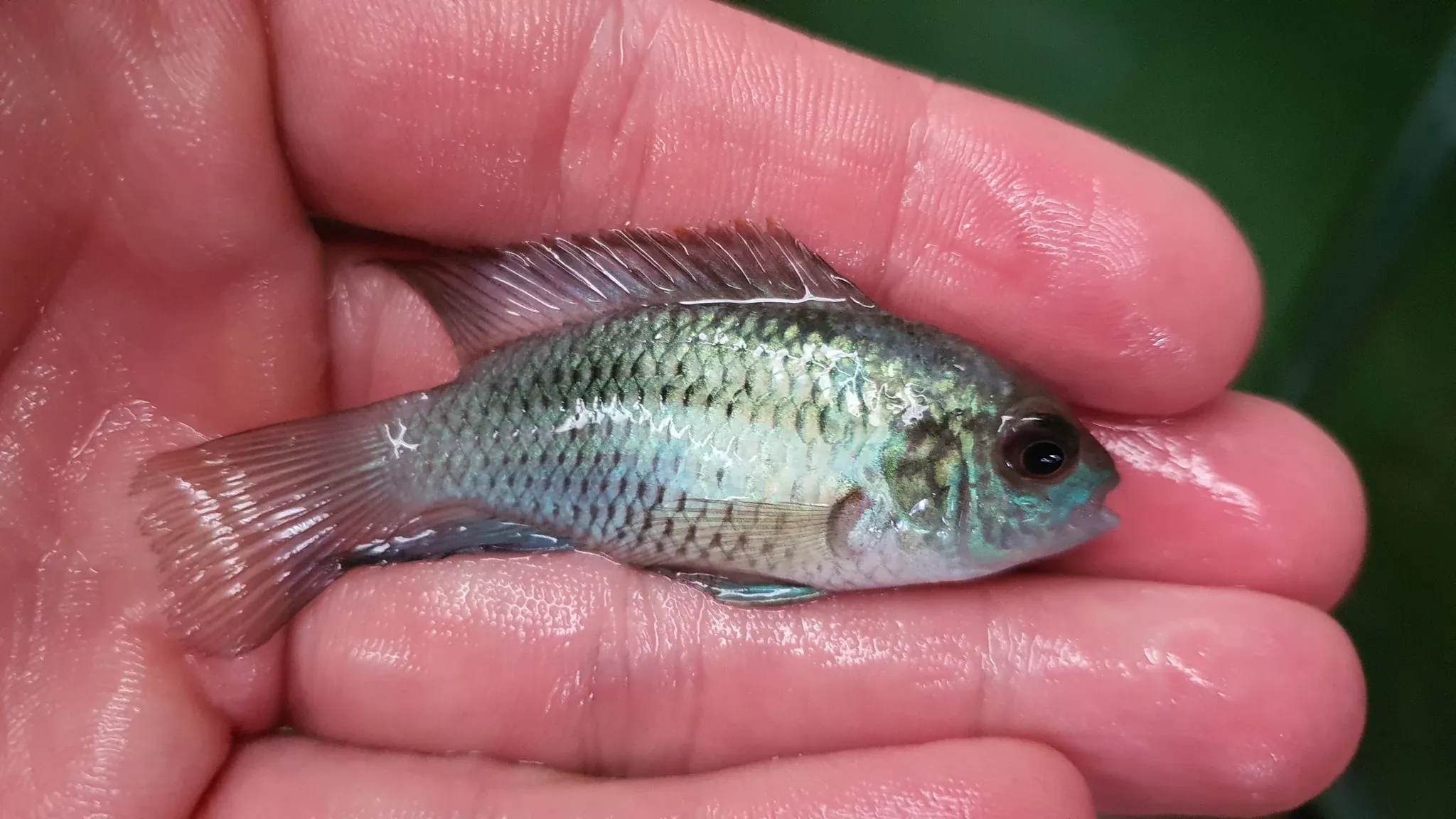
Electric Blue Acara Care Guide: Tank Size, Diet, Water Parameters and Temperament
The electric blue acara is one of the calmest, most affordable cichlids sold in US stores, but that shimmering color hides a fish that grows to 5-7 inches and digs like it's paid by the hour. This guide covers the tank size, water parameters, diet, and tank mate choices you need before bringing one home, plus the mistakes that trip up most first-time owners.
What Is an Electric Blue Acara?
The electric blue acara (EBA) is a captive-bred color strain of the blue acara, Andinoacara pulcher (formerly classified as Aequidens pulcher). The wild-type species comes from slow-moving, warm rivers, streams, and ponds in northern South America — Trinidad and Tobago, Venezuela, and Colombia, with some sources adding Panama — where it inhabits sandy or muddy bottoms among roots and leaf litter.
The exact origin of the electric-blue coloration is genuinely debated. Some hobbyists describe it as a hybrid, occasionally implicating rams in the mix; others insist it's simply a selectively line-bred color morph of the same species. There's no documented, verifiable answer either way, so treat the genetics as unsettled rather than repeat either claim as fact. What's not in dispute: every EBA on the market today is captive-bred, and the color strain tends to be noticeably less hardy than the wild-type fish, a tradeoff of generations of selective breeding for color over robustness.
Size, Growth, and Lifespan
Expect an adult length of 5 to 7 inches, with males running larger than females. Most of that growth happens fast — an EBA reaches close to adult size within about a year, so a fish that looks like a 2-inch tetra-tank resident at the store will not stay that way for long.
Lifespan typically runs 8 to 10 years with reasonable care. Fish kept in excellent, stable conditions have been reported reaching their mid-teens; claims of a 20-year electric blue acara are outliers and shouldn't be treated as typical.
Tank Size Requirements
Tank size is the single most common source of disappointment with this species, largely because sources disagree wildly on the minimum. Here's a workable breakdown:
| Setup | Minimum tank size | Notes |
|---|---|---|
| Single juvenile (temporary) | 20-29 gal (76-110 L) | Fine only until the fish outgrows it — plan the upgrade |
| Single adult | 30 gal (114 L) absolute floor | Add roughly 15 gal per additional fish |
| Bonded pair | 40 gal breeder (151 L) minimum | The classic EBA setup |
| Community tank | 55+ gal (208+ L) | 75 gal (284 L) gives real breathing room |
Footprint matters more than height. Acaras are bottom- and mid-water fish that sift substrate and patrol the tank floor, so a 48-inch-long footprint serves them far better than a tall, narrow tank of the same volume. If you're comparing tanks by gallons alone, remember that a "30-gallon" tank isn't automatically 4 feet long — check the actual dimensions, since a 30-gallon tall gives an EBA much less usable floor space than a 30-gallon long.
Water Parameters
Stability matters more than hitting an exact number, but here are the working ranges:
- Temperature: 72-82°F (22-28°C), with 76-80°F (24-27°C) as the sweet spot. Avoid letting temperature drift below 72°F — this strain is noticeably more susceptible to ich when kept cool, so a reliable, appropriately sized heater is non-negotiable.
- pH: 6.0-7.5 overall range; aim for a stable 6.5-7.5. Consistency beats chasing a perfect number — a fish acclimated to 7.0 that holds steady is better off than one bounced between 6.5 and 7.8 every water change.
- General hardness (dGH): roughly 5-20 dGH — soft to moderately hard. Most dechlorinated US tap water falls comfortably in this range.
- Ammonia and nitrite: 0 ppm, always.
- Nitrate: keep it under 20 ppm; never let it climb above 40 ppm.
Nitrate and Old Tank Syndrome
Nitrate creeps up from overfeeding, overstocking, dirty filter media, and rotting plant matter — all common in cichlid tanks because acaras are messy, meaty eaters. In long-neglected tanks, carbonate hardness (KH) gets depleted along with nutrient buildup, and pH can drift downward without warning. If you inherit or catch up on a neglected tank, don't correct it with one large water change — a sudden shift in pH or temperature can shock the fish. Instead, do several smaller changes over consecutive days and test KH alongside pH so you know the buffering capacity you're working with.
Maintenance and Filtration
Run weekly water changes of 25-30%, and match the temperature and pH of the new water reasonably closely to avoid stressing the fish. Because acaras eat messily and produce a fair amount of waste, filtration should be strong but not blasting — a canister filter or a large hang-on-back unit rated above your tank's actual volume works well. Avoid a filter outflow so strong it pins a shy or recovering fish against the glass.
Substrate and Decor
Use fine sand. Electric blue acaras sift substrate almost constantly, and gravel or anything sharp-edged can injure their mouths and fins during normal digging behavior. Anchor any rockwork, driftwood, or caves directly on the glass bottom before adding sand on top — a fish that excavates around the base of a poorly placed rock or cave can topple it.
Good decor choices:
- Driftwood pieces for cover and grazing surface
- Caves and overhangs for security and potential spawning sites
- Flat stones, left exposed rather than buried — these often become spawning platforms
- Floating plants to diffuse light and soften the tank's overall brightness
- Dim to moderate lighting overall; this species doesn't need or particularly enjoy bright light
Will They Eat or Destroy Your Plants?
EBAs uproot far more than they actually eat. Rooted stem plants and anything shallow-planted will get dug up repeatedly. Stick to rhizome plants tied to wood or rock — Java fern and anubias handle this well since they don't need substrate to anchor into — along with floating plants. Large, well-established Amazon swords can survive if the root system is substantial or the plant is potted to keep it from being unearthed.
Diet and Feeding
Electric blue acaras are omnivores that lean carnivorous — not strict carnivores, and not the vegetable-heavy grazers some describe them as. Build the diet around:
- A quality sinking cichlid pellet as the base
- Frozen or live bloodworms, brine shrimp, mysis shrimp, and daphnia
- Chopped earthworms as an occasional protein treat
- A spirulina or vegetable-based pellet worked in periodically for plant matter
Feed adults once or twice daily; juveniles do better with two to three smaller meals. In either case, offer only what disappears in about two minutes and remove uneaten leftovers — overfeeding meaty foods is a direct driver of nitrate spikes, bloating, and hole-in-the-head disease, which is strongly linked to poor water quality and diet imbalance.
Temperament and Tank Mates
This is genuinely one of the calmer cichlids kept in the hobby — some call it peaceful, others semi-aggressive, and both are half right. The honest summary: EBAs are peaceful and even a bit shy toward fish their own size or larger, become territorial and defensive when spawning, and will eat any fish small enough to fit in their mouth. That last point rules out a lot of otherwise "peaceful community" stocking lists.
Good tank mates:
- Corydoras catfish and bristlenose plecos
- Larger, robust tetras — black skirt, bleeding heart, congo tetra
- Rainbowfish
- Peaceful gouramis
- Severums, angelfish, and keyhole cichlids
- Larger barbs, with some caution
- Mollies and swordtails
Avoid:
- Neon tetras, ember tetras, small rasboras — sized to be eaten
- Shrimp of any kind — also food
- Aggressive or oversized cichlids: jack dempseys, green terrors, most African cichlids, and adult oscars, all of which will bully or eventually eat an EBA
- Known fin nippers
- Other strikingly blue fish, which can occasionally trigger territorial rivalry
EBAs can be kept singly, as a bonded pair (the most common and reliable setup), or in a small group — but only in a genuinely large tank with plenty of sightline breaks. Adding a school of mid-size dither fish, like the tetras above, tends to make an EBA visibly bolder and less prone to hiding.
If you're assembling a South American cichlid community, browse FishyHub's American Cichlids selection for compatible tankmates. For contrast, keep African cichlids — a mismatch in both water chemistry and temperament — in a completely separate system; FishyHub's African Cichlids category is worth browsing only if you're planning a dedicated Rift Lake tank, not a mixed one.
Sexing and Breeding
Sexing: Males grow larger, develop longer and more pointed dorsal and anal fin extensions, and may show a nuchal hump on the forehead once they pass roughly 4 inches. Females stay smaller and rounder-bodied with shorter fins. Venting (examining the shape of the genital papilla) is the only truly definitive method if you need certainty.
Breeding: EBAs reach maturity around 4 inches, roughly 8-10 months old, and form monogamous pairs. A pair will clean off a flat rock or similar surface and lay 150-300 eggs, which hatch in 2-4 days at 77-80°F. Fry become free-swimming about a week after hatching, and both parents guard them closely — feeding baby brine shrimp works well once the fry are swimming freely. Remove the fry after 2-3 weeks, or sooner if the parents begin preparing for another clutch, since a healthy pair can spawn again within a month. Dedicate a species-only tank or a 20+ gallon breeding tank if you intend to raise a clutch through to adulthood, and have a rehoming plan ready — a productive pair will outpace most hobbyists' space.
Health and Quarantine
Common issues include ich, skin and gill flukes, fin rot, and hole-in-the-head disease — the last two are frequently tied back to poor water quality and nitrate accumulation rather than being purely infectious. Quarantine any new fish for 2-4 weeks before adding them to an established EBA tank, and treat cool water temperature as a genuine risk factor: this strain is more ich-prone than the wild type when kept below its comfortable range.
Stress Signs to Watch For
A quick visual checklist for a fish that isn't doing well:
- Clamped fins
- Hiding more than usual
- Color fading toward gray or the dark vertical bars becoming more prominent
- Gasping at the surface
- Glass surfing
- Refusing food
If you spot any of these, run through this order: observe general behavior, test ammonia/nitrite/nitrate, check that the heater and filter are both functioning correctly, look for signs of bullying from tankmates, and inspect the body and fins for spots or damage.
Heater Placement (and Why Acaras Break Heaters)
Acaras dig, and digging fish knock things loose. Position the heater near the filter outflow or another area of high water flow for even heat distribution, often angled or mounted horizontally low in the tank. Use a heater guard — a simple plastic cage — since an unsecured heater can be uprooted or cracked by a fish excavating nearby substrate. Place a separate thermometer at the opposite end of the tank so you're not relying on the heater's own readout alone. As a rough guide, budget about 3-5 watts per gallon of tank volume. If you have a vertical heater and need to lower the water level for maintenance, unplug it first — an exposed heating element can crack or start a fire.
Common Mistakes to Avoid
- Buying a 1-2 inch juvenile for a 20-gallon tank without planning for a 6-inch adult. This is the single most frequent regret among new owners.
- Housing with neons or shrimp, which simply become food, or with aggressive cichlids that will bully or injure the EBA.
- Gravel or sharp-edged substrate, which causes mouth and fin injuries during normal digging.
- Unsecured heaters or rockwork toppled during substrate excavation.
- Overfeeding meaty foods, driving nitrate spikes, bloating, and hole-in-the-head symptoms.
- Letting temperature drift low, inviting ich outbreaks in a strain that's already more vulnerable than the wild type.
- Post-spawning aggression toward tankmates — add visual barriers (dense plants, driftwood) or temporarily remove other fish if a breeding pair turns territorial.
- Assuming pale or dark coloring is "just personality" — it's usually stress, water quality, or lighting, so test water before assuming otherwise.
- A fish that hides constantly usually needs more dither fish and more cover, not less.
Related Species and Alternatives
Keyhole Cichlid
The keyhole cichlid (Cleithracara maronii) is a smaller, shyer South American relative — around 4-5 inches — that shares nearly identical water parameter preferences with the EBA. A pair needs 30+ gallons, and the two species pair up well in a mixed South American cichlid tank since both are calm by cichlid standards.
Wild-Type Blue Acara
The non-color-bred blue acara is the same species as the EBA, typically silver-blue with dark bars or spotting rather than solid electric blue. It's noticeably tougher and grows slightly larger, with identical care requirements otherwise. If long-term hardiness matters more to you than the striking color, the wild type is the better pick.
A Note on "Acara" Naming
Bandit acaras (genus Guianacara) are a different genus entirely, native to Venezuela and the Guianas, named for the dark eye-bar "mask" that resembles a bandit's disguise. Despite the shared common name, they are not blue acaras and shouldn't be confused with them or assumed to share identical care needs.
Where EBAs Fit Among Beginner Cichlids
Electric blue acaras sit comfortably alongside keyhole cichlids, bolivian rams, kribensis (a West African species with different but manageable needs), angelfish, and severums as solid first-cichlid choices. Convict cichlids are also hardy and beginner-tolerant but are considerably meaner and will bully tankmates that an EBA would happily ignore.
How Long Do Cichlids Live?
Lifespan scales roughly with adult size: dwarf cichlids typically live 3-5 years, mid-size species like acaras, keyholes, and angelfish reach 8-12 years, and large species like oscars can live 12-15+ years. Consistent water quality and diet influence lifespan more than genetics alone in every size class.
Frequently Asked Questions
Are electric blue acaras aggressive?
Mostly calm and even a bit shy day to day. They become territorial and defensive specifically around spawning, and they will eat any fish small enough to swallow — so "aggressive" isn't quite right, but "harmless" isn't either.
Can one live in a 20 or 29-gallon tank?
Only temporarily, as a juvenile. Plan for 30 gallons minimum for a single adult and 40+ gallons for a pair — the 20/29-gallon tank is a stopgap, not a permanent home.
Can they live with angelfish, discus, or oscars?
Angelfish are generally a good match. Discus are possible on paper but usually impractical, since discus prefer warmer water (82-86°F) than the EBA's comfortable range. Oscars will eventually bully or eat an electric blue acara once they outgrow it.
Can they live with African cichlids?
No. Water chemistry preferences and aggression levels are mismatched enough that mixing the two groups reliably ends badly for the EBA.
How big do electric blue acaras get and how fast?
Expect 5 to 7 inches at full size, with most of that growth happening in the first year of life.
Will they eat my aquarium plants?
They uproot far more than they eat. Anubias, Java fern, and floating plants tolerate their digging well since none require substrate anchoring.
How do I tell males from females?
Look at fin length and body size — males have longer, more pointed dorsal and anal fins and may develop a nuchal hump past about 4 inches, while females stay smaller and rounder. Venting is the definitive method if you need certainty.
Why is my electric blue acara losing color?
Usually stress, poor water quality, age, or a shift into breeding coloration. Test ammonia, nitrite, and nitrate first before assuming it's something more serious.
If you've worked through the numbers above and think an electric blue acara fits your setup, you can browse available stock and compatible tankmates in FishyHub's Angelfish, Discus, Rams & Cichlids category, along with fine sand substrate in the Gravel & Sand selection to get the tank floor right from day one.

