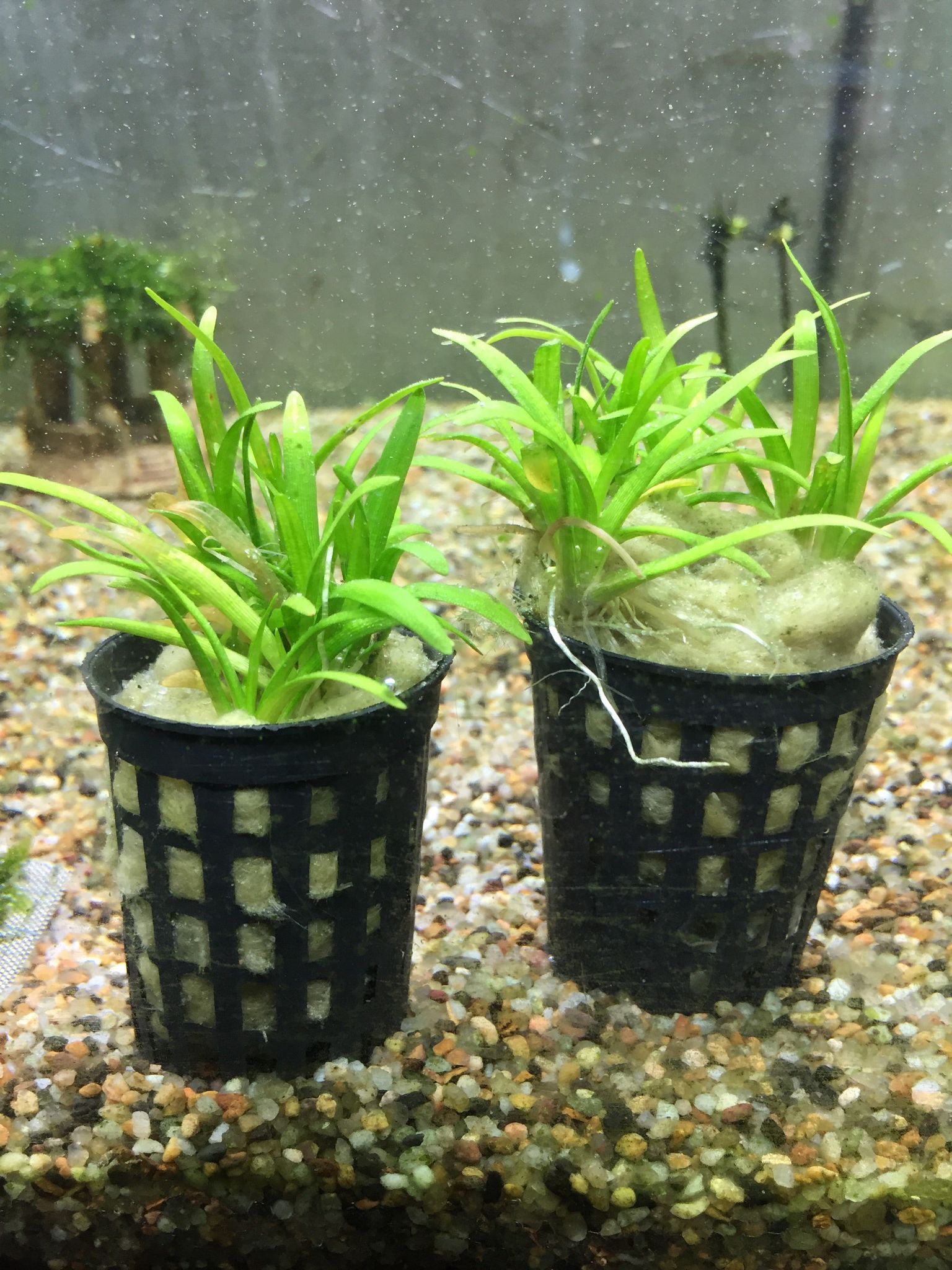
Dwarf Sagittaria Care Guide: Light, CO2, Substrate and Growth Tips
Dwarf sagittaria (Sagittaria subulata) is one of the hardiest carpeting plants available for freshwater tanks, but whether it forms a tidy lawn or a tall, sparse patch of grass comes down to a few specific choices. This guide covers the light, CO2, substrate, and spacing decisions that determine its shape, plus the fixes for melting, yellowing, and stalled growth.
What Is Dwarf Sagittaria?
Dwarf sagittaria goes by several common names: awl-leaf sagittaria, narrow-leaved arrowhead, and Hudson sagittaria. It's a grass-like rosette plant native to eastern US coastal and estuarine waters, with related populations in parts of South America. That native range is part of why it tolerates such a broad swath of American tap water without complaint.
It's widely rated easy, roughly a 1-2 out of 5 on difficulty scales. That rating deserves a caveat, though: keeping the plant alive and getting it to form a flat, dense carpet are two different challenges. Survival is nearly foolproof; a tidy aquascape result takes a bit more attention to light, spacing, and trimming.
- Size: 4-8 in (10-20 cm) under moderate-to-high light; can stretch to 10-12 in (25-30 cm) under low light
- Tank size: 5-gallon (19 L) nano tanks and up; no upper limit
- Growth habit: rosette that spreads via horizontal runners (stolons), much like a strawberry plant
Light Requirements
Dwarf sagittaria tolerates a wide light range, and this is where a lot of the confusion around it starts. Some sources call it a low-to-medium light plant; others insist a carpet needs moderate-to-high, CO2-assisted light. Both are true for different goals.
- Background or accent growth: low-to-medium light works fine; the plant simply grows taller as it reaches toward the light source.
- A flat, dense carpet: needs moderate-to-moderately-high light, roughly in the 30-150+ PAR range depending on how compact you want the growth.
- More light = shorter, denser growth. Less light = taller, leggier growth.
Avoid pushing to the very high end of that range without matching CO2 and fertilization — intense light without the nutrients to back it up invites algae and can stress or bleach the plant rather than improve it.
For practical purposes, most nano and standard LED fixtures rated for low-to-medium planted tanks will grow dwarf sagittaria as a background plant on their stock settings. To push it toward carpet form, run the fixture on a stronger setting or raise it to the higher end of its adjustable output, and keep the photoperiod consistent (typically 7-9 hours) rather than compensating with longer hours, which just invites algae. You can browse aquarium LED lighting options sized for nano through standard tanks when setting up a new carpet.
Does Dwarf Sagittaria Need CO2?
No — it grows perfectly well low-tech, without any supplemental CO2. That said, pressurized or liquid-carbon CO2 noticeably speeds growth and produces a denser, flatter carpet faster than light alone.
The practical way to think about it:
| Goal | CO2 needed? |
|---|---|
| Background or accent clump | No — grows fine on light and root-tab fertilization alone |
| Fast, dense, flat carpet | Not mandatory, but strongly recommended |
| Recovering from melt or transplant shock | Optional; stable low-tech conditions matter more than CO2 |
If you do run CO2, keep it in the same range as any other planted tank — around 20-30 ppm — and start injection a couple of hours before lights-on, stopping at lights-off so livestock aren't exposed to peak CO2 overnight.
Substrate and Root Feeding
Dwarf sagittaria is a root feeder, meaning its roots pull in more nutrients than its leaves do. This single fact explains most of the stunted, pale growth reported with this plant.
- Use a nutrient-rich planted substrate (an aqua soil or a nutrient-fortified substrate) for the best baseline growth, or
- Push root tabs into the substrate near the root zone every 3-4 months if you're using inert gravel or sand
- Provide 2-3 inches (5-7.5 cm) of substrate depth so the root system has room to spread horizontally as runners establish
Planting in bare or nutrient-poor gravel with no root tabs is a common mistake — it produces slow, pale, stunted growth even when water parameters look perfect. You can compare aquarium substrate and soil options on FishyHub when setting up or upgrading a planted-tank substrate.
Water Parameters
Dwarf sagittaria's native range spans brackish estuaries to freshwater streams, which explains its wide tolerance.
| Parameter | Range |
|---|---|
| Temperature | 68-82°F (20-28°C) |
| pH | 6.0-8.0 |
| GH | ~2-15 dGH (soft to fairly hard) |
| Salinity | Tolerates mildly brackish conditions |
This adaptability makes it a solid choice for community setups running slightly outside "ideal" planted-tank numbers, and it's one reason it shows up in outdoor and semi-brackish setups as well as standard freshwater tanks.
Fertilization and the Iron/Yellowing Issue
Alongside root tabs, dwarf sagittaria benefits from a complete liquid fertilizer dosed to the water column. It's also notably prone to iron deficiency (chlorosis) — new leaves turning pale yellow while older leaves stay green is the classic symptom, and it can happen even when nitrogen, phosphorus, and potassium levels are otherwise fine. If you see this pattern, dose an iron-specific supplement and check that your overall fertilizing routine isn't skipping micronutrients.
Planting: Crown Placement Is Everything
The single most common planting mistake with dwarf sagittaria is burying the crown — the base where the leaves emerge from the roots. Buried crowns rot within days.
Correct planting method:
- Separate individual runners or plantlets, each with a small root system attached.
- Tuck only the roots into the substrate.
- Leave the crown sitting at or just above the substrate surface — never covered.
- Space plants according to the growth form you want (see below).
Spacing: Carpet vs. Tall Background Growth
Spacing is the main lever for controlling final form, alongside light:
- Tight spacing (1-2 in / 2.5-5 cm apart), foreground placement, regular trimming → low, dense carpet
- Wider spacing, background placement, minimal trimming → taller, grassy backdrop growth
Both are valid depending on where you're using the plant in the layout — it's genuinely a light-and-spacing choice, not luck.
Propagation
Once established, dwarf sagittaria spreads through horizontal runners (stolons) that send up new plantlets along their length — the same growth habit as a strawberry plant. Under good conditions, a small initial planting can fill a foreground area within a couple of months.
To propagate deliberately:
- Wait until a daughter plantlet along a runner has grown its own visible root system.
- Snip it free from the runner with clean scissors.
- Replant it wherever you want to fill in, following the same crown-placement rule above.
You can also simply leave runners alone and let the carpet fill in naturally, which is the lower-effort route for most home aquariums.
Trimming Without Killing the Plant
Because dwarf sagittaria grows from a central rosette rather than a single stem, it doesn't respond well to tip-trimming the way stem plants do. Cutting partway through a leaf tends to cause that leaf to melt and die rather than heal over.
- Cut whole leaves at the base, right at the crown, rather than snipping tips.
- Remove dead or melting leaves promptly — decaying plant matter fouls the water and feeds algae.
- Periodically vacuum around dense carpets, since thick mats trap detritus that a gravel vac won't reach on its own.
Common Mistakes and Troubleshooting
| Problem | Likely cause | Fix |
|---|---|---|
| Base rot shortly after planting | Crown buried in substrate | Replant with the crown exposed at the surface |
| Pale, stunted growth | Nutrient-poor substrate, no root tabs | Add root tabs every 3-4 months or switch to a nutrient-rich substrate |
| Growing tall instead of carpeting | Light too low for the goal | Increase light intensity and/or move to a brighter zone; add CO2 if needed |
| Leaves melting after trimming | Tips cut instead of whole leaves removed | Always cut full leaves at the base |
| New leaves pale yellow | Iron deficiency | Dose an iron-specific liquid supplement |
| Melting shortly after purchase or replanting | Transplant shock, or emersed-to-submersed conversion | Remove dead leaves, wait 1-3 weeks for new growth; don't discard the plant |
| Detritus buildup in the carpet | Overcrowding without periodic maintenance | Thin dense patches and gravel-vacuum around the mat |
A Note on Transplant and Emersed-Grown Melt
Plants sold in nursery pots wrapped in rockwool are often grown emersed (partly out of water) at the supplier level. Converting to fully submersed growth, or simply moving a plant between different water chemistries, can trigger temporary melting. This is normal — remove the dying leaves, keep parameters stable, and expect new, fully aquatic-adapted growth within one to three weeks.
Quarantining New Plants
Before adding any new plant to an established tank, rinse it thoroughly and consider a brief dip or quarantine period. Plant shipments can carry hitchhiking snails or algae spores, and a quick inspection under good light before planting saves headaches later.
Growing Dwarf Sagittaria Emersed
Because its native habitat includes shallow, seasonally exposed water, dwarf sagittaria also grows well partly out of water in paludarium or riparium setups, developing strappy leaves above the waterline. It's an underused option for hobbyists building a mixed aquatic/terrestrial display, and it transitions back to submersed growth (with the melt-and-recover pattern above) if later moved fully underwater.
Some Sagittaria species are also used as native emergent plants in temperate outdoor ponds in parts of the US, which is worth knowing if you keep a seasonal pond alongside your indoor tanks — though dwarf sagittaria specifically is more commonly grown submersed indoors.
Tank Mates and Compatibility
Dwarf sagittaria is compatible with essentially any peaceful community stocking: tetras, corydoras, bettas, and freshwater shrimp all coexist with it without issue, and a well-established carpet gives shrimp valuable grazing surface and cover. You can browse freshwater shrimp that do particularly well foraging through carpeting plants like this one.
Avoid it with:
- Goldfish and other plant-eating species, which will graze it down
- Large, heavy-digging cichlids, which uproot carpets faster than they can re-establish
Similar and Alternative Plants
Dwarf sagittaria gets confused with several other carpeting and rosette plants. Here's how they actually compare:
| Plant | Min. tank size | Light/CO2 needs | Notes |
|---|---|---|---|
| Dwarf sagittaria | 5 gal (19 L) | Low-medium tolerated; medium-high + optional CO2 for carpet | Broadest parameter tolerance of this group |
| Pygmy chain sword (Helanthium tenellus) | 10 gal (38 L) | Decent lighting, root tabs/liquid fert | Warm range 72-79°F (22-26°C); yellows from iron deficiency too |
| Dwarf hairgrass | 10 gal (38 L) | Medium-high light, CO2 recommended for carpet | Finer, grassier texture than sagittaria |
| Blyxa japonica | 10-20 gal (38-76 L) | Good light, CO2, rich substrate | Compact rosette but more demanding; a step-up choice for a showier foreground |
| Acorus gramineus (Japanese rush) | N/A submersed | Not a true aquatic plant | Bog/marginal plant — grow with leaves above the waterline, or it rots over time |
Key distinction: dwarf sagittaria is not the same plant as dwarf hairgrass or pygmy chain sword, despite filling a similar carpeting role. It has broader, grass-like leaves derived from an arrowhead-plant lineage and generally tolerates a wider range of water parameters than pygmy chain sword, making it the more forgiving pick for a first carpet attempt.
If you're assembling a broader aquascape, dwarf sagittaria fits well among other easy, no-CO2-required beginner plants — a category that also includes java fern and micro sword — and any of them earn their keep by competing with algae for nutrients, helping stabilize water quality, and giving fish additional cover that reduces stress.
Frequently Asked Questions
Does dwarf sagittaria need CO2?
No, it grows without it. CO2 is optional but speeds growth and helps the plant form a denser, flatter carpet than it would under light alone.
How do I make dwarf sagittaria carpet instead of growing tall?
Give it moderate-to-high light, plant runners close together (1-2 in / 2.5-5 cm apart), place it in the foreground, and trim regularly by removing whole leaves at the base.
Why is my dwarf sagittaria melting after planting?
Transplant shock — from moving between different water conditions, or converting from emersed nursery growth to submersed growth — is normal. Remove the dead leaves and expect recovery within 1-3 weeks.
Why are the leaves turning yellow?
This is usually iron deficiency, which this species is particularly prone to even when other parameters look fine. Dose a liquid iron supplement and review your overall fertilizing routine.
What substrate does dwarf sagittaria need?
A nutrient-rich planted-tank substrate works best, or root tabs pushed into inert gravel or sand every 3-4 months. Either way, aim for 2-3 inches (5-7.5 cm) of depth so roots have room to spread.
Can dwarf sagittaria grow in low light?
Yes, it tolerates low light, but it will grow tall and leggy rather than forming a low, dense carpet.
Is dwarf sagittaria the same as dwarf hairgrass or pygmy chain sword?
No. All three fill a similar carpeting role, but they're different species. Dwarf sagittaria has broader, grass-like leaves and is generally hardier across a wider range of water parameters than pygmy chain sword.
How fast does dwarf sagittaria spread?
Fast, once established. It spreads through runners that continuously produce new plantlets, and a small initial planting can fill a foreground area within a couple of months under good conditions.
Ready to start a carpet? Browse substrate and root tab-compatible soils on FishyHub to give dwarf sagittaria the root-feeding foundation it needs from day one.

