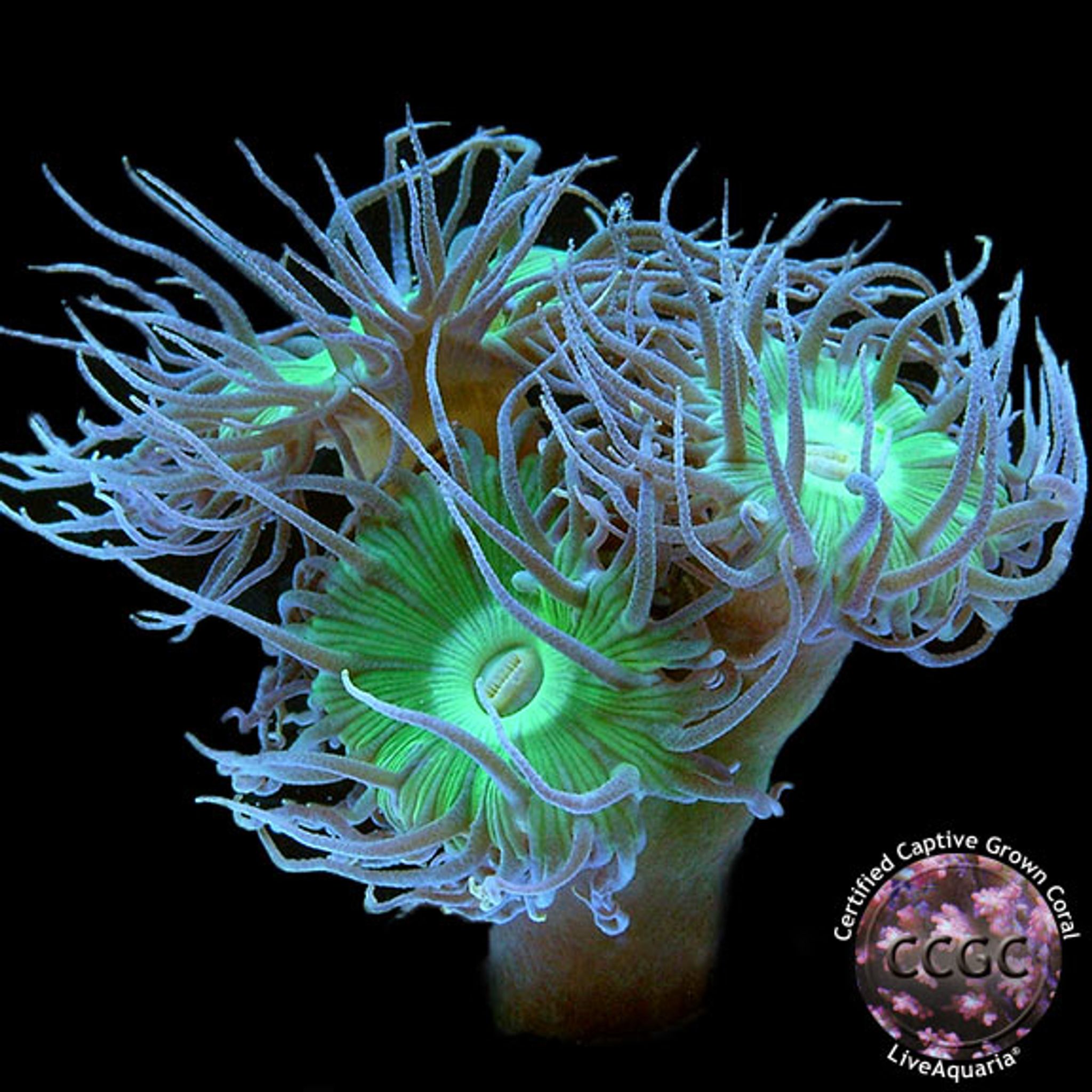

Duncan Coral Care Guide: Lighting, Flow, Feeding and Placement
Duncan coral (Duncanopsammia axifuga) is one of the most forgiving large-polyp stony corals a reef keeper can start with, tolerating a wide swing in light and flow while still rewarding attention with fast growth. This guide lays out the exact PAR, flow, feeding, and placement numbers you need, plus what to do when polyps stay closed.
Quick-Start Spec Box
Before the details, here's the whole picture at a glance:
| Parameter | Target Range |
|---|---|
| Lighting (PAR) | 75–150 (tolerates 30–200 with slow acclimation) |
| Flow | Low to medium, indirect/turbulent |
| Feeding | 2x per week (up to 3x for max growth) |
| Placement | Low to mid tank, on rock, not in sand |
| Temperature | 75–82°F (24–28°C) |
| Salinity | 1.023–1.025 SG (~35 ppt) |
| pH | 8.0–8.4 |
| Alkalinity | 8–12 dKH |
| Calcium | 400–450 ppm |
| Magnesium | 1250–1450 ppm |
| Nitrate | ~5–15 ppm tolerated |
What Is Duncan Coral?
Duncanopsammia axifuga is the only species in its genus, also sold as whisker coral or daisy coral. It's native to the Indo-Pacific, including the Great Barrier Reef area, and ranges south into the South China Sea. In the wild and in captivity it grows as a branching colony of a shared skeleton base topped with wide, fleshy polyp heads and short tentacles — a shape that makes it instantly recognizable once you know what to look for.
It's widely rated as one of the easiest LPS corals available, which is why it's a common recommendation for hobbyists moving up from soft corals into their first large-polyp stony.
Lighting: Aim for the Middle, Then Relax
Most sources land on 75–150 PAR as the sweet spot for good color and steady growth. Duncan's full tolerated range is broader — some tanks run it as low as 30 PAR and others push past 200 PAR without visible harm — so a tank that isn't hitting a perfect number isn't a dealbreaker.
The number that matters more than the target is the rate of change. If you're moving a Duncan colony to a brighter fixture or a higher position in the tank, acclimate over roughly 2–3 weeks, stepping intensity up gradually rather than all at once. Skipping this step is one of the most common ways to bleach an otherwise healthy specimen.
Color is also a spectrum question, not just an intensity one. Duncan's tentacles and oral discs come in green, purple, blue, pink, or brown, and that coloration tends to intensify under actinic-heavy lighting — so if you want deeper color, adjust the blue channel before you reach for more total output.
Browsing a LED lamp with dimmable channels makes this acclimation process much easier, since you can step intensity up in small increments over several weeks instead of jumping straight to a fixed setting.
Flow: Gentle and Indirect, Never a Direct Jet
Low to medium, indirect flow is the consensus recommendation. In gentle, turbulent current, Duncan's tentacles extend long and soft; under a direct laminar stream, they shrink into a stubby, retracted shape and can eventually tear.
A minority view calls for moderate-to-high flow to keep algae from building up on the skeleton between the polyp heads — and that's worth taking seriously as a middle ground. The practical answer: aim for medium, indirect, turbulent flow that ripples the tentacles without blasting them directly. That's enough to prevent detritus and algae film from settling while still keeping polyps relaxed and open.
Signs your flow is wrong:
- Polyps constantly retracted or stubby → flow too strong or too direct
- Visible film, algae, or detritus collecting between heads → flow too weak
- Tentacles waving loosely, fully extended most of the day → flow is right
Feeding Duncan Coral
Duncan is mixotrophic: it gets baseline energy from the zooxanthellae living in its tissue, but it is also highly food-responsive and will actively grab particulate and meaty foods drifting past its tentacles. Fed colonies consistently show larger polyps and faster head production — often several times the size of unfed colonies in the same tank — so skipping feeding entirely isn't fatal, but it does mean much slower growth and duller color.
What to Feed
- Mysis shrimp
- Chopped seafood or krill
- Zooplankton
- Enriched brine shrimp
- Copepods
- Phytoplankton
- LPS-formulated pellets or powders
How and When to Feed
Target-feed directly onto open polyps using a syringe, turkey baster, or feeding tube — broadcast feeding works too, but it puts your coral in direct competition with fish for the food. The best time is after the lights dim or after dark, when polyps are at their most extended and actively feeding.
Turn off flow and the protein skimmer briefly during feeding sessions so the food isn't scattered or pulled out of the water column before the polyps can grab it.
Frequency: general LPS advice suggests 1–2 times per week, while Duncan-specific guidance often bumps that to 2–3 times per week. A 2x/week target-feeding schedule is a solid baseline for most tanks; increase to 3x if you're chasing maximum growth and color, but keep an eye on nutrient levels as you do.
A Note on Overfeeding
Uneaten food doesn't just disappear — it degrades water quality, spikes nitrate and phosphate, clouds the water, and can trigger nuisance algae. Feed only what the polyps can consume within a few minutes, remove any obvious excess, and avoid feeding a photosynthetic LPS like Duncan every single day. If nutrients do spike, an extra water change is usually the fastest correction.
Feeding Corals in General
Most corals kept in home aquariums are mixotrophs, blending photosynthesis with captured food, and the right food particle size depends on the coral's polyp and mouth size. LPS corals like Duncan can handle larger zooplankton and meaty chunks that small-polyp stony corals simply can't process. Across the hobby, target-feeding at night when polyps are extended consistently gets the best uptake, which is why the timing advice above applies well beyond just Duncan.
Best Live Foods for Coral
Phytoplankton and copepods are the two staple live foods used reef-wide. Live phytoplankton feeds filter-feeding organisms directly and helps sustain copepod populations that graze on it. Copepods themselves provide a protein-rich food across a range of particle sizes — useful as a refugium-fed supplement alongside Duncan's direct target feedings rather than a replacement for them.
Coral Nutrition Science
Coral polyps capture zooplankton like copepods and rotifers using nematocyst-armed tentacles and a layer of mucus. Regular feeding on these natural prey items measurably improves growth rates, which is the underlying reason target-feeding schedules exist at all rather than relying on light alone.
Placement: Give It Room and Keep It Off the Sand
Duncan does best low to mid tank, mounted on rock or a stable surface rather than buried in substrate — sand irritates its tissue and encourages detritus to collect around the base. Give the colony enough clearance to fully extend its tentacles without touching neighboring corals.
Because Duncan lacks long sweeper tentacles, it's considered peaceful and reef-safe — but that peacefulness only protects its neighbors, not itself. Keep distance from aggressive, sweeper-tentacle corals such as hammer, torch, frogspawn, and favia, since their stings can cause chronic retraction in a Duncan colony placed too close. Also watch for pinching invertebrates like cleaner shrimp, boxer shrimp, and emerald crabs, which can bother open polyps.
On the fish side, Duncan is compatible with tangs, clownfish, and damsels, making it an easy addition to a typical mixed reef community.
Growth and Fragging
Under good conditions, Duncan grows quickly for an LPS, budding new polyp heads roughly every few months. Eventually a colony will need fragging to control its size or to separate heads that have started crowding each other.
To frag:
- Cut between polyp heads using bone or coral cutters, an electric saw, or a bandsaw, keeping an intact section of skeleton attached to each frag.
- Glue each frag to a plug and let it heal in a low-flow, stable area before moving it to its final spot.
- A brief iodine dip on the cut surfaces is a reasonable precaution against infection.
Water Parameters
Duncan does well within standard reef-tank ranges, and it's more tolerant of moderate nutrients than many small-polyp stony corals — don't feel pressure to strip nitrate to zero, since a little dissolved nutrient in the water tends to support LPS better than an ultra-low-nutrient system tuned for SPS. If you're running a very lean, low-nutrient reef, plan on supplemental target feeding to make up the difference.
Beginner LPS Tips
Duncan is consistently named alongside hammer, torch, frogspawn, candy cane, blastomussa, and bubble coral as an easy first LPS choice. The general rule across this group is low-to-medium light and low-to-medium flow, with careful spacing since many of these corals carry sweeper tentacles. Duncan itself does not, which makes it one of the safer neighbors to place between more aggressive LPS species.
If you're assembling a first LPS collection, browsing LPS hard corals side by side is a good way to compare growth habits and space requirements before committing tank real estate to any one species.
Duncan vs. Sun Coral: Don't Confuse the Two
Duncan is sometimes mistaken for sun coral (Tubastraea) because both belong to the dendrophyllid family and share a similar branching, cup-polyp look. The care requirements are opposite, though: sun coral is non-photosynthetic, so it needs little to no light but requires meaty feedings multiple times a day to survive. Duncan is photosynthetic and thrives on just 2–3 target feedings a week. If you picked up a Duncan expecting a daily feeding commitment, you can dial that back considerably.
Common Mistakes
- Blasting the colony with direct flow — tears tissue and keeps polyps permanently retracted; redirect the pump or reposition the coral.
- Upgrading lighting too fast — causes bleaching; always step up intensity gradually over a couple of weeks.
- Placing in or near sand — irritates tissue and invites detritus buildup; mount on rock instead.
- Skipping feeding entirely — the coral survives on photosynthesis alone but grows and colors far more slowly; add target feeding if growth has stalled.
- Overfeeding — causes nutrient spikes, cloudy water, and algae; scale back to twice weekly and remove excess food promptly.
- Ignoring aggressive neighbors — sweeper tentacles from nearby Euphyllia or Favia species can sting Duncan and cause chronic retraction; keep several inches of clear space.
- Skipping quarantine or dips on new frags — risks introducing pests like flatworms or Aiptasia, or brown jelly infection; dip new frags before adding them to the display.
- Misreading closed polyps as dead — new heads often stay closed while forming. Distinguish this from disease by checking for tissue recession, odor, or jelly-like decay, which call for an immediate freshwater or iodine dip and isolation.
Frequently Asked Questions
Is Duncan coral easy for beginners?
Yes. It's one of the hardiest and most forgiving LPS corals available, tolerating a wide range of light and flow conditions, which is why it's such a common recommendation for a first LPS purchase.
Do Duncan corals need to be fed?
Not strictly — they get baseline energy from photosynthesis. That said, regular target feeding meaningfully boosts growth speed, polyp size, and coloration compared to an unfed colony.
What's the best flow for Duncan coral?
Gentle, indirect, medium flow that ripples the tentacles without blasting them directly. Avoid pointing any pump or return in a direct laminar stream at the colony.
Why are my Duncan coral's polyps closed?
Usually acclimation stress, too much light or flow, or an aggressive coral nearby — new heads can also stay closed simply because they're still forming. Rule out disease first by checking for foul odor, tissue loss, or jelly-like decay, which need immediate attention.
How fast does Duncan coral grow, and when should I frag it?
It grows quickly for an LPS, typically producing new polyp heads every few months under good conditions. Frag it once the colony outgrows its space or heads start crowding each other, cutting between heads with a saw or coral cutters.
Can Duncan coral sting other corals?
It lacks long sweeper tentacles and is generally considered peaceful and reef-safe. Still, give it clearance from aggressive neighboring corals that could sting it, since Duncan is more likely to be stung than to sting.
What water parameters does Duncan coral need?
Standard reef parameters work well: 75–82°F, salinity around 1.025 SG, alkalinity 8–12 dKH, calcium 400–450 ppm, and magnesium 1250–1450 ppm, with some tolerance for moderate nitrate levels.
Is Duncan coral the same as sun coral?
No. Both are dendrophyllid corals with a similar look, but Duncan is photosynthetic and needs only occasional feeding plus adequate light, while sun coral is non-photosynthetic and needs no light but heavy daily feeding.
Ready to add a Duncan colony to your reef? Browse current LPS hard corals on FishyHub, and pair your new coral with a freeze-dried food suited to target feeding.


