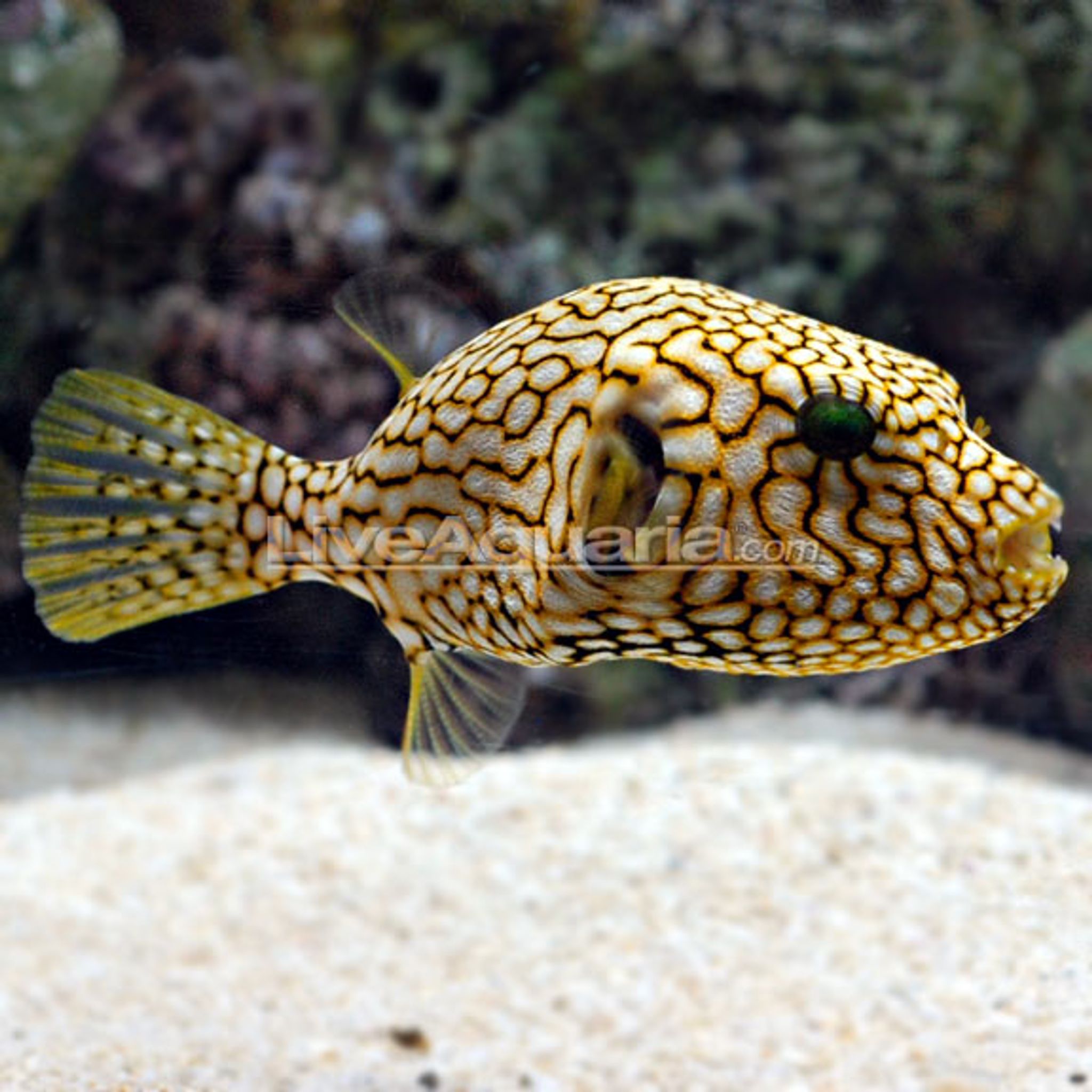
Dogface Puffer Care Guide: Tank Size, Diet, Compatibility and Reef Safety
The dogface puffer is one of the most personable fish in the saltwater hobby, but it is also one of the most misrepresented — "it's a small puffer" is a myth that leads to undersized tanks and unhappy fish. This guide covers the real tank size requirements, diet, teeth maintenance, reef-safety verdict, and tankmate choices you need before bringing one home.
Species Snapshot
The dogface puffer (Arothron nigropunctatus) belongs to the family Tetraodontidae. It also goes by black-spotted puffer, blackspotted blaasop, or simply dog-faced puffer. Despite the range of color morphs — yellow, gray, and brown are all common — every one of them is the same species, identified by the dark patch surrounding the eyes and mouth that gives the fish its "dog face."
- Adult size: 10–13 inches (25–33 cm) in captivity, commonly settling around 12 inches; wild specimens can approach the top of that range.
- Lifespan: 10+ years with stable care, and some keepers report 15–20 years in ideal conditions.
- Origin: All dogface puffers in the trade are wild-caught — there is no established captive-breeding program, and sexing individuals externally is not reliable. This affects both sourcing and how seriously you should take quarantine (more on that below).
- Temperament: Semi-aggressive, intelligent, and curious. Many keepers report their puffer recognizing them and accepting hand-feeding, but the same intelligence comes with territoriality as the fish matures.
Tank Size: The Number One Myth to Correct
The most persistent misconception is that a dogface puffer stays small enough for a nano or small community tank. It does not.
| Life stage | Tank size | Notes |
|---|---|---|
| Juvenile (temporary only) | 40–55 gal (150–210 L) | Will outgrow this within 1–2 years; plan the upgrade before buying |
| Single adult, minimum | 90 gal (340 L) | Absolute floor for one adult dogface puffer |
| Single adult, preferred | 125+ gal (475+ L) | Recommended long-term, especially with tankmates |
Sources disagree on the lower bound — some call 75–90 gallons adequate for life, while more conservative guidance (factoring in the fish's full adult size and heavy bioload) pushes for 125 gallons or more. The safer approach is to treat 90 gallons as an absolute minimum for one fish and plan for 125+ if you want any tankmates or long-term headroom. Buying a juvenile for a small tank "because it's tiny now" is a common and costly mistake — it leads to stunted growth, chronic poor water quality, and an eventual rehoming problem.
If you're shopping for a larger system, browse glass tanks sized with this fish's adult length and bioload in mind rather than its current juvenile size.
Water Parameters
Dogface puffers are often called "hardy," but that reputation is relative — they are sensitive to poor water quality despite tolerating a normal reef parameter range:
- Temperature: 72–78°F (22–26°C)
- pH: 8.1–8.4
- Specific gravity: 1.020–1.025
- dKH: 8–12
- Ammonia and nitrite: 0
- Nitrate: ideally under 10–20 ppm
Filtration and Bioload
A single adult dogface puffer can produce as much waste as several smaller fish combined — underestimating this because "it's just one fish" is a recurring mistake. Plan filtration and skimming capacity as if the tank held 1.5–2x its actual display volume, not just for the gallons on the label. Practical requirements:
- A protein skimmer and biological filtration sized above what the tank size alone would suggest.
- Weekly 10–15% water changes to keep nitrate and organics in check.
- A sump or canister setup rather than relying on filtration meant for a lightly-stocked reef.
Diet and the Ever-Growing Beak
Dogface puffers are strict carnivores, and their diet does double duty: it feeds the fish and wears down a beak that never stops growing.
Core diet:
- Clams and mussels (in-shell when possible)
- Shrimp, crab, and snails
- Squid and krill
- Occasional nori or marine algae
Feed once or twice daily with real variety — puffers overeat readily and put on weight fast, and obesity shortens their lifespan and stresses their organs. Hard-shelled foods aren't optional extras; they're the primary defense against beak overgrowth. A diet of only soft foods like frozen mysis or fish fillets is a common mistake that leads directly to dental problems.
Signs of Beak Overgrowth
Watch for these before it becomes an emergency:
- Asymmetric growth on one side of the mouth
- Visible "tusks" protruding past the lips
- Difficulty closing the mouth fully
- Dropped food or reluctance to eat despite apparent interest
If overgrowth progresses to the point the fish can't feed itself, an experienced keeper or veterinarian needs to manually trim the beak. This is a real, foreseeable maintenance task for this species — not a rare edge case — and the fix starts with reintroducing hard-shell foods at the first sign of trouble.
Puffing Behavior
Puffers inflate by rapidly gulping water, not air, as a defense response. Occasional puffing during handling, transport, or a startling moment is normal. Frequent or repeated puffing is not — it signals stress from poor water quality, bullying tankmates, or excessive handling and should prompt an investigation into tank conditions, not be treated as a fun trick to trigger on purpose. Repeated forced inflation is genuinely stressful for the fish.
Tankmates and Compatibility
Dogface puffers are territorial, especially toward fish with a similar body shape or their own species. Two dogface puffers together is not recommended except in very large systems — this includes other puffers, not just its own kind, if they look similar.
Good tankmate candidates (medium-to-large, robust fish that can hold their own):
- Tangs and surgeonfish
- Larger wrasses
- Angelfish
- Some triggerfish
- Lionfish and groupers
Avoid:
- Small, slow-moving fish
- Ornamental shrimp, crabs, snails, and hermits — the puffer will eat or harass them
- Aggressive fin-nippers that could stress the puffer in return
Browse tangs and surgeonfish as a starting point for compatible, similarly-sized company.
Reef Safety: The Honest Verdict
This is the question most guides answer with a vague "maybe," and it deserves a straight answer: dogface puffers are not reliably reef safe. Most individuals will eat or pick at snails, crabs, shrimp, clams, and sometimes soft corals, zoanthids, or LPS corals. A minority of keepers report a dogface puffer that leaves a reef mostly undisturbed, but this is inconsistent from fish to fish and can't be predicted in advance.
The practical takeaway: label this fish "reef safe with caution" at best, and default to keeping it in a fish-only-with-live-rock (FOWLR) system. Never attempt reef-keeping with a dogface puffer if the tank holds valuable or sensitive coral, or any motile invertebrates you'd be upset to lose. If you already run a cleanup crew of snails or similar inverts, plan to either skip them in a puffer tank entirely or accept that most will eventually become food.
Disease, Quarantine, and Acclimation
Dogface puffers are susceptible to the two most common marine parasitic diseases: marine ich (Cryptocaryon irritans) and marine velvet (Amyloodinium ocellatum). Because puffers are scaleless, many copper-based medications are risky or outright toxic to them — treating with copper is a mistake that can do more harm than the disease itself. Hyposalinity or careful puffer-safe, non-copper treatments are the safer route, and any treatment should happen in a separate quarantine tank, never the display.
Quarantine recommendations:
- Quarantine new dogface puffers for 4+ weeks minimum before adding them to a display, observing closely for parasites.
- Since all specimens are wild-caught, this observation period matters more than it would for a captive-bred fish.
- Quarantine tankmates added later too — skipping this is a common way to introduce ich or velvet to an otherwise healthy puffer tank.
- Drip acclimate new arrivals over 45-plus minutes; puffers are sensitive to rapid swings in salinity or pH.
Why Buying Pre-Quarantined Stock Helps
Reputable quarantine facilities hold fish for roughly 4–6+ weeks under medicated and observation protocols before they're offered for sale. Buying pre-quarantined stock shortens — but does not eliminate — the need for your own home quarantine period. For an expensive, long-lived fish like a dogface puffer, that extra layer of protection is generally worth the premium, but it's not a substitute for your own observation window once the fish arrives.
Is a Dogface Puffer a Good Beginner Fish?
No — despite feeding readily and tolerating standard reef parameters, this is not a first saltwater fish. Beginner-fish criteria (small size, minimal bioload, forgiving of mistakes, low ongoing maintenance) all point away from this species: it needs a 90+ gallon tank from day one of adulthood, produces heavy waste, requires deliberate beak-maintenance feeding, and forces a firm reef-or-FOWLR decision before purchase.
For comparison, easier beginner picks are small, hardy, easy-feeding fish that fit modest tanks — clownfish, certain gobies, some damsels, and blennies. Those species are a sensible place to start; the dogface puffer is a step up in commitment that suits someone ready to run a large, dedicated FOWLR system.
A Related Species Worth Knowing: The Guineafowl Puffer
Shoppers often see Arothron meleagris, the guineafowl puffer, displayed alongside dogface puffers, and the two are sometimes confused. It's a closely related species reaching a similar size (up to ~12 inches), sharing the same carnivorous hard-shell diet and beak-growth concerns, and it is likewise not reef safe. Guineafowl puffers come in black, gold/yellow, and gold-with-white-spots color forms. If you're comparing puffers in a store's marine fish section, treat the care requirements as essentially identical to the dogface puffer.
Midnight Dogface Puffer
The "midnight" dogface puffer is not a separate species — it's a darker, near-solid black-to-charcoal color morph of the same Arothron nigropunctatus. Its care requirements are identical to a standard-colored dogface puffer; the only real difference is that its striking, rarer coloration typically commands a price premium.
Setting Up a System Sized for a Dogface Puffer
If you're building a new 90–165 gallon system specifically with this fish in mind, budget for more than the tank itself:
- A protein skimmer and sump rated above the display's actual volume
- A return pump matched to that sump
- Heater(s) sized generously for the total water volume
- A flow controller or reliable powerheads
- Quality live rock and sand
- A separate quarantine tank
- A stronger lighting fixture only if you're planning any coral in a FOWLR-with-inverts setup
A dogface-puffer-sized system carries a much heavier bioload than a typical reef nano, so every component above should be sized up accordingly, not just the tank.
Before You Buy: A Quick Readiness Checklist
- Tank is mature, cycled, and at least 90 gallons (125+ preferred)
- Filtration and skimming are rated well above the tank's raw volume
- A quarantine tank is already set up and ready to run
- Target tankmates are chosen from the compatible list above and are similarly robust
- You've decided FOWLR vs. reef and are comfortable with the reef risk if you go that route
- You have a reliable source of hard-shelled foods lined up
Frequently Asked Questions
What size tank does a dogface puffer really need?
Plan for 90 gallons minimum for one adult, with 125+ gallons preferred long-term. This accounts for its roughly 12-inch adult length and its unusually heavy waste output for a single fish.
Is a dogface puffer reef safe?
Not reliably. Treat it as fish-only or FOWLR by default, since most individuals will eat snails, crabs, and shrimp, and may pick at corals. A minority of fish leave reefs alone, but this can't be predicted before purchase.
What do dogface puffers eat?
A carnivorous diet built around hard-shelled foods — clams, mussels, shrimp, crab, and squid — fed once or twice daily with variety. These foods aren't just nutrition; they wear down the fish's constantly growing beak.
Why is my puffer's mouth or beak overgrown, and how do I fix it?
This is almost always caused by a diet that's been too soft for too long. Add hard-shell foods immediately, and if the fish can no longer feed itself, have an experienced keeper or veterinarian trim the beak manually.
Can I keep two dogface puffers together?
It's not recommended except in very large tanks. Dogface puffers are territorial toward their own kind and toward other fish with a similar body shape.
How long do dogface puffers live?
Commonly 10 or more years, with some keepers reporting 15–20 years, given stable water quality and a varied, hard-shell-heavy diet.
Why does my puffer keep puffing up?
Occasional puffing during handling or transport is normal. Frequent puffing signals stress — usually from poor water quality, bullying tankmates, or excessive handling — and should be investigated rather than encouraged.
Are dogface puffers good for beginners?
Not as a first saltwater fish. Feeding is genuinely easy, but the tank size, filtration demands, beak maintenance, and reef-compatibility decisions make it better suited to someone who has already run a stable marine system.
Ready to see current stock? Browse marine puffers on FishyHub to compare available dogface puffers and plan your system around the right one.

