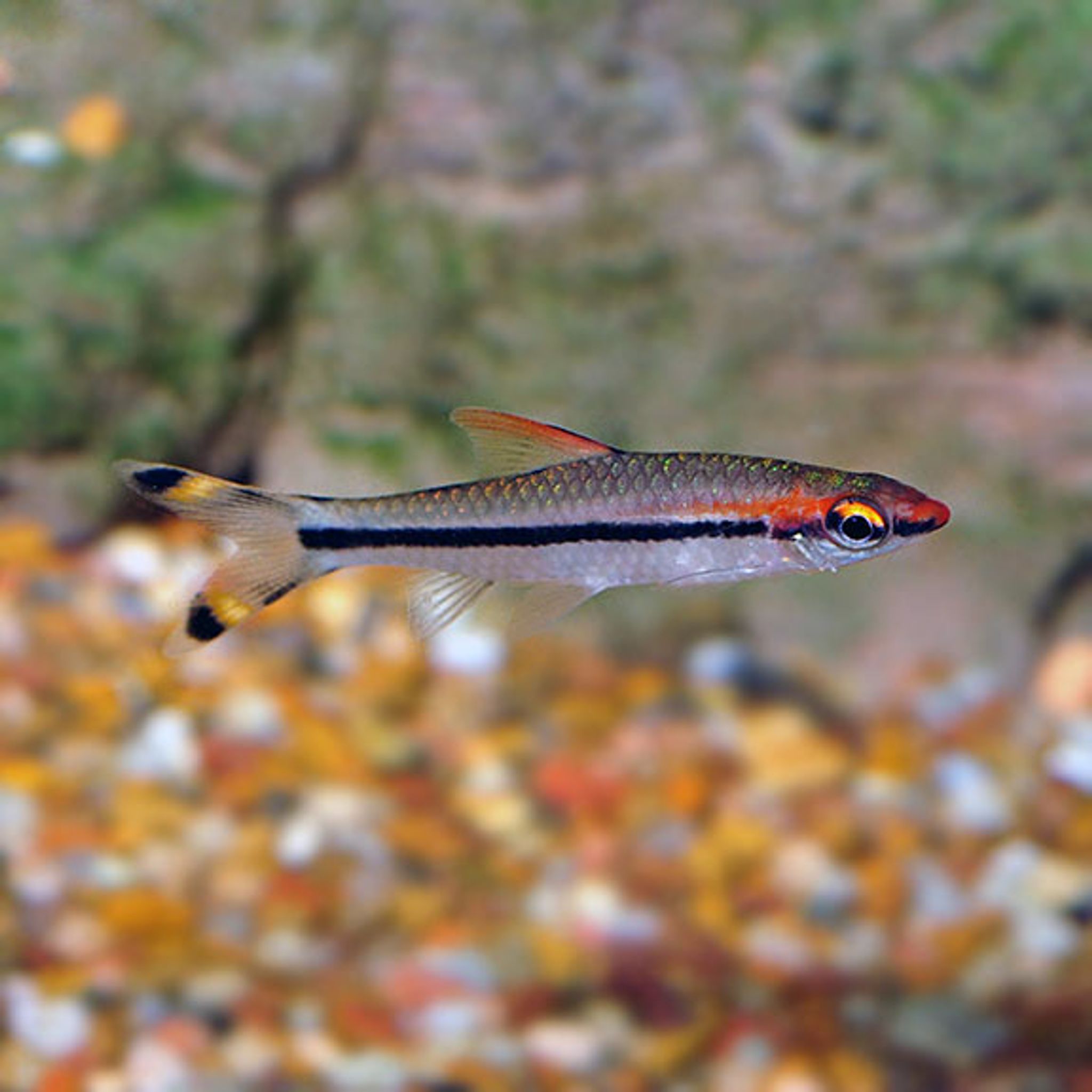
Denison Barb Care Guide: Tank Size, Diet, Water Parameters and Temperament
The Denison barb, often sold as the "roseline shark," is a fast, torpedo-shaped schooling fish that needs far more room and a much larger group than its 3-inch juvenile size at the store suggests. This guide covers the tank length and school size that actually prevent problems, plus the cooler water parameters, diet, and tankmates that keep this species healthy long-term.
Species Snapshot
Denison barb (Sahyadria denisonii, formerly classified under Puntius and Barbus) is a cyprinid native to the fast-flowing, well-oxygenated hill streams of the Western Ghats in Kerala, India. It is not a true shark — the "roseline shark" name refers only to its torpedo-like body shape and swimming style. Other common names include red-line torpedo barb, Miss Kerala, and bleeding-eye barb.
Adults reach up to 6 inches (about 15 cm), making it one of the largest commonly kept barbs. A mature Denison barb shows a silver body with a black horizontal stripe running from snout to tail, a scarlet-red stripe running through the eye toward mid-body, a red-edged dorsal fin, and a yellow-and-black striped caudal fin. Juveniles at the store are usually pale and lack the full red stripe and tail pattern, which is one reason buyers underestimate the fish's eventual size and space needs.
A Conservation-Sensitive Species
Denison barb is IUCN-listed as endangered in the wild, driven by decades of over-collection for the aquarium trade combined with habitat loss in its narrow native range. Most stock sold today is captive- or farm-raised rather than wild-caught, but sourcing still matters: buy captive-bred fish where the listing or seller indicates it, since every wild-collected individual sold adds pressure to an already-declining population. You can browse current stock and check sourcing details on FishyHub's barb selection before committing to a school.
Tank Size and School Size (Read This First)
This is the single biggest mismatch between what buyers expect and what the fish needs. A common setup mistake is buying two or three juveniles for a 20-30 gallon tank, then watching them turn aggressive and nippy as they mature. The fix is planning for the adult fish, not the juvenile in the bag.
Length matters more than raw gallons. Denison barbs are horizontal, fast swimmers built for open water, so a tall, short-footprint tank is worse for them than a long, shallow one of similar volume.
| Setup | Minimum length | Volume | Suitable for |
|---|---|---|---|
| Bare-minimum starter | 36 in (91 cm) | 40-gallon breeder | A lightly stocked group of 6, short-to-medium term |
| Standard minimum | 48 in (122 cm) | ~55 gallons | A full school of 6-8 long-term |
| Recommended | 48+ in (122+ cm) | 75+ gallons | A school of 8-10 plus community tankmates |
Treat 48 inches (4 feet) of tank length as non-negotiable for a permanent setup. A 40-gallon breeder shares that same footprint at a shorter length and smaller volume, so it can work as a bare-minimum starting point for a small group, but it isn't the long-term answer sources sometimes suggest.
Group size: keep a minimum of 6, ideally 8-10 or more. Fewer than 6 and Denison barbs become stressed, nippy toward each other, and prone to aggression against tankmates — they redirect the energy they'd normally spend chasing each other around a larger school. A properly sized school is also calmer and shows better color, since less energy goes into squabbling.
Always use a tight-fitting lid. Denison barbs are strong jumpers, and a fast startle response in an open-top tank is a common way to lose fish to the floor.
Cycling Before You Stock a Full School
Adding 8-10 semi-large barbs to a brand-new tank at once creates a sudden bioload spike that an uncycled filter can't handle. Run a fishless cycle first — dose ammonia and let the beneficial bacteria colony establish until the tank processes ammonia and nitrite to zero within 24 hours — before introducing the school, and consider adding fish in two batches over a week or two even in a cycled tank to spread out the initial waste load.
Water Parameters
Denison barbs come from cool, high-oxygen hill streams, which makes them noticeably cooler-tolerant than a typical "tropical community" fish.
| Parameter | Target range |
|---|---|
| Temperature | 60-77°F (15.5-25°C); avoid sustained heat above ~78°F (25.5°C) |
| pH | 6.5-7.8 |
| General hardness | 5-25 dGH |
| Ammonia | 0 ppm |
| Nitrite | 0 ppm |
| Nitrate | Under 20 ppm |
Some sources list an upper temperature tolerance closer to 78-79°F for short periods, but treat 77°F as the practical ceiling for sustained conditions — running warmer for extended periods stresses the fish and can shorten lifespan and raise disease risk. This is also why Denison barbs are a poor match for standard tropical heaters set in the high 70s or low 80s: dial the heater back, or skip it entirely in a warm, stable room, and choose tankmates that tolerate the cooler range.
They also need especially clean water. Keep nitrate on the low end and stay on top of routine testing for ammonia, nitrite, and pH, since this species is more sensitive to water quality drift than many hardier community fish.
Flow and Oxygen
Hill-stream fish need strong current and high dissolved oxygen — low flow leads to gasping at the surface and general stress. Target roughly 4-6x the tank's volume in filter turnover per hour. For a 75-gallon tank, that means aiming for a combined filter and powerhead output in the 300-450 gallons-per-hour range. A single hang-on or canister filter rated for the tank size often isn't enough current on its own; adding a powerhead angled across the tank length recreates the push of current these fish evolved swimming against. You can compare turnover-rated options in FishyHub's filter selection when planning flow for a barb setup.
Diet
Denison barbs are omnivorous and easy to feed once you establish a routine:
- Staple: high-quality sinking pellets or flake, fed 1-2 times daily in amounts eaten within a couple of minutes
- Protein boost, several times a week: live or frozen bloodworms, brine shrimp, or daphnia
- Plant matter: blanched vegetables such as zucchini or spinach
- Color support: carotenoid-rich foods like spirulina, krill, or color-enhancing pellets, which help maintain the intensity of the red stripe
Avoid overfeeding — uneaten food is one of the main contributors to cloudy or foul-smelling water in a heavily stocked school tank, discussed further below.
Temperament and Tankmates
Properly kept, Denison barb is a peaceful, active community fish. The temperament problems reported online almost always trace back to an undersized school or cramped tank rather than an inherently aggressive nature.
Good tankmates: other barbs, larger tetras, rainbowfish, danios, white clouds, corydoras and other peaceful loaches, plecos, and similarly sized peaceful cichlids that tolerate cooler water.
Avoid: slow-moving or long-finned fish (bettas, fancy guppies, angelfish) that invite fin-nipping from a fast-moving school; very small fish that can be outcompeted or seen as food; and warm-water-only species whose temperature requirements conflict with the cooler range Denison barbs need.
Shrimp are a gamble. Small dwarf shrimp like cherry shrimp are frequently eaten and this isn't a good choice for a dedicated shrimp colony. Larger amano shrimp fare somewhat better thanks to their size, but there's no guarantee they'll be left alone in a tank full of active barbs.
Lifespan with good care runs about 5-8 years, with the longer end of that range associated with spacious, well-maintained setups rather than crowded or undersized tanks.
Breeding
Breeding Denison barb in a home aquarium is extremely difficult and not a realistic beginner project. Commercial supply relies on hormone-induced spawning at specialized farms. It's an egg-scattering cyprinid with no parental care, so accidental home spawns are rare, and any fry that do appear have low survival odds without deliberate intervention (separate rearing tank, infusoria or fine dry food, and protection from adult fish that will eat the eggs). Set expectations accordingly rather than planning around a home breeding project.
Other Large Barbs Worth Knowing
Denison barb belongs to a group of larger barb species that regularly get bought too small a tank. If you're comparing barb options, here's how some relatives stack up:
- Tinfoil barb: much larger still, reaching up to 14 inches, and needs a very large tank of 125+ gallons — a serious step up from Denison barb.
- Arulius barb: a smaller, peaceful black-and-gold barb that's easier to house and a good alternative for medium tanks that can't fit a Denison barb school.
- Filament barb: 5-6 inches, silver/gold with a red-orange lateral stripe, and plant-safe, making it a solid companion for a large planted tank.
- Curmuca barb: a lesser-known, elongated, slender-snouted barb that's peaceful and hardy in a community setting.
- Silver barb: peaceful and active, and schools well alongside tinfoil and curmuca barbs in a large mixed-barb display.
As a point of trivia on the wider family: in 2023, researchers described Neolissochilus pnar, a blind cavefish from Meghalaya, India, related to barbs and mahseer. It isn't a home-aquarium fish, but it's a reminder of how diverse South and Southeast Asian cyprinids are beyond the handful of species sold in the trade.
Common Water-Quality Problems in a Barb Tank
Because Denison barbs need strong flow and pristine water, general water-quality troubleshooting is directly relevant to keeping them healthy:
- Cloudy water: usually new-tank haze or a bacterial bloom after a big water change or new fish additions, unrinsed substrate, or a green algae bloom from excess light or nutrients. Most cloudiness from a bacterial bloom clears on its own within a week or two with normal maintenance.
- Smelly water: rotting waste or uneaten food trapped in a clogged filter, insufficient water changes letting organics build up, or anaerobic dead zones producing a rotten-egg odor where flow and oxygen are poor — a particular risk if the tank's current isn't strong enough for this species to begin with.
- Foam at the surface: protein or organic foam from waste buildup and decomposing debris, more common in dirty or overstocked tanks; this differs from the normal light bubble layer that appears briefly after a water change.
The fix for all three is the same routine that keeps Denison barbs thriving: weekly water changes, regular filter cleaning, not overstocking, and not overfeeding.
Frequently Asked Questions
Is a Denison barb the same as a roseline shark?
Yes. Roseline shark, red-line torpedo barb, Miss Kerala, and bleeding-eye barb are all common names for the same species, Sahyadria denisonii. It is not a true shark — the name refers to its torpedo-shaped, fast-swimming body.
What's the minimum tank size?
Roughly 55 gallons, and at least 48 inches (4 feet) long. Length matters more than raw volume because these are fast, horizontal swimmers; a shorter, deeper tank of the same gallon count is a worse fit.
How many should I keep together?
A minimum of 6, ideally 8-10 or more. Groups smaller than 6 tend to become stressed and turn nippy toward each other and tankmates.
What temperature do they need?
Cooler than most tropical community fish — about 60-77°F. Avoid sustained heat above the high 70s, since prolonged warmth stresses the species and can shorten lifespan.
Are Denison barbs endangered?
Yes. They're IUCN-listed as endangered due to wild overharvesting for the aquarium trade and habitat loss. Buy captive-bred stock where it's identified as such.
Can I keep them with shrimp?
It's risky for small shrimp like cherry shrimp, which are frequently eaten. Larger amano shrimp fare somewhat better because of their size, but there's no guarantee they'll be safe in a tank full of active barbs.
Can I breed them at home?
It's extremely unlikely. Commercial breeding relies on hormone induction at specialized farms, and accidental home spawns are rare with low fry survival without dedicated rearing effort.
Why is my Denison barb losing its color?
Usually one of three causes: stress from an undersized school, declining water quality, or a diet lacking carotenoid-rich foods like spirulina or krill. Address the school size and water parameters first, then add color-supporting foods.
If you're ready to plan a Denison barb setup, browse current stock and other schooling species in FishyHub's Freshwater Livestock category to build out a school and compatible tankmates in one order.

