Crinum Care Guide: Light, CO2, Substrate and Growth Tips
Crinum is a bulb plant built for patience: it asks for little light, no CO2, and a decent root zone, then rewards you with tall, swaying leaves for years. This guide covers exactly how much light and substrate it needs, how to plant the bulb without rotting it, and why weeks of apparent inactivity after purchase is normal rather than a sign of a dead plant.
What Is Crinum, and Which Species Should You Buy?
Crinum aquatic plants grow from a bulb (technically a rhizome-like structure) rather than a root system alone, and several species are sold for freshwater tanks under different common names:
- Crinum calamistratum — long, narrow, wavy leaves; stays a background plant and tends to be the most compact of the aquatic Crinums.
- Crinum thaianum ("onion plant") — very long, ribbon-like leaves that routinely reach and trail across the surface even in tall tanks.
- Crinum natans — broader, more strap-like wavy leaves, often used as a bold focal point.
Species identity matters more than most care sheets admit. The three above are true aquatics that can stay fully submerged indefinitely. However, some plants labeled "Crinum" and sold in the houseplant trade are better suited to emersed or bog-style growth, with only their roots and base wet and the leaves kept in open air. Submerging one of these terrestrial-leaning types full-time can cause it to melt repeatedly instead of settling in. Before buying, confirm the species is one of the fully aquatic types above if you intend to grow it completely underwater.
Light Requirements
Crinum does well under low to moderate light, roughly in the range of 1.5–3 watts per gallon on older fluorescent-equivalent terms, or about 20–50 PAR for anyone measuring with a light meter. It tolerates low light without complaint, simply growing slower and staying more compact.
- Under low light, expect thinner growth and a longer runway before the plant fills in.
- Under moderate-to-high light, leaves emerge faster and can look denser and greener — but only if nutrients and root feeding keep pace.
- Too much light without matched nutrients is a common cause of algae forming on Crinum's broad leaf surfaces, since the plant can't use the extra energy fast enough to outcompete algae.
The safe default is low-to-moderate light. Push higher only if you're also committed to consistent root tab dosing and, ideally, some liquid fertilization. You can browse fixtures suited to low-tech planted setups in FishyHub's lighting category if you're assembling a tank around Crinum and similar low-demand plants.
Does Crinum Need CO2?
No. Crinum is one of the better low-tech, non-CO2 plants available and thrives in tanks with no injected carbon at all. Supplemental CO2 (pressurized or DIY yeast-based) is entirely optional — it will speed up growth and can produce denser, greener leaf tissue, but skipping it does not put the plant at risk the way it would a demanding carpet or stem plant.
This makes Crinum a good anchor plant for anyone building a beginner-friendly aquascape, or for mixed tanks where some higher-tech stem plants get CO2 and the Crinum simply grows a bit slower alongside them.
CO2 for Planted Tanks in General (Quick Context)
If you're running CO2 anyway for more demanding plants, it's worth understanding the basics even though Crinum doesn't require it:
- CO2 boosts photosynthesis, which is why fast-growing stem plants and carpeting plants often depend on it to compete with algae.
- DIY yeast-based systems are cheap and low-output, suitable for smaller tanks; pressurized systems give precise, adjustable, higher output for larger or heavily planted tanks.
- A common target range is 20–30 ppm dissolved CO2.
- Use a drop checker and a timer tied to your lighting schedule to avoid overdosing — too much CO2 stresses or can kill fish, especially overnight when plants stop consuming it and CO2 keeps accumulating if the system isn't timed off.
Substrate and Planting
Substrate Choice and Depth
Crinum prefers a nutrient-rich substrate — an aquasoil or a capped root-tab substrate — at a minimum depth of 2–3 inches (5–7.5 cm) so the bulb can anchor properly and roots have room to spread. Plain sand or gravel works too, as long as you push root tabs in near the bulb regularly, since inert substrates carry no nutrient reserve of their own.
Avoid substrate that's so fine or tightly packed that it compacts around the roots and cuts off oxygen — this can suffocate the root system even in an otherwise nutrient-rich mix. FishyHub carries both substrate options and dedicated aquasoil if you want to build a nutrient base specifically for root feeders like Crinum.
How to Plant the Bulb Correctly
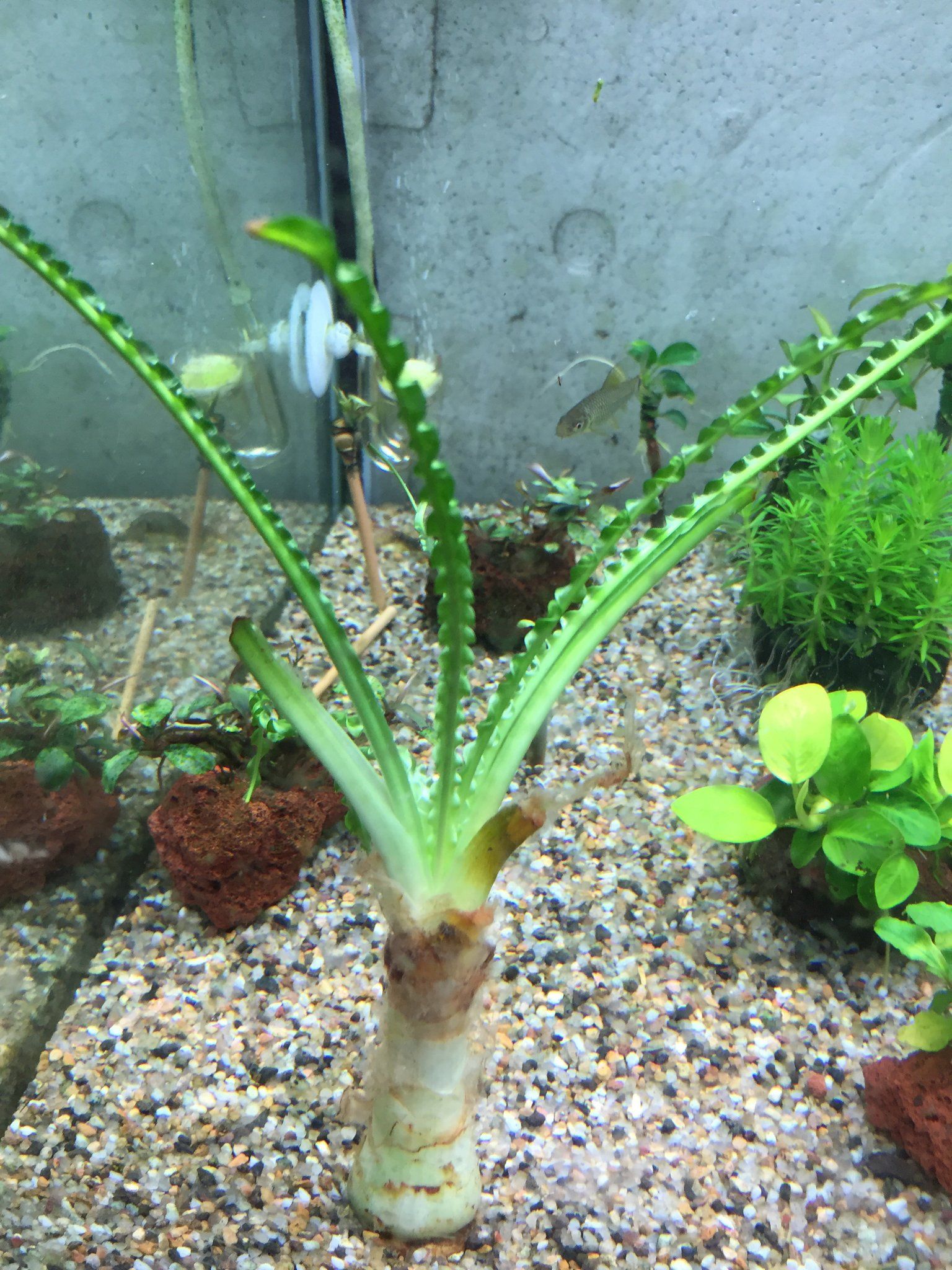
This is where most planting mistakes happen. The rule: bury only the root and basal plate of the bulb, leaving the upper half to two-thirds of the bulb body exposed above the substrate line.
- Fully burying the bulb is the single most common cause of rot — a buried bulb crown can't get enough gas exchange and starts to soften and smell.
- Some sources suggest burying the bulb halfway; others say keep the entire bulb exposed with only roots in substrate. The safer approach, and the one that best avoids rot, is to err toward less burial — cover the base and roots, and let the rest of the bulb sit visibly above the substrate.
- Place Crinum in the midground to background of the tank, since even the more compact species eventually put out long leaves that will dominate the foreground if planted too close to the glass.
Water Parameters
Crinum is forgiving and adapts to a wide range of common freshwater conditions, which is part of why it suits community and low-tech tanks so well.
| Parameter | Range |
|---|---|
| Temperature | 72–82°F (22–28°C) |
| pH | 6.5–7.8 |
| Hardness | Soft to moderately hard |
Because it tolerates this much variation, Crinum pairs easily with most community fish and doesn't require you to chase a narrow chemistry target the way some sensitive stem plants do.
Fertilization and Feeding
Crinum is a heavy root feeder — it draws most of its nutrition through its roots rather than the water column, which is why substrate quality and root tabs matter more here than for many stem or floating plants.
- Push root tabs near the bulb's root zone every 4–6 weeks as the primary feeding method.
- If leaves develop pale or clear patches, that's usually a sign of iron or micronutrient deficiency — supplement with a liquid micro/iron fertilizer in addition to root tabs.
- In bare gravel with no root tabs at all, expect pale, thin, stunted leaf growth over time as the plant runs out of accessible nutrients.
Growth Habit, Size, and Tank Planning
Why Growth Starts Slow
Crinum is notorious for a slow establishment period. After planting — or after the stress of shipping and transplanting — it's completely normal to see no visible new growth for three to six weeks, sometimes longer. The bulb is rebuilding its root system before it commits energy to new leaves. This is the single most common source of "my Crinum is dying" concern, when in fact the plant is just establishing.
Once rooted, growth accelerates noticeably. Mature leaves can reach 12–24 inches (30–60 cm) or more, with C. thaianum in particular capable of trailing well past that length across the water surface.
Tank Size and Placement
Because of that eventual leaf length, Crinum is best suited to tanks 20 gallons (75 L) and larger, ideally with enough depth or height to give long leaves somewhere to go without immediately reaching the surface and tangling. In smaller tanks, overcrowding becomes a real problem: leaves can block light to other plants, wrap around filter intakes, or crowd out CO2 diffusers. If you're setting up a tank specifically to house Crinum long-term, a roomier glass tank gives the plant space to mature without constant trimming.
Propagation
Crinum propagates by producing bulb offsets (plantlets) at the base of the parent bulb. Once an offset has grown its own roots, it can be gently separated from the parent and replanted following the same shallow-burial method described above.
Trimming and Maintenance
- Trim only yellowing or damaged leaf tips with clean scissors, cutting near where the damage starts.
- Never cut into the bulb tissue itself — that opens the door to infection and rot the same way overburial does.
- Older outer leaves will yellow and shed naturally as the plant grows; this is routine maintenance, not disease, and you can simply remove the dead leaf once it detaches.
Troubleshooting Common Mistakes
| Mistake | Result | Fix |
|---|---|---|
| Burying the bulb completely | Mushy, foul-smelling rot at the base | Re-plant with only roots/basal plate covered |
| Giving up after a few weeks of no growth | Discarding a healthy, still-establishing plant | Wait 3–6+ weeks before judging health |
| No root tabs in bare gravel | Pale, thin, stunted leaves | Add root tabs on a 4–6 week schedule |
| Ignoring eventual leaf length | Leaves tangle filter intakes, block light | Plant in 20-gallon-plus tanks with room to grow |
| Trimming into bulb tissue | Risk of infection | Trim only damaged leaf tips, never the bulb |
| Mistaking leaf shedding for disease | Unnecessary panic/removal | Recognize old-leaf drop as normal turnover |
Is It Establishing or Is It Rotting?
A genuinely establishing bulb stays firm to the touch and odor-free, even if it shows zero new leaf growth for weeks. A rotting bulb turns soft or mushy and develops a distinct foul smell at the base. If the bulb passes both the firmness and smell checks, leave it alone and keep up normal root tab dosing — new growth is likely just delayed, not absent for good.
Companion and Comparison Plants
Acorus gramineus (Dwarf Sweet Flag)
A common companion for Crinum-style low-tech layouts. It prefers moderate-to-high light but tolerates low light with slower, more compact growth. It wants a nutrient-rich, loose substrate, handles a wide parameter range (64–82°F / 18–28°C, pH 6–8), and works well as a background or paludarium plant reaching 12–20 inches (30–50 cm). CO2 is optional, and regular liquid fertilizer helps it fill in. Its narrow, grass-like blades give a nice textural contrast against Crinum's broader, wavy leaves.
Lucky Bamboo (Dracaena sanderiana)
Despite being commonly sold near aquarium plants, lucky bamboo is not a true aquatic and should never be fully submerged. It needs to be kept with its leaves above the waterline and only its roots in water; fully submerged foliage rots and fouls the water with ammonia. It wants bright, indirect light and is a heavy root feeder that benefits from regular liquid fertilization. Use it as an emersed accent near a filter or under an open hood rather than as a substrate plant the way you'd use Crinum.
Red Mangroves
Mangroves are a brackish/marine-associated plant, not a natural pairing with a freshwater Crinum tank, but worth knowing about as a broader "aquarium plants" reference point. They need bright light, roots kept wet with leaves exposed to air, tolerate a range of salinity, grow very slowly, and are mainly used in refugiums or paludariums rather than as submerged display plants.
Plants That Are Toxic to Fish
Not every attractive houseplant is safe near or in a tank. Some terrestrial ornamentals — certain Dieffenbachia varieties, and pothos with cut stems leaking sap into the water, among others — can be harmful if their sap or tissue contaminates aquarium water. The core safety rules:
- Only add plants specifically verified safe for full or partial aquatic use.
- Rinse any new plant thoroughly to remove pesticide residue before it goes anywhere near your tank.
- Quarantine or dip new plants before adding them to an established display, the same way you would with new livestock.
Using Crinum in Aquascaping
Crinum's long, wavy leaves move gently in filter flow, which makes it a strong focal point in blackwater or naturalistic-style layouts where a slow, swaying silhouette reads better than rigid stem plants. Placing a single Crinum bulb slightly off-center in the midground, with Acorus gramineus grouped behind it for a contrasting narrow-leaf texture, is an easy way to build depth without needing CO2 or intense lighting to pull it off.
Frequently Asked Questions
Does Crinum need CO2 to grow?
No. Crinum grows well in low-tech tanks without any injected CO2. Adding CO2 will speed up growth and can deepen leaf color, but it's a bonus, not a requirement.
How much light does Crinum need?
Low to moderate light is enough, roughly 20–50 PAR. Higher light can produce faster, denser growth, but only if root tabs and nutrients keep pace — otherwise the extra light tends to feed algae on the leaves instead.
How do I plant a Crinum bulb correctly?
Bury only the root and basal plate in a nutrient-rich substrate, leaving the upper half to two-thirds of the bulb exposed above the substrate line. Place it in the midground or background, since the leaves will eventually get long.
Why isn't my Crinum growing?
New growth commonly takes three to six weeks, sometimes longer, after planting or shipping while the plant rebuilds its root system — this is normal establishment shock, not a dead plant. If there's still no growth after that window, check that root tabs are in place and light levels aren't too low.
Can Crinum grow in a low-tech, beginner tank?
Yes — that's one of its main advantages. It tolerates a wide range of water parameters, doesn't need CO2, and gets by on low-to-moderate light, making it one of the more forgiving bulb plants for a first planted tank.
How big does Crinum get, and what tank size do I need?
Leaves commonly reach 12–24 inches or more, with some species trailing across the surface in taller tanks. Plan on a 20-gallon or larger tank so the plant has room to mature without leaves tangling filter intakes or crowding other plants.
Is Crinum safe with fish and invertebrates?
Yes — as a true aquatic plant, Crinum poses no toxicity risk to fish or invertebrates. That's not true of every plant sold near aquarium supplies; some terrestrial ornamentals are unsafe if fully submerged, so always confirm a plant is aquarium-safe before adding it.
How do I propagate Crinum?
Wait for bulb offsets (small plantlets) to form at the base of the parent bulb and develop their own roots, then gently separate them and replant using the same shallow-burial method as the parent bulb.
Ready to start a low-tech Crinum setup or round out the substrate and root-feeding routine it needs? Browse FishyHub's substrate selection to find the right nutrient base for a bulb plant that rewards a little patience with years of steady growth.

