Convict Cichlid Care Guide: Tank Size, Diet, Water Parameters and Temperament
The convict cichlid is one of the cheapest, hardiest cichlids sold in US fish stores, and also one of the most misunderstood — it looks small and calm in a store tank but turns into a territorial bulldozer at home. This guide covers exactly how big a tank it needs, what to feed it, the water parameters that keep it healthy, and why it usually can't live in a normal community tank.
Quick Stats
| Trait | Detail |
|---|---|
| Scientific name | Amatitlania nigrofasciata (older names: Cichlasoma, Archocentrus, Cryptoheros nigrofasciatus) |
| Origin | Central America, Pacific and Atlantic slopes from Guatemala to Panama; streams and rocky lake shallows |
| Adult size | Males 5–6 in (13–15 cm); females 3.5–4.5 in (9–11 cm) |
| Lifespan | 8–10 years, occasionally longer |
| Minimum tank | 30 gal (114 L) for one fish or a pair |
| Temperature | 75–82°F (24–28°C); 78–80°F is the sweet spot |
| pH | 6.5–8.0, stability matters more than the exact number |
| Diet | Omnivore — pellets plus meaty and vegetable foods |
| Temperament | Territorial, aggressive, not a community fish |
What a Convict Cichlid Looks Like
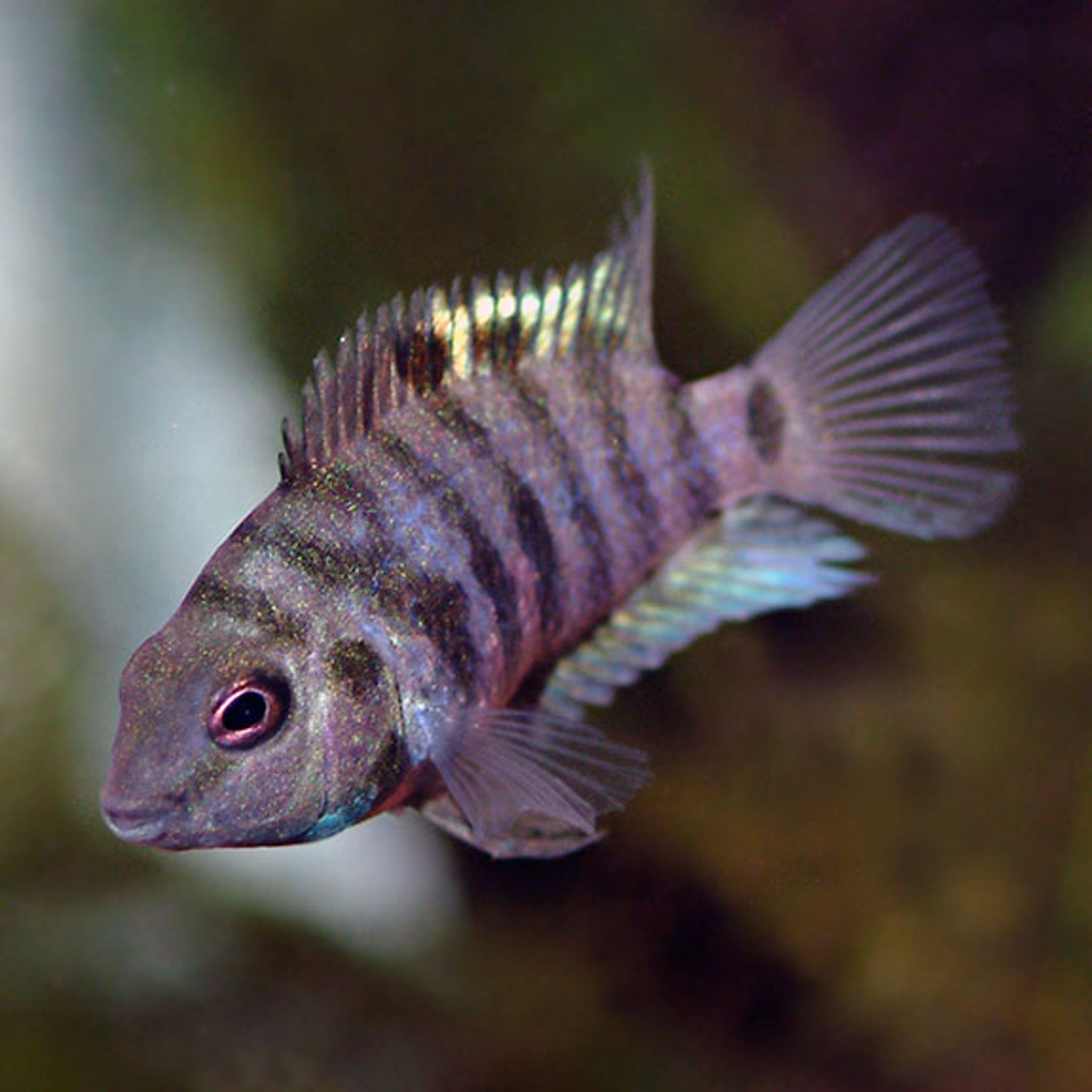
Wild-type convicts are gray-blue with 8–9 vertical black bars, which is where the "convict" name comes from. The most common man-made variant in US stores is the pink convict (also called leucistic), a pale pink-white fish that is not a true albino — it still has dark eyes and often a faint orange tint on females. Marbled and true albino (red-eyed) strains also show up occasionally. All color forms have identical care needs and identical temperament; the pink form is just slightly more visible to tankmates and predators, which matters a little when picking tank mates or open décor.
Tank Size by Stocking Scenario
Sources disagree a lot here — recommendations range from 20 to 30 gallons for a single fish, up to 50 for a pair. The safest approach is to size for the setup you actually plan to run, not the smallest number you can find:
- Single fish or a mated pair, nothing else: 30 gal (114 L) minimum. A single convict is genuinely one of the easier cichlids to house.
- Pair plus dither fish or a bottom dweller: 40 gal breeder or larger. The extra floor length matters more than depth.
- Mixed Central American cichlid community: 55+ gal, giving each territory-holder enough distance from the others.
- Juveniles: a 20 gal is fine as a temporary grow-out, but convicts outgrow it within months and need to move up.
Floor area beats height for this species — convicts hold territory on the substrate, not in open water, so a long, wide footprint always outperforms a tall, narrow tank of the same gallon count.
Water Parameters
| Parameter | Target range |
|---|---|
| Temperature | 76–80°F (24–27°C) for daily keeping; brief rises to 82°F (28°C) can trigger spawning |
| pH | 6.5–8.0 |
| General hardness | Roughly 6–15 dGH |
| Ammonia / nitrite | 0 ppm |
| Nitrate | Under 20–40 ppm |
| Water changes | 25–30% weekly, or at minimum every two weeks |
Most US municipal tap water runs neutral to slightly hard and alkaline, which sits comfortably inside the convict's range — you generally don't need to chase an exact pH number, just keep it stable. If your utility uses chloramine rather than plain chlorine (check your local water report), use a dechlorinator rated to neutralize chloramine specifically, not just chlorine. Run moderate flow and strong filtration; convicts are messy eaters and constant diggers, so the filter needs to keep up with both waste and stirred-up sediment. In parts of the US where room temperatures drop in winter, use a heater with a guard, since convicts will investigate and can damage an exposed heating element.
Setting Up the Tank
- Substrate: sand or fine, smooth gravel. Convicts excavate constantly, and sharp gravel can injure their mouths and bellies over time.
- Décor: caves, flat stones, clay pots, and driftwood arranged to break sightlines between territories. Secure any rockwork directly to the glass bottom (not stacked loosely on substrate) — digging fish routinely topple unsecured rock piles, which risks cracked glass and crushed fish.
- Lid: a tight-fitting one. Cichlids under stress or during territorial disputes can jump.
- Plants: most rooted plants get uprooted or shredded. Use epiphytes like java fern or anubias tied to wood or rock instead of planted in substrate, or a robust potted sword plant. Floating plants generally survive undisturbed since they're out of digging range.
Diet
Convicts are unfussy omnivores. Build the diet around:
- A quality cichlid pellet or flake as the base, ideally with some spirulina or vegetable content included.
- Frozen or live meaty foods — bloodworm, brine shrimp, mysis, daphnia — a few times a week for variety.
- Blanched vegetables — peas, zucchini, spinach — to cover plant matter.
Feed 2–3 small meals a day, offering only what's eaten within about two minutes, and skip feeding one day a week. Avoid feeder goldfish entirely — they carry disease risk, contain the enzyme thiaminase which breaks down vitamin B1, and add unnecessary fat to the diet.
Temperament and Tank Mates
This is the part most new owners underestimate. Convicts are territorial and aggressive well beyond what their size suggests, and a mated pair will claim a large share of any tank they're in — adding a convict to a peaceful community tank almost always ends in harassment and dead fish.
If you want tank mates, they need to be robust, similar in size, and fast enough to avoid cornering:
- Other medium Central American cichlids with enough space: firemouth, Jack Dempsey, rainbow cichlid, Honduran red point.
- Blue acara.
- Large barbs or giant danios as dither fish to diffuse aggression.
- Bristlenose or common plecos, and other larger catfish.
Avoid tetras, guppies, shrimp, snails, slow or long-finned fish, and anything small enough to be eaten. Also skip oscars, green terrors, and Texas cichlids despite occasionally appearing on tank mate lists elsewhere — they eventually grow far larger than a convict and can kill one, or get killed themselves by an aggressive spawning pair while still small. Any mixed setup like this needs 55+ gallons minimum. A key sequencing mistake: buying a pair first and adding tank mates later. By then the pair's territory is already established, and newcomers get treated as intruders. Add dither fish first, or fully rearrange the rockwork when introducing anything new, to reset territorial boundaries.
Keeping options, from lowest to highest maintenance:
- A single fish — the calmest, easiest way to keep a convict.
- A group of juveniles — let a natural pair form, then rehome the rest.
- A mated pair alone — the best display option, with breeding effectively guaranteed.
Sexing
- Males: larger, with a steeper forehead that can develop a nuchal hump with age, and longer, more pointed dorsal and anal fins.
- Females: smaller, with orange-red to gold patches on the belly and dorsal fin. Pink females still show a faint orange tint despite the lighter body color.
Breeding Convicts
Convicts are cave or substrate spawners with biparental care, and pairs are monogamous for the duration of a breeding cycle. They mature around 6 months old, at roughly 2–3 inches. The female cleans a cave or flat rock and lays eggs there — clutch sizes are usually cited anywhere from about 30 to 100–300 eggs; the higher counts (100+) are more accurate for the clutch itself, with larger, more experienced females laying more, but survival to the free-swimming stage is often much lower, especially with young or first-time parents.
Eggs hatch in about 3–4 days at 80°F. The wrigglers live off their yolk sac for another 4–7 days before free-swimming, during which both parents guard the cave, herd the fry, and dig small pits nearby. On removing the male: some guides say to pull him once fry are free-swimming, but leaving the pair together is usually fine unless the male starts attacking the female — move fry only when they reach about 0.5–1 inch, or when the parents show signs of preparing to spawn again.
Raising the Fry
- Move or hatch fry into a dedicated grow-out tank with a sponge filter or bare bottom for easy cleaning.
- Feed newly hatched brine shrimp or micro/powdered foods several times a day.
- Siphon out uneaten food regularly and do 50% water changes a few times a week — fry tanks foul fast.
- At this feeding rate, fry typically reach about 1 inch within a few weeks.
Managing Surplus Fry
A productive pair can spawn every 3–6 weeks once a batch of fry is removed, and stores frequently won't want more convicts since they're so easy to breed. Have a plan before you get a pair: keep a single fish or same-sex group if you don't want fry at all, or be ready to remove eggs/rock and slightly lower the tank temperature to discourage spawning. Never release surplus fish into local waterways. Convicts are an established invasive species in parts of the US, including warm springs and drainages in states like Nevada, and are regulated in some states — treat rehoming through local hobbyists or stores as the only responsible option.
Convicts as a First Cichlid
Convicts are a classic starter cichlid for exactly this reason: they're hardy, inexpensive, and forgiving of beginner mistakes, as long as the tank is cycled before the fish goes in. When buying, look for a fish that is alert and full-bodied, with intact fins, no white spots, no clamped fins, and no sunken or hollow-looking belly. You can browse currently available stock in FishyHub's American Cichlids category, alongside compatible bottom dwellers in Plecos, Corys & Bottom Dwellers.
Related Central American and Comparable Cichlids
Convicts belong to a wider group of Central American cichlids worth knowing before you shop:
- Texas cichlid and Nicaragua cichlid — close relatives that grow much larger, 8–12 in, and need substantially bigger tanks than a convict.
- Honduran red point — a smaller, slightly milder member of the convict group, often listed as a compatible tank mate given enough space.
- Coatzacoalcos and hogaboomorum-type cichlids, and Nicaraguan crater-lake species — other regional relatives sharing similar rock-and-cave spawning habits.
Outside the Americas, West African jewel cichlids (Hemichromis lifalili, H. exsul) and various South American cave-spawning cichlids show a very similar pattern: strong pair bonds, cave or rock spawning, and fierce parental care. They make an interesting behavioral comparison, but mixing jewels and convicts in the same tank usually just produces constant fighting rather than a workable community — keep them as separate projects.
Common Mistakes to Avoid
- Adding a convict to a peaceful community tank — expect harassment and losses among the existing fish.
- Adding tank mates after a pair is already established — introduce dithers first or rearrange décor when adding anything new.
- Unsecured rockwork — digging fish can topple loose stacks, risking cracked glass and injury.
- A battered female — if a male turns on his mate, separate them with a divider, add more caves and sightline breaks, or rehome one fish; not every pairing works out.
- No plan for fry — expect a new batch every few weeks once a pair is established; know in advance whether you'll remove eggs, adjust temperature, or keep single/same-sex fish instead.
- Overfeeding — leads to bloat and nitrate spikes; stick to what's eaten in about two minutes per feeding.
Health and Quarantine
Convicts are genuinely hardy fish, but common issues still include ich, fin rot, bacterial infections tied to poor water quality, hole-in-the-head disease linked to weak nutrition and water conditions, bloat from overfeeding, and injuries from territorial fights. Quarantine any new fish for 2–4 weeks before adding them to an established tank, and treat any suspicious spots or lesions early using products from FishyHub's Treatment category.
Frequently Asked Questions
Can a convict live in a 20 gallon tank?
Only short-term as a juvenile. As it grows and becomes territorial, it needs at least a 30-gallon tank long term, whether kept alone or as a pair.
How can I tell a male convict from a female?
Females are smaller and show orange-red to gold patches on the belly and dorsal fin (even pink females retain a faint orange tint). Males are larger, with a steeper forehead that can form a nuchal hump and longer, more pointed dorsal and anal fins.
Why is my pair digging and chasing everything?
That's typical spawning preparation. Expect to see eggs on a flat rock or inside a cave within days once this behavior starts.
Can convicts live with oscars or angelfish?
Angelfish, no — they're too slow and delicate for a convict's aggression. Oscars are also a poor match: they'll eventually outgrow and eat a convict, or get harassed by a defensive spawning pair while still small.
How often do convicts breed?
Roughly every 3–6 weeks once the previous batch of fry has been removed or has dispersed, as long as the pair stays healthy and well fed.
Do convict cichlids eat plants?
They uproot or shred most rooted plants while digging. Stick to epiphytes like java fern and anubias tied to wood or rock, which survive much better.
Can I keep just one convict?
Yes, and it's often the calmest way to keep the species — a single fish skips the territorial intensity and guaranteed breeding that come with a pair.
How long do convict cichlids live?
Typically 8–10 years with stable water quality and a varied diet, occasionally longer.
Ready to start your own setup? Browse available stock and compatible tank mates in FishyHub's Angelfish, Discus, Rams & Cichlids category.

