Common Torch Coral Problems: Tissue Loss, Fading, Pests and Recovery
A torch coral (Euphyllia glabrescens) that suddenly stops opening, sheds tissue, or fades to white can look identical whether the cause is an emergency or a slow parameter drift. This guide sorts torch coral symptoms into fast-moving emergencies and gradual chronic problems, then walks through diagnosis, treatment, and realistic recovery timelines.
What a Healthy Torch Coral Looks Like
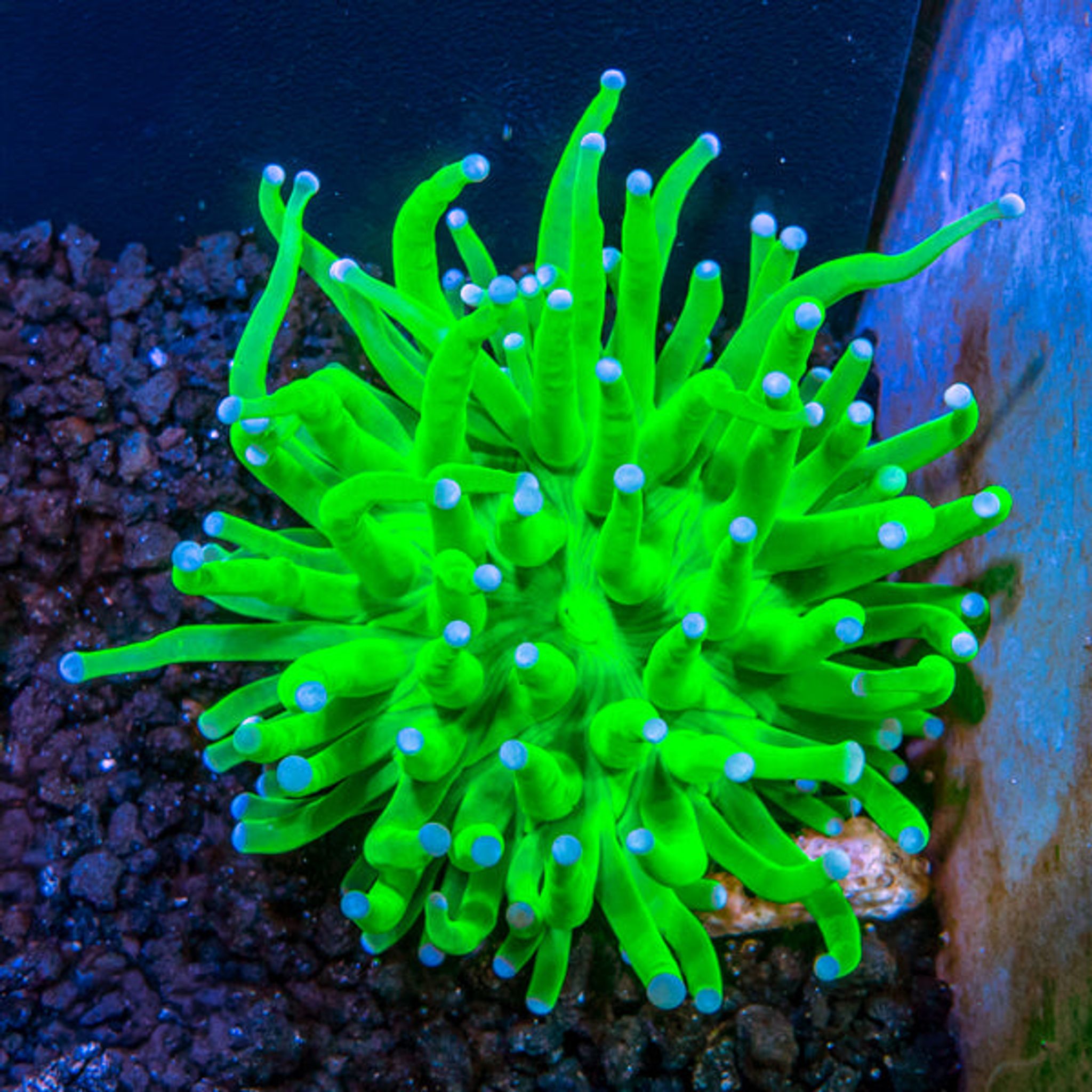
Before troubleshooting, know the baseline. A healthy torch has long sweeper tentacles extended for most of the day, often with globe- or ball-shaped tips in shades of green, gold, or gray. It retracts fully at night, during and right after feeding, or briefly when disturbed by tank maintenance or a passing fish. None of that is a symptom. The actual warning signs are polyps that stay closed for days with no obvious trigger, tissue that visibly thins or recedes, or color that shifts sharply toward brown, pale, or white.
Ideal Conditions (Quick Reference)
Many torch coral problems trace back to one of these ranges drifting, or drifting too fast rather than the number itself being off.
| Parameter | Target Range | Notes |
|---|---|---|
| Temperature | 76–80°F (24–27°C) | Stay in the tighter middle of commonly cited 76–82°F ranges |
| Specific gravity | 1.024–1.026 | |
| pH | 8.1–8.4 | |
| Alkalinity | 8–11 dKH | Stability matters more than the exact number |
| Calcium | 380–450 ppm | |
| Magnesium | 1250–1350 ppm | |
| Ammonia / Nitrite | Near zero | |
| Nitrate | ~2–10 ppm | Detectable is better than zero for LPS |
| Phosphate | ~0.03–0.1 ppm | |
| Lighting (PAR at polyp) | ~50–150 | Moderate, not reef-blasting |
| Flow | Moderate, indirect, turbulent | Polyps should sway, not flatten |
Note the nitrate and phosphate ranges. Some care sheets push toward zero for the sake of coloration, but chasing an ultra-low-nutrient system is a common cause of chronic torch coral decline. For an LPS-heavy reef, moderate and stable nutrients beat rock-bottom ones.
Fast Triage: Is This an Emergency or a Slow Decline?
Run through this checklist in order before doing anything else:
- Look for stringy, sloughing tissue or a foul smell. If present, this is an emergency — go to the Rapid Tissue Necrosis section now.
- Check flow and placement. Is the coral getting blasted directly, or sitting in dead water where detritus collects on the tissue?
- Check alkalinity stability, not just the current reading — pull the last several test log entries if you have them.
- Inspect for pests under magnification, including the base and skeleton crevices.
- Consider allelopathy — is a neighboring coral's sweeper tentacle or chemical zone reaching it?
Fast symptoms (hours to a day) demand immediate action. Slow symptoms (days to weeks) give you time to adjust parameters and observe before cutting anything.
Rapid Tissue Necrosis and Brown Jelly (Emergency)
Rapid Tissue Necrosis (RTN) and brown jelly disease can strip an entire head of tissue in under a day. Signs include sudden, fast-spreading tissue loss, stringy brown or tan mucus-like tissue sloughing off, and a foul odor.
Treat this as an emergency:
- Cut healthy tissue away from the dying area immediately with a clean blade or bone cutter, leaving a margin of visibly normal tissue.
- Move the cut frag to a separate container or quarantine tank, away from the display.
- Dip the piece in an iodine-based or coral-safe dip.
- Use a turkey baster to gently blow necrotic tissue and debris off the remaining healthy area, improving flow across the wound.
- Remove the affected coral from the display if the infection is spreading, since brown jelly is treated as at least locally contagious via water contact and drifting debris, even though the exact transmission mechanism is debated.
Waiting to see if a fast-spreading recession "stops on its own" is the single most common mistake here — early cutting saves noticeably more coral than watching and hoping.
Slow Tissue Recession ("Melting")
Chronic recession, whether it creeps from the base upward or from the skeleton down into the tissue, usually points to sustained stress rather than a single event. Common causes:
- Unstable alkalinity — swings up and down, even within a "normal" range, stress LPS tissue more than a slightly off but steady number.
- Nutrient extremes in either direction — spikes or a crashed near-zero system.
- Poor flow — either stagnant (detritus settles and invites brown jelly) or excessive (tissue tears and won't extend).
- Sting damage or allelopathy from a neighboring coral.
- Physical damage from a falling frag or rough handling.
- A slow-moving infection that hasn't yet turned into full RTN.
A useful diagnostic clue: recession that's worse on one side of the coral, especially the side facing another coral, points strongly to stinging rather than disease. This is an overlooked cause that gets misdiagnosed as infection far more often than it should. Leave several inches of clearance — more as the coral grows — between a torch and its neighbors, since its sweeper tentacles extend at night and can sting anything within reach.
Ignoring a one-sided, slow recession for weeks is a common mistake. It's often manageable with early cutting, a dip, and isolation, but left alone it can progress into full RTN.
Fading, Bleaching and Browning
These two problems look opposite but both come down to the coral's zooxanthellae population.
Bleaching or Turning White/Pale
Tissue usually stays intact, but color drains out. Typical causes are light stress (often a new fixture or moving the coral higher without acclimation), elevated temperature, or long-term nutrient starvation in an ultra-clean tank. Fix by dimming the light or relocating to a lower-light, lower-flow spot, and relaxing aggressive nutrient export — target the 5–10 ppm nitrate range rather than zero.
Turning Brown or Muddy
The opposite problem: excess nutrients or too little light lets zooxanthellae overgrow, muting the coral's natural color into a brown or muddy tone. Improve lighting intensity moderately or trim back nutrient inputs.
In both cases, changes should be gradual. Sudden light increases — a new fixture, or moving a frag higher in the tank — are a frequent cause of bleaching and recession. Acclimate light changes over 2–4 weeks, not days.
Torch Coral Not Extending
A torch that stays closed for days without visible tissue damage is not necessarily sick. Check for:
- Pests (see below).
- Aggressive tankmates — sweeper tentacles from other corals, or hermit crabs and snails repeatedly bumping it.
- Too-strong flow or light for its placement.
- Low or swinging alkalinity.
- Recent transport stress — a newly acquired or recently moved torch can take 1–2 weeks to settle before extending normally again.
Give it that settling window in a calm spot before assuming disease. Nighttime retraction, and reduced extension during or shortly after feeding, is completely normal behavior and not a symptom of anything.
Torch Coral Pests
Two categories of pests turn up on torch corals, and they are not equally serious.
Mostly harmless: bristleworms and small crustacean "spider"-like or copepod-like hitchhikers sometimes live in the skeleton. They're usually scavengers that don't damage healthy tissue.
The real concern: a euphyllia-specific flatworm, roughly 6–10 mm and noticeably thicker than typical flatworms, feeds directly on tissue and causes chronically short, unopened polyps. Adults die from a coral dip within minutes, but their eggs are dip-resistant. Breaking the life cycle requires repeated weekly dipping for 6–8 weeks — a single dip will knock back adults but let eggs hatch into a fresh generation. Quarantine and dip all new euphyllia before adding them to the display; this is the single most effective prevention step.
Fragging as a Rescue Technique
Cutting a coral isn't only for propagation — it's a standard way to save a torch head with spreading tissue loss. The technique:
- Cut with bone shears or a sharp blade at a branch point, well clear of any receding or discolored tissue.
- Let the cut skeleton callus for about a day before mounting.
- Mount the frag with coral-safe putty or glue on a plug.
- Keep flow gentle but present over the frag until it reattaches.
Recovery: What to Expect and When to Stop
Recovery is realistic but slow. Once parameters are stabilized and dead tissue removed, expect the process to unfold over weeks to a few months, not days — new tissue has to grow back over bare skeleton gradually. During this period:
- Keep flow gentle but present over the wound; don't let detritus settle on it.
- Avoid moving the coral repeatedly — repositioning resets acclimation and adds stress during an already vulnerable phase.
- Use iodine dosing or dips only during active pest or disease treatment, not as an indefinite "just in case" routine — ongoing unnecessary dosing has its own downsides.
- Track alkalinity regularly, not occasionally, since stability is what actually protects the healing tissue.
When to consider giving up: if recession has already reached the oral disc or mouth structures of a head, survival odds drop sharply. A frag with visible mouth and feeding tentacle structures still intact has a real chance; one where the mouth itself has been consumed usually does not.
Frequently Asked Questions
Why is my torch coral not opening/extending?
Usually recent transport stress, too much flow or light for its spot, low or swinging alkalinity, nearby aggressive tankmates, or an early pest infestation. Give it 1–2 weeks in a calm location before assuming disease.
Can a torch coral recover from tissue loss?
Yes, if caught before recession reaches the mouth or oral disc structures. Cut away dead tissue, dip the remaining piece, stabilize parameters, and the healthy tissue can regrow over the skeleton over weeks to months.
What does brown jelly disease look like on torch coral?
Stringy brown or tan, mucus-like tissue sloughing off rapidly, often with a foul odor. Treat it as an emergency: cut healthy tissue away from the dying area immediately and isolate the frag.
Why is my torch coral turning brown?
Typically too little light or excess nutrients, letting zooxanthellae overgrow and mute the coral's natural color. Increase lighting moderately or reduce nutrient load.
Why is my torch coral bleaching or going white?
Light or temperature stress, or nutrient starvation in an overly clean tank. Dial back intense light and allow slightly higher nitrate and phosphate rather than chasing zero.
What are the small white or clear bugs/spiders on my torch coral?
Often harmless amphipod- or copepod-like hitchhikers that don't damage tissue. The more concerning pest is a euphyllia-specific flatworm that causes chronically closed polyps — treatable with repeated coral dips over 6–8 weeks to catch both adults and resistant eggs.
How much flow and light does a torch coral need?
Moderate, indirect flow that gently sways the polyps without flattening them, and moderate light around PAR 50–150 at the polyp. Avoid direct blasting flow or SPS-level light intensity.
Is it normal for torch coral polyps to retract at night?
Yes. Nocturnal retraction and reduced extension during or after feeding is normal behavior, not a disease symptom.
Shopping for a new torch coral or treating one that's struggling? Browse LPS hard corals on FishyHub, along with coral dips and medications and water conditioners and additives for quarantine and stabilization.

