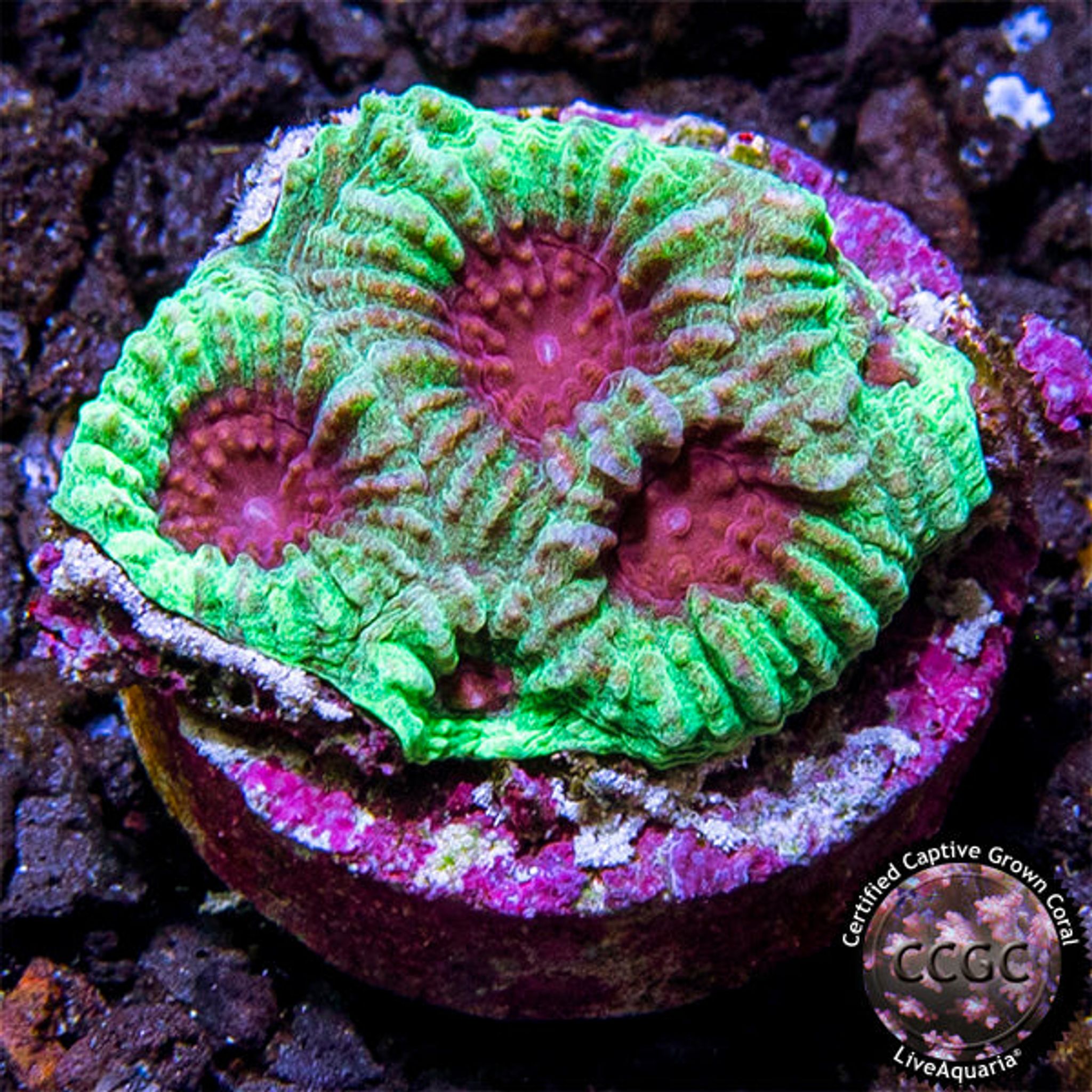
Common Favia Coral Problems: Tissue Loss, Fading, Pests and Recovery
If your Favia (brain) coral is showing bare skeleton, a pale patch, a foul-smelling slime, or a nighttime visitor crawling across it, you need to know what you're dealing with before you touch anything. This guide walks through the four main problem categories, what actually causes each one, and the exact steps to stop the damage and help the coral regrow — without the panic-driven overreactions that usually make things worse.
A Quick Note on Names
Corals sold as "Favia" in the hobby are frequently reclassified today as Dipsastraea, Favites, Coelastrea, or Goniastrea under current taxonomy. This naming shuffle doesn't change husbandry or disease risk at all — every coral in this "brain" or "moon" group shares the same fleshy coenosarc layer over a hard calcium carbonate skeleton, and the same troubleshooting logic applies regardless of which genus a tag uses. For simplicity, this article uses "Favia" to cover the whole group.
Read the Coral First: A Quick Decision Tree
Before reaching for a dip, a dose, or a fragging tool, match what you're seeing to one of these paths:
- Pale, but polyps are extended and feeding → Likely photoacclimation or a shift toward lower nutrients. Watch and feed; don't intervene yet.
- Pale or white, with polyps retracted → Check light intensity, flow, and temperature for a recent change. This is a stress response, not necessarily death.
- Visible slime, brown or amber, foul smell → Isolate the coral immediately. This is likely brown jelly infection and it spreads.
- A snail, worm, or nudibranch on or near the tissue → Remove it, dip the coral, and start a quarantine period for anything new added recently.
Tissue Recession: STN vs. RTN
Tissue loss on Favia shows up as skeleton showing through thinning or receding flesh, and it generally falls into two speeds:
- STN (slow tissue necrosis): Tissue recedes gradually, patch by patch, sometimes over days to weeks. This gives you time to find the cause and intervene before the whole colony is affected.
- RTN (rapid tissue necrosis): Tissue disappears across large sections or the entire colony within a day or two. This calls for immediate action — frag away dead tissue and isolate the coral the same day you notice it.
The response protocol differs by speed: STN allows for careful diagnosis first, while RTN demands you act to physically stop the spread before you've even confirmed the root cause.
What Causes Tissue Loss
- Sudden parameter swings, especially in alkalinity or salinity
- Physical damage from frag-cutting, shipping, or rough handling
- Chemical (allelopathic) stress from aggressive neighbors like Euphyllia, Galaxea, or zoanthid mats
- Old or degraded transport water left in the bag or container too long
- Air exposure during maintenance or frag-dipping
- Pest predation
- Low-grade bacterial infection that follows any of the above
Treating the visible tissue loss without identifying and removing the underlying stressor almost always leads to recurrence.
Bleaching and Fading
A Favia turning white, tan, or pastel is undergoing bleaching — the loss of the zooxanthellae algae that give it color. Common triggers include:
- Light shock: too much intensity, too suddenly, especially for a coral just introduced to a new tank
- Heat stress: sustained temperatures above roughly 85°F (29°C)
- Extremely low nutrients: an ultra-low-nutrient system can starve zooxanthellae just as easily as excess light can bleach them out
Not every pale coral is in crisis. A Favia can also "brown up" from the opposite problem — too much nutrient or too little light — which is its own form of stress. The key distinction: paling that's sudden, tied to a specific event (new light, a heater failure, a dosing mistake), or paired with retracted polyps is a real concern. Gradual, mild paling with polyps still extending and feeding normally is often just photoacclimation.
Brown Jelly Infection
Brown jelly is a translucent brown or amber slime that forms over dying or damaged tissue, driven by ciliates feeding on necrotic flesh. It has a distinct foul smell and can spread to neighboring LPS within hours to days if left alone. Do not "watch it" — isolate the coral immediately.
Treatment steps:
- Move the coral to a quarantine or dip container away from the display right away.
- Physically remove the jelly with a turkey baster or siphon — never let it drift back into the tank, as it is contagious.
- Cut away dead or heavily infected tissue with a clean tool, down to healthy tissue and skeleton.
- Dip the coral in an iodine-based or coral-safe antiseptic dip.
- Return it to the display only once the slime is completely gone and cut edges look clean.
- Monitor daily for at least a week for any recurrence.
Pests That Target Favia
| Pest | How to Spot It | Typical Threat Level |
|---|---|---|
| Coralliophila-type predatory snails | Shell wedged against tissue, often at night | High — actively feeds on live tissue |
| Nudibranchs | Small, camouflaged, egg spirals nearby | Moderate to high, species-dependent |
| Red flatworms | Thin, flat, fast-moving on the surface | Moderate, especially in numbers |
| Fireworms | Bristled, segmented, usually nocturnal | Moderate — can bite into tissue |
| Bristleworms | Bristled, thicker-bodied, scavenging | Low — mostly eat already-dead tissue |
Bristleworms are frequently blamed for damage they didn't cause. The consensus is that they scavenge tissue that's already dead rather than actively predating on healthy coral, though a very large population can aggravate a coral that's already stressed for other reasons.
Inspection tips:
- Check with a flashlight at night, since many predatory snails and flatworms are nocturnal.
- Remove visible pests manually with tweezers.
- If infestations keep recurring, run a dedicated 2–4 week quarantine for all new LPS before they join the display.
Ideal Tank Setup for Prevention
Most Favia problems trace back to instability rather than one specific "bad" number. Use this range as a stable target, not a moving goal:
| Parameter | Target Range |
|---|---|
| Temperature | 76–80°F (24–27°C) |
| Salinity | 1.024–1.026 SG |
| pH | 7.8–8.4 |
| Alkalinity | 8–11 dKH (stability matters more than the exact number) |
| Calcium | 380–450 ppm |
| Magnesium | 1250–1350 ppm |
| Nitrate | ~2–10 ppm |
| Phosphate | ~0.03–0.1 ppm |
| Lighting | 50–150 PAR |
| Flow | Low to medium, indirect |
Favia tolerates a wider nutrient range than SPS corals and can actually decline in an ultra-low-nutrient tank — don't chase zero nitrate and phosphate on a Favia-dominant or mixed LPS/SPS system.
Lighting: Moderate intensity, generally cited between 50–150 PAR, works well. Treat this as a starting range rather than a fixed target — judge success by polyp extension and color, not by hitting a specific PAR reading. Direct, high-intensity light (200+ PAR) meant for SPS placement can bleach a Favia, especially a freshly acclimated frag.
Flow: Low to medium and turbulent rather than a direct, laminar blast. Too much flow keeps polyps retracted and prevents feeding; too little allows detritus and film algae to settle on any exposed skeleton.
Placement and spacing: Favia has long sweeper tentacles and stings aggressively. Leave 1–2 inches of clearance from any neighboring coral on flat, stable substrate, bottom to mid-tank. Nightly stinging from an unnoticed neighbor is one of the most common, and most underrated, causes of slow, mysterious-looking tissue loss.
Acclimating a New Favia to Avoid Shipping Stress
Shipping stress is a major, avoidable cause of early tissue loss and bleaching. Step new arrivals in gradually:
- Drip-acclimate to match salinity and temperature before adding to any tank, including quarantine.
- Place the coral low in the tank or under a shaded/lower-intensity zone for the first week.
- Raise light intensity gradually over 2–4 weeks, watching for polyp retraction as a sign to slow down.
- Keep flow gentle for the first week or two rather than placing it directly in strong current.
- Hold off on target feeding for the first 2–3 days to let it settle, then resume normal feeding.
Feeding: Recovery Tool and Routine Husbandry
Feeding matters both for ongoing health and as an active part of recovery:
- Healthy Favia: target-feed meaty foods — mysis, coral-specific pellets, or amino-acid additives — a couple of times a week.
- Stressed or recovering Favia: increase to 2–3 times a week, feeding remaining healthy polyps directly to support tissue regrowth.
Feeding alone won't fix an unresolved parameter or lighting problem, but it meaningfully speeds recovery once the underlying stressor is addressed.
Frag-Cutting and Handling Best Practices
Whether you're trimming dead sections or propagating a healthy colony, minimize damage and infection risk:
- Use a clean, dedicated cutting tool — sterilize it between corals to avoid cross-contamination.
- Cut through skeleton, not through live tissue, whenever possible.
- Work quickly to limit air exposure; keep the coral wet throughout.
- Dip the cut piece afterward in a coral-safe antiseptic dip.
- Place fresh cuts in lower flow and lower light for the first 1–2 weeks to recover before returning to normal placement.
Quarantine and Dipping Protocol for New Corals
This is the single most effective pest-prevention step available:
- Dip every new coral in an iodine-based or commercial coral dip for 5–10 minutes, following the product's label.
- Inspect closely under a flashlight at night before and after dipping.
- Hold the coral in a separate quarantine setup for 2–4 weeks, watching for pests, unusual slime, or tissue changes.
- Only move it to the display once it's shown stable color and polyp extension for several consecutive days.
A dedicated quarantine and coral dip is available to browse in FishyHub's Treatment › Medication category if you need to add one to your maintenance kit.
General Recovery Protocol
When you're dealing with active tissue loss or a coral that's clearly struggling, work through these steps in order:
- Find the stressor first. Test water parameters, check flow and light, inspect for pests, and check for contact with neighboring corals. Treating symptoms without fixing the cause just delays a repeat episode.
- Frag off necrotic tissue to stop it from spreading polyp-to-polyp across the colony.
- Move to recovery conditions — stable, slightly lower flow and light than normal placement.
- Target feed remaining healthy polyps 2–3 times a week with meaty foods.
- Be patient. Regrowth of tissue over exposed skeleton can take weeks to months, not days.
Photo-documentation helps. Taking a weekly photo from the same angle makes slow tissue recession visible early, well before it's obvious to the naked eye during routine viewing.
Common Mistakes That Make Things Worse
- Placing a new frag straight under high-intensity SPS lighting without acclimation — a leading cause of bleaching in the first two weeks.
- Blasting flow directly onto the coral, which keeps polyps permanently retracted, starves the coral, and is often misread as disease.
- Ignoring neighbor contact, letting sweeper tentacles sting an adjacent coral nightly until tissue loss appears mysterious.
- Chasing a single "bad" test result — like alkalinity — with one large corrective dose, causing a bigger swing than the original reading.
- Leaving brown jelly in the tank to "watch it" rather than isolating and removing it immediately.
- Skipping dips and quarantine on new frags, then tracing an outbreak of flatworms or predatory snails back to that one addition weeks later.
- Assuming all pale coral is dying and discarding or over-treating one that's simply photoacclimating and would recover with stability and feeding alone.
Frequently Asked Questions
Can a Favia coral recover from tissue loss on its own?
Often yes, if the underlying stressor is fixed and the remaining tissue is healthy. Exposed skeleton can slowly regrow tissue over the polyp margins across weeks to months, but it needs stable water parameters and consistent feeding to get there.
Is brown jelly disease contagious to other corals?
Yes, it's considered contagious and can spread to nearby LPS corals within hours to days. It should be isolated and physically removed immediately, not left to "watch."
Why is my Favia coral white?
Most likely it's bleaching triggered by a lighting, temperature, or parameter swing, or heavy tissue loss has exposed bare skeleton underneath. Check for any recent tank changes and look closely at whether the polyps are still extending.
What eats Favia coral in a reef tank?
Certain predatory snails (Coralliophila-type), some nudibranchs, and occasionally fireworms actively feed on live tissue. Bristleworms mostly scavenge tissue that's already dead rather than actively predating.
How often should I feed a Favia coral?
A couple of times a week with meaty foods is a reasonable baseline for a healthy coral. Increase target feeding to 2–3 times a week during recovery from stress or tissue loss.
What water parameters cause Favia to decline?
Unstable alkalinity, calcium, or magnesium, temperature swings, and extremely low nutrient levels are the most cited culprits. Stability over time matters more than hitting an exact number on any single test.
Should I frag a Favia that has tissue loss?
Cutting away dead or infected tissue down to healthy tissue and skeleton can stop the spread across a colony, and it's a standard step in treating both brown jelly and advancing STN/RTN.
How do I quarantine and dip a new Favia frag?
Dip it in an iodine-based or commercial coral dip for the labeled time before it goes anywhere near the display, then hold it in a separate quarantine tank for a few weeks to watch for pests before introducing it to the main system.
Browsing for a healthy Favia to add once your tank parameters are dialed in? You can check current availability in FishyHub's LPS Hard Corals category.

