Common Elegance Coral Problems: Tissue Loss, Fading, Pests and Recovery
An elegance coral that won't inflate, is losing tissue, or has turned pale is telling you something specific about its environment or health. This guide walks through the most common symptoms one by one, ranks the likely causes, and lays out a practical recovery and quarantine protocol so you can act before a problem spreads.
Why Elegance Coral Is Prone to Trouble
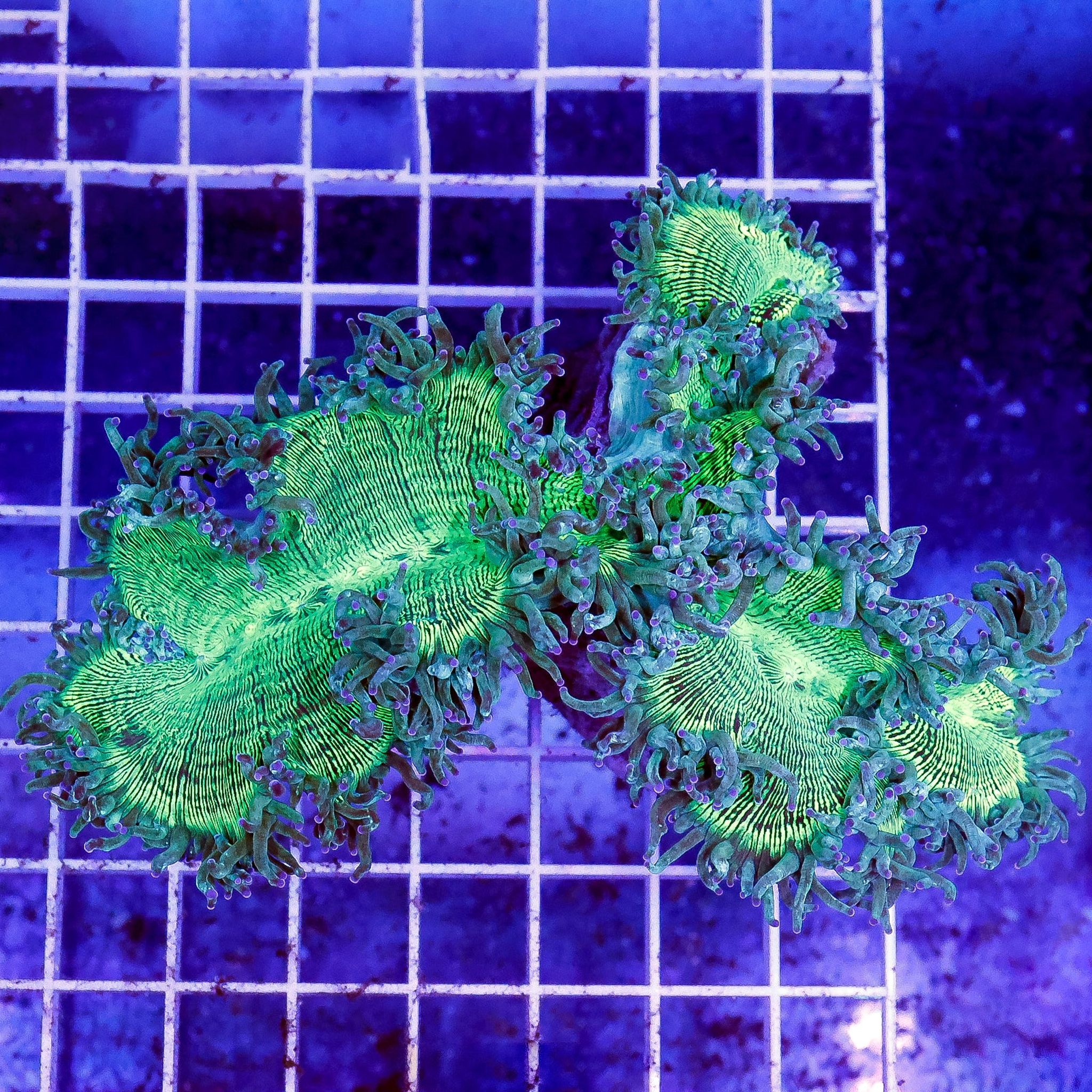
Elegance coral (Catalaphyllia jardinei) is a large-polyp stony (LPS) coral from the Indo-Pacific, recognizable by its long, sweeping tentacles tipped in green, tan, pink, or purple, and by a skeleton made of elongated, wavy valleys. It has a reputation among reef keepers as one of the more failure-prone popular LPS species, largely because of an unexplained decline pattern sometimes called "elegance coral syndrome" (more on that below).
Difficulty ratings vary a lot from source to source, and the honest answer is: it depends heavily on where the coral came from. Aquacultured or maricultured specimens, mostly from Australian farms, tend to be noticeably hardier and more forgiving. Wild-collected pieces, historically sourced from Indonesian reefs, carry a much higher risk of unexplained decline. If you're buying, ask about origin — it's the single biggest predictor of how much trouble you're in for.
Core Parameters That Prevent Most Problems
Many elegance coral issues trace back to water chemistry that's technically "fine" for a reef tank but wrong for this specific coral.
| Parameter | Target range | Note |
|---|---|---|
| Temperature | 76–80°F (24–27°C) | Stability matters more than the exact number |
| Salinity | 1.024–1.026 SG | Avoid sudden swings during water changes |
| pH | 8.1–8.4 | |
| Alkalinity | 8–11 dKH | Swings are more damaging than a slightly high or low steady value |
| Calcium | 380–450 ppm | |
| Magnesium | 1250–1350 ppm | |
| Nitrate | 2–10 ppm | Elegance does poorly at zero |
| Phosphate | 0.03–0.1 ppm | Elegance does poorly at zero |
The nutrient line is worth emphasizing because it contradicts a lot of general reef advice. Elegance coral does not thrive in an ultra-low-nutrient system (ULNS) the way many small-polyp stony (SPS) corals do. A tank that's been dialed in to near-zero nitrate and phosphate for SPS color can quietly starve an elegance coral even though every test kit reads "clean." If your elegance is declining in an otherwise pristine tank, undetectable nutrients are a real suspect, not a sign you need to scrub harder.
Lighting and flow matter just as much:
- Lighting: low-to-moderate PAR, roughly 50–150. Elegance is naturally a sand-dwelling or low-rockwork species, so it should sit low in the light path, not up on a shelf. Sudden PAR increases — a new fixture, a rearranged aquascape, or turning intensity up too fast — are a common trigger for bleaching and tissue recession.
- Flow: gentle and indirect, ideally alternating rather than constant. Strong, direct flow keeps the polyp from extending fully and can physically tear tissue over time.
- Feeding: target feed meaty foods — mysis, chopped silverside, or an LPS pellet or gel food — one to two times a week. Well-fed elegance corals are markedly more resistant to tissue loss than unfed ones, and feeding is one of the cheapest things you can do to improve long-term odds.
- Placement: give it a sand bed or low, flat rock, spaced well clear of neighbors. Sweeper tentacles extend several inches and sting anything they reach — and that stinging conflict damages both corals involved. Placement mistakes like these are behind a large share of avoidable elegance coral problems.
Symptom-by-Symptom Troubleshooting
Use this section to match what you're seeing to the most likely cause and the right first move.
Won't Inflate or Stays Deflated
A deflated, closed-up elegance coral is usually not dying — it's stressed. The most common causes, roughly in order of likelihood, are new-arrival transport stress, a flow or light mismatch, or a recent parameter swing (a water change, a dosing change, a salinity shift). Give it one to two weeks in a stable, low-flow, moderate-light spot before assuming failure. A common mistake is treating a deflated coral as dead and removing it — check that the tissue is still intact and firm before giving up on it.
Tissue Receding from the Skeleton
Recession usually starts at the base or around the edges of the oral disc, and it's most often driven by an escalating bacterial or protozoan infection, sometimes set off by physical damage, poor water quality, or a nutrient extreme in either direction. This is time-sensitive: a receding coral needs to be isolated quickly, because infection can progress to total tissue loss within days. Recovery is often possible if you cut away the affected area early — see the protocol below.
Brown Jelly Sloughing Off the Tissue
This is the emergency scenario. Brown, jelly-like tissue sloughing off the coral is the classic sign of a ciliate or protozoan infection, commonly called brown jelly infection (BJI). It can spread rapidly across the whole colony and to neighboring corals through the water column. Treat it as an emergency: remove the coral from the display immediately, don't wait to see if it stabilizes on its own.
Pale, White, or Bleached Tissue
Pale or bleached tissue with the flesh still intact means the coral has lost its zooxanthellae (the symbiotic algae that give it color), usually from too much light, too rapid a light increase, heat stress, or prolonged poor nutrition. This is distinct from the white skeleton exposed by actual tissue loss — bleaching leaves the tissue in place, just colorless.
Dull or Brown "Browned Out" Coloration
This is close to the opposite problem: tissue is present and intact, but the coloring looks dull, muddy, or overly brown. It's usually caused by excess nutrients or insufficient light — the reverse of bleaching, and worth distinguishing carefully since the fix is opposite in each case.
Bleaching vs. Infection vs. Nutrient Issues at a Glance
Because retraction and discoloration look similar across very different problems, this quick differential helps narrow things down fast:
| Presentation | Tissue condition | Most likely cause |
|---|---|---|
| Uniform whitening | Tissue intact, coral shape normal | Bleaching (light, heat, or nutrition stress) |
| Active sloughing, exposed white skeleton | Tissue receding or gone | Infection (bacterial/protozoan, including BJI) |
| Dull, muddy, brown color | Tissue present, colors flat | Nutrient excess or too little light |
Elegance Coral Syndrome: What It Is (and Isn't)
"Elegance coral syndrome" is an informal, widely used term for a pattern of unexplained, progressive tissue recession or death that shows up even in tanks with good water conditions — most commonly reported in wild-collected Indonesian specimens, less so in aquacultured Australian ones. There's no single confirmed cause. Leading theories include:
- A protozoan or parasitic infection (a Helicostoma nonatum-type organism has been implicated in some cases)
- Immune stress from collection, handling, and shipping
- Chronic malnutrition in an under-fed coral
- Genetic or reef-of-origin factors from the source population
Because no single cause is confirmed, there's no guaranteed cure — prevention through careful sourcing, quarantine, and consistent feeding matters far more than trying to treat the syndrome after the fact.
Pests on Elegance Coral
Pest pressure on elegance is lower than on many other corals, but it does happen. Watch for:
- Predatory snails, including pyramid-snail-type species that target LPS tissue
- Small crustaceans that can irritate or feed on the polyp
- Nudibranchs, which in some cases specifically parasitize Euphyllia and Catalaphyllia corals
Inspect closely at night with a flashlight, when pests are most active and easiest to spot against the extended tentacles. If you find something, combine a coral-safe pesticide dip with manual removal, and quarantine any new coral for two to four weeks before it goes into the display — this single habit prevents most pest and infection outbreaks from ever reaching your main tank.
Recovery and Quarantine Protocol
When you're dealing with active recession or infection, speed and a clean setup matter more than any single product.
- Isolate immediately. Move the coral out of the display at the first sign of spreading tissue loss or brown jelly — waterborne pathogens can reach other LPS corals in the same system fast.
- Cut away the damage. Using a clean blade, physically frag away dead or dying tissue back to a clearly healthy margin.
- Choose the right dip. This depends on what you're treating: an iodine-based or coral-specific antiseptic dip for infection, versus a coral-safe pesticide dip for pests. These are not interchangeable — dipping for the wrong problem wastes time you don't have.
- Move to quarantine. A simple isolation tank with stable, slightly nutrient-enriched (not ultra-clean) water, low flow, and low-to-moderate light is enough — it doesn't need to be a full reef setup.
- Hand feed and monitor daily. Check tissue integrity every day and re-cut or re-dip if recession continues.
Full-colony recession has a lower survival rate than a localized problem, but a coral caught early — with the healthy portion separated from the dying tissue — often stabilizes well in quarantine with good nutrition and low stress.
Buying and Sourcing Tips
Prevention starts at the point of purchase:
- Look for full polyp extension and tentacles that are actively waving, not limp
- Avoid anything with visible slime or a brown film
- Check that the skeleton isn't exposed at the base — that's an early sign of recession
- Favor aquacultured or maricultured origin over wild-collected when it's identifiable
- Skip anything that looks permanently deflated compared to neighboring specimens
You can browse current stock in LPS Hard Corals on FishyHub to compare available elegance corals before choosing one.
Fragging Elegance Coral Safely
Fragging elegance is different from fragging a soft coral because you're cutting through skeleton, not just tissue. Use a fresh blade or a small saw rated for coral skeleton, and always cut with a clear margin of healthy tissue on the piece you're keeping. Frag for two different reasons — deliberate propagation of a healthy colony, versus emergency removal of diseased tissue — and the aftercare is the same either way: a low-stress, low-flow recovery spot and no display placement until the cut edge has fully healed over.
Common Mistakes to Avoid
- Placing elegance too high in the light or flow path, when it's naturally a lower, sand-dwelling coral
- Placing it too close to neighbors, so sweeper tentacles sting and get stung back
- Assuming a deflated coral is dead and pulling it before checking tissue integrity
- Chasing zero nutrients in the display, which effectively starves this species
- Skipping quarantine on new arrivals, letting brown jelly or pests spread to the whole tank
- Skipping target feeding, which leaves the coral far more vulnerable to slow decline
- Overreacting to normal tentacle retraction at night or after feeding as if it were disease
Frequently Asked Questions
Why won't my elegance coral open up?
The most common reasons are new-arrival stress, a flow or light mismatch, or a recent water parameter swing. Give it one to two weeks in a stable, low-flow, moderate-light spot before troubleshooting further — many corals simply need time to acclimate.
Is brown jelly on my elegance coral treatable?
Yes, if caught early. Isolate the coral immediately, siphon off visible jelly, dip it appropriately, and move it to quarantine — left in the display, brown jelly infection can be fatal within days.
Can elegance coral recover from tissue recession?
Often, yes, if the healthy portion is cut away from the dying tissue and the coral is stabilized in a low-stress quarantine setup with good nutrition. Full-colony recession has a lower survival rate than a localized, caught-early case.
What does elegance coral syndrome mean?
It's an informal term for unexplained, progressive decline in this species, likely caused by some combination of pathogen, collection stress, and nutrition rather than one single factor. There's no guaranteed cure, so prevention through sourcing and consistent husbandry is the priority.
Why is my elegance coral losing its color?
It's either bleaching — too much light or heat, with tissue still intact but pale — or browning out, from excess nutrients or too little light, where tissue is present but the color looks dull. The fix is opposite in each case, so identifying which one you're dealing with matters before you act.
What pests attack elegance coral?
Predatory snails and, less commonly, nudibranchs or flatworms can target elegance coral. Inspect new corals closely at night with a flashlight, and quarantine anything new for two to four weeks before adding it to the display.
Should I feed my elegance coral?
Yes. Target feeding meaty foods one to two times a week meaningfully improves resilience and coloration, and unfed specimens are far more prone to slow decline.
If you're troubleshooting an existing elegance coral or shopping for a new, healthy specimen, you can explore current options in Corals on FishyHub.

