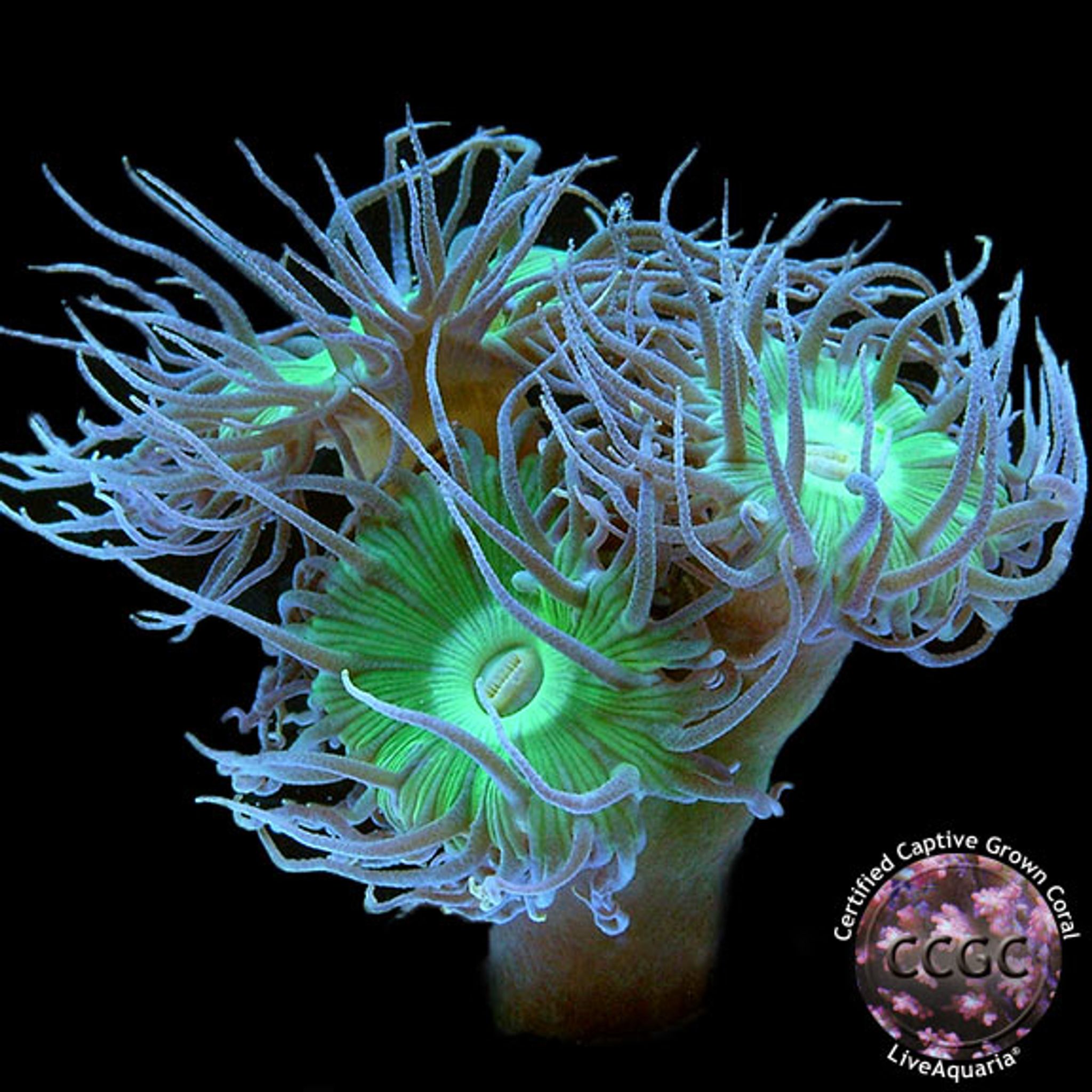
Common Duncan Coral Problems: Tissue Loss, Fading, Pests and Recovery
Duncan coral (Duncanopsammia axifuga) is one of the hardiest large-polyp stony corals a reef keeper can own, but its branching skeleton and habit of closing polyps at will confuse a lot of newer owners into thinking something is wrong when it isn't. This guide walks through what's normal, what each real problem looks like, and exactly how to respond so you don't over-treat a healthy coral or under-react to a dying one.
Normal Duncan Behavior vs. an Actual Problem
Before troubleshooting anything, rule out the most common false alarm: temporary polyp closure. Duncan polyps routinely retract during the day, under bright light, after a meal, or when flow is a bit too strong — this is a behavioral response, not disease.
A true problem looks different. Watch for these distinguishing signs:
| Sign | Normal behavior | Actual problem |
|---|---|---|
| Polyp closure | Closes during the day, reopens by evening or after lights dim | Stays closed for days with no reopening |
| Tissue appearance | Slightly duller color after a parameter swing, recovers in 1–3 days | Progressive recession exposing bare white skeleton |
| Direction of change | Fluctuates, reverses on its own | One-directional, gets worse day over day |
| Texture | Firm, intact flesh | Gooey, stringy, or disintegrating tissue |
If tissue recession is moving steadily from a branch tip or the base toward the rest of the colony, or you see stringy brown material, treat it as urgent. If polyps are simply shut and everything else looks intact, give it 24–48 hours before intervening.
Baseline Conditions Duncans Need
Most Duncan problems trace back to one of these parameters drifting out of range. Keep a testing log so you can spot trends rather than reacting to a single bad reading.
- Temperature: 75–80°F (24–27°C)
- Salinity: 1.024–1.026 SG (about 35 ppt)
- Alkalinity: 8–12 dKH
- Calcium: 350–450 ppm
- Magnesium: 1,250–1,350 ppm
- pH: 7.8–8.4
- Phosphate: under 0.2 ppm
- Nitrate: low but detectable — a completely nutrient-free tank can starve a Duncan's zooxanthellae rather than help it
Sudden swings in alkalinity or calcium, even within these ranges, stress LPS tissue more than a steady reading at the edge of the range. Consistency matters more than chasing a "perfect" number.
Light and Flow
Duncans tolerate a wide light range — roughly 50–150 PAR — and can thrive in both shaded low-light spots and moderate reef lighting. Rather than chasing one ideal number, the safer rule is to acclimate gradually to whatever intensity you choose, moving the coral or ramping intensity over 2–4 weeks rather than days.
Flow works the same way: aim for gentle, indirect or turbulent flow. Direct, forceful flow keeps polyps retracted; too little flow lets detritus settle on the branching skeleton and invites pests. Adjust based on how the polyps actually extend, not a fixed setting.
Tissue Loss and Recession
Progressive tissue loss usually has one of these root causes:
- Water quality swings — nitrate or phosphate spikes, or a crash after aggressive nutrient export
- Parameter instability, especially alkalinity or calcium swings
- Physical damage from fragging, handling, or shifting rockwork
- Pest predation wearing away tissue over time
- Old tissue die-back at a fresh frag cut, which is often localized and self-limiting
Because a Duncan colony shares tissue across its branching skeleton, recession on one branch can be isolated or can spread along shared tissue to the rest of the colony — so early intervention matters more than it would on a solitary-polyp coral.
Recovery steps:
- Identify and correct the trigger (retest parameters, check flow and light history).
- Isolate the coral in a quarantine or hospital container if recession is active.
- Dip the coral to rule out and remove pests.
- Trim away clearly dead or dying tissue if it risks spreading toward healthy branches.
- Improve flow around the base to prevent detritus buildup.
- Hold parameters rock steady and resume light target feeding once the coral stabilizes.
Brown Jelly Disease
Brown jelly is the fastest-moving and most dangerous Duncan problem. It appears as a gooey, stringy, brownish film over the tissue, usually following physical injury or acute stress, and it can consume a colony within days if untreated.
At-home triage, in order:
- Isolate immediately — move the coral to a separate container or quarantine tank so waterborne bacteria and dislodged tissue can't reach other corals.
- Siphon off the jelly — use an airline hose to gently vacuum the gooey material and necrotic tissue away from the skeleton without dragging it across healthy branches.
- Dip the coral in a coral-safe iodine or antibacterial dip to knock back surface bacteria.
- Frag away unaffected healthy tissue if the infection is clearly spreading and you need to save part of the colony — cutting a healthy branch free of an infected one can stop the spread along shared tissue.
- Keep water pristine with extra water changes during recovery, and run moderate, steady flow — not stagnant, not blasting.
Check the isolated coral daily. If the jelly keeps reappearing after siphoning, the infection is still active and needs another dip cycle.
Fading, Paling and Bleaching
A Duncan losing its brown, tan, or green pigment is losing its zooxanthellae, the symbiotic algae that give it color and much of its energy. Common triggers:
- Too much light — a new, stronger fixture or moving the coral higher in the tank
- Thermal stress — a heater or chiller malfunction, or a swing outside 75–80°F
- Chronically low nutrients — ultra-low-nutrient systems tuned for SPS corals can starve a Duncan's zooxanthellae
- Insufficient light, less commonly, in a tank run unusually dim
Fix: match lighting to whatever level the coral was previously acclimated to, and if you're introducing new lighting, ramp it up over 2–4 weeks rather than switching it on at full intensity. Allow some detectable nitrate and phosphate rather than running a bare-bones nutrient export system, and supplement with regular target feeding to support the coral while its pigment recovers.
Pests That Target Duncan Corals
Duncans aren't a magnet for pests the way some SPS corals are, but a few specific threats show up regularly:
- Small predatory flatworms and nudibranchs that graze on polyp tissue at night — slow-acting and easy to miss during the day
- Opportunistic snails that target coral tissue rather than just algae
- Bristleworms — mostly harmless scavengers, but occasionally opportunistic on tissue that's already dead or dying
- Vermetid snails and spirorbid worms fouling the skeleton and branches with tubes and mucus nets
- Nearby pest anemones (aiptasia, majano) that sting adjacent Duncan tissue if they've spread too close
Detection and treatment:
- Inspect the coral at night with a flashlight — most Duncan predators are nocturnal and hide in skeleton crevices during the day.
- Use a magnifying loupe to check polyp bases and branch junctions closely.
- Remove visible pests manually with tweezers.
- Dip every new coral on arrival, and periodically as routine prevention, with a freshwater or iodine-based coral dip.
- Quarantine all new frags for 2–4+ weeks before adding them to the display, so any pest or infection shows up before it reaches your main tank.
Reef keepers stocking up on dip solutions or hospital-tank medication can browse the treatment and medication category alongside the coral itself.
General Recovery Protocol
Once you've identified the cause of a problem, recovery follows the same basic pattern regardless of what triggered it:
- Stabilize parameters first — don't chase multiple variables at once.
- Move the coral to a lower-flow, lower-light recovery spot if your tank layout allows it.
- Hold temperature and chemistry rock steady — avoid further swings while tissue is healing.
- Target-feed lightly to support energy reserves during recovery.
- Resist further handling — don't keep moving or re-dipping a coral that's already stressed.
- Monitor daily for any sign that tissue loss is still spreading.
- Be patient — full recovery and polyp re-extension over damaged tissue typically takes days to a few weeks, not hours.
Placement Notes
Duncan skeletons branch outward as they grow, so give the colony room on rockwork or open sand — it doesn't need to attach to anything the way most LPS corals do. Avoid placing it directly under SPS-level lighting or in a high-flow zone; a mid-to-lower position with gentle, indirect flow suits most specimens best.
Top Tips for Beginner Reefers
Duncan coral is a classic first LPS pick, which makes it worth pairing with good general tank habits:
- Start photoperiods conservative — roughly 6–8 hours a day — and ramp up gradually to avoid algae blooms.
- Run adequate but not excessive flow from powerheads rather than one strong jet aimed at the rockwork.
- Test weekly and hold alkalinity, calcium, magnesium, phosphate, temperature, and salinity within the ranges above.
- Let the tank cycle fully (6+ weeks) before stocking, and add hardy invertebrates and easy corals before fish.
- Do weekly water changes of roughly 20% and top off evaporation with fresh water.
- Remember that larger tanks buffer parameter swings better than small ones — a nano tank punishes mistakes faster.
Browsing LPS hard corals is a good way to see what pairs well with a Duncan at a similar difficulty level, and a gel or freeze-dried food makes target feeding easy to work into a weekly routine.
Common Mistakes to Avoid
- Over-reacting to normal polyp closure — repeated dipping or moving a coral that's simply closed for the day adds stress without fixing anything.
- Swapping lighting or flow equipment abruptly — acclimate to a new fixture or pump over weeks, not days.
- Skipping quarantine on new frags — this is the single most common way brown jelly triggers and pests enter a display tank.
- Letting detritus build up around the base and branches, which stresses tissue and attracts pests.
- Chasing zero nutrients — an ultra-clean, SPS-tuned system can slowly starve a Duncan's zooxanthellae.
- Ignoring slow, steady recession — a small, localized tissue loss is far easier to stop with an early dip or frag than a colony-wide infection.
- Damaging tissue during fragging or aquascaping — any fresh wound is an entry point for brown jelly.
Frequently Asked Questions
Why are my Duncan coral's polyps not opening?
This is usually a normal daytime, lighting, or flow response, or a reaction to recent feeding — not disease. Check whether the closure reverses within a day or two before assuming something is wrong, and look at recent parameter tests for a trend rather than reacting to a single closed day.
Is brown jelly on my Duncan contagious to other corals?
Yes. Brown jelly can spread through direct contact or waterborne bacteria, so isolate the affected coral immediately and remove the necrotic tissue by siphoning rather than leaving it in the display.
How do I know if my Duncan coral is dying vs. just stressed?
Progressive, one-directional tissue recession that exposes bare skeleton is the key sign of dying tissue. Temporary closure or slight color dulling that reverses within a few days is just stress and doesn't need aggressive intervention.
Can a Duncan coral come back from tissue loss?
Yes, if the underlying cause is corrected early and enough healthy tissue remains. Duncans can regrow tissue over exposed skeleton over several weeks given stable parameters and regular feeding.
What causes a Duncan coral to turn white or pale?
Paling or bleaching is usually caused by too much or too-sudden light, thermal stress, or chronic low nutrients starving the coral's symbiotic algae. Matching light levels to what the coral is acclimated to and allowing some detectable nutrients usually resolves it.
What pests attack Duncan corals?
Small predatory flatworms and nudibranchs, opportunistic snails, and nearby pest anemones like aiptasia or majano stinging adjacent tissue are the most common threats. A nighttime flashlight inspection is the most reliable way to catch nocturnal predators before they cause visible damage.
Do Duncan corals need to be fed?
Not strictly — they get significant energy from their zooxanthellae. That said, regular target feeding with mysis, brine, or other meaty foods a few times a week markedly improves color, growth, and recovery speed after stress.
How often should I dip a Duncan coral?
At minimum, dip on arrival before adding it to the display, and again any time you suspect a pest or infection. Many hobbyists also dip periodically as routine prevention, especially after fragging or handling.
Whether you're troubleshooting an existing colony or looking to add a hardy first LPS to your reef, FishyHub's LPS hard coral selection is a good place to browse Duncan corals and similar beginner-friendly species.

