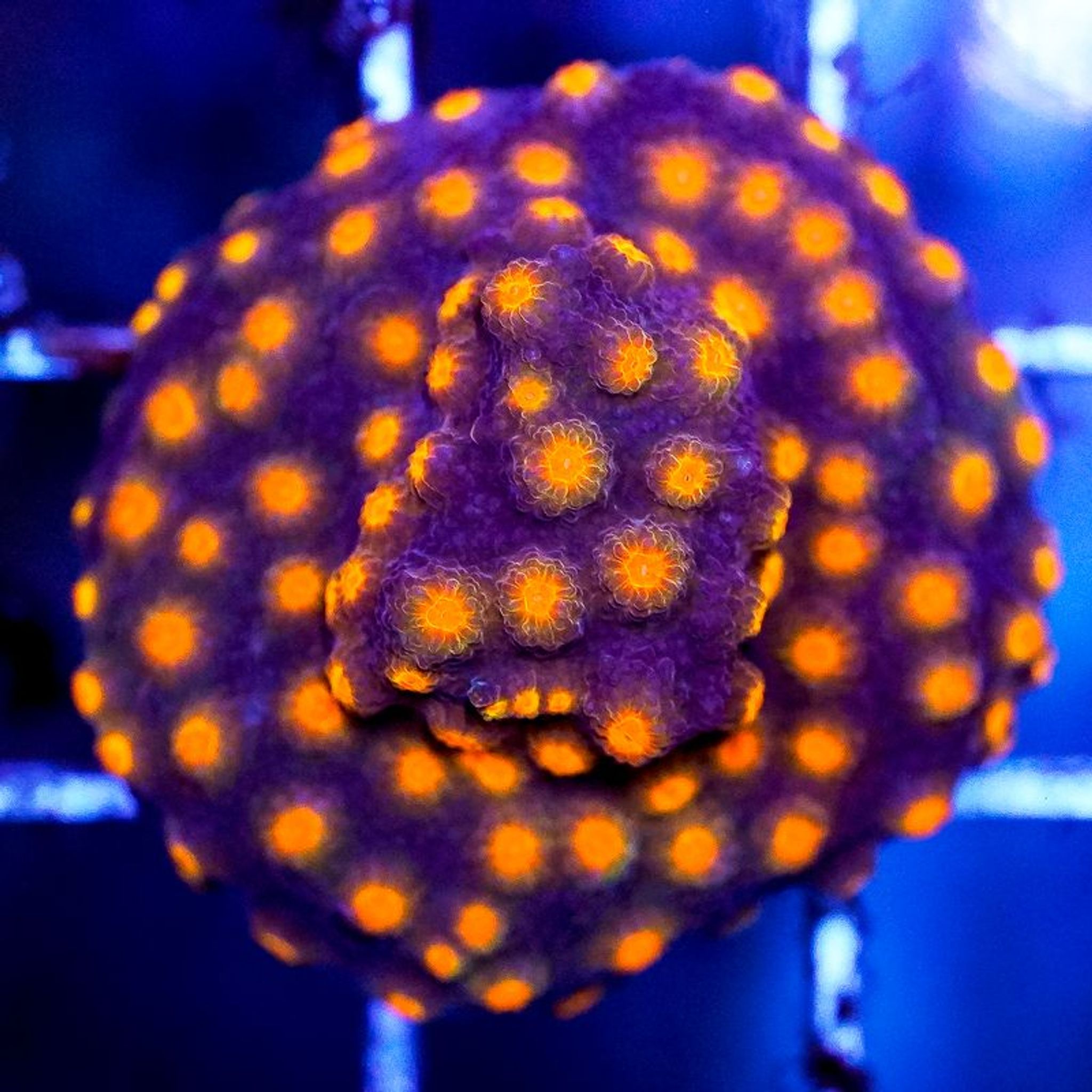
Common Cyphastrea Problems: Tissue Loss, Fading, Pests and Recovery
A pale patch or a receding edge on a Cyphastrea colony rarely means the coral is doomed — but it does mean something in the tank changed. This guide walks through the most common symptoms (tissue loss, fading, bleaching, browning-out, and pests), what usually causes each one, and how to respond without making things worse.
Cyphastrea at a Glance
Cyphastrea is an encrusting, ball- or plate-shaped stony coral with tiny polyps that mostly extend at night or in low flow. It comes in green, red/orange, blue, and rainbow color morphs, and it's considered one of the more forgiving semi-SPS corals for hobbyists stepping up from softies and LPS.
- Light: moderate, roughly 50–150 PAR
- Flow: low to medium, indirect
- Tolerance: more forgiving of nutrient and light swings than true Acropora, but not bulletproof
Most Cyphastrea problems trace back to swings in lighting, flow, or alkalinity — not the coral itself being finicky. Browse live colonies and frags in FishyHub's LPS hard corals selection to compare healthy coloration before diagnosing an existing piece.
Symptom-to-Cause Quick Reference
Before troubleshooting, it helps to know which condition you're actually looking at. These four are frequently confused with one another.
| Symptom | What it looks like | Speed | Usual cause |
|---|---|---|---|
| STN (slow tissue necrosis) | Tissue recedes from an edge or base, exposing skeleton gradually | Days to weeks | Alkalinity/temp swings, injury, poor flow, detritus buildup |
| RTN (rapid tissue necrosis) | Tissue sloughs off in sheets, bare white skeleton | 24–48 hours | Severe stress event, pest damage, infection following injury |
| Bleaching | Tissue stays intact but turns stark white | Hours to days | Light shock, thermal spike, chemical exposure, pH/alkalinity crash |
| Browning-out | Colors mute to drab olive/brown, tissue intact | Days to weeks | Excess nitrate/phosphate, overpopulated zooxanthellae |
| Fading/paling | Color washes out but isn't stark white | Days to weeks | New/brighter light without acclimation, or nutrients driven too low |
Tissue Loss: STN vs. RTN
Slow tissue necrosis (STN) creeps in over days to weeks, usually starting at an edge or the base and working inward. Common triggers include:
- Alkalinity swings greater than 0.5–1 dKH per day
- Temperature swings outside a stable range
- Physical injury from fragging or handling
- A sudden jump in light intensity
- Pest bites
- Poor flow letting detritus settle on the base
Rapid tissue necrosis (RTN) is far more urgent — tissue can strip to bare skeleton within 24–48 hours. It often follows a severe stress event or untreated pest damage and can spread through direct tissue contact or, in some reports, water contact within a shared system.
First 48 Hours: What to Do (and Not Do)
When you first spot recession, resist the urge to overcorrect. A practical order of operations:
- Test first: alkalinity, calcium, magnesium, temperature, nitrate, and phosphate.
- Inspect physically: check the base and skeleton texture with a flashlight for pests, slime trails, or egg masses.
- Check recent changes: new lighting, a new skimmer, a recent dosing change, or a new tankmate placed nearby.
- Don't dose a large alkalinity correction all at once — a big swing to "fix" a small one often causes more damage than the original drift.
- Don't swap lighting or move the coral to a different flow zone yet; make one change at a time so you can tell what worked.
If recession is STN-level and slow, correct parameters and monitor for 24–48 hours before cutting — some cases stop on their own once the stressor is removed. If it's accelerating toward healthy tissue or behaving like RTN, don't wait: cut ahead of the necrotic line, glue the healthy fragment to a new plug or rock, and isolate or discard the dying piece to protect neighboring corals in a shared system.
Water Parameters That Matter Most
| Parameter | Target range | Note |
|---|---|---|
| Salinity | 1.024–1.026 SG | |
| Temperature | 76–80°F (24–27°C) | |
| Alkalinity | 8–11 dKH | Stability matters more than the exact number |
| Calcium | 380–450 ppm | |
| Magnesium | 1250–1350 ppm | |
| Nitrate | 2–10 ppm | Cyphastrea often colors up better here than near zero |
| Phosphate | 0.03–0.1 ppm |
Test alkalinity and calcium weekly at minimum in an established tank, and 2–3 times a week when dosing manually or recovering from a recent swing — alkalinity stability matters more for Cyphastrea than any other single parameter.
Fading, Bleaching, and Browning-Out: Don't Mix Them Up
These three get confused constantly, and the fixes are opposite, so misdiagnosing one wastes time and can worsen the problem.
Fading or Paling (Not Full Bleaching)
A gradual wash-out of color, without going stark white, is usually photoadaptation or a nutrient issue rather than disease:
- Light intensity increased faster than the coral could adjust, so it expelled some zooxanthellae to reach a sustainable level
- Nutrients driven too low, often right after adding a new skimmer, GFO reactor, carbon dosing, or an algae scrubber
- Insufficient feeding for a coral that partly relies on particulate and dissolved food sources
Full Bleaching
Stark white tissue with the skeleton structure still intact points to near-total loss of zooxanthellae from a sharper shock:
- A new light fixture introduced without acclimation
- A thermal spike
- Chemical exposure (medication, copper, cleaning residue)
- A severe pH or alkalinity crash
Browning-Out
The opposite problem: tissue turns drab olive or brown and pigment gets masked. This happens when nitrate and/or phosphate run too high, letting zooxanthellae overpopulate. The fix is controlled nutrient export — not starving nutrients to zero, which can trigger fading or bleaching instead.
A commonly under-covered nuance: Cyphastrea tolerates moderate nutrients better than showier SPS like Acropora, and it often looks worse in an ultra-low-nutrient system chasing perfect Acropora-grade water. If you keep Cyphastrea alongside Acropora and nutrients read consistently undetectable while colors fade, that's a cue to ease off export rather than push nutrients lower.
Understanding Nitrate Supplementation
In an ultra-low-nutrient system (ULNS), corals can pale or bleach from nutrient starvation rather than excess. Some reefers respond by dosing a nitrate source (such as sodium nitrate or a commercial nitrate supplement) in small, slow increments:
- Test nitrate and phosphate before adjusting anything
- Dose slowly and retest — large jumps risk algae blooms
- Manage phosphate alongside nitrate; the two should move together, since raising one without the other unbalances coral nutrition
- Watch coloration and polyp behavior over 1–2 weeks rather than expecting an overnight change
Alkalinity and Calcium Dosing: Weighing the Methods
There's no single "best" way to maintain alkalinity and calcium — each method trades automation, cost, and stability risk differently.
| Method | Pros | Cons |
|---|---|---|
| Two-part/three-part liquid dosing | Precise, easy to automate with a doser | Two reagents must stay balanced; needs consistent testing |
| Kalkwasser via auto-top-off | Cheap, also supports pH | Limited capacity for heavily stocked tanks; needs careful ATO calibration |
| Calcium reactor | Very stable for large SPS-dominant systems, low ongoing cost per gallon | Higher upfront cost and complexity; CO2 media needs maintenance |
| All-in-one dosing or frequent water changes | Simple, low equipment need | Doesn't scale well as coral biomass and demand grow |
Match the method to your tank size and how hands-on you want to be. For Cyphastrea specifically, avoiding swings matters more than which method delivers stability — consistent, monitored small adjustments beat any single "correct" technique.
Common Cyphastrea Pests
The main pest concern for Cyphastrea is the coral-eating flatworm: small, coral-colored, and easy to miss, causing pinpoint tissue loss or rough patches. For context, Acropora-eating flatworms and red bugs are Acropora-specific pests and not a primary Cyphastrea concern, and nudibranchs tend to target Acropora and zoanthids more. Vermetid snails and bristleworms can mechanically irritate tissue near the base, and predatory snails occasionally take bites, though this is rare.
General pest ID checklist:
- Irregular bite marks or rough patches on the tissue
- Slime trails across the skeleton
- Tiny eggs or masses tucked into skeleton texture
- Visible worms spotted at night with a flashlight or blue light
Pest Treatment and Prevention
- Manually remove pests with tweezers or a turkey-baster blast of water
- Dip the coral in a coral-safe dip (iodine-based, or a Lugol's/interceptor-style dip per label directions) — check FishyHub's treatment and medication range for dip options
- Quarantine every new coral for 2–4+ weeks before adding it to the display — this single step prevents most pest introductions
- Support water stability during and after treatment with water conditioners and additives
Recovery: Getting a Damaged Colony Back
- Identify and remove the stressor first — parameters, lighting, or a pest — before doing anything else.
- Stabilize alkalinity, calcium, nitrate, and phosphate; avoid large corrective swings.
- Improve flow so detritus doesn't resettle on the tissue or base.
- Dip the piece to rule out pests even if none are visible.
- Target feed with coral-specific foods or amino acid blends to support tissue regrowth once conditions are stable.
- Be patient — a surviving base can re-encrust over damaged skeleton over weeks to months.
One placement detail that's easy to overlook: epoxy or a frag plug set flush against the base can trap detritus underneath, causing slow recession that looks mysterious but is really a flow and placement issue. Mount pieces with a little clearance and orient them so waste doesn't collect against the tissue.
Common Mistakes to Avoid
- Placing a new Cyphastrea directly under intense light without 2–3+ weeks of gradual acclimation
- Testing water only when something already looks wrong, missing slow drift
- Confusing browning-out with bleaching and applying the opposite fix
- Skipping quarantine and dipping on new frags, introducing pests to the whole system
- Overreacting to normal reduced polyp extension or slight color shift in the first 1–2 weeks after a frag cut
- Letting poor flow placement allow detritus to sit on the base
- Overcorrecting alkalinity or calcium after spotting a drop, causing a bigger swing than the original problem
Frequently Asked Questions
Is my Cyphastrea dying or just adjusting to a new tank?
Some color change and reduced polyp extension in the first 1–2 weeks after introduction is normal. Active tissue recession, exposed white skeleton, or a foul smell are signs of a real problem worth investigating.
Why did my Cyphastrea turn white overnight?
This is most likely rapid bleaching triggered by a light, temperature, or chemical shock. Check for any recent equipment or lighting schedule changes and test your parameters immediately.
Can a bleached Cyphastrea come back?
Yes, if the skeleton and underlying tissue are still alive and the stressor has been removed. Recovery can take several weeks as zooxanthellae repopulate, and it helps to keep the piece under lower light initially.
What's eating tiny bite marks out of my coral?
A small coral-eating flatworm is the most likely culprit, with a bristleworm or predatory snail as less common possibilities. Inspect at night with a flashlight and consider a coral-safe dip.
How often should I test alkalinity and calcium?
Weekly at minimum in an established tank, and 2–3 times a week when dosing manually or after any recent swing. Alkalinity stability matters most for LPS and semi-SPS corals like Cyphastrea.
Do I need to feed my Cyphastrea?
Not strictly, in a well-fed reef system with adequate lighting. Targeted feeding with coral foods or phytoplankton/zooplankton blends can support color and recovery after a stress event, since it supplements what the coral gets from its zooxanthellae.
Should I frag a receding piece or leave it alone?
Correct parameters first and watch for 24–48 hours, since minor STN sometimes halts once the stressor is fixed. If recession keeps advancing toward healthy tissue, cut ahead of the necrotic line and mount the healthy fragment separately.
Is it safe to keep Cyphastrea near other corals?
Generally yes, since it lacks long sweeper tentacles that sting neighbors. Still, leave a few inches of clearance, since an encrusting colony can slowly grow over nearby corals given enough time.
Once parameters are stable and any pest concerns are ruled out, most Cyphastrea problems resolve with patience rather than dramatic intervention. Browse healthy, quarantine-ready colonies and frags in FishyHub's full corals selection to start or expand your collection.

