Common Bubble Coral Problems: Tissue Loss, Fading, Pests and Recovery
A bubble coral that suddenly stops inflating, turns pale, or shows a strange brown streak can send any reef keeper into a panic. This guide sorts the symptoms into clear categories — deflation, tissue loss, color change, disease, bailout, and pests — so you can identify the cause and act before a fixable issue becomes a lost coral.
Bubble Coral Basics: What You're Working With
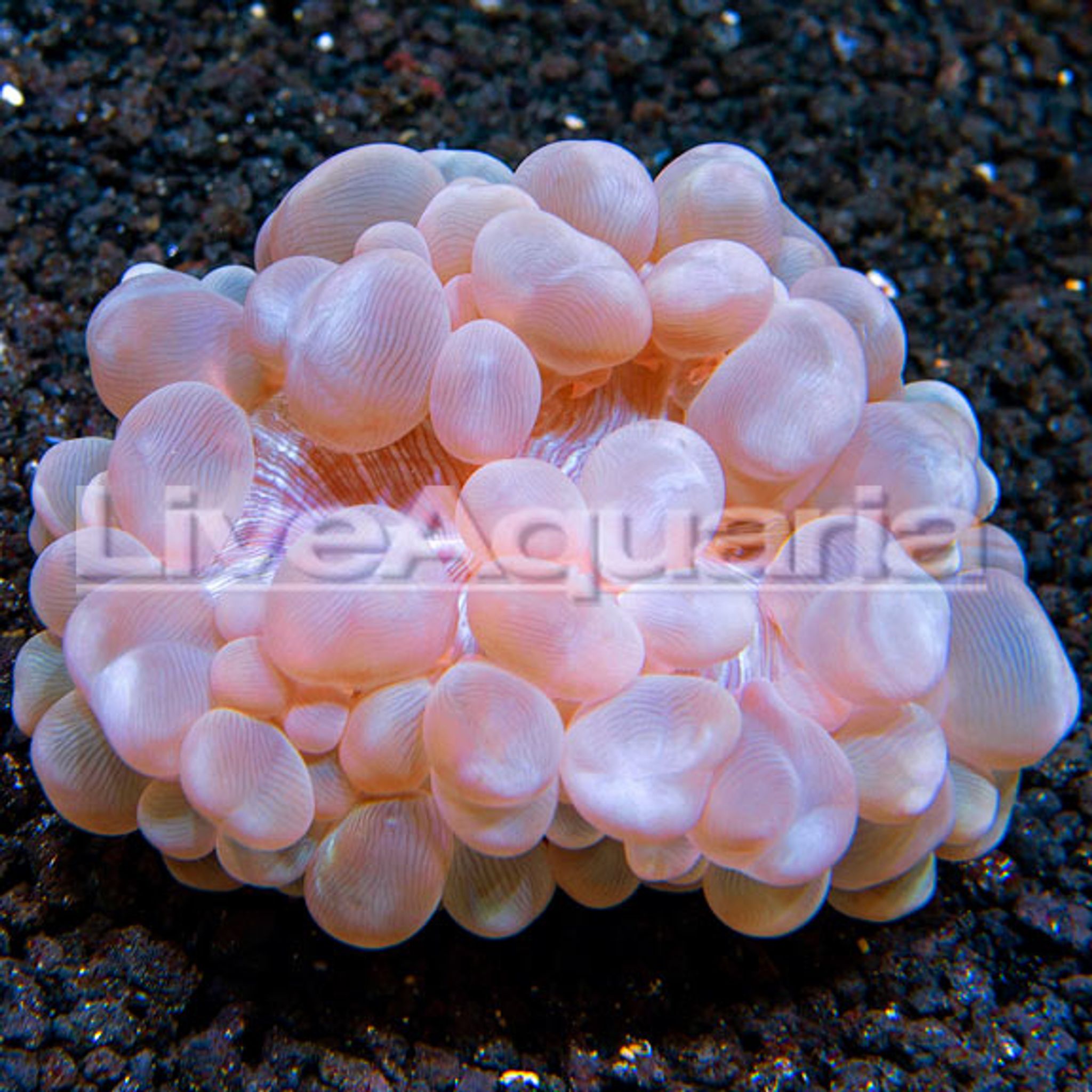
Bubble coral is a large-polyp stony (LPS) coral in the genus Plerogyra or Physogyra. During the day it inflates translucent, fluid-filled vesicles ("bubbles") to capture light for its symbiotic algae, called zooxanthellae. At night it deflates and extends long sweeper and feeding tentacles to sting passing prey — and sometimes its neighbors.
Several look-alike forms exist, and confusing normal variation with a problem is one of the most common new-buyer mistakes:
- Classic grape bubble (Plerogyra sinuosa) — large, round vesicles, moderate retraction at night.
- Pearl bubble — naturally smaller, tighter clusters of bubbles; don't expect grape-sized inflation.
- Branching/fox or discus bubble (Physogyra species) — smaller, more numerous bubbles on a branching skeleton, often stays more retracted during the day than Plerogyra.
If your coral matches its species' normal bubble size and retraction pattern, it may not be sick at all — check the sections below before assuming a problem.
Quick-Reference: Ideal Parameters for Bubble Coral
Most tissue loss, fading, and disease cases trace back to one of these being off — check this table first.
| Parameter | Target Range |
|---|---|
| Temperature | 76–80°F (24–27°C) |
| Salinity | 1.024–1.026 SG |
| pH | 8.1–8.4 |
| Alkalinity (KH) | 8–11 dKH |
| Calcium | 380–450 ppm |
| Magnesium | 1250–1350 ppm |
| Nitrate / Phosphate | Low but detectable (not zero) |
| Light (PAR) | ~50–100 PAR, low-moderate, acclimate slowly |
| Flow | Low, indirect, alternating/turbulent |
Alkalinity swings deserve special attention. Sources tend to lump water quality issues together as one vague cause, but unstable KH — even within an otherwise "acceptable" range — is an underrated, common trigger for LPS tissue recession. If a bubble coral is receding for no obvious reason, test alkalinity trends over several days before looking anywhere else.
On light intensity specifically, guidance varies: some hobbyists describe bubble coral as tolerant of moderate-to-fairly-bright light once acclimated, while others treat it strictly as a shaded, low-light species. The safer approach is to default to the lower end of the range (roughly 50–100 PAR) and always acclimate gradually to any increase, since most bleaching and tissue-stress complaints come from a sudden light change rather than the light source itself.
Symptom-First Troubleshooting
Problem 1: Not Inflating / Staying Deflated
This is the most common "is my coral dying?" question, and it's usually not disease.
Likely causes:
- Flow too strong or too direct, hitting the polyp head-on
- A recent lighting change (new fixture, moved to a higher shelf)
- Water quality swing, especially alkalinity
- Recent shipping, acclimation, or handling stress
- Normal nighttime retraction (check the clock before panicking)
Quick checks:
- What time is it? Nighttime deflation with extended sweeper tentacles is normal.
- Has anything in the tank changed in the last 48 hours (light, flow, new equipment)?
- Is a powerhead or return nozzle pointed directly at it?
Recovery plan: Move the coral to a sheltered spot — the base of rockwork or a location out of the direct line of a powerhead — where flow is indirect and alternating. Give it 24–48 hours after any tank change before intervening further. If it was recently added to the tank, deflation for the first day or two is a normal acclimation response.
Problem 2: Tissue Loss / Recession
Recession shows up as skeleton (the white, calcified structure) becoming visible where tissue has pulled back or peeled away.
Common causes:
- Pinched or punctured tissue during handling, shipping, or frag work
- Poor or unstable water quality — alkalinity swings in particular
- Physical damage from skeleton contacting rock, glue, or tools
- Being stung by an aggressive neighboring coral
- Natural die-off of individual older polyps within a colony (not a system-wide problem)
Recovery plan:
- Test alkalinity, calcium, and magnesium immediately — don't assume "poor water quality" is too vague to check specifically.
- Inspect for direct contact with rock, glue, or a neighboring coral's sweeper tentacles.
- If damage is physical, relocate the coral away from the contact point.
- If parameters were off, correct them gradually rather than in one large swing.
- Monitor weekly — minor recession often stabilizes and regrows over several weeks once the cause is removed.
When to worry more: if recession is spreading day over day rather than holding steady, treat it as a possible early sign of infection (see Brown Jelly Disease below) rather than routine tissue loss.
Problem 3: Bleaching, Fading, or Color Loss
Color change moves in two very different directions, and the fix depends on which one you're seeing.
| Symptom | Likely Cause | Fix |
|---|---|---|
| Pale or white, tissue intact | Too much light, a sudden light increase, heat stress, or expelled zooxanthellae from stress | Reduce/shade light, verify temperature, correct gradually |
| Brown and dull, losing color/pattern | Too little light, or excess nutrients feeding zooxanthellae | Increase light slightly, or reduce nutrient/algae load |
Bleaching happens when the coral's zooxanthellae are lost or damaged, most often from a fast increase in light intensity or overheating. Full recovery — the coral regaining normal color and zooxanthellae density — can take several weeks under corrected lighting, and the tissue itself often survives even when badly faded, as long as the underlying cause is fixed quickly.
Problem 4: Brown Jelly Disease — An Emergency
This is the fastest-moving and most dangerous condition covered here. Tissue liquefies into a stringy, brown, jelly-like mass over a period of hours to about 24 hours, exposing bare white skeleton underneath. It's typically triggered by an initial injury or small necrotic (dead tissue) spot that gets colonized by opportunistic bacteria and ciliates.
Ignoring a small brown or necrotic spot is the single most common precursor to full brown jelly disease — act within hours, not days.
Emergency treatment steps:
- Using clean tools, frag or cut away the dead tissue and a margin of the adjacent tissue that looks healthy but is at risk.
- Move the coral into an isolated container or quarantine setup immediately — do not leave it in the display.
- Siphon out any jelly or debris right away. It is tank-safe to spread to other corals if it drifts, so don't wait.
- Consider a coral-safe iodine (Lugol's-type) dip or general coral dip on the remaining healthy fragment.
- Restore stable flow and parameters in the isolation container and monitor closely for further spread.
Problem 5: Polyp Bailout
Polyp bailout is when individual polyps detach from the skeleton entirely and drift in the water column — a stress response to conditions like temperature swings, poor water quality, or injury.
Opinions differ on what this means for the coral. Some hobbyists treat bailout as a near-fatal event, while others view it as a legitimate, if inconsistent, form of asexual propagation. The realistic middle ground: attempt a rescue, but don't expect guaranteed success.
Rescue steps:
- Net or gently scoop detached polyps without touching the tissue directly.
- Place them in a very low-flow area, either in the display or a separate container.
- Give them time — some reattach to a surface and grow into a new small colony, others do not survive.
- Address whatever triggered the bailout (check the parameter table above) so remaining tissue doesn't follow.
Problem 6: Pests
The main bubble-coral-specific pest is a parasitic flatworm — tiny worms found directly on the tissue that cause retraction and patchy damage over time. Nudibranchs and small crustaceans occasionally target LPS corals as well.
New corals and rock can also carry pests that don't target bubble coral directly (Acropora-eating flatworms, red bugs, zoanthid pests), which is exactly why dipping is a routine quarantine step regardless of which coral you're adding.
Pest control process:
- Quarantine new corals for a minimum of 2–4 weeks before adding them to the display.
- Let polyps fully extend in dip-safe holding water (about 30 minutes) before dipping — pests hiding in retracted tissue won't be exposed otherwise.
- Dip in a coral-safe pest-treatment or iodine dip, matching the water temperature to reduce added stress.
- Repeat the dip over the following several days to weeks, since a single treatment often misses eggs that hatch later.
- If flatworms are visibly established on the tissue, isolate the coral until the population is fully cleared.
You can browse quarantine-ready specimens and treatment products through FishyHub's LPS hard corals and medication selections.
Full Recovery Checklist for a Declining Bubble Coral
Work through this list in order whenever a bubble coral looks off and the cause isn't obvious:
- Test alkalinity, calcium, magnesium, temperature, and salinity.
- Check flow direction and strength at the coral's exact location.
- Check recent lighting changes — new fixture, moved position, increased photoperiod.
- Inspect closely for a brown/necrotic spot, jelly texture, or visible pests.
- If disease is suspected, isolate the coral immediately rather than waiting to confirm.
- Dip the coral if pests are visible or suspected.
- Quarantine before returning it to the display.
- Document the timeline — steady, slow change points to environment; fast spreading points to disease.
Aggression and Placement
Bubble coral's long nighttime sweeper tentacles sting anything they reach, and the coral is equally vulnerable to being stung back. One-sided tissue recession — damage only on the side facing a neighbor — is a placement problem, not a disease.
- Keep several inches of clearance between bubble coral and any neighboring coral.
- Be especially cautious with long-sweeper LPS corals like torch, hammer, or frogspawn nearby — their reach is longer than it looks during the day.
- Some fish, including certain wrasses and butterflyfish, will nip at LPS tissue; if recession appears alongside fish activity around the coral, consider tankmate behavior as a cause.
Acclimating a New Bubble Coral
- Use a slow drip acclimation for at least 30–60 minutes to match salinity and temperature gradually.
- Place the coral in lower light and lower flow than its intended final spot for the first week.
- Ramp light intensity and photoperiod up gradually over 1–2 weeks rather than placing it under full intensity immediately.
- Watch closely for the first week: some deflation and reduced feeding response is normal during this period and isn't necessarily a problem.
- Hold off on target feeding for the first few days until the coral is inflating normally.
Handling and Mounting
The internal skeleton "walls" (called septa) are visible when the polyp is deflated. Never let glue, epoxy, bare skin, or tools touch these — a puncture here is a direct route to infection and tissue loss. When mounting, use both glue and epoxy on a stable, level base so the coral can't shift and abrade itself against rock over time.
Feeding for Recovery and Health
Bubble coral gets most of its energy from its zooxanthellae, and feeding is best treated as an optional boost rather than a requirement — prioritize correcting light, flow, and water quality first. When feeding, offer small meaty foods like mysis, chopped shrimp, or a gel food once or twice a week at night, when tentacles are extended, and briefly reduce flow so food doesn't blow away before the coral can catch it.
When to Keep Treating vs. When to Let Go
There's no exact cutoff, but a few signals help:
- Keep treating if tissue loss has stabilized or slowed, if a clear cause (flow, light, aggression) has been identified and corrected, or if less than roughly half the tissue mass is affected.
- Prognosis is poor if skeleton exposure is spreading daily despite isolation and treatment, or if brown jelly has progressed past 24 hours without intervention.
Frequently Asked Questions
Why won't my bubble coral inflate?
Usually the cause is flow that's too direct or strong, a recent lighting change, transport stress, or simply normal nighttime retraction. Give it 1–2 days and check its placement relative to flow and light before assuming illness.
Is brown jelly disease contagious to other corals?
The jelly itself carries bacteria that can affect other corals if it drifts or makes contact, so siphon it out immediately and isolate the affected coral rather than leaving it in the display.
Can a bubble coral recover from tissue loss?
Yes, if the underlying cause — water quality, physical damage, aggression, or disease — is identified and corrected quickly. Remaining healthy polyps can regrow tissue over the following weeks.
What does it mean when my bubble coral turns white or pale?
This is bleaching, usually from too much or too sudden light, heat stress, or expelled zooxanthellae. Correct lighting and temperature, then monitor for color recovery over several weeks.
What does it mean when it looks brown and dull instead of colorful?
This is typically the opposite problem: too little light or excess nutrients feeding the zooxanthellae. The fix is often the reverse of a bleaching case — slightly more light or lower nutrients.
How do I get rid of pests on my bubble coral?
Let the polyps fully extend in holding water, then dip in a coral-safe treatment, quarantine for 2–4 weeks, and repeat the dip over several days to catch eggs that survive the first round. Isolate the coral if flatworms are visibly established on the tissue.
Why did my bubble coral's polyps detach from the skeleton?
This is likely polyp bailout, a stress response to poor water conditions or injury. Try to rescue the detached polyps into a low-flow area rather than discarding them, though success is inconsistent.
If you're shopping for a healthy specimen to start with, or replacing one that didn't make it, FishyHub's LPS hard corals category is a good place to compare available bubble coral and other LPS options before you buy.

