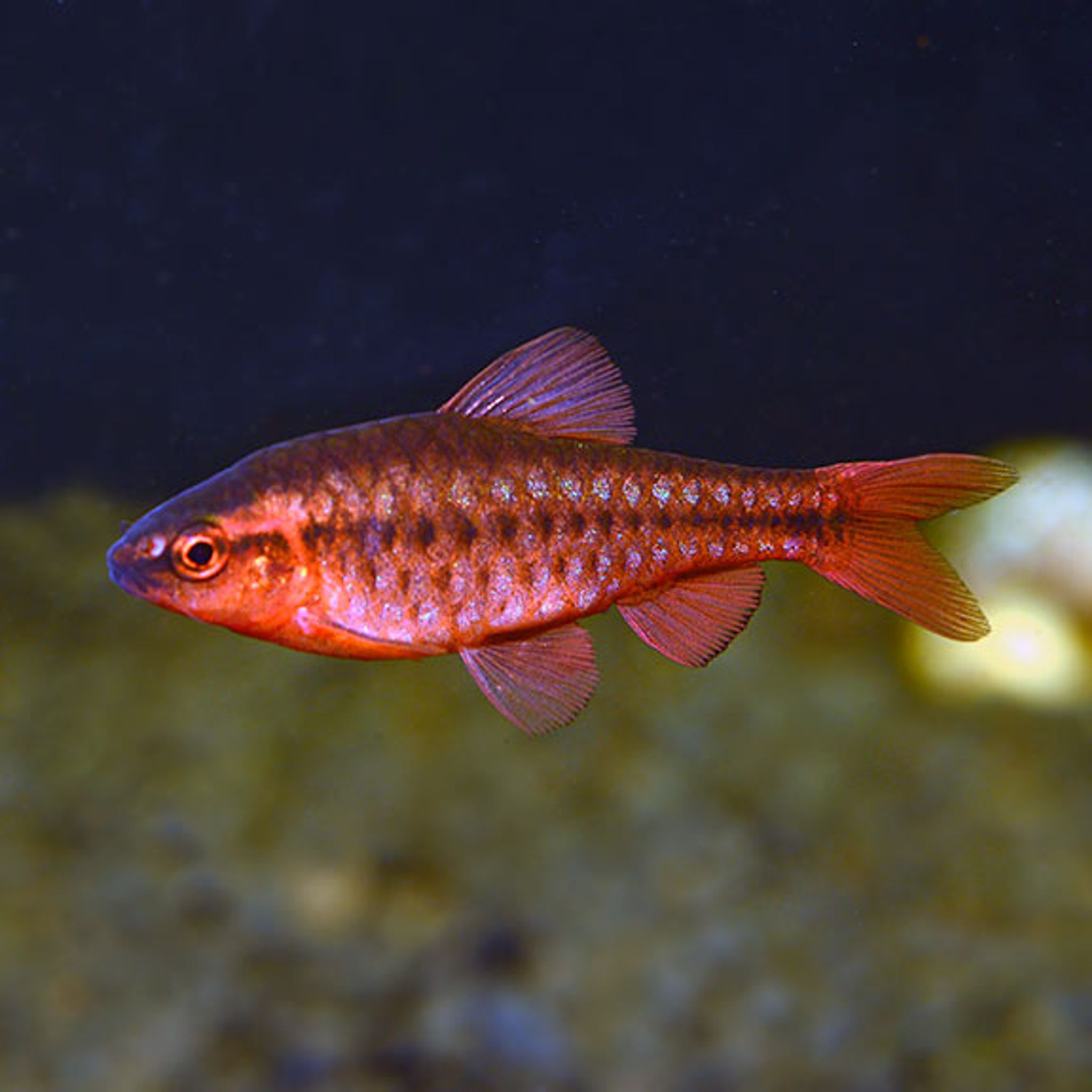
Cherry Barb Care Guide: Tank Size, Diet, Water Parameters and Temperament
Cherry barbs are the barb that breaks the "barb" stereotype — a small, deep-red schooling fish that behaves more like a peaceful tetra than a fin-nipping troublemaker. This guide gives you decisive numbers for tank size, water parameters, diet, and compatibility, plus breeding and troubleshooting notes, so you can decide quickly whether this species fits your setup.
Species Basics
The cherry barb's current scientific name is Pethia titteya, though older books and many product labels still list it as Puntius titteya. Both names refer to the same fish; the genus was reclassified as taxonomists split the old Puntius group into smaller, more accurate genera.
In the wild, cherry barbs come from shaded, slow-moving forest streams in Sri Lanka. Habitat loss has pushed wild populations to a vulnerable conservation status, but this isn't a reason to avoid the species — nearly all cherry barbs sold today are tank-bred on farms, so buying captive-raised stock (rather than wild-caught) supports the hobby without pressuring wild populations at all.
- Size: about 2 inches (5 cm) at maturity; males run slightly smaller and slimmer than females.
- Lifespan: typically 4–6 years with good care; some sources report 3–7 years, and well-maintained fish in stable, mature tanks can reach 7–8 years.
- Color: males show deep cherry-red bodies, especially when conditioned and courting; females are tan to olive with a more subdued red stripe. Long-fin and albino/leucistic strains are also available in the trade.
Tank Size and Group Size
Recommendations across the hobby swing wildly, from 10-gallon "minimums" up to 30-gallon suggestions for the same school size. A 10-gallon tank is outdated advice for a schooling fish — treat it as too small.
A defensible, real-world minimum is 20 gallons (preferably a "long" footprint) for a school of six, adding roughly 2–5 gallons for each additional fish beyond that. Bigger is always better for a schooling species, but 20 gallons long is the number to build a stocking plan around.
The footprint matters as much as the total gallons. Cherry barbs are horizontal swimmers that patrol the length of a tank in a loose school — a long, low tank gives them more usable swimming lane than a tall tank of the same volume, and it shows off schooling behavior far better.
Group Size Formula
| Fish count | Minimum tank size | Notes |
|---|---|---|
| 6 (recommended minimum) | 20 gallons long | Baseline school size |
| 8–10 (ideal) | 25–30 gallons | Reduces pecking-order stress |
| Each additional fish | +2–5 gallons | Scale gradually, don't overcrowd |
Keep at least six cherry barbs, ideally 8–10. A group that's too small — or skewed heavily toward males — increases chasing and fin-nipping between the barbs themselves. A ratio of roughly one male to two females spreads out male attention, reduces male-on-male squabbling, and still lets the males show full color.
Water Parameters
Cherry barbs are adaptable but do best within a fairly tight band. Wild-caught individuals (uncommon in the trade) prefer the more acidic end; farm-raised fish tolerate a wider range.
| Parameter | Range | Notes |
|---|---|---|
| Temperature | 73–81°F (23–27°C) | Core comfort zone is 74–79°F (23–26°C) |
| pH | 6.0–7.5 | Sweet spot; tolerates up to 8.0 if acclimated slowly |
| Hardness | 2–19 dGH | Soft to moderately hard |
| Ammonia / Nitrite | 0 ppm | Non-negotiable |
| Nitrate | Under 20 ppm | As with most community fish |
Treat 6.0–7.5 pH as the working target rather than chasing the wider extremes some sources allow — a fish that's drip-acclimated slowly can handle a bit higher, but sudden swings are far more dangerous than a slightly "imperfect" steady number.
Tank Setup
Recreate a shaded stream, not an open showtank:
- Substrate: dark sand or fine gravel makes red coloration pop by contrast.
- Planting: heavily planted, with floating or tall plants to dim overhead light and mimic a shaded canopy.
- Hardscape: driftwood and rocks for hiding spots — cherry barbs are naturally a bit shy and appreciate cover.
- Open water: leave a clear swimming lane through the middle-to-front of the tank for schooling; don't crowd every inch with decor.
Basic Equipment Sizing
- Filtration: a sponge filter or hang-on-back (HOB) filter with gentle output works well, since these fish come from slow-moving streams and don't appreciate strong current. Look for a turnover rate around 4–6 times the tank volume per hour rather than maxing out flow.
- Heater: a rough rule of thumb is about 3–5 watts per gallon for a stable indoor room temperature; a 20-gallon tank typically runs comfortably on a 75–100 watt heater with a thermostat.
- Cycling: run a full nitrogen cycle before adding any fish — this is the single biggest predictor of whether a "hardy" species like this one thrives or mysteriously keeps dying.
Fully cycled tanks, appropriate filtration, and a gentle-flow sponge or HOB unit are worth browsing on FishyHub's filter selection before stocking day.
Diet
Cherry barbs are easygoing omnivores:
- Staple: a high-quality flake or micro-pellet food.
- Protein: live or frozen brine shrimp, bloodworms, or daphnia a few times a week.
- Vegetables: blanched zucchini, peas, or spinach.
- Color enhancement: spirulina-based or color-enhancing foods help intensify male red coloration.
Feed 2–3 times daily, offering only what the group clears in 2–3 minutes. Overfeeding is one of the most common mistakes with this species — leftover food fouls the water, spikes ammonia, and raises the risk of ich and fin rot.
Temperament and Tank Mates
Despite the "barb" name, cherry barbs are genuinely peaceful and behave more like a tetra than a tiger barb. Occasional chasing within the group is pecking-order or mating behavior directed at their own kind, not aggression toward other tank residents. Fin-nipping is rare compared to more boisterous barbs, though it can still surface if the group is too small or badly skewed toward males.
Good Tank Mates
- Tetras, rasboras, and danios
- Corydoras and other peaceful bottom dwellers
- Otocinclus and mild gouramis
- Livebearers — guppies, mollies, platies
- Kuhli loaches
- Mystery snails and adult cherry shrimp
Use Caution or Avoid
- Bettas: reports are mixed — treat this as a case-by-case, advanced pairing rather than a beginner combo, since either species can nip the other depending on individual temperament.
- Shrimp fry: adult cherry shrimp are usually safe, but barbs will readily eat shrimplets, so don't count on a barb tank to sustain a breeding shrimp colony.
- Tiger barbs and other nippy species: their boisterous energy can stress a cherry barb school.
- Large or predatory fish, and long-finned slow swimmers kept alongside an undersized cherry barb group.
If you're building out a broader community stock list, FishyHub's small community fish category is a good place to compare compatible tetra and rasbora options.
Breeding at Home
Cherry barbs are easy egg-scatterers with no parental care — in fact, the adults will eat their own eggs given the chance, so a dedicated setup is essential:
- Set up a 5–10 gallon spawning tank with fine-leaved plants or a spawning mesh to protect eggs.
- Condition the breeding pair(s) on protein-rich foods for a week or two beforehand.
- Spawning most often happens at dawn.
- Remove the adults immediately after spawning to prevent egg predation.
- Eggs hatch in 24–48 hours.
- Fry become free-swimming within a few days and need infusoria or microworms before graduating to baby brine shrimp.
Common Health Issues
Cherry barbs are hardy, but they're still susceptible to standard freshwater ailments — nearly always triggered by poor water quality, temperature swings, or stress from too small a group:
- Ich (white spot disease)
- Fin rot
- Fungal infections
- Gill flukes
- Occasional swim bladder issues
Common Mistakes to Avoid
- Keeping fewer than 6: causes stress, skittishness, and more fin-nipping since the pecking order has nowhere to diffuse.
- Undersized tanks: crowd an active schooling fish and cause faster water-quality swings.
- Skipping the nitrogen cycle: ammonia and nitrite spikes are the top cause of "my hardy fish keep dying."
- Uneven male-to-female ratios: too many males increases chasing and stress.
- Leaving adults in with eggs or fry: they will eat both.
- Overfeeding: fouls water and drives disease risk.
- Replacing too much filter media at once: kills off beneficial bacteria and causes a mini-cycle crash — always rinse or replace media gradually, using old tank water.
Related Barb Species
Cherry barbs are usually ranked as the most peaceful, beginner-friendly barb on any "top barbs" list, in direct contrast to boisterous species like tiger barbs. If you're comparing options, here's how some relatives stack up:
| Species | Adult size | Temperament | Minimum tank |
|---|---|---|---|
| Cherry barb | ~2 in (5 cm) | Peaceful, rarely nips | 20 gal long |
| Tiger barb | ~2.75 in (7 cm) | Boisterous, known fin-nipper | 20–30 gal |
| Black ruby barb | ~2.5 in (6.5 cm) | Peaceful, easy care | 20 gal |
| Gold barb | ~3 in (7.5 cm) | Hardy, peaceful | 20–25 gal |
Albino Cherry Barb
A color morph, not a separate species — pale peach-to-gold body with red eyes. Care is identical to the standard form, but albino individuals are more light-sensitive due to reduced pigment. Dim lighting and floating plants help, and it's worth watching feeding time to make sure they aren't outcompeted, since their eyesight tends to be weaker.
Black Ruby Barb
Pethia nigrofasciata, another Sri Lankan species with a similarly peaceful, easy-care profile. It prefers slightly warmer water in the upper 70s°F and does well in the same 20-gallon minimum school setup as cherry barbs — a natural comparison for anyone browsing FishyHub's barb category.
Gold Barb
A hardier, slightly larger (about 3 inches) barb originating from China and Vietnam. Low-maintenance and peaceful, it's a solid alternative or companion species for keepers who want a bit more size without sacrificing temperament.
Other Nano Barbs
Checker barb, panda barb, and drape fin barb are smaller niche species (about 1.75–2 inches) with peaceful temperaments and similar tank needs — worth a look if you want variety within the same footprint. Butterfly barbs and Angolan barbs are more advanced, specialty species better suited to experienced keepers looking for a breeding project.
Filter Maintenance FAQs
Since filtration keeps any cherry barb tank stable, a few quick maintenance notes:
- Cartridge changes: roughly monthly, adjusted for bioload and water quality — a lightly stocked tank can stretch longer.
- Rinsing biological media: always rinse in old tank water, never tap water, to preserve the beneficial bacteria colony.
- Noisy filter: usually trapped air, a low water level, or debris caught on the impeller.
- Filter stopped working: most often a clogged or jammed impeller — clean it thoroughly before assuming the unit needs replacing.
Frequently Asked Questions
How many cherry barbs should be kept together?
At least 6, ideally 8–10, with more females than males. A ratio of about one male to two females reduces chasing and stress within the group.
What size tank does a school of cherry barbs need?
Around 20 gallons minimum for six fish, with a long footprint preferred over a tall one. Add roughly 2–5 gallons for each additional fish beyond that baseline.
Are cherry barbs fin nippers like other barbs?
Rarely. They're one of the most peaceful barbs in the hobby, especially when kept in an adequately sized group — most "nipping" reports trace back to groups that are too small or too male-heavy.
Can cherry barbs live with bettas or shrimp?
Betta compatibility is case-by-case — reports are mixed, so treat it as an advanced pairing rather than a beginner combo. They're generally safe with adult cherry shrimp, but they will eat shrimp fry, so don't rely on them for a breeding shrimp colony.
What do cherry barbs eat?
An omnivore diet of high-quality flake or micro-pellet food, supplemented with live or frozen protein like brine shrimp, bloodworms, or daphnia, plus blanched vegetables. Feed 2–3 times daily, only what clears in a few minutes.
How do you breed cherry barbs at home?
Use a separate 5–10 gallon spawning tank with dense, fine-leaved plants, condition the pair on protein-rich food, and remove the adults immediately after spawning. Eggs hatch in 24–48 hours, and fry need infusoria or microworms before moving on to baby brine shrimp.
Why is my cherry barb losing color or hiding?
Usually stress — most commonly from too small a group, poor water quality, or being kept without enough tankmates of its own kind. Check water parameters first, then consider whether the school needs more members.
How often should I change my filter media/cartridge?
Roughly monthly as a baseline, adjusted for bioload. Rinse biological media in old tank water rather than replacing it outright, to avoid crashing your beneficial bacteria colony.
Ready to start or expand a peaceful community tank? Browse tank-bred stock in FishyHub's barb category to find cherry barbs and their close relatives.

