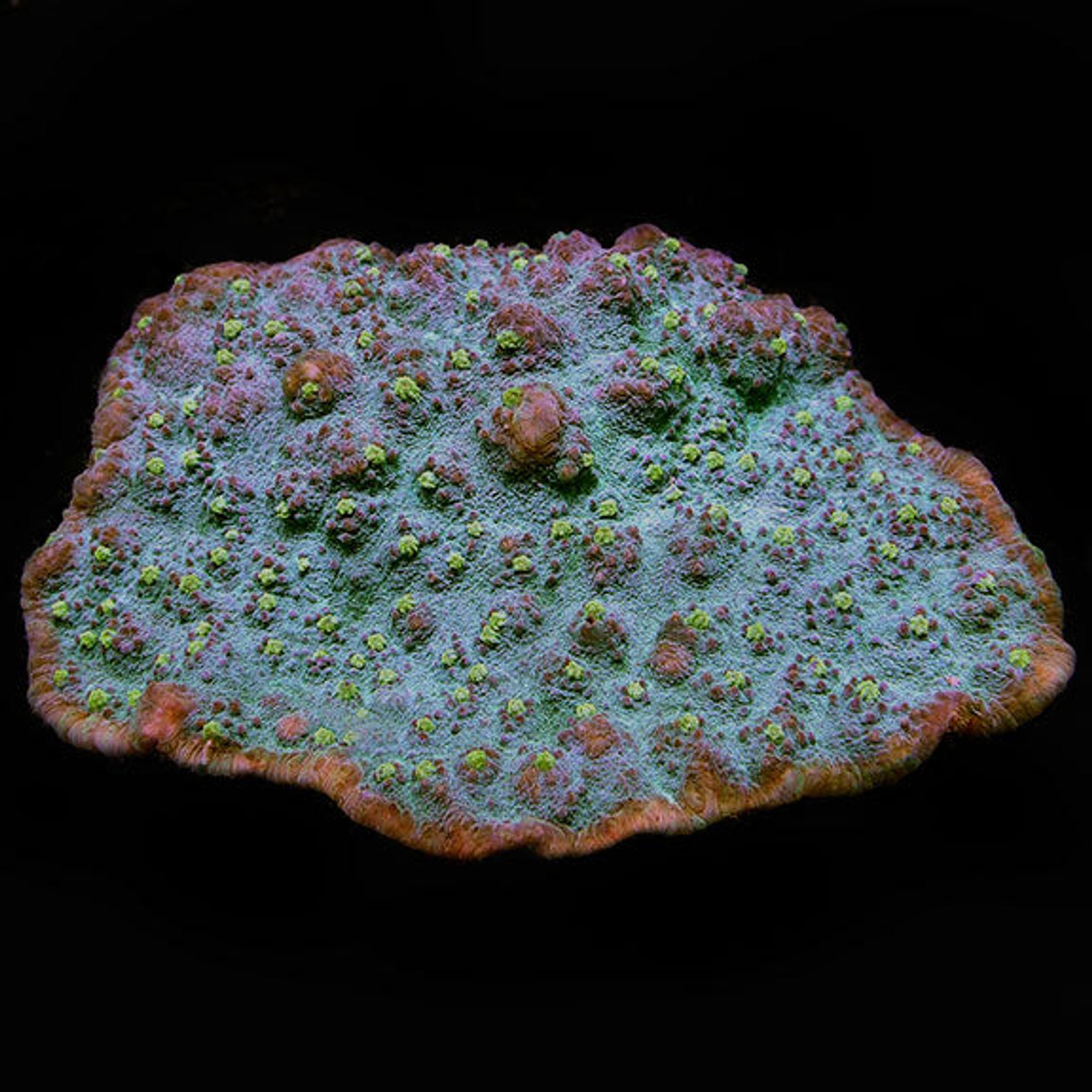
Chalice Coral Care Guide: Lighting, Flow, Feeding and Placement
Chalice corals are prized for saturated colors and platy growth, but a new frag that looks perfect on arrival can pale within days if lighting, flow, or placement is wrong. This guide gives concrete starting ranges for PAR, flow, feeding, and spacing so you can acclimate a chalice with confidence instead of guessing at "moderate" everything.
What "Chalice" Actually Means
"Chalice" is a hobby and trade name, not a single species. It's a catch-all for large-polyp stony (LPS) corals from several genera that share a plating or cup-shaped growth form and vivid, mottled coloration — mainly Echinophyllia, Oxypora, Mycedium, and Echinopora, with some Lithophyllon and Australophyllia sold under the same label.
The category exists because aquaculturists select and name colorful morphs for the trade rather than sorting them by strict taxonomy. That's also why care advice varies so much online: two corals both labeled "chalice" can be different genera with different natural light and flow tolerances. Treat any chalice as an individual — start conservative and adjust based on how that specific colony responds, not a fixed universal number.
The good news is that once acclimated, most chalices are easy to intermediate in care level — hardy reef fish and other tankmates rarely bother them directly, and they tolerate a normal reef-standard water column. The risk sits almost entirely in the first few weeks after purchase.
Lighting: Start Low, Ramp Slowly
Most chalices do well under moderate light, roughly 80-150 PAR at the coral's placement depth. Some hobbyists report success as low as 75-80 PAR, and hardier or shallower morphs tolerate up to 200 PAR — but because "chalice" spans multiple genera, don't chase one universal number. Deeper-water or darker-colored morphs generally prefer the low end of that range.
Acclimation matters more than the exact PAR target. New frags should go in low in the tank, or under dimmed/shaded light, and ramp up gradually over 2-3 weeks. Watch tissue and color at each step before increasing further — paling, receding tissue margins, or reduced polyp extension mean you've moved too fast.
Any modern LED fixture works as long as it's dimmable. A blue/actinic channel around 420-460 nm brings out the coral's fluorescent pigments, which is most of the appeal of keeping chalices in the first place. You can browse dimmable LED lighting options to find a fixture that supports a slow ramp schedule.
Choosing a Fixture for Chalice Placement
- Check the PAR spread across the whole footprint, not just the peak reading under the center of the fixture — corners and edges near the sand bed (where many chalices sit) often read much lower.
- Prioritize genuine blue/UV output in the 380-450 nm range for fluorescence and growth, rather than diodes that just look blue.
- App or Bluetooth control is genuinely useful here, both for programming a gradual intensity ramp on new frags and for dialing back output during summer heat spikes.
- Start a reef photoperiod around 8-10 hours total, with light concentrated in the middle hours.
Flow: Indirect and Turbulent, Not Direct
Chalices want low-to-moderate, indirect or turbulent flow — as a rough sizing benchmark, aim for about 20-40x total tank turnover per hour when selecting pump capacity. That's a starting point for equipment sizing, not a number to hit exactly at the coral itself.
What matters practically is the qualitative picture:
- Enough movement that detritus doesn't settle and rot in the bowl or cup shape of the colony — buildup there causes localized tissue recession or infection.
- Not so much direct flow that the flat, sail-like colony gets flipped, or that polyps can't extend to feed.
Aim flow so it washes across and around the coral rather than blasting it head-on. A wavemaker set to random/pulsing mode, or flow bounced off rockwork before it reaches the coral, works better than a powerhead pointed straight at it.
Feeding: Optional but Worth Doing
Chalices are photosynthetic and get the majority of their energy from the zooxanthellae living in their tissue — they will survive on light alone. Supplemental feeding isn't required for survival, but it measurably improves color and growth, so most keepers target-feed 2-3 times per week.
Good foods include:
- Mysis or cyclops
- Finely chopped shrimp
- Amino-acid or coral-specific liquid/gel blends
- Powdered phytoplankton
- Small sinking pellets
Use a turkey baster or pipette to place food directly over the polyp or mouth, and briefly reduce flow in that spot so the food doesn't blow away before the coral can capture it.
Feeding response is easy to miss. Chalices have small mouths and minimal visible polyp extension compared to other LPS, so you may not see obvious tentacles reaching out. Many colonies feed best at night or right before lights-out, when extension is more pronounced — if daytime feeding attempts seem to do nothing, try again after dark.
Placement and Spacing
Place chalices in the lower-to-middle sections of the tank, on flat rock or rubble where the colony has room to encrust and expand outward. Avoid steep angles — a chalice on a slope collects less detritus runoff into its cup, but growth is more even on a flat or gently sloped surface.
Spacing is the single most important placement rule. Chalices are aggressive and extend long sweeper tentacles, mainly at night, that sting and kill neighboring coral tissue on contact. Give a minimum of 3-6 inches (about 7.5-15 cm) of clear space from any other coral, more if the neighbor is also aggressive or slow-growing. When in doubt, add rockwork as a physical barrier rather than relying on distance alone.
Before adding any new chalice frag to a display tank, it's worth a brief quarantine or coral dip to check for LPS-specific pests such as flatworms or nudibranchs — these are easy to miss on a small frag and can spread quickly once established.
| Factor | Safe starting range |
|---|---|
| PAR (light intensity) | 80-150 PAR, ramp over 2-3 weeks |
| Flow | 20-40x turnover; indirect/turbulent |
| Feeding | 2-3x/week, small meaty foods |
| Neighbor spacing | 3-6+ in (7.5-15+ cm) |
| Tank size | 40 gal (150 L) or larger |
| Temperature | 76-78°F (24-26°C), brief spikes to ~82°F (28°C) tolerated |
| pH | 8.1-8.4 |
| Salinity | 1.025-1.026 SG |
| Alkalinity | 8-9 dKH |
| Calcium | 420-450 ppm |
| Magnesium | 1,250-1,350 ppm |
| Nitrate / Phosphate | ~5-10 ppm / ~0.05-0.1 ppm |
Note that chalices, like most LPS, tend to do better with some measurable nitrate and phosphate rather than in an ultra-low-nutrient system — a crash toward zero on either parameter is a common, under-recognized cause of bleaching. You can find compatible LPS hard corals to plan a stable, well-spaced layout before you buy.
Growth and Fragging
Growth rate depends heavily on which genus and skeleton type you have. Thick-skeleton chalices grow slowly, often around 1/4 inch (0.6 cm) per month, while thin-skeleton or more encrusting types can roughly double in size within about 4 months under good conditions.
Fragging a chalice is intermediate-difficulty work:
- Use a tile saw, rotary tool, or bandsaw for thick-skeleton pieces; a scalpel or snips work for thinner, encrusting types.
- Plan cuts so each frag piece keeps at least one intact "eye" (mouth) — a piece without one won't recover.
- Dip cut frags in an iodine-based coral dip and rinse before gluing to a plug or rock.
- Allow several weeks of undisturbed healing before moving or handling a fresh frag again.
- Sterilize tools between cuts, especially between different colonies — cross-contamination can spread pathogens or trigger tissue rejection between genetically distinct chalices glued near each other.
Common Mistakes and Quick Fixes
| Symptom | Likely cause | Fix |
|---|---|---|
| Paling or bleaching soon after purchase | Light intensity increased too fast | Ramp light over 2-3 weeks; move lower in the tank temporarily |
| Tissue recession in the cup center | Detritus trapped, insufficient flow | Increase gentle indirect flow; baste debris out periodically |
| Colony flipped or polyps won't extend | Flow too direct/strong | Redirect to indirect, turbulent flow instead of a direct jet |
| No visible feeding response | Subtle polyp extension, wrong timing | Feed at night or just before lights-out; reduce flow briefly |
| Dull color, slow growth despite good light | Nutrients crashed too low | Allow some measurable nitrate/phosphate rather than running bare |
| Neighboring corals showing dead patches | Sweeper tentacle stings | Increase spacing to 3-6+ in; add a rock barrier |
If a chalice looks stressed, work through it in that order: check flow first (too little or too direct), then nutrients, then spacing from neighbors, and only then consider light as the culprit — light-related stress usually shows up as color loss over days to weeks, not overnight.
Related LPS Corals to Know
Plate corals share much of the same husbandry family as chalices — moderate light and flow, similar sensitivity to placement — but they're generally kept loose on the sand bed rather than glued to rock, since an inflated plate coral can tip over if fixed in place. They also extend nocturnal tentacles to feed and absorb dissolved nutrients, and they're just as capable of stinging neighbors, so give them open space too.
NPS (non-photosynthetic) corals are a genuinely different category worth distinguishing from chalices. NPS corals lack zooxanthellae entirely and naturally live in shaded, deep, or cave habitats — they need little to no light but require heavy, frequent feeding (often several times a week) plus strong current to deliver planktonic food to their open polyps. Some duller chalice morphs get mistaken for NPS corals because they look muted under bright light, but a true chalice is photosynthetic and should not be kept dark and fed like an NPS species.
Genus Spotlight: Echinophyllia Aspera
This chalice species is fully photosynthetic and doesn't strictly need feeding, though it readily accepts small meaty foods like cyclops when its tentacles extend at night. Growth is closely tied to stable, consistently monitored calcium and alkalinity — inconsistent dosing measurably slows growth compared to a well-monitored system. The tissue at the outer plate edge is notably fragile, so handle frags carefully during acclimation and placement, especially right after shipping.
Genus Spotlight: Mycedium Elephantotus
This species needs generous personal space away from neighbors and does best under moderate-to-fairly-intense light with moderate flow. Watch for bleaching or unusual darkening as an early signal to relocate the colony to a different spot. Given time, it can form very large plating colonies, so plan real estate on the rockwork well ahead of that growth. It readily accepts hand or target feeding of small meaty foods delivered just before lights-out, which helps trigger tentacle extension.
Frequently Asked Questions
Is a chalice coral one species?
No. "Chalice" is a hobby name covering several LPS genera — mainly Echinophyllia, Oxypora, Mycedium, and Echinopora — grouped together for their plating growth form and bright coloration rather than close taxonomic relation. That's why care advice for "chalice corals" varies so much between specimens.
Why did my chalice lose its color after I bought it?
Color loss right after purchase is almost always stress from a change in light or flow, or from shipping itself, rather than a fatal problem. Give it weeks, not days, under low light with a gradual ramp before concluding the color loss is permanent — most chalices recover fully with patience.
Do chalice corals need to be fed?
Not strictly — they get most of their energy from photosynthesis and can survive on light alone. Supplemental feeding 2-3 times a week with small meaty foods improves color and growth but isn't mandatory for survival.
How much light and flow do chalice corals need?
Aim for roughly 80-150 PAR at placement depth and indirect, turbulent flow sized around 20-40x tank turnover. Start any new frag at the low end of both ranges and increase gradually based on how the coral's color and polyp extension respond.
Can chalice corals sting other corals?
Yes. Chalices can extend sweeper tentacles, mainly at night, that sting and kill tissue on neighboring corals they touch. Keep at least 3-6 inches of clear space from any other coral, and use rockwork as a physical barrier where space is tight.
What's the difference between a chalice, a plate coral, and an NPS coral?
Chalices and plate corals are both photosynthetic LPS with similar light and flow needs, but plate corals are typically kept loose on sand rather than glued down. NPS corals are a different category entirely — no zooxanthellae, little to no light needed, but heavy, frequent feeding and strong current required to feed their polyps.
Why is my chalice's mouth gaping or its tissue receding?
Gaping mouths or receding tissue margins usually point to stress from water quality, flow, or handling damage rather than disease alone. Check flow first (too little allows detritus to sit in the cup; too much prevents proper polyp function), then verify nutrient and alkalinity stability, then reassess placement and spacing from neighbors.
How do I frag a chalice coral safely?
Cut with a tile saw, rotary tool, or bandsaw for thick skeletons, or a scalpel for thinner encrusting types, making sure each piece keeps an intact mouth. Dip the cut frags in an iodine-based coral dip, rinse, glue to a plug or rock, and let them heal undisturbed for several weeks — sterilizing tools between cuts and between different colonies to avoid spreading disease.
Ready to add a chalice to your reef? Browse current frags and colonies in FishyHub's Corals category to compare morphs before you plan lighting, flow, and placement.

