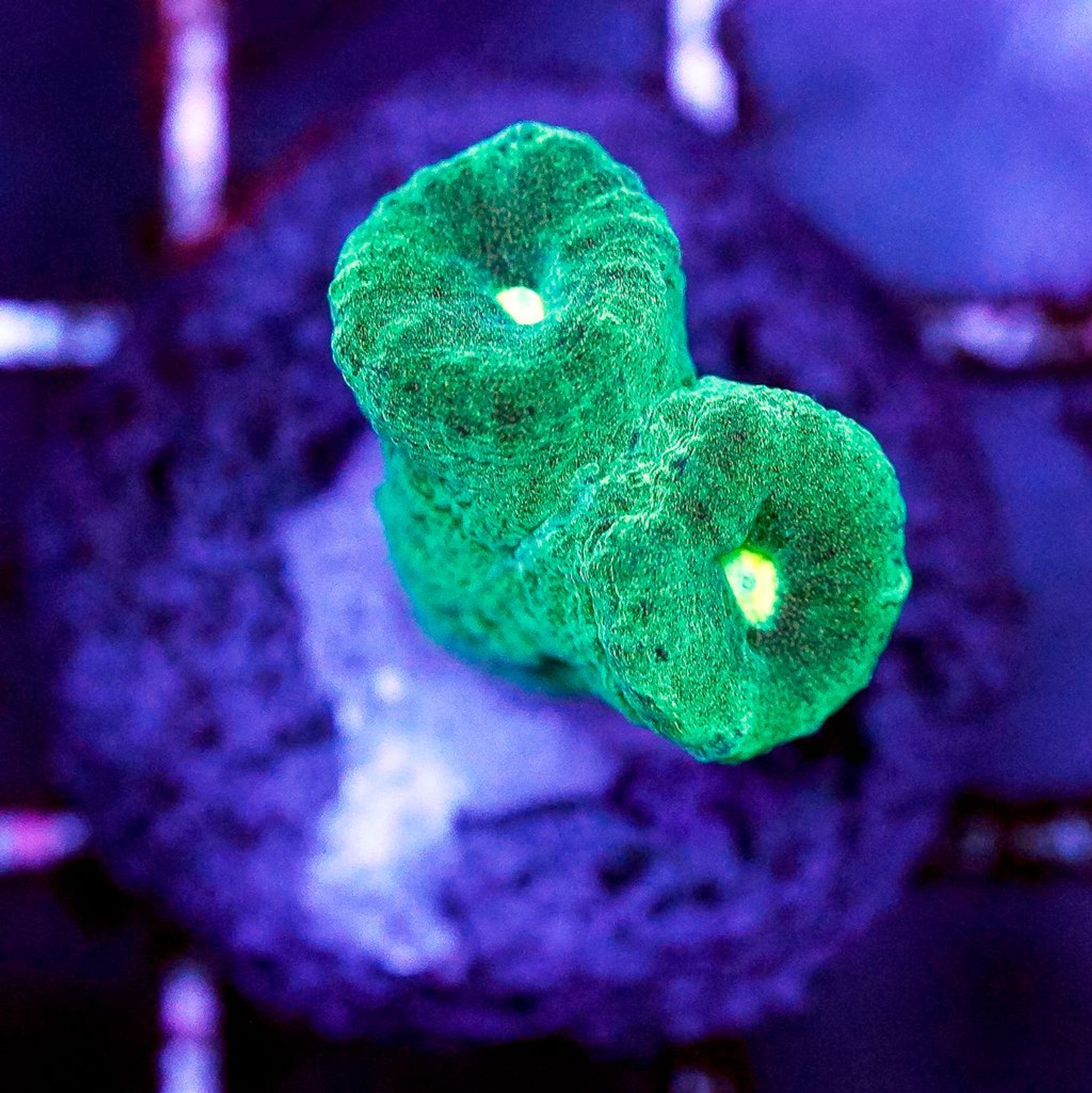
Candy Cane Coral Care Guide: Lighting, Flow, Feeding and Placement
Candy cane coral (Caulastrea) is one of the most forgiving large-polyp stony corals available, which makes it a common first LPS purchase for reef keepers moving past soft corals. This guide gives exact PAR, flow, feeding and placement targets instead of vague "moderate" advice, so you know precisely where to put the frag and how to keep it fleshy and colorful.
What Is Candy Cane Coral?
Candy cane coral, also called trumpet coral or candy coral, belongs to the genus Caulastrea. It grows as a cluster of upright branches, each capped with a fleshy polyp and its own mouth. Under good light the polyps swell and overlap, creating the striped "candy cane" look that gives the species its name.
Because each branch functions somewhat independently, a healthy colony reads as a bed of separate rounded polyps rather than one continuous mat, which is a useful way to distinguish it from other Euphylliid corals at a glance.
Candy Cane vs. Trumpet vs. Torch and Hammer Coral
This is a common point of confusion at checkout. "Trumpet coral" is frequently used as another name for Caulastrea, but the same term is sometimes applied loosely to Euphyllia species as well. Torch and hammer corals are true Euphyllia, with longer sweeper tentacles and generally stronger stings than candy cane. Always confirm the scientific name before buying, since care needs and aggression levels differ between these related but distinct corals.
Difficulty Level
Candy cane coral is widely rated as one of the easiest LPS corals to keep. It tolerates a wide range of light and flow, doesn't demand feeding to survive, and recovers well from minor parameter swings compared to more sensitive LPS species. That combination makes it a reasonable "first LPS" for someone stepping up from mushrooms and zoanthids.
Lighting Requirements
Reported PAR ranges for candy cane coral vary depending on the source, partly because "trumpet coral" search results blend in wider Euphyllia data. Across sources, candy cane tolerates roughly 50–150 PAR total.
- Practical sweet spot: 75–100 PAR under LED or T5 lighting for reliable color and steady growth.
- Lower-light tanks: 50–75 PAR still works fine; growth and coloration will just be a bit slower.
- Acclimation matters more than the number: move a new coral to brighter light gradually, over 1–2 weeks, rather than exposing it to a high-intensity fixture like metal halide or a strong LED right away. Sudden jumps in intensity risk bleaching and stress more than starting on the low side ever will.
Since this species is not light-demanding, it's a solid choice for the lower and mid sections of the tank rather than the top shelf reserved for SPS. Anyone shopping for a fixture that can be dialed down for LPS-friendly intensity can browse LED lighting options built for adjustable output.
Flow Requirements
Flow strength is another area where sources disagree slightly. One view is strictly low flow, arguing that anything stronger deflates the polyps. Another allows low-to-moderate flow, noting that a bit of turbulence helps clear detritus from around the skeleton.
The practical middle ground: aim for low-to-moderate, indirect or random flow rather than a direct laminar blast from a powerhead. Some gentle turbulence is beneficial and keeps debris from settling in the branch gaps, but a coral sitting directly in a jet stream will usually show it by staying shrunken and pale-looking rather than plump and fleshy.
Placement in the Tank
Candy cane coral does best in the lower-to-mid rockwork, on a ledge near the sandbed or tucked into a shaded pocket rather than perched on the highest point of the aquascape. It works well as part of the "floor" of a mixed reef, where light and flow are naturally gentler than up near the surface.
Beginner Placement Chart
Use this as a starting point, then fine-tune based on your PAR meter and how the polyps respond.
| Tank Type | Suggested Zone | Flow Setting | Distance from Direct Pump Output |
|---|---|---|---|
| Nano reef (10–20 gal / 38–76 L) | Lower third, shaded rock shelf | Low; single small circulation pump on low-to-mid % | At least 8–10 in (20–25 cm), angled away |
| Standard reef (40–75 gal / 151–284 L) | Lower-to-mid rockwork, off to the side of the main flow path | Low-to-moderate; 10–30% on a controllable powerhead | At least 12 in (30 cm), indirect angle |
| Larger reef (90+ gal / 340+ L) | Mid rockwork in a naturally calmer pocket between rock formations | Low-to-moderate, relying on return flow bounce rather than direct pump aim | 12–18 in (30–46 cm) from any dedicated powerhead |
Feeding
Candy cane coral gets significant energy from the zooxanthellae living in its tissue, so feeding isn't required for survival. That said, feeding measurably speeds up growth and improves color, making it worth the extra few minutes a week.
- Frequency: 1–3 times per week. More frequent feeding mainly accelerates growth rather than being necessary for basic health.
- Food options: mysis or brine shrimp, small krill bits, an LPS-formulated pellet, or a coral amino/plankton blend.
- Technique: target-feed with a turkey baster or pipette after the lights dim, once polyps are visibly extended. Turn off return and circulation pumps for 15–30 minutes during feeding so the food doesn't blow away before the polyps can capture it.
- Watch your fish: some fish learn to associate feeding time with an easy meal and will peck at the coral itself, so keep an eye on tankmates during the first few feedings.
Shoppers stocking up on target-feeding options can browse coral and marine foods suited to LPS feeding.
Water Parameters
Stability matters more than hitting an exact number. A steady parameter that's slightly outside the ideal range is generally less damaging than one that swings.
| Parameter | Target Range |
|---|---|
| Temperature | 74–78°F (23–26°C) |
| Salinity | 1.023–1.026 |
| pH | 8.0–8.3 |
| Alkalinity | 8–12 dKH |
| Calcium | 380–450 ppm |
| Magnesium | 1250–1350 ppm |
| Nitrate | Roughly 1–10 ppm tolerated |
| Phosphate | Near 0–0.05 ppm |
On calcium specifically, some sources narrow the target to around 425 ppm rather than a full range. Either approach works as long as the number holds steady week to week rather than drifting.
Aggression, Spacing and Compatibility
Candy cane coral carries mild-to-moderate sweeper tentacles that can extend up to about 2 inches (5 cm) at night to sting nearby competitors. Leave 3–6 inches (7.5–15 cm) of clearance — roughly a fist-width or more — between it and neighboring corals. Increase that gap further next to known aggressors like torch or hammer coral.
It's a peaceful addition to mixed reef and beginner setups, pairs fine with other LPS given adequate spacing, and generally shouldn't be crowded next to fast-growing SPS that need much higher light and flow than it does.
For tankmates, most peaceful reef fish are fine around candy cane coral. Avoid known coral-nippers such as some butterflyfish and larger angelfish species, which may pick at extended polyps. It doesn't host clownfish the way an anemone does, so don't expect anemonefish behavior around it.
Quarantine Before Adding to Display
New frags, even from a trusted source, should go through a coral dip before joining the display tank. LPS corals like candy cane can carry pests such as flatworms, and a quarantine period lets you catch problems before they spread. A coral dip or treatment product is a low-cost step that avoids a much bigger cleanup later.
Aquacultured vs. wild frags: aquacultured colonies are generally hardier and adjust to home lighting faster than wild-collected or imported frags, which is worth factoring in when choosing between similar-looking pieces.
Color Morphs
Candy cane coral is available in numerous color morphs, including green, blue or purple-rimmed, red/orange, and multi-color "rainbow" variants. Color intensity is influenced by light spectrum and PAR, and to a lesser degree by nutrient levels in the tank — but color is a cosmetic outcome, not a separate care requirement.
Growth and Fragging
Candy cane coral grows colonially through polyp and skeleton division, gradually branching into a multi-head colony. To frag it:
- Wait until the polyps are fully retracted — cutting while tissue is extended risks injuring the polyp.
- Use a coral-safe saw, bandsaw, or rotary tool to cut individual branches at the skeleton.
- Glue the cut base of each branch to a frag plug using cyanoacrylate (coral glue).
Related LPS: Galaxea Coral Compared
Galaxea coral is a useful contrast when weighing beginner LPS options. It shares a similar light tolerance to candy cane (roughly 50–100 PAR) and is largely photosynthetic, so it doesn't require feeding either. Where it differs sharply is flow and spacing: Galaxea wants medium-to-high, turbulent flow rather than steady laminar current, since consistent one-direction flow can cause tissue recession. It's also known for unusually long, aggressive sweeper tentacles, so it needs noticeably wider spacing than candy cane, along with stable calcium, alkalinity and magnesium as it grows. In short, similar light needs but higher flow demands and a much bigger aggression radius.
Common Mistakes to Avoid
- Direct flow blasting the coral: polyps stay shrunken and deflated. Reposition to an indirect flow path.
- Sudden light upgrades: a new fixture or a move to a brighter tank without acclimation can bleach or brown the tissue. Step up intensity gradually over 1–2 weeks.
- Placing too close to aggressive neighbors: sweeper tentacle stings from torch, hammer, or other LPS can cause tissue recession on the losing side. Leave adequate gaps.
- Skipping feeding, then wondering why growth is slow: feeding is optional for survival but the main lever for faster colony growth.
- Letting alkalinity or calcium swing: instability is more damaging than sitting slightly outside the ideal range.
- Fragging while polyps are still extended: always wait for full retraction before cutting.
- Confusing genus at the store: candy cane, trumpet, torch and hammer corals look related but have different sting strength and flow needs — check the scientific name before buying.
Frequently Asked Questions
Is candy cane coral good for beginners?
Yes. It's widely considered one of the hardiest, most forgiving LPS corals, tolerant of a fairly wide range of light and flow conditions, which makes it a solid first LPS purchase.
Do candy cane corals need to be fed?
Not strictly. They get significant energy from zooxanthellae, but feeding 1–3 times a week measurably boosts growth speed and color intensity.
What PAR does candy cane coral need?
Roughly 50–150 PAR is tolerated overall, with a practical target of about 75–100 PAR for reliable color and growth. Tanks running 50–75 PAR still support a healthy colony, just with somewhat slower progress.
How much flow does candy cane coral need?
Low to moderate, indirect flow. Avoid pointing a powerhead straight at it; some gentle turbulence is fine and even helps prevent detritus buildup around the skeleton.
Is candy cane coral the same as trumpet coral?
Generally yes — both names commonly refer to Caulastrea. However, "trumpet coral" is sometimes used loosely for Euphyllia species too, so confirm the scientific name before purchasing to avoid mixing up care requirements.
How do you frag candy cane coral?
Wait for the polyps to fully retract, cut individual branches at the skeleton with a coral-safe saw or rotary tool, then glue the cut base to a frag plug with cyanoacrylate coral glue.
Why are my candy cane coral polyps not opening?
Usually it's flow that's too strong, a recent lighting change, or unstable water parameters. Check flow position and any recent tank changes first before assuming a bigger problem.
How close can I place candy cane coral to other corals?
Leave about 3–6 inches (7.5–15 cm) of clearance because of its moderate sweeper tentacle reach, and increase that distance next to known aggressors like torch or hammer coral.
Ready to add one to your reef? Browse available frags and colonies in LPS hard corals on FishyHub to find a candy cane coral that fits your tank.

