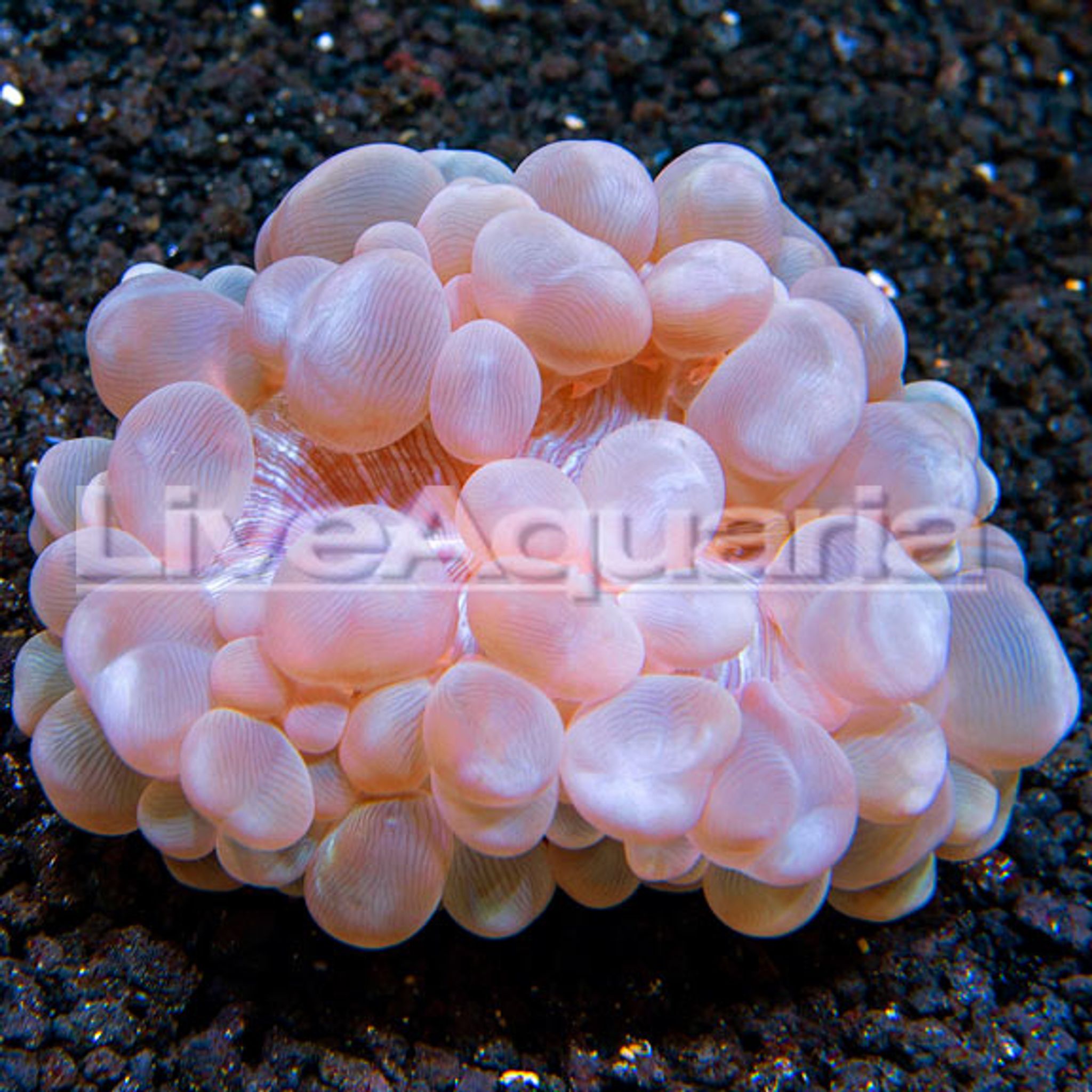
Bubble Coral Care Guide: Lighting, Flow, Feeding and Placement
Bubble coral is one of the most forgiving large polyp stony (LPS) corals for a stable reef tank, but many specimens sit deflated because of one avoidable setup mistake. This guide gives concrete PAR and flow numbers, a feeding routine, a placement system that protects tankmates from its sting, and a way to diagnose a coral that won't inflate.
What Is Bubble Coral?
"Bubble coral" is the common name for corals in the genus Plerogyra (most often Plerogyra sinuosa, also called bladder or grape coral) and the closely related genus Physogyra (Physogyra lichtensteini, sold as pearl or grape coral). Both belong to Euphylliidae, the same family as hammer, torch, and frogspawn corals.
During the day, the coral inflates grape-like, fluid-filled vesicles — modified tentacles that maximize surface area for light capture and house its symbiotic algae (zooxanthellae). At night, the vesicles deflate and long, thin sweeper tentacles extend to sting passing food and defend territory.
Plerogyra vs. Physogyra: What's the Difference?
Shoppers often see both sold simply as "bubble coral," so a quick comparison helps when choosing.
| Feature | Plerogyra (bubble coral) | Physogyra (pearl/grape coral) |
|---|---|---|
| Vesicle shape | Larger, elongated, grape-like bubbles | Smaller, rounder, tightly packed "pearls" |
| Vesicle size | Can inflate quite large | More compact and uniform |
| Skeleton | Distinct septa (ridges) when deflated | Similar septa, slightly finer |
| Care needs | Same lighting, flow, and feeding | Same lighting, flow, and feeding |
For care purposes the two are treated identically, so the rest of this guide applies to both.
Difficulty Level and Tank Size
Bubble coral is usually rated beginner-to-intermediate. It's hardy, tolerant of a range of parameters, and grows quickly for an LPS coral. That said, it isn't a true first coral: its sharp exposed skeleton and long nighttime sweeper tentacles make handling and placement riskier than a beginner-friendly soft coral, so it suits someone who already has a stable, cycled reef tank.
A tank of 30 gallons (about 113 liters) or larger is a sensible minimum — not because the coral itself is large, but because it gives room to keep a full 6-inch-plus buffer around it once inflated and its sweeper tentacles extend at night.
Lighting
Bubble coral wants low-to-moderate light, generally 50–150 PAR, with most specimens doing best around 80–130 PAR. Start a new coral conservatively at 75–100 PAR and adjust based on coloration and inflation.
- Paler or translucent specimens typically need less light than vividly pigmented ones — treat color as a guide to how much light a colony was grown under.
- Acclimate light gradually. Start the coral low in the tank or under a dimmed fixture, and increase intensity or height over 1–2+ weeks. A sudden jump — a new fixture, a higher shelf, a large dimmer change — can bleach tissue and stop inflation.
- Consistent daytime inflation and stable coloration are the best feedback for whether the level is right.
Browse LED lighting options for a fixture with enough dimming range for a slow, controlled acclimation.
Flow
Flow should be low-to-moderate and indirect or turbulent — never a direct jet aimed at the coral. The goal is a gentle, randomized sway across the vesicles, just enough to prevent detritus from settling on the exposed skeleton. Avoid placing bubble coral in the path of a powerhead or wavemaker, since direct flow is one of the most common reasons it stays closed around the clock, and reduce or pause flow at feeding time so movement doesn't blow food away.
A Note on Return Pumps for LPS Tanks
Tanks built around bubble coral and other Euphylliidae benefit from a controllable, adjustable pump rather than a fixed high-output AC pump. A DC-driven return pump, or one paired with a controller, lets you dial flow down where LPS corals sit while still moving enough water for filtration elsewhere. Pairing it with flow diffusers or rockwork-aimed outlets is usually the simplest way to get the soft, indirect flow bubble coral prefers.
Water Parameters
Bubble coral tolerates typical reef parameters well, but stability matters more than hitting an exact number — swings in salinity, alkalinity, or temperature are a common, underrated cause of a coral that won't inflate.
| Parameter | Target range |
|---|---|
| Temperature | 72–78°F (22–26°C) |
| Salinity | 1.024–1.026 SG |
| Alkalinity | 8–11 dKH |
| Calcium | 380–450 ppm |
| Magnesium | 1250–1350 ppm |
| Nitrate | ~2–10 ppm |
| Phosphate | ~0.02–0.05 ppm |
On nutrients, sources disagree on chasing near-zero readings versus a measurable baseline. The safer approach is low but not zero — ultra-low nutrients are linked to poor inflation and washed-out color, while moderate, stable readings support consistent polyp extension. Running a calcium reactor or heavy CO2 supplementation for alkalinity dosing? Also watch for pH swings, an under-discussed contributor to inflation problems.
Feeding
Bubble coral gets most of its energy from photosynthesis through its zooxanthellae, but it responds well to supplemental feeding 1–3 times per week. More isn't necessarily better — overfeeding risks nutrient spikes and can cause the coral to regurgitate food.
Good choices include mysis shrimp, brine shrimp, chopped clam, scallop, or silverside, and a prepared gel food or LPS/coral pellet. To feed: reduce or turn off flow nearby, then use a turkey baster or feeding tool to place small pieces directly onto the oral disc — the mouth — rather than broadcasting into the water column. Feeding at night, when tentacles are naturally extended, often gets the best response; restore normal flow once the coral has drawn the food in.
Explore freeze-dried and prepared foods sized appropriately for target-feeding LPS corals.
Placement
Bubble coral does best on a flat, level rock ledge in the lower-to-middle part of the tank, where light and flow are gentler. Avoid the sand bed — detritus collects against the base of the skeleton there and can cause tissue irritation or algae growth on exposed septa.
- Secure it firmly with reef-safe epoxy or putty — the skeleton is often top-heavy and irregular, and an unsecured colony can tip and crush its own tissue against the rock.
- Keep it level, since a tilted placement causes tissue to pool on one side and creates chronic stress even when light and flow are correct.
- As a colony matures and forms multiple heads, periodically check whether it's crowding its own space or a neighbor's, since growth over months can erase the safety margin you started with.
Spacing and Aggression
Bubble coral looks passive, but it's one of the more aggressive "peaceful-looking" LPS corals once the sun goes down. Its sweeper tentacles extend at night to sting anything within reach — commonly 5–6 inches, with 8–12 inches a safer margin for larger colonies or anything downstream of its flow. Leave at least 6 inches of clear space from other corals and sessile invertebrates in every direction, planned around mature size and tentacle reach rather than the current frag-sized footprint, and keep it separated from other sweeper-tentacle Euphylliidae — hammer, torch, frogspawn.
Fish compatibility is generally good: bubble coral is reef-safe toward fish aside from species known to pick at LPS polyps, such as some angelfish and butterflyfish. Its risk is directed almost entirely at neighboring corals and soft-bodied invertebrates, not fish.
Galaxea: A Related Coral to Keep Further Away
Galaxea fascicularis is a different stony coral sometimes displayed near bubble coral or confused with it, and it's worth mentioning because it's considerably more aggressive. Galaxea wants similar moderate light (roughly 100–200 PAR) and flow, but its sweeper tentacles can reach 6–12 inches — longer than bubble coral's, so treat it as needing even more distance, not an interchangeable tankmate. Browse LPS hard corals to compare species and space requirements before finalizing your layout.
Handling and Quarantine
The exposed white skeleton (the septa) is sharp, and fleshy tissue tears easily against it. Never squeeze or grip the skeleton, and handle the coral only when deflated if possible; gloves help during frag work. Any puncture is an entry point for infection that can kill the polyp, or the whole colony if it spreads.
Before adding a new specimen to a display tank, run it through a brief quarantine and dip protocol: a short soak in a coral or iodine-based dip, a visual check for flatworms, torn tissue, or receding flesh, and a quarantine period apart from the main tank. This matters more for wild-collected pieces than captive-propagated frags, which carry lower disease risk, but it's cheap insurance either way.
Growth and Propagation
Bubble coral grows fairly quickly for an LPS species. Once a colony develops multiple "heads," it can be fragged by cutting through the skeleton between heads — the same technique used for hammer and torch coral. Let fresh cuts heal in a low-flow, low-light area before moving fragments to permanent spots.
Troubleshooting: Why Won't My Bubble Coral Inflate?
A bubble coral deflated for more than a few days is signaling a problem. Work through this checklist in order, from most to least likely cause:
- Light first. Is PAR above roughly 130–150, or was there a recent fixture change or move higher in the tank without a gradual ramp-up?
- Flow second. Is a powerhead or wavemaker aimed directly at the coral? Direct flow is the single most common cause of chronic non-inflation.
- Parameter stability third. Check recent trends in salinity, alkalinity, and temperature — a swing over the past few days matters more than the current reading.
- Acclimation lag last. A newly introduced coral can take days to a couple of weeks to settle in. If the other three check out, patience is the right answer before assuming disease.
Other Common Mistakes
- Placing corals too close together, causing sting marks or tissue recession from repeated nightly contact.
- Overfeeding, which spikes nutrients and can cause regurgitation.
- Rough handling during acclimation or frag work that punctures the skeleton.
- Algae on exposed skeleton, usually a sign of chronic deflation — fix the cause and clean manually.
- Buying visibly diseased stock — inspect for torn tissue, receding flesh, or flatworms before purchase.
Frequently Asked Questions
Is bubble coral easy for beginners?
Generally yes among LPS corals — hardy and forgiving on parameters. But the handling risk from its sharp skeleton and its sweeper-tentacle sting make it better suited to someone with an already-stable reef tank than a first coral in a new system.
How much light does bubble coral need?
Low-to-moderate light, roughly 80–130 PAR. Start new specimens at the low end (75–100 PAR) and acclimate upward over one to two weeks or more, watching coloration and inflation.
Does bubble coral need strong flow?
No. It prefers low, indirect, turbulent flow over strong or direct current. A powerhead or wavemaker aimed straight at it is one of the most common reasons it stays closed.
What do you feed bubble coral?
Small meaty foods such as mysis or brine shrimp, or chopped clam, scallop, or silverside, plus prepared coral foods. Target-feed the mouth one to three times a week, pausing flow nearby so food isn't swept away.
Why is my bubble coral not inflating?
Check light intensity, then flow, then recent parameter stability, in that order — these cover most cases. If all three check out and the coral was introduced recently, give it time; acclimation lag can last days to a couple of weeks.
How far apart should bubble coral be from other corals?
At least 6 inches in every direction, leaning toward 8–12 inches for larger colonies or anything downstream of its flow. Sweeper tentacles extend at night and reach further than the daytime footprint suggests.
Can bubble coral be fragged?
Yes. Once a colony develops multiple heads, it can be fragged by cutting the skeleton between heads, the same approach used for hammer and torch coral.
Final Thoughts
Most bubble coral problems trace back to light that's too intense, flow that's too direct, or parameters that aren't stable — check those before assuming illness. Get placement and spacing right, feed in moderation, and this coral rewards you with steady growth and daily inflation. Browse FishyHub's marine corals to compare available bubble coral specimens and other LPS options.

