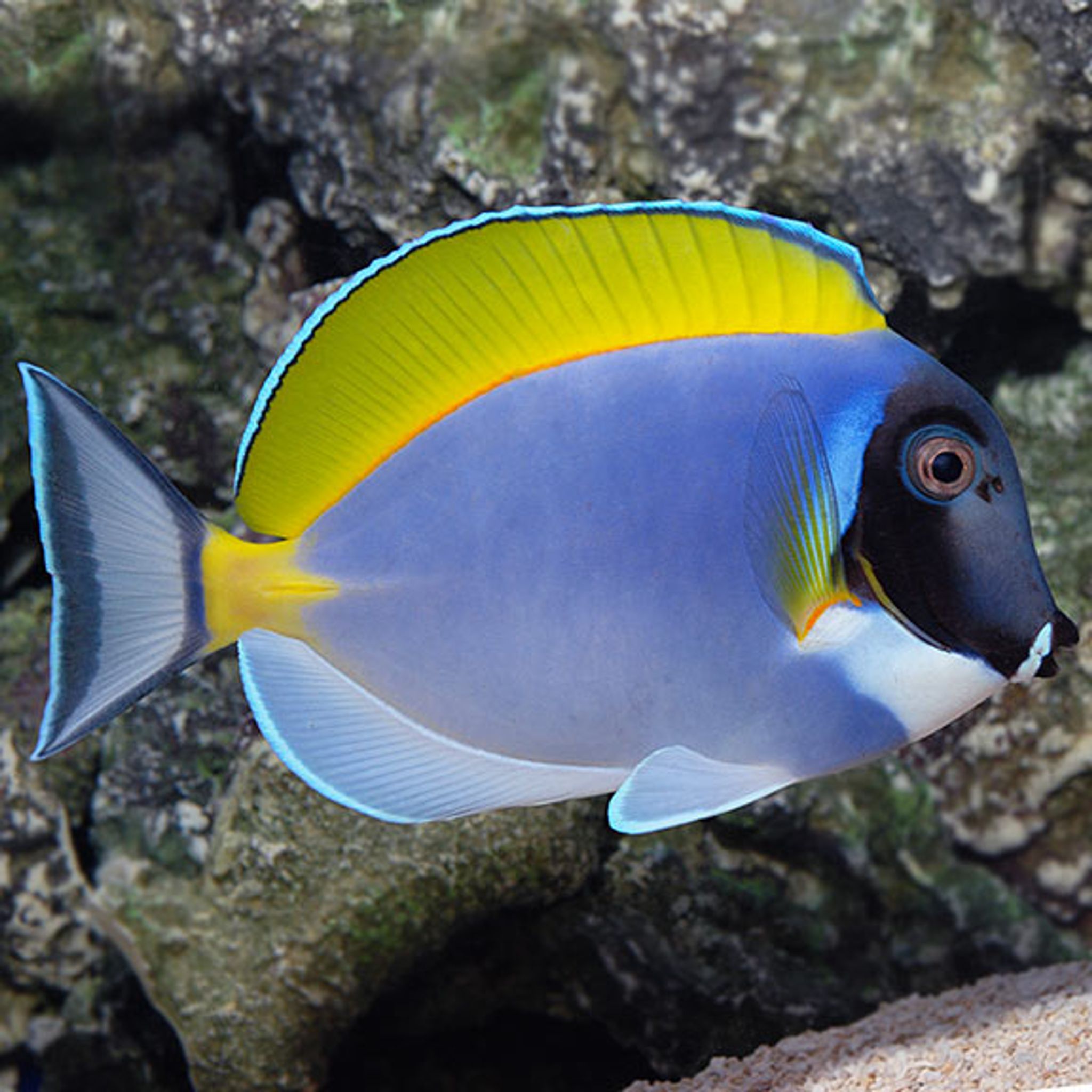
Blue Tang Care Guide: Tank Size, Diet, Compatibility and Reef Safety
Blue tangs are sold as 1–3 inch juveniles that fit in almost any tank, but they grow into 10–12 inch adults that need serious swimming room. This guide covers real adult tank sizing, a daily feeding plan, which tankmates actually work, and why this species needs a stricter quarantine routine than most reef fish.
Species Snapshot
The blue tang (Paracanthurus hepatus) is also sold as the Blue Hippo Tang, Regal Tang, Palette Surgeonfish, or simply Hippo Tang. Its bright blue body, black "palette" markings, and yellow tail made it one of the most recognizable reef fish in pop culture, which drives a lot of impulse purchases from buyers who haven't planned for its adult size.
- Adult size: 10–12 inches is typical in captivity, with reports up to 12–13 inches in the wild.
- Lifespan: 20–30 years is the well-supported captive range; some sources cite 30–45 years under ideal, well-fed conditions, but treat that as an optimistic outlier rather than a planning number.
- Juvenile appearance: Small juveniles are more vividly colored, shy, and stay close to rockwork for cover.
- Adult behavior: As they grow, blue tangs become bolder open-water swimmers, and territoriality increases with size.
Real Adult Tank Size (Not the Juvenile Myth)
This is the single most important thing to get right before buying a blue tang. A 1–2 inch juvenile can look comfortable in a 40 or 55 gallon tank, but that same fish is on track to need six times the space within a couple of years.
- 180 gallons (ideally in a "6-foot standard" footprint) is the honest minimum for a full-grown adult. The length matters as much as the volume — blue tangs are active lateral swimmers and need a long horizontal run, not just tall water.
- 120–125 gallons can work as a temporary juvenile setup, but only with a concrete upgrade plan already in place. Treat it as a compromise floor, not a permanent home.
- Sources you'll find elsewhere range anywhere from 120g to 180g as "minimum." The honest reading of that range: 180g is the real adult target, and anything smaller is a stopgap.
Bioload and Flow: What the Size Numbers Leave Out
Gallon figures alone don't capture what an adult tang actually needs. As active, high-oxygen-demand reef-edge swimmers, they do best with strong, turbulent water movement and high dissolved oxygen — not just a big box of water. When sizing a pump and skimmer for a tang-stocked system, aim for flow and filtration capacity rated well above the bare minimum for the tank's volume, and prioritize surface agitation and gas exchange alongside horizontal flow.
Are You Ready for a Blue Tang? A Quick Self-Check
Before buying, run through this checklist — nearly every care source calls this species "not beginner friendly," but few explain exactly why:
| Readiness factor | What you need |
|---|---|
| Tank maturity | Established 3–6+ months, fully cycled |
| Tank size (or upgrade plan) | 180g target, 120–125g only as a documented interim step |
| Filtration | Sump-based system with a quality protein skimmer |
| Keeper experience | Comfortable diagnosing and treating marine ich |
| Quarantine setup | A separate QT tank ready before the fish arrives |
| Existing livestock | No aggressive tangs, triggerfish, or large angelfish already established |
If you're missing more than one of these, it's worth building out the system first and browsing FishyHub's tangs and surgeonfish selection once your setup is ready rather than buying to "grow into" the tank.
Water Parameters
Blue tangs aren't unusually fussy about parameters, but they are sensitive to instability.
| Parameter | Target range |
|---|---|
| Temperature | 75–79°F (24–26°C) — treat stability as more important than the exact number |
| Specific gravity | 1.020–1.025 |
| pH | 8.1–8.4 |
| dKH | 8–12 |
| Nitrate / Phosphate | Near zero |
You'll see temperature ranges quoted anywhere from 72–78°F to 75–82°F depending on the source. Splitting the difference at 75–79°F gives a stable middle target that avoids both cold-stress and the metabolic stress of running warm.
Filtration and Equipment
- Sump-based filtration is strongly preferred over a hang-on-back setup — an adult tang's bioload and flow needs typically outgrow HOB capacity.
- A quality protein skimmer is essential, not optional.
- Live rock provides both biological filtration and a grazing surface for natural algae browsing.
- The tank should be mature (3–6+ months) before a blue tang is introduced — this is not a starter fish for a brand-new system.
Diet: Vegetable-Forward, Fed Daily
Blue tangs are omnivorous algae grazers by nature, and diet quality directly affects their immune strength, coloration, and even aggression level.
- 70–80% of the diet should be vegetable matter: nori, dried seaweed, spirulina-based foods, macroalgae, and blanched zucchini, spinach, or romaine.
- The remaining portion should be meaty protein: mysis shrimp, brine shrimp, or occasional chopped seafood.
- Use a veggie clip or feeding rock to present greens in a way that mimics natural grazing.
- Feed vegetable matter daily or near-daily — not just 2–3 times a week. Some sources treat a few weekly feedings as adequate, but given how quickly this species declines nutritionally, daily grazing opportunities are the safer standard.
Underfeeding vegetable matter is one of the most common mistakes with this species, and it directly contributes to a condition covered below: Head and Lateral Line Erosion.
Temperament and Compatibility
Blue tangs are generally one of the more peaceful tang species toward non-tang tankmates, but they become territorial and aggressive toward their own kind and other tangs — especially in tanks under roughly 150–180 gallons.
Good tankmates: clownfish, gobies, firefish, small peaceful damsels, and other non-tang reef fish.
Avoid: large aggressive angelfish, triggerfish, dottybacks, maroon clownfish, and other tang species unless the tank is very large.
FishyHub's clownfish selection is a common, well-matched pairing for a blue tang display once the tank is large enough.
Can You Keep Two Blue Tangs Together?
Most tangs are intolerant of conspecifics, full stop. Blue tangs are an occasional exception — they can sometimes shoal or tolerate each other if introduced simultaneously as juveniles in a large enough tank. This is inconsistent and risky to rely on. The safe default is one blue tang per tank, with simultaneous juvenile introduction treated as an advanced, not-guaranteed technique. Adding a second tang into an already-established territory, even another blue tang, tends to trigger serious aggression.
Reef and Invert Safety
Blue tangs are considered reef-safe. They won't eat coral polyps or most ornamental invertebrates, and their grazing habit actually helps control nuisance algae in a reef display.
The caveat: a hungry or underfed blue tang may occasionally nip at large-polyp corals or clam mantles. The fix is prevention, not tolerance — keep them well-fed on vegetable matter and this behavior is rarely an issue.
Why Blue Tangs Get Sick So Easily
Blue tangs are notably more disease-prone than many other tangs. Like other surgeonfish, they're "dry-skinned," meaning they carry a thinner slime coat than many reef fish — one reason they're more vulnerable to external parasites. New arrivals are especially at risk during the stress of shipping and acclimation.
Slow Down Acclimation for This Species
Because blue tangs are unusually stress-sensitive, they benefit from a slower, longer drip acclimation than hardier fish — rushing temperature and salinity adjustment right after shipping compounds the stress that makes them vulnerable to disease in the first place. Dim lighting and minimal handling during this window also help.
Marine Ich (Cryptocaryon irritans) Explained
Marine ich is the parasite blue tangs are most commonly associated with.
- What it is: a protozoan parasite that embeds in the fish's skin and gills.
- Why tangs are prone to it: their thin slime coat offers less natural protection than many other reef fish.
- Symptoms: small white spots on the body and fins, scratching or flashing against rock and substrate, and rapid or labored breathing.
- Important myth to bust: raising tank temperature does not kill marine ich, unlike the freshwater ich strain. Treating Cryptocaryon requires an actual parasiticide protocol or a tank-transfer/fallow approach — not a heater adjustment.
Other Diseases to Watch For
Ich isn't the only threat. Blue tang keepers should also know:
- Marine velvet (Amyloodinium): a fast-acting parasite that can present as a fine gold or dust-like coating on the skin.
- Brooklynellosis: a fast-moving disease marked by excess mucus production and rapid decline.
- Marine flukes: external parasitic worms that cause flashing, scratching, and irritation similar to early ich.
| Symptom | Likely issue |
|---|---|
| Small white spots on body/fins | Marine ich (Cryptocaryon) |
| Fine gold or dust-like coating | Marine velvet (Amyloodinium) |
| Heavy mucus coat, rapid decline | Brooklynellosis |
| Flashing/scratching without visible spots | Marine flukes |
| Pitting on the face or lateral line | Head and Lateral Line Erosion (HLLE) |
Head and Lateral Line Erosion (HLLE)
HLLE shows up as pitting along the face and lateral line and is linked to poor diet — specifically a lack of vegetable matter and vitamins — and sometimes to low-quality activated carbon in the filtration path. The good news: it's generally reversible with improved nutrition (daily greens) and better water quality, which is another reason the feeding guidance above isn't optional.
Quarantine Protocol: The Non-Negotiable Step
Skipping quarantine is treated as the single biggest cause of ich outbreaks in blue tangs specifically. A dedicated quarantine tank lets you observe feeding and behavior, catch and treat problems before they reach the display, and avoid risking an entire established reef.
- Duration: recommendations range from 2 weeks (medication-focused approaches) to 4–6 weeks (biosecurity-focused approaches). 4 weeks is a practical minimum, extended further if any symptoms appear during observation.
- A brief freshwater or medicated dip during transfer can knock down external parasites before the fish even enters quarantine.
Choosing a Quarantine Treatment
Whether inverts are present in your display tank determines which quarantine medication path makes sense, since the quarantine tank itself should be bare (no rock, no inverts) regardless of the method:
| Situation | Recommended approach |
|---|---|
| Fish-only system, no inverts anywhere | Copper-based medication — effective, but toxic to inverts and never usable in a reef display |
| Reef display with corals/inverts | Chloroquine phosphate in quarantine — a gentler, reef-safer profile; common dosing starts lower and is raised after 24 hours, sustained for about 2 weeks |
| Preference for a milder option | A copper-free "reef-safe" ich treatment in quarantine |
If Ich Reaches the Display Tank
Once ich is established in a display with live rock, corals, or inverts, copper is off the table entirely — it will kill your invertebrates and disrupt your rock's biology. Your two realistic options:
- Tank-transfer method: moving the fish through a series of bare tanks on a schedule to break the parasite's lifecycle.
- Fallow period: leaving the display without fish hosts for several weeks so the parasite dies off from lack of hosts.
Decide upfront whether your system is fish-only or reef, since that choice dictates which treatment path is actually available to you.
Aquarium Biosecurity Basics
- Use dedicated nets and siphons per tank rather than sharing equipment between quarantine and display.
- Wash and sanitize hands between handling different tanks.
- Source from quarantined, reputable suppliers to reduce the chance of introducing pathogens in the first place.
Selecting a Healthy Specimen
- Favor a specimen 3+ inches rather than the smallest juveniles — smaller fish are cheaper but carry more health risk.
- Confirm it is already actively eating before purchase.
- Look for clear eyes and intact fins.
- Avoid any fish showing spots, clamped fins, or labored breathing.
Similar Species: Don't Confuse Your "Blue Tang"
Search demand often conflates several different fish under the "blue tang" name. Here's how they differ:
| Species | Key traits | Tank needs |
|---|---|---|
| Blue/Hippo Tang (Paracanthurus hepatus) | Blue body, black palette pattern, yellow tail | 180g adult target |
| Sohal Tang | Bold black-and-white stripes, very aggressive | 200g+ |
| Mimic Tang | Juveniles mimic dwarf angelfish coloration for camouflage/protection | Similar to blue tang |
| Atlantic (Ocean) Blue Tang | Different genus, native to the Western Atlantic — not the same species despite the name | Varies; a different care profile |
If you searched "blue tang" and found an unfamiliar Atlantic species, note that it's genetically and geographically distinct from the Pacific hippo tang covered in this guide, even though the common name overlaps.
If you decide the tank, equipment, and quarantine plan are ready, you can browse live blue tangs and other tangs and surgeonfish on FishyHub, along with reef-safe medications for quarantine in the treatment and medication category.
Frequently Asked Questions
How big of a tank does a blue tang actually need?
A full-grown adult needs 180 gallons, ideally in a 6-foot-long footprint for lateral swimming room. A 120–125 gallon tank can work as a temporary juvenile setup only if you have a concrete plan to upgrade.
How big do blue tangs get?
Typically 10–12 inches in captivity, with occasional reports of slightly larger specimens.
Are blue tangs reef safe?
Yes — they don't eat coral polyps or most ornamental invertebrates and help control nuisance algae. A hungry or underfed specimen may occasionally nip at large-polyp corals or clam mantles, so keep them well-fed on vegetable matter.
Can you keep two blue tangs together?
It's risky. Blue tangs are generally intolerant of their own kind, though simultaneous introduction of juveniles in a large tank is an inconsistent exception. The safe default is one blue tang per tank.
Why do blue tangs get sick so easily?
Their thin slime coat offers less natural protection against parasites than many reef fish, and they're especially stress-sensitive right after shipping and acclimation — a combination that makes them prone to marine ich and other parasitic diseases.
What do blue tangs eat?
Mostly vegetable matter — nori, spirulina, and macroalgae — making up 70–80% of the diet, fed daily via a veggie clip or feeding rock, plus occasional meaty protein like mysis or brine shrimp.
How long do blue tangs live?
20–30 years is the well-supported captive range. Some sources claim 30–45 years under ideal, well-fed conditions, but that's an optimistic outlier rather than a planning baseline.
Do I need to quarantine a blue tang before adding it to my display?
Yes. Given this species' unusual susceptibility to marine ich, 4 weeks is the safe minimum quarantine period, extended if any symptoms appear during observation.

