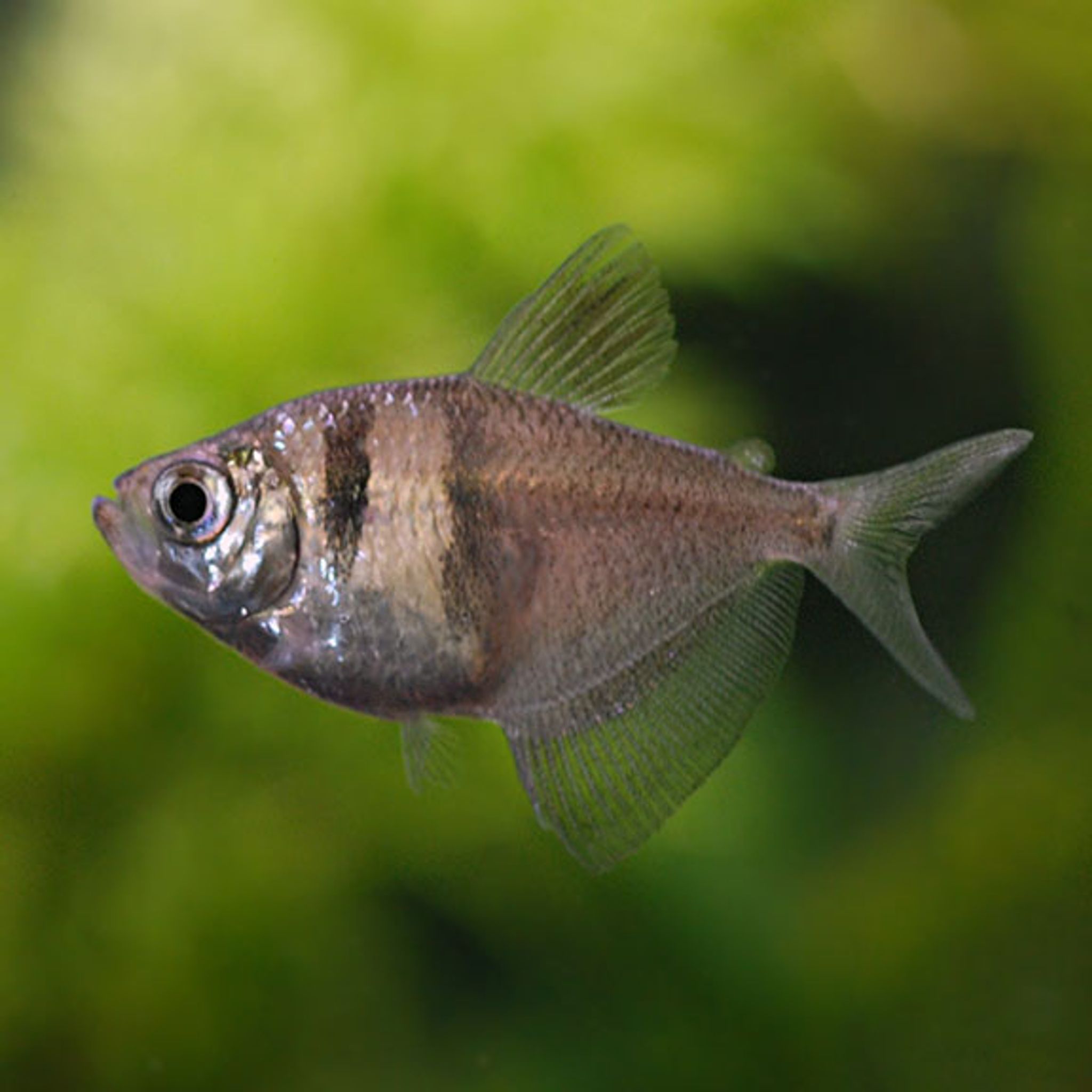
Black Skirt Tetra Care Guide: Tank Size, Diet, Water Parameters and Temperament
Black skirt tetras are hardy, inexpensive and forgiving of the moderately hard tap water found in much of the US, which makes them a solid beginner fish. Keep at least 6 in a 20-gallon long or larger tank at 72–78°F and feed a protein-leaning diet. The one catch is fin-nipping: they need a big enough group and should never share a tank with bettas, angelfish or other long-finned, slow fish.
Black Skirt Tetra at a Glance
| Trait | Recommendation |
|---|---|
| Scientific name | Gymnocorymbus ternetzi |
| Adult size | 2–2.5 in (5–6 cm), occasionally near 3 in (7.5 cm) |
| Lifespan | 3–5 years, sometimes longer |
| Minimum group | 6, ideally 8–10+ |
| Tank size | 20 gal (76 L) long recommended; 15 gal (57 L) absolute minimum for 6 |
| Temperature | 72–78°F (22–26°C) target; 70–85°F (21–29°C) survivable |
| pH | 6.0–7.5 ideal, up to about 8.0 tolerated |
| Hardness | 4–15 dGH, KH roughly 4–8 dKH |
| Diet | Omnivore that prefers protein |
| Temperament | Active, semi-aggressive toward long fins |
| Care level | Easy |
What Is a Black Skirt Tetra?
The black skirt tetra is a characin native to the Paraguay and Paraná river basins and southern Brazil. You will also see it sold as the black widow tetra, petticoat tetra or blackamoor. These are all the same fish.
It has a deep, silver-gray body with two dark vertical bars just behind the gill cover and a large black anal fin that flares out like a skirt. Because the body is tall rather than slender, a black skirt carries noticeably more bulk than a neon tetra of similar length.
Color changes with age
Juveniles are the darkest. As the fish matures, that inky black naturally softens toward gray, which is normal and not a sign of illness. Stress, poor water, bright lighting and pale gravel can also wash out the color, so a sudden fade in a young fish is worth investigating.
Varieties you will see in US stores
- White skirt tetra: A pale, leucistic line with identical care.
- Long-fin black skirt: Flowing fins slow these fish down, and they tend to get nipped by their own shortfin cousins. Keep long-fin types together.
- GloFish tetras: Genetically modified fluorescent black skirts. Care is the same, and a blue actinic light is optional, not required. They are legal in most US states but not all; California has had restrictions in the past, so check your state's current rules before buying.
- Dyed or injected fish: An older practice that harms the fish. Avoid any tetra that has been artificially colored.
Tank Size and Setup
20 gallons long is the practical minimum. A 15-gallon tank can hold a group of 6 if you are experienced and keep up with maintenance, but it leaves little margin. For 10 or more, or a mixed community, go to 30 gallons (114 L).
Footprint matters more than total gallons. Black skirts are fast swimmers, and a long tank gives them room to chase and school without cornering tankmates. A tall 20-gallon tank with the same volume but less length usually produces more nipping.
Setup checklist
- Dark substrate to deepen their black coloration.
- Planted edges and background with stem plants, java fern and anubias, plus driftwood for cover.
- Open water in the middle, since they spend most of their time in the middle and upper levels.
- Moderate or dimmed lighting; floating plants help.
- Gentle to moderate flow from a hang-on-back, canister or sponge filter.
- A tight-fitting lid, because they can jump.
- A heater, which most US homes need to hold a steady temperature.
Stocking examples
| Tank | Example stocking |
|---|---|
| 20 gal long | 6–8 black skirts + 4–5 corydoras |
| 30 gal | 10 black skirts + 6 harlequin rasboras + 5 corydoras |
| 40 gal breeder | 10–12 black skirts + 6 zebra danios + 6 kuhli loaches + 1 bristlenose pleco |
Treat these as starting points. Heavier stocking needs more filtration and more frequent water changes.
Water Parameters
| Parameter | Target |
|---|---|
| Temperature | 72–78°F (22–26°C) |
| pH | 6.0–7.5 (tolerates up to ~8.0) |
| General hardness | 4–15 dGH |
| Carbonate hardness | ~4–8 dKH |
| Ammonia / nitrite | 0 ppm |
| Nitrate | Under 20–40 ppm |
Some keepers quote a range as wide as 70–85°F. Black skirts will survive those extremes, but long-term health is better at 72–78°F. For most households, a heater set to about 74–76°F works well.
US tap water
Most municipal tap water in the US is fine for black skirts without RO. Read your city's annual water quality report to see typical pH and hardness, and always use a dechlorinator that handles chloramine. Even if your tap runs slightly above pH 7.5, these fish adapt well. Steady conditions matter more than hitting a precise number, so skip pH-adjusting chemicals that cause swings.
Maintenance
- Cycle the tank fully before adding fish; never drop a full school into a new, uncycled tank.
- Change 25–30% of the water weekly, or every other week in lightly stocked tanks.
- Test ammonia, nitrite and nitrate regularly, especially in the first months.
Diet and Feeding
Some sources call black skirts carnivores, but they are best treated as omnivores that lean toward protein.
- Staple: A quality micro-pellet or flake.
- Meaty extras, a few times a week: Frozen or live bloodworms, brine shrimp, daphnia and mosquito larvae. Freeze-dried versions work as a backup.
- Occasional greens: A plant-based flake now and then is fine, though they prefer protein.
Feed 1–2 times a day, offering only what the group eats in about 2 minutes. Overfeeding fouls the water and can lead to bloating and swim bladder trouble.
Temperament and Tankmates
Black skirts are active and mostly peaceful toward fish of similar size and speed. Their reputation comes from nipping slow, long-finned fish. The behavior gets much worse when they are kept in small groups or cramped tanks. In a school of 8–10, most of the chasing stays within the group.
Good tankmates
- Other medium tetras (serpae tetras are nippy themselves and best avoided)
- Harlequin and other rasboras
- Danios
- Short-finned barbs
- Platies and mollies
- Corydoras and bristlenose plecos
- Kuhli loaches
- Dwarf gouramis, with observation for nipping
Bottom dwellers like corydoras are a natural fit because they use a level of the tank black skirts ignore.
Fish to avoid
- Bettas
- Fancy guppies
- Angelfish
- Long-finned fancy goldfish (which also need cooler water)
- Any fish large enough to swallow a 2-inch tetra
Adults will also eat shrimplets, so a breeding shrimp colony is not a good match.
Male vs Female
- Females are larger with a rounder, fuller belly.
- Males are slimmer, with a broader or longer anal fin and sometimes a more pointed dorsal. Some males show small white spots on the tail.
Breeding Black Skirt Tetras
Black skirts are among the easiest tetras to spawn, which makes them a good first egg-scatterer project.
- Set up a 10–20 gal breeding tank with soft, slightly acidic water at about 80–84°F (27–29°C), dim light, and fine-leaved plants or a spawning mop.
- Condition the pair on live or frozen foods.
- Let them spawn. A female can scatter hundreds up to about 1,000 eggs.
- Remove the adults right away, as they will eat the eggs.
- Hatching: Eggs hatch in about 1–2 days, and fry swim freely a few days later.
- Feed fry infusoria first, then baby brine shrimp.
Health and Common Mistakes
Black skirts are hardy, but ich, fin rot, fungus and bacterial infections appear when water quality slips. Lifespans shorter than 3 years usually point to husbandry problems rather than the species.
Acclimating big-box store fish
Float the bag to match temperature, then add small amounts of tank water over 20–30 minutes before netting the fish in. Quarantine new arrivals for 2–4 weeks in a separate tank so any disease shows up before it reaches your display.
Troubleshooting
| Problem | Likely cause | Fix |
|---|---|---|
| Constant nipping and hiding | Group of 2–3 | Increase to 6+ |
| Torn fins on a betta or angelfish | Wrong tankmates | Separate or rehome |
| Color fading | Age, stress, bright light, pale substrate | Test water, add cover, dim lights |
| Clamped fins or white spots | Poor water, ich | Test water; for ich, raise heat gradually to about 82–86°F and medicate |
| Bloating | Overfeeding | Skip 1–2 days, then feed less |
| Sudden deaths after setup | Uncycled tank | Cycle before stocking; test daily |
Similar Tetras Worth Knowing
| Species | Adult size | Min. tank | Notes |
|---|---|---|---|
| Black phantom tetra | 1.5–1.8 in | 20 gal for 6 | Black shoulder spot; males spar harmlessly; milder nippers; 72–82°F, pH 6.0–7.5 |
| Blind cave / Mexican tetra (Astyanax mexicanus) | 3–4 in | 30 gal+ | Eyeless and sighted forms of one species; about 68–77°F, harder water; senses water movement; dim light; can nip; 5+ years |
| Red eye tetra (Moenkhausia sanctaefilomenae) | 2.5–3 in | 30 gal | Hardy; peaceful in groups of 5–6+, nippy alone; may nibble soft plants |
| Penguin tetra (Thayeria boehlkei) | 2–2.5 in | 10–20 gal | Stripe runs into lower tail lobe; swims tail-down; 72–82°F, pH 6.0–7.0 |
Other lookalikes include the red-finned Colombian tetra (fairly boisterous) and the costae tetra. The bucktooth tetra is a scale-eater and too aggressive for community tanks.
Best tetras for beginners
Black skirts rank among the hardiest tetras, alongside serpae, black phantom, glowlight and rummynose tetras. Neons and cardinals are more delicate and do better in an established tank.
How long do tetras live?
Most small tetras live 3–5 years. Larger, tougher species such as blind cave and red eye tetras can reach 5–8 years.
Frequently Asked Questions
Are black skirt tetras aggressive?
They are semi-aggressive only toward slow, long-finned fish. With similar-sized, quick tankmates they are generally peaceful. A large school of 8–10 spreads most of the nipping among themselves.
Can black skirt tetras live with bettas?
It is not recommended. A betta's long fins and slow swimming make it a prime target, and the stress and fin damage can lead to infection. Give a betta its own tank or peaceful, non-nipping companions.
How many black skirt tetras can go in a 20-gallon tank?
About 6–8 in a 20-gallon long, plus a few bottom dwellers such as corydoras. A long footprint is better than a tall one for this active species.
Do black skirt tetras need a heater?
Yes, in most US homes. Room temperature often drops below their comfort range at night or in winter. Set the heater to about 74–76°F.
Why is my black skirt tetra turning gray?
Some graying is normal as the fish ages. In a younger fish, fading usually signals stress, poor water quality, bright lighting or a pale substrate. Test the water first, then add cover and dim the lights.
Are GloFish tetras the same fish, and will they eat shrimp or plants?
GloFish tetras are genetically modified black skirts with the same care needs. Black skirts of any color will eat shrimplets but mostly leave plants alone.
Stock Your Tank
Black skirt tetras reward a well-sized group, a long tank and stable water with years of lively schooling. When you are ready to plan your school, browse the tetra selection on FishyHub, and round out their diet with options from Food & Supplements.

