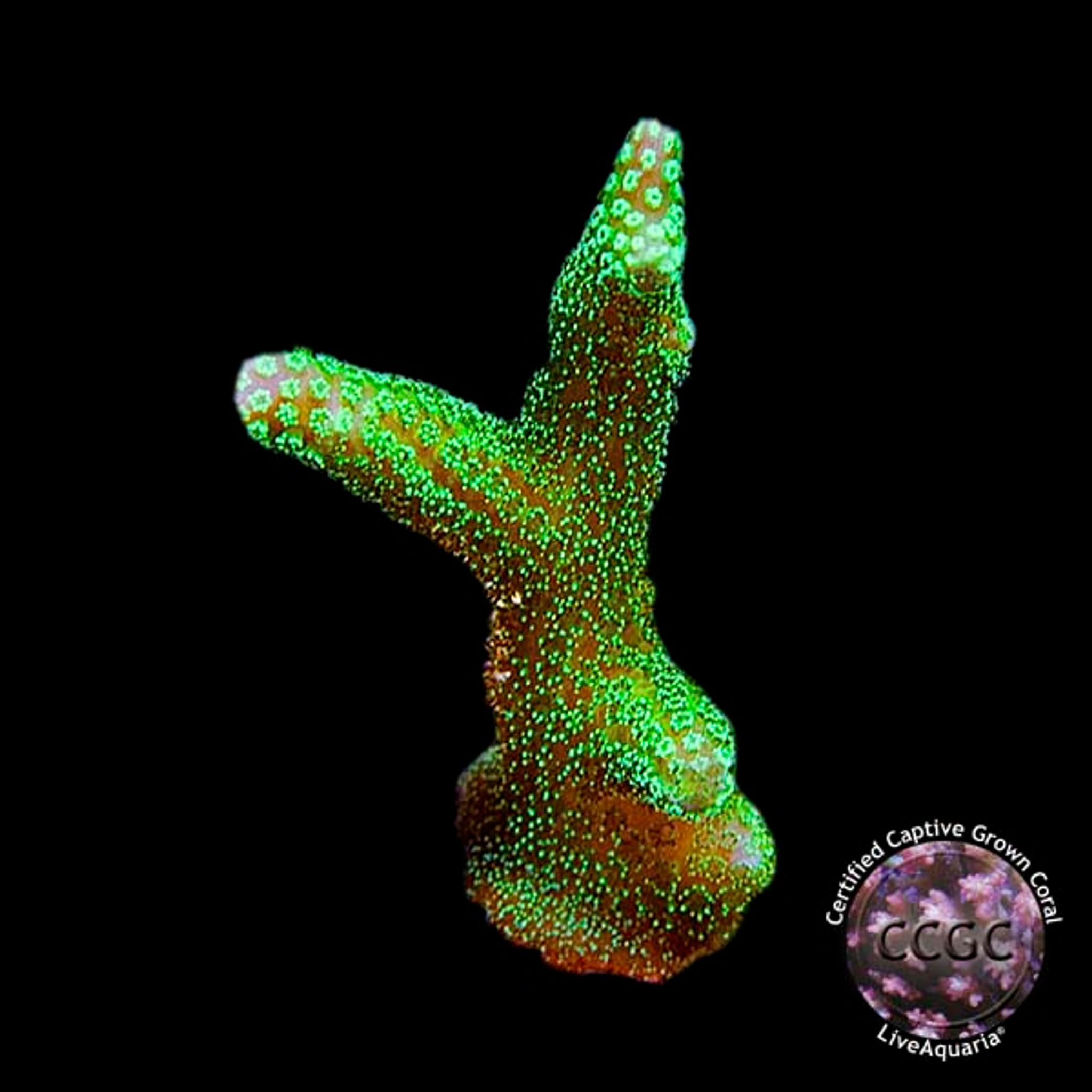
Birdsnest Coral Care Guide: Lighting, Flow, Feeding and Placement
Birdsnest coral (Seriatopora species) is often called a gateway small-polyp stony (SPS) coral because it grows quickly and tolerates a wider margin of error than an Acropora. That reputation is only half the story — birdsnest still needs a mature, chemically stable reef tank, not a beginner setup fresh out of cycling. This guide covers the lighting, flow, feeding, placement and water-chemistry targets that keep a colony encrusting and branching rather than bleaching.
What Is Birdsnest Coral
Birdsnest, also sold as brush, needle, or finger coral, belongs to the genus Seriatopora — a small-polyp stony coral with tiny, tightly packed polyps covering a rigid, calcium-carbonate skeleton. Like other SPS corals, it generally demands brighter light, stronger water movement, and tighter chemical stability than soft corals or large-polyp stony (LPS) corals. Within that category, birdsnest is one of the more forgiving entry points, which is why it's frequently recommended to hobbyists moving from softies and LPS into their first SPS.
Is Birdsnest Coral Right for Your Tank?
The honest framing is: birdsnest is easy to grow once conditions are right, but demanding about stability. Some care sheets call it "moderate care," while others note it can be surprisingly touchy — both are correct, depending on whether the tank underneath it is actually mature.
Tank maturity matters more than any single parameter. Add it to an immature system and you're likely to see unstable parameters and early tissue dieback. As a baseline:
- Wait until the tank has been stable for at least 6 months post-cycle before adding birdsnest.
- Many experienced reefers prefer 12–18 months of documented stability before introducing SPS at all.
- A smaller tank with a strong maintenance routine can outperform a larger tank running on autopilot — but larger, more mature systems still buffer swings more easily.
Tank Size and Water Parameters
A nano reef can house birdsnest, but the number that matters most is stability, not gallons.
| Parameter | Target range |
|---|---|
| Tank size | 10–15 gallons (38–57 L) minimum, larger is more forgiving |
| Temperature | 74–83°F (23–28°C), core range ~76–80°F (24–27°C) |
| Salinity | 1.023–1.025 SG (roughly 32–35 ppt) |
| pH | 8.1–8.4 |
| Calcium | 400–450 ppm |
| Alkalinity (KH) | 8–12 dKH |
| Magnesium | ~1,300–1,350 ppm |
| Nitrate | Under ~5–10 ppm, but not zero |
| Phosphate | Near-undetectable, but not absolute zero |
Zero nutrients aren't the goal. Chasing nitrate and phosphate down to absolute zero to hit an "SPS-safe" number can starve corals of the trace nutrition they need, leading to paling or stalled growth. A small, measurable amount of both is healthier than nothing at all.
Lighting for Birdsnest Coral
Birdsnest wants moderate to moderately-high light — noticeably less demanding than Acropora, but still more than most soft corals need. LED, T5, or metal halide fixtures all work.
- Target roughly 100–250 PAR, adjusted for the specific variety and how deep it sits in the tank.
- Some deep-water color morphs tolerate meaningfully lower light than shallow-water forms.
- There isn't one universal PAR number — color and growth response over the first few weeks tell you more than any chart. Starting moderate and watching the coral is the safer default over chasing a single figure.
A Simple Placement-by-Light Chart
| Position in tank | Approximate PAR | Notes |
|---|---|---|
| Top third / high shelf | 200–250 | Best for shallow-water color morphs |
| Mid-water column | 120–200 | Good general-purpose placement for most colonies |
| Lower third / shaded ledge | 80–120 | Suits deep-water morphs or newly acclimated frags |
Always acclimate to light gradually. Start new frags near 50% of your fixture's target intensity and ramp up over 1–2+ weeks. Sudden increases in light are one of the most common causes of bleaching in an otherwise healthy colony.
General Reef Lighting Notes
Regardless of species, most reef tanks run 9–12 hours of light followed by a genuine dark period. LEDs have largely replaced metal halide and T5 for efficiency and spectral control, though both older technologies still work. Shallow-water corals generally favor a more even blue/white spectrum, while deeper-water species respond better to a bluer-shifted spectrum. You can browse LED lighting suited to SPS-capable setups on FishyHub.
Flow Requirements
Birdsnest wants moderate to moderately strong flow, ideally random and multidirectional rather than a single laminar jet aimed at the colony.
- Good flow keeps detritus off the branches and delivers dissolved nutrients to the inner branches as the colony fills in.
- Flow intensity actually shapes branch thickness over time — colonies under stronger flow tend to grow noticeably thicker branches, which is worth factoring into your aquascaping rather than treating as a strict rule.
- Once a flow pattern is established, don't change it drastically. The skeleton grows to match existing flow; re-orienting a colony or dramatically shifting your pump output can stunt branches or cause tissue die-off on the side that's suddenly shaded from flow.
Placement in the Reef Tank
Give birdsnest the middle of the tank to the upper-mid water column, on a rock ledge or frag plug with open space in every direction.
- Leave at least 2–3 inches (5–7.5 cm) of clearance from neighboring corals. Birdsnest grows outward fast and will sting anything its branches reach.
- Underestimating outward spread is one of the most frequent aquascaping mistakes with this coral — plan for the colony it will become, not the frag it is today.
- Never glue a frag where growth would be forced downward or into a wall; give it room to branch freely.
Feeding Birdsnest Coral
Feeding is genuinely optional here, and sources disagree on how useful it is. One camp argues target feeding is unnecessary and can even be counterproductive; another recommends weekly feeding for mineral and growth support. Both are reconcilable: good lighting, flow, and water chemistry do the heavy lifting, and feeding is a secondary boost for color and growth in a tank that's already well run.
- Birdsnest gets most of its nutrition from photosynthesis via its zooxanthellae, plus passive capture of dissolved organics and fine plankton drifting past.
- If you do feed, use very fine particulate or planktonic foods — rotifer-size or smaller — roughly once a week. Polyps are tiny and can't handle large food particles.
- Overfeeding is a real risk. It fouls water and spikes nutrients faster than it benefits growth, undermining the nutrient control an SPS-dominant tank depends on.
Calcium and Alkalinity Basics
SPS corals like birdsnest build their skeleton by pulling calcium and carbonate ions out of the water to precipitate aragonite. Faster-growing corals consume these elements faster than slow-growing softies or LPS, so calcium and alkalinity swings show up sooner and matter more.
How the two interact: alkalinity (carbonate hardness, or KH) is essentially the water's buffering capacity — it drops as corals consume carbonate to build skeleton. Because calcium and alkalinity are consumed together, they need to be tracked together, not checked in isolation. A common troubleshooting mistake is testing one and assuming the other is fine.
Choosing a Calcium and Alkalinity Method
| Method | Best for | Notes |
|---|---|---|
| Two-part liquid dosing | Small to mid-size tanks | Simplest to start with; manual or pump-dosed |
| Kalkwasser | Small to mid tanks with an auto-top-off | Raises pH as it dissolves calcium hydroxide; best dosed slowly, at night |
| Calcium reactor | Larger, heavily stocked SPS systems | Higher upfront setup, lower ongoing labor at scale |
Pick based on tank size and coral load, not on gadget hype — a two-part regimen dosed consistently will outperform an oversized reactor that gets ignored.
Kalkwasser Notes
Kalkwasser (calcium hydroxide) is typically mixed into fresh top-off water and dosed slowly to avoid pH spikes — cap swings around 0.1–0.2 pH at a time. It's best dosed at night, when tank pH is naturally lower, via a reactor, a doser, or simply mixed into an auto-top-off reservoir. Strength is generally scaled at roughly ½–1½ teaspoons per gallon, adjusted to the tank's actual demand rather than a fixed recipe.
Maintaining Calcium, Alkalinity and Trace Elements
- Test calcium, alkalinity, and magnesium weekly with a reliable kit once SPS is in the tank — infrequent testing lets swings go unnoticed until visible damage appears.
- Adjust dosing in small increments rather than large corrections.
- Top up trace elements like strontium and iodine, which get diluted by water changes and consumed by coral growth.
- Stability matters more than hitting an exact number — a tank holding steady at 380 ppm calcium beats one swinging between 350 and 450.
Fragging Birdsnest Coral
Birdsnest is one of the easiest and fastest-growing SPS corals to propagate, which makes it a popular candidate for a first fragging attempt.
- Snap or cut a healthy branch with clean cutters or a saw.
- Let the cut surface heal briefly before handling further.
- Glue or epoxy the frag horizontally, on its side, to a frag plug — this orientation encrusts the base faster than standing it upright.
- Isolate the frag to heal before returning it to the display.
Handle branches gently; they're brittle and snap easily during shipping or handling. A few broken tips on a shipped frag is a normal cosmetic risk, not a sign of a sick coral.
Acclimating a New Birdsnest Frag
Shipping and handling stress, combined with abrupt light or flow changes, are the leading causes of bleaching right after introduction. To avoid that:
- Drip-acclimate for salinity and pH before the frag ever touches display water.
- Dim-light acclimate for the first 1–2 weeks — a shaded spot or lower shelf works well.
- Move gradually toward the target placement and light intensity once the coral shows healthy polyp extension and color.
Compatible Tank Mates
Birdsnest pairs well with most reef-safe fish and invertebrates, including clownfish, many tangs, and cleaner shrimp and snails. You can browse compatible reef fish under marine fish on FishyHub.
Avoid known corallivores:
- Certain butterflyfish
- Some triggerfish and parrotfish
- Coral-eating nudibranchs and flatworms
Pests and Disease to Watch For
Birdsnest can be affected by the same pest pressure that troubles other SPS. Watch for red bugs, Acropora-eating flatworms that can cross over onto Seriatopora, and brown jelly infections that tend to start on damaged or snapped branches. Quarantining new frags before adding them to the display — and inspecting branches closely under light — catches most of these before they spread.
Moving from a Mixed Reef to an SPS-Dominant Tank
If you're adding birdsnest as your first step toward a broader SPS collection, the conversion from a soft-coral or LPS-dominant tank generally requires:
- Upgrading lighting intensity to match SPS demand.
- Increasing and diversifying flow (multiple pumps rather than one).
- Tightening nutrient control — lower but still non-zero nitrate and phosphate.
- Adding consistent calcium and alkalinity dosing rather than relying on water changes alone.
Make these changes gradually, over several weeks, so existing softies and LPS aren't shocked by the shift.
A Related Genus: Anacropora
Anacropora is a related, fast-growing SPS genus in the same broad family group as Acropora. It generally prefers low-to-medium light — lighter coloration develops under more intense light, richer color under medium light — and needs minimal target feeding. Like birdsnest, its rapid growth means it draws down calcium and alkalinity faster than slower-growing corals, so the same dosing discipline applies.
Plumbing for an SPS-Capable System
Anyone upgrading toward SPS should also look at overflow and return pump sizing, since parameter stability depends partly on adequate turnover:
- Overflow capacity should exceed return pump flow with margin, so it never runs the risk of overflowing the sump.
- Return pump flow rate and head height should be calculated for the tank's actual turnover needs, not just the pump's rated max.
- Oversized or undersized return pumps are a common setup mistake that shows up later as flow or stability problems.
Common Mistakes to Avoid
- Adding birdsnest too early. An immature tank leads to unstable parameters and early bleaching or dieback.
- Sudden lighting or flow changes. Both can cause bleaching or shaded-side tissue recession — change gradually and monitor for weeks.
- Skipping calcium/alkalinity/magnesium testing. Fast SPS growth depletes these faster than a soft-coral tank; infrequent testing lets swings go unnoticed.
- Overfeeding target foods. Fouls water and spikes nutrients without meaningfully benefiting a coral that gets most nutrition from light.
- Crowding neighbors. Birdsnest grows quickly and will sting adjacent corals that are placed too close.
- Rough handling during fragging or shipping. Always use clean tools, minimize air exposure, and let new frags heal in isolation before full introduction.
Color Troubleshooting
If a colony starts browning out, it's often getting too little light relative to available nutrients. If it washes out to pale or white without recession, suspect excess light or a parameter swing rather than disease. Match color changes to a recent change in your tank — a new bulb, a skipped water change, a dosing adjustment — before assuming something more serious is wrong.
Frequently Asked Questions
Is birdsnest coral good for beginners?
Generally yes among SPS corals — it's hardy and fast-growing compared to most of its family. That said, it still needs an already-established, chemically stable tank; it is not a good choice for a brand-new setup.
What size tank does birdsnest coral need?
A nano tank of 10–15 gallons (38–57 liters) can work. Stability matters more than raw size, though larger, more mature systems generally buffer parameter swings better than small ones.
How much light does birdsnest coral need?
Moderate to moderately-high light, roughly in the 100–250 PAR range depending on the variety and its depth in the tank. Introduce new light gradually — start near 50% intensity and ramp up over 1–2 weeks.
Does birdsnest coral need to be fed?
Not strictly. It gets most of its nutrition from photosynthesis and passive capture of fine particles in the water column. Occasional fine-particle feeding is optional and mainly boosts color and growth rather than being essential for survival.
Why is my birdsnest coral bleaching or turning pale?
Usually a parameter swing — temperature, salinity, or alkalinity — or a too-rapid change in light or flow. Chronically zero nutrients can also cause paling, so this is more often a husbandry issue than disease.
How fast does birdsnest coral grow, and how do I frag it?
It's one of the fastest-growing SPS corals available to hobbyists. To propagate, cut or snap a healthy branch, let it heal briefly, then glue it on its side to a frag plug so it encrusts the base quickly.
What flow does birdsnest coral need?
Moderate, ideally random and multidirectional flow rather than a single directed jet. Once a flow pattern is established, avoid changing it drastically, since the colony's branch structure grows to match existing flow.
What fish or inverts should I avoid with birdsnest coral?
Avoid corallivorous fish such as certain butterflyfish, triggerfish, and parrotfish, along with coral-eating pests like some nudibranchs and flatworms that can also target Seriatopora.
If you're ready to add a colony, browse available SPS corals on FishyHub to compare varieties before you buy.

