Best Tank Mates for Rosy Barb: Compatible Fish and Species to Avoid
The best rosy barb tank mates are fast, short-finned fish of similar size that are happy in cooler water: danios, White Cloud Mountain minnows, other peaceful barbs, platies, swordtails, larger tetras, and Corydoras. Skip bettas, fancy goldfish, fancy guppies and anything with trailing fins or a mouth-sized body. Most lists leave out one filter, temperature, so every pick below is checked against water temperature, adult size and fin shape.
Rosy Barb Profile: What You Are Matching Against
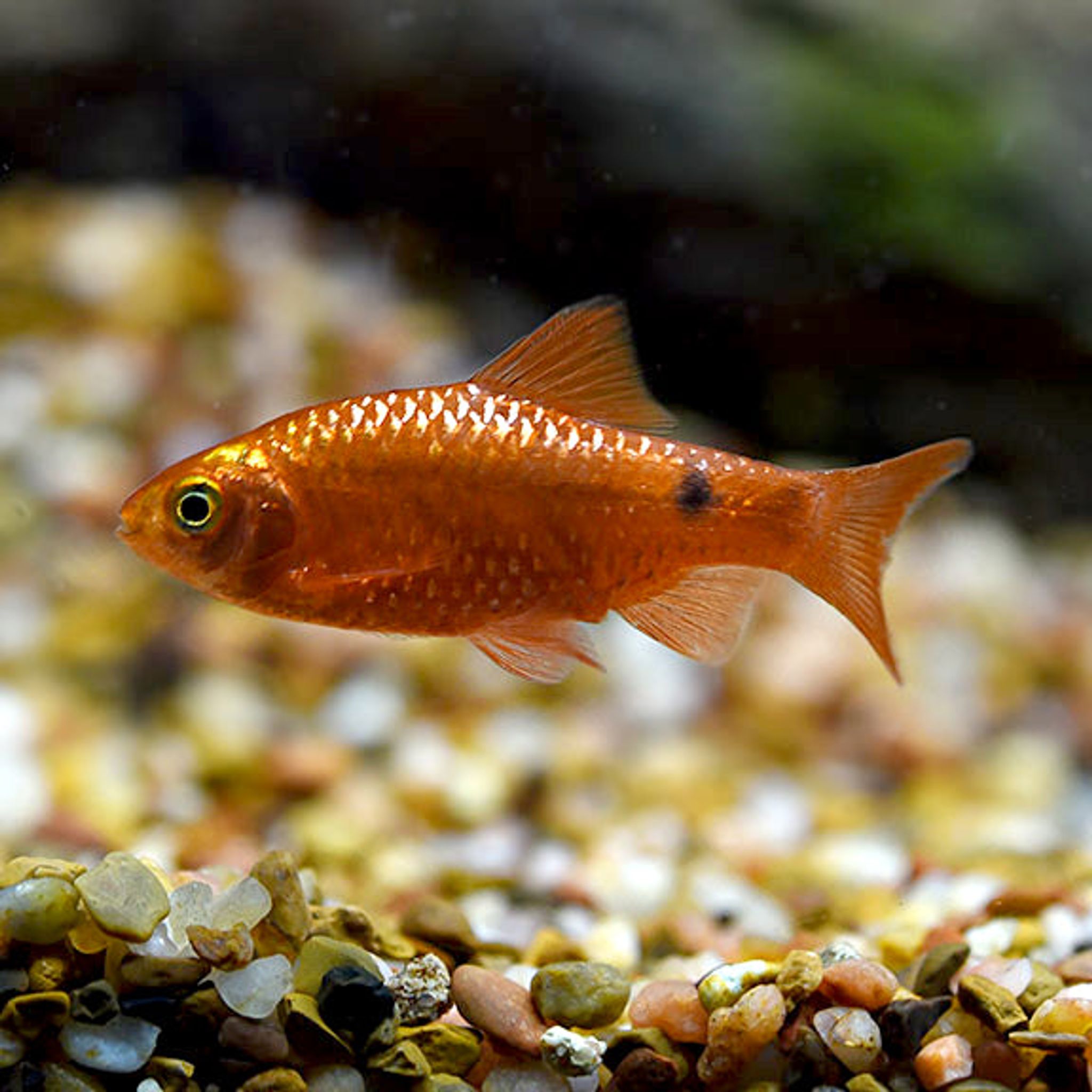
The rosy barb (Pethia conchonius) is an active, mid-water shoaling cyprinid from South Asia. Before choosing companions, know what the barb brings to the tank:
- Size: usually 3–4 inches (7.5–10 cm) in home aquariums, occasionally up to about 6 inches (15 cm). Juveniles sold at around 1.5 inches (4 cm) grow quickly.
- Temperament: mostly peaceful but capable of nipping. Males spar and chase more during spawning.
- Temperature: a subtropical fish. The core range is 64–72°F (18–22°C), and it tolerates roughly 60–79°F (16–26°C).
- Water chemistry: pH 6.0–8.0, soft to moderately hard (about 4–19 dGH). Very hardy.
- Lifespan: 5 years or more, so you are planning a long-term community.
Group Size and Sex Ratio
Keep at least 5, ideally 6–10, with more females than males. In a larger shoal, chasing gets spread around the group, so less of it lands on other species. Pairs and trios tend to turn nippy. Sex ratio also matters. Males are the redder, more intense fish, and a surplus of them means constant sparring, which spills over onto tank mates.
Tank Size
Some keepers get by with 20 gallons (75 L) for five young fish. A 30 gallon (115 L) tank is the safer minimum for an adult group. Add about 5 gallons (19 L) for each extra barb, and choose a long footprint over a tall tank because these fish swim end to end. If you plan to add angelfish or other mid-sized fish, move up to a 4-foot, 55 gallon (210 L) tank.
Compatibility Rules for Choosing Tank Mates
A good companion checks all five boxes:
- Similar or larger body size, so it can't be eaten or pushed around.
- Fast or robust swimmer that can keep up at feeding time.
- Short fins that don't invite nipping.
- Peaceful to semi-aggressive, but not a predator.
- Comfortable in cooler water, ideally overlapping 68–74°F (20–23°C).
Is the Rosy Barb Peaceful or a Fin Nipper?
Descriptions run from "very peaceful" to "semi-aggressive nipper," and both are accurate depending on setup. In a proper shoal with room to swim, rosies are good community fish. Crowded or kept in twos and threes, they nip.
Quick Compatibility Table
| Species | Temp match with rosies | Adult size vs. rosy | Fin-nip risk | Verdict |
|---|---|---|---|---|
| White Cloud Mountain minnow | Excellent (cool) | Smaller but fast | Low | Top pick |
| Zebra and other danios | Excellent | Similar, very fast | Low | Top pick |
| Cherry, gold, checker barbs | Good | Similar or smaller | Low | Top pick |
| Platies, swordtails | Good | Similar | Low | Top pick |
| Peppered Corydoras | Good (cool-tolerant) | Bottom zone | Low | Top pick |
| Bristlenose pleco | Good | Bottom zone | Low | Top pick |
| Hillstream loaches | Excellent (cool) | Bottom/glass zone | Low | Top pick |
| Black skirt, bloodfin, Congo, emperor tetras | Fair to good | Similar | Low to moderate | Good pick |
| Dwarf rainbowfish | Fair | Similar | Low | Good pick |
| Pearl, blue/three-spot gourami | Fair (warmer) | Larger | Moderate | Good pick |
| Tiger barbs | Good | Similar, nippier | High | Conditional |
| Angelfish | Poor (warm) | Larger, long fins | High | Conditional |
| Kribensis, peaceful cichlids | Fair | Similar | Low | Conditional |
| Mollies | Poor (warm, hard) | Similar | Low | Conditional |
| Neon, rummy-nose tetras | Poor (warm) | Smaller | Low | Compromise |
| Bettas | Poor (warm) | Long fins | Very high | Avoid |
| Fancy goldfish | Good temp, bad match | Slow, long fins | Very high | Avoid |
| Fancy guppies | Fair | Small, long fins | Very high | Avoid |
Top Tank Mates for Rosy Barbs
Other Peaceful Barbs
Cherry, gold and checker barbs share the same schooling habits and tolerate similar water. Gold barbs in particular handle cool temperatures. Keep each species in its own proper group. You can browse barbs on FishyHub if you want to plan a mixed-barb tank.
Danios and White Cloud Mountain Minnows
Zebra danios and their relatives are fast enough that rosies never catch them, and they like the same cooler water. White Cloud Mountain minnows are probably the closest temperature match of any common community fish. Stock them in a group of 8 or more so they don't feel outnumbered. The danio selection covers several suitable options.
Livebearers: Platies and Swordtails
Sturdy, short-finned and adaptable. Platies do well at the cooler end of the range. Avoid long-finned "lyretail" or "hi-fin" swordtail varieties.
Larger Tetras
Black skirt, bloodfin, Congo and emperor tetras are big enough and quick enough to hold their own. Bloodfins handle cooler water better than most tetras.
Dwarf Rainbowfish and Larger Gouramis
Dwarf rainbowfish are active mid-water swimmers that match rosies' energy. Pearl and blue/three-spot gouramis are large enough to be left alone, but they prefer the warmer end of the overlap, so keep a mixed tank near 72–74°F (22–23°C).
Bottom Dwellers
Corydoras (peppered cories are the best cool-water choice), bristlenose plecos, and hillstream loaches use the bottom zone and rarely cross paths with the barbs. Kuhli loaches work too but prefer warmer water (see compromise picks).
Conditional and Compromise Picks
- Angelfish: only in a large tank (55+ gallons) with a big, busy barb shoal. Watch the angel's long fins closely, and remember that angels want warmer water.
- Kribensis and other peaceful American or West African cichlids: rosies can act as useful dither fish, drawing the cichlids out of hiding. Give them caves and space.
- Mollies: peaceful, but they prefer warmer, harder water than rosies like.
- Tiger barbs: workable only when both species are in solid groups in 40+ gallons (150 L). Tigers are the nippier of the two.
- Neon tetras, rummy-noses, Bolivian rams and kuhli loaches: some lists rate them highly, but they want 74–80°F+ (23–27°C+). Treat them as compromise picks for a heated tank held at about 74°F, and don't use them in unheated setups.
- Celestial pearl danios and ember tetras: tiny and timid next to 4-inch adult barbs. Add them only to a large, heavily planted tank, or skip them.
Species to Avoid
- Bettas: the flowing fins are a target, and bettas want warmer water.
- Fancy goldfish, fancy guppies, veiltail and long-finned angelfish, and any fish with trailing fins.
- Large predators and aggressive cichlids such as oscars, jack Dempseys and large African cichlids. Rosies become food or targets.
- Nano fish and fry small enough to fit in a barb's mouth.
- Slow or shy feeders, including some gouramis and dwarf cichlids, that lose every meal to the fast-eating barbs.
Long-Finned Rosy Barbs Are a Special Case
The long-finned rosy barb variant is itself a nip target. Don't mix it with standard rosies or tiger barbs, which may shred its fins. It's best kept with calm, non-nipping companions.
The Rosy Barb and Goldfish Myth
Because both handle cool water, rosies and goldfish often get recommended together. The temperature does overlap, but the pairing fails anyway. Fancy goldfish are slow and have trailing fins that barbs nip. Common and comet goldfish grow too large and produce too much waste for most aquariums. In practice, don't combine them.
Invertebrates: Snails and Shrimp
- Nerite and mystery snails: generally safe.
- Adult Amano or ghost shrimp: usually OK, especially with plenty of plant cover.
- Dwarf shrimp (cherry) and shrimplets: will be picked at or eaten. Keep them in a separate tank.
Cool-Water and Unheated Community Ideas
Many US homes stay between 65–72°F (18–22°C), which suits rosies without a heater. Build an unheated tank from species that share that range:
- White Cloud Mountain minnows
- Zebra and other danios
- Gold barbs
- Platies
- Hillstream loaches
- Peppered Corydoras
A heater is still worth using in cold rooms, where it keeps the temperature steady, or whenever you add tropical mates. Don't run rosies in an 80°F (27°C) tropical tank, because constant warmth shortens their lifespan.
Sample Stocking Plans
| Tank | Rosy barbs | Suggested companions | Notes |
|---|---|---|---|
| 30 gal (115 L), unheated | 6 (2 males, 4 females) | 8 White Cloud minnows, 6 peppered Corydoras, 1–2 nerite snails | Cool community, low bioload |
| 30 gal (115 L), heated ~72°F | 6 | 6 zebra danios, 1 bristlenose pleco, 3 platies | Keep an eye on the bioload |
| 55 gal (210 L), heated 70–74°F | 8–12 | 8 black skirt or bloodfin tetras, 6 Corydoras, 1 pearl gourami, 1 bristlenose pleco | Long tank gives swimming room |
| 55 gal (210 L), cool | 10 | 8 gold barbs, 10 danios, 3 hillstream loaches, platies | Strong current suits the loaches |
Rosies eat heavily and produce plenty of waste, so these plans assume good filtration and weekly 25–30% water changes.
Setting Up the Tank to Reduce Aggression
- Dense planting along the back and sides, with open swimming space in the middle.
- Line-of-sight breaks from rocks, wood and plant clumps, so a chased fish can get away.
- Hardy plants such as java fern, anubias and similar tough species, since rosies graze soft ones.
- A bare tank without cover makes spawning-time aggression worse. Rosies are egg scatterers that eat their own eggs, and males chase hard when conditioned.
Feeding a Mixed Community
Rosies are omnivores. Use a quality flake or pellet as the staple, and add frozen bloodworms or brine shrimp plus vegetables such as blanched zucchini, peas or spirulina. Feed small amounts once or twice a day. Barbs grab everything fast, so drop sinking food for bottom dwellers and target-feed them after lights-out if they seem thin.
Introducing Tank Mates Safely
- Quarantine all new fish for 2–4 weeks.
- Let the barbs settle before adding others.
- Add shy or bottom species first, or at the same time as the barbs, so they claim territory.
Signs of Incompatibility in the First Two Weeks
Watch for clamped fins, constant hiding, torn fin edges, and missed meals. If a fish is being nipped, separate it, check whether your barb group is too small, and keep the water clean to prevent fin rot (treat with medication if it develops). Have a backup plan before you buy, such as a spare tank or someone who can rehome the fish.
Common Mistakes
- Keeping only 2–3 barbs: leads to chasing and nipping. Increase the group to 6+.
- Trusting "barbs are community fish" and adding bettas or fancy goldfish: shredded fins follow.
- Ignoring temperature: 80°F shortens rosy lifespan, and cool water stresses tropical mates.
- Buying 1.5-inch juveniles without planning for 4-inch adults.
- Starving slow eaters: target-feed after the barbs are done.
Frequently Asked Questions
Can rosy barbs live with goldfish?
Generally no. The temperature overlaps, but fancy goldfish are slow with trailing fins that barbs nip, and common or comet goldfish grow too big and messy for most home tanks.
Can rosy barbs live with bettas?
No. A betta's long fins are an easy target, and bettas need warmer water than rosies prefer.
Are rosy barbs fin nippers?
They can be, especially in groups of two or three. In a shoal of 6 or more with plenty of space, nipping drops off sharply.
Can rosy barbs live with tiger barbs?
Yes, if both species are kept in solid groups in a tank of 40 gallons (150 L) or more. Tiger barbs are the nippier species, so keep long-finned rosies away from them.
Do rosy barbs need a heater?
Often not in a US home kept at 65–72°F (18–22°C). A heater helps in cold rooms and becomes necessary once you add tropical tank mates.
How many rosy barbs should I keep per tank?
About 5–6 in a 30 gallon (115 L) tank and 8–12 in a 55 gallon (210 L). Aim for more females than males.
Build Your Rosy Barb Community
Filter every choice by temperature, size and fin shape first, and the rest of the planning gets much easier. When you're ready to shop, browse small community fishes on FishyHub for danios, platies, tetras and other good matches for your rosy barb shoal.

