Best Tank Mates for Pearl Gourami: Compatible Fish and Species to Avoid
The best tank mates for pearl gourami are peaceful schooling fish such as tetras, rasboras and cherry barbs, plus calm bottom dwellers like corydoras, kuhli loaches and bristlenose plecos. Avoid bettas, fin-nipping barbs and tetras, aggressive cichlids and goldfish. Below you'll find the reasoning behind each pick, stocking plans by tank size, and a simple method for judging fish that aren't on any list.
Pearl Gourami at a Glance
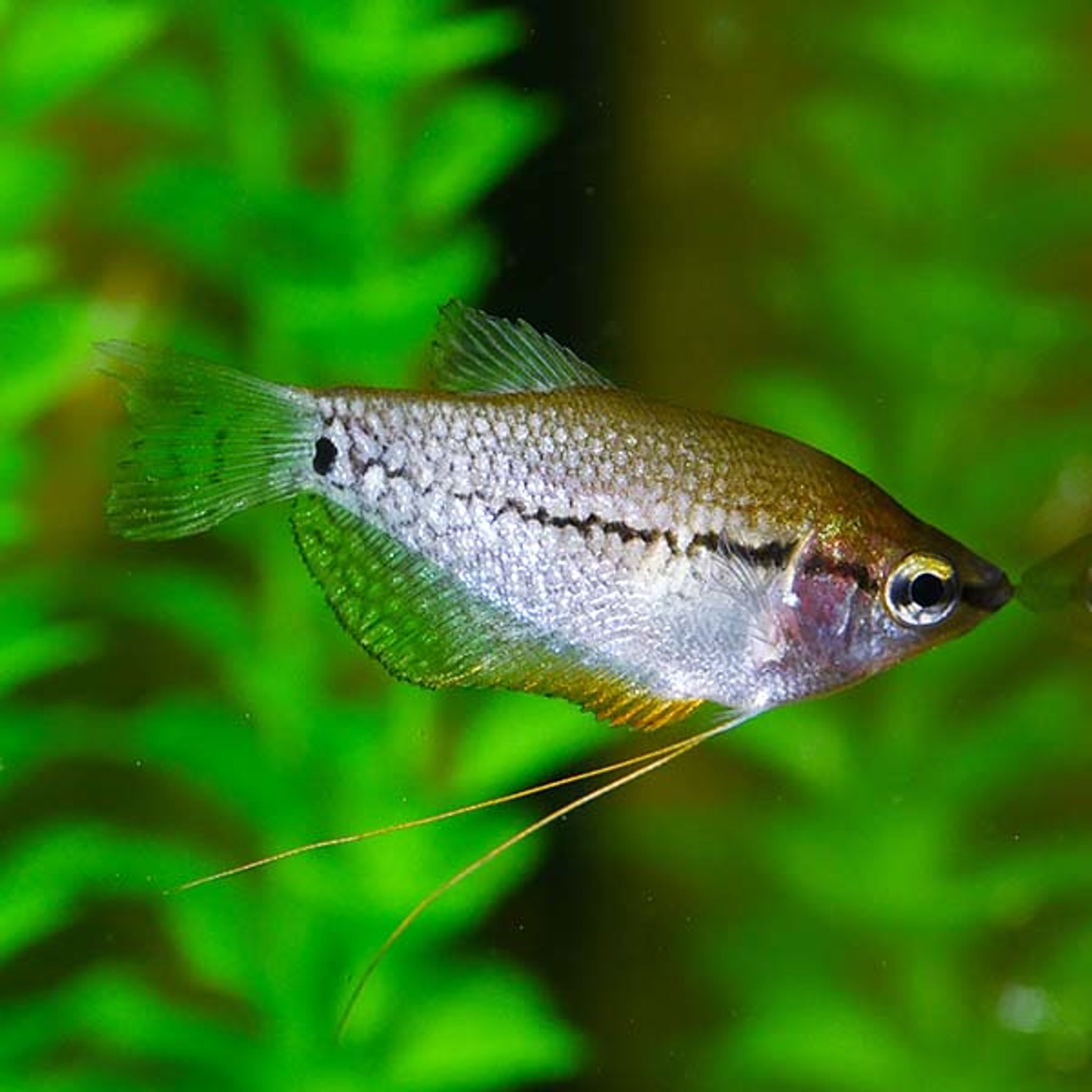
Pearl gouramis (Trichopodus leerii) grow to about 4–5 inches (10–13 cm) and usually live 4–5 years, sometimes 6 or more. They are calm, somewhat shy fish that spend most of their time in the middle and upper water column.
A few traits shape every compatibility decision:
- Labyrinth organ. Pearls gulp air from the surface, so they need open surface access at all times.
- Pelvic "feelers." Those long, thread-like ventral fins are touch and taste organs. That's why pearls gently poke at tank mates and decor, and it's also why fin-nippers go straight for them.
- Slow eaters. Pearls take their time at feeding. Greedy fish such as danios or livebearers can clear the food before the pearls get their share, so plan on target feeding.
- Origin. Wild pearls come from soft, acidic blackwater swamps on the Malay Peninsula, Borneo and Sumatra and are listed as Near Threatened. Most fish sold in the US are farm-raised and noticeably hardier.
Temperament: Peaceful, With Individual Variation
Most keepers describe pearls as peaceful, and that's the right default. Individuals do vary, though, and males can get pushy, especially when breeding. A few hobbyists label the species semi-aggressive for this reason. Plan for a peaceful fish, but watch each new addition for the first couple of weeks.
Tank Size, Water and Group Structure
| Factor | Recommendation |
|---|---|
| Minimum tank | 30 gal (114 L) for a small group |
| Extra space | Roughly 5–10 gal (19–38 L) per added pearl |
| Tank shape | Long footprint over a tall one |
| Temperature | 77–82°F (25–28°C); most community mates overlap at 76–80°F (24–27°C) |
| pH | Aim for 6.5–7.5 (tolerates roughly 6.0 up to about 8) |
| Hardness | Soft to moderately hard |
| Group size | 4 or more |
| Sex ratio | 1 male to 2–3 females, or all females |
Published pH ranges disagree (some run 6.5–8, others 5.5–7.5), so the 6.5–7.5 overlap is the safest target for a mixed community.
Sexing pearls: males have a red-orange throat and breast (brightest when breeding) and a longer, pointed dorsal fin. Females have a rounded dorsal and a paler chest. Two males in a small tank usually means constant chasing, so stick to one male unless the tank is large.
How to Judge Any Tank Mate: The Swim-Level Method
Rather than memorizing lists, run each candidate through these checks:
- Swim level. Pearls own the mid-to-upper zone. Favor fish that live at the bottom or lower-middle of the tank so nobody competes for the surface.
- Size. Similar in size, or smaller but not bite-sized. A fish that fits in a 5-inch gourami's mouth is at risk.
- Temperament. Peaceful only. No fin-nippers, no territorial bullies.
- Energy level. Avoid hyperactive species that stress shy pearls, or give them a long tank.
- Parameter overlap. The species should be comfortable at 76–80°F and pH 6.5–7.5.
A fish that passes all five is usually a safe bet. One that fails on temperament should be ruled out no matter how well it scores elsewhere.
Best Tank Mates for Pearl Gourami
Schooling Fish (Keep 6 or More of Each)
These fill the middle of the tank with movement without challenging the gouramis:
- Neon, cardinal, ember, rummynose, black skirt and glowlight tetras. Peaceful, mid-level swimmers. Embers are the smallest, so add them only with young or especially mellow pearls.
- Harlequin and scissortail rasboras. Calm, sturdy and a close parameter match.
- Pearl and zebra danios. Hardy but busy. Keep them in a long tank and target feed the pearls.
- Cherry barbs. One of the few barbs that doesn't nip.
- Rosy barbs. Semi-boisterous. Only keep them as a large group in a big tank.
You can browse many of these on our small community fishes page.
Bottom Dwellers
- Corydoras. Keep a group of 6+ on sand so their barbels stay intact.
- Kuhli loaches. Shy, nocturnal and ideal for a planted tank.
- Bristlenose pleco. Stays compact and grazes algae.
- Otocinclus. Only in a mature tank with established algae.
- Yo-yo loach. Active but generally fine with pearls.
- Clown loaches. Only in 75+ gal (284+ L) tanks, since they grow large and live in groups.
Explore options in plecos, corys and bottom dwellers.
Centerpiece Fish
- Bolivian ram. A calm dwarf cichlid that stays near the bottom.
- Larger rainbowfish. Active and colorful; give them swimming length.
- Kribensis. Works in a roomy tank, though pairs get territorial near their cave when spawning.
- Angelfish (conditional). Territorial but workable in a tall 40+ gal (151+ L) tank if the angels are added young or at the same time as the pearls. Adult angels may eat tiny tetras, so choose larger schooling fish.
Invertebrates
- Nerite and mystery snails are safe.
- Adult Amano shrimp are usually fine.
- Cherry shrimp adults may survive in a heavily planted tank, but pearls will eat the shrimplets. Don't count on a shrimp colony.
Livebearers: A Split Decision
Some keepers call guppies, platies, mollies and swordtails great mates. Others point out that livebearers share the surface zone and that long, fancy guppy tails invite nipping. The practical middle ground:
- Platies and swordtails are fine in larger tanks.
- Skip fancy guppies.
- Mollies need harder water than pearls prefer, so they're a weaker match.
Livebearers are fast, greedy eaters, so target feed your pearls.
Other Gouramis
Advice here is inconsistent. Some sources happily pair pearls with dwarf, gold or blue gouramis; at least one says to keep no other gouramis at all. A cautious approach:
- Honey or sparkling gouramis: acceptable in bigger tanks.
- Dwarf gouramis: risky. Only try in a large, well-planted tank, and never with two males.
- Three-spot varieties (blue, gold, opaline): add only in 55+ gal (208+ L) tanks and watch closely, because they can bully.
Fish to Avoid
| Avoid | Why |
|---|---|
| Bettas (any variety) | Both claim the surface and build bubble nests; betta fins invite conflict |
| Tiger, serpae and Buenos Aires tetras; tiger barbs and other nippy barbs | Shred the pelvic feelers and long fins |
| Oscars, jack Dempseys, most African cichlids | Too large or aggressive |
| Red-tail and rainbow sharks | Territorial and pushy |
| Kissing and giant gouramis | Too big and aggressive |
| Goldfish | Need cooler water and produce heavy waste |
| Nano fish and shrimplets | Small enough to become food |
Stocking Plans by Tank Size
These are starting points for a well-filtered, planted tank. Add fish in stages, not all at once.
| Tank | Pearls | Suggested mates |
|---|---|---|
| 30 gal (114 L), long | 3 (1 male, 2 females) | 8 harlequin rasboras, 6 small corydoras, 2 nerite snails |
| 40 gal (151 L) breeder | 4 (1 male, 3 females) | 10 rummynose tetras, 6 corydoras, 5 kuhli loaches, 1 bristlenose pleco |
| 55 gal (208 L) | 5 (1 male, 4 females) | 10 cardinal tetras, 8 cherry barbs, 8 corydoras, 1 bristlenose pleco, 1 pair of Bolivian rams |
| 75 gal (284 L) | 5–6 (1 male, rest females) | 12 black skirt or glowlight tetras, 6 platies or swordtails, 6 clown loaches, 1 bristlenose pleco, Amano shrimp |
In a tall 40+ gal tank, you can swap the rams for 2–3 young angelfish added alongside the pearls; skip tiny tetras in that case.
Setup That Keeps the Peace
- Plant densely and add driftwood to break up sightlines.
- Use some floating plants for cover and nesting, but keep open patches of surface so the gouramis can gulp air.
- Keep the current gentle. Pearls struggle in strong flow.
- Order of introduction matters. Add pearls before or alongside other peaceful fish, not into a tank where territorial fish are already settled.
Plants That Suit a Pearl Tank
The same hardy plants recommended for betta tanks work well here: java fern, anubias, cryptocorynes, Amazon sword, vallisneria and java moss, with frogbit and red root floaters in moderation. Pearls use the floaters to anchor bubble nests.
Lighting and Lights-Out
Labyrinth fish, bettas and pearls included, see poorly in low light and rely on their lateral line to navigate in the dark. Run a regular 8–10 hour photoperiod on a timer, and avoid snapping the lights on in a dark room, which startles shy pearls. Turning on room lights first helps.
Resetting Territories After Fighting
If a fish becomes a bully, rearrange the hardscape and plants to erase established territories. For a persistent aggressor, remove it to a separate tank for a week or two, rearrange the decor, then reintroduce it so it has to re-establish itself as the newcomer.
Breeding Behavior and Aggression
A breeding male builds a bubble nest among floating plants and chases off anything that comes near. His throat colors intensify at the same time. Watch for torn fins on tank mates, and separate the fish if the chasing doesn't settle down.
Comparison: Gold and Blue Gourami Tank Mates
The gold gourami is a color form of the three-spot gourami, and so is the blue gourami; they're the same species. Both grow larger than a pearl (up to about 6 inches, 15 cm) and are bolder and more territorial.
- Good mates for gold or blue gouramis: corydoras, kuhli loaches, zebra loaches, tetras, harlequin rasboras, danios and bristlenose plecos, largely overlapping the pearl list.
- Avoid: very small fish they may harass or eat, and very large fish that bully them back.
- Temperature: blues do well around 76°F (24°C), within the pearl's range.
- With pearls: only in a large tank (55+ gal) with plenty of cover and close observation.
Can Pearl Gouramis Live With Bettas?
No, regardless of variety. Veiltail, dragon scale, halfmoon and wild betta species all present the same problems: both fish build bubble nests and claim the surface, and a betta's flowing fins provoke curious or territorial gouramis. Bettas live about 3–5 years and are better kept in their own tank.
Adding New Tank Mates Safely
Acclimation From Bag to Tank
- Float the sealed bag for about 15 minutes to match temperature.
- Add a small amount of tank water to the bag roughly every 15 minutes over 30–60 minutes.
- Net the fish into the tank and discard the store water.
Quarantine
Keep every new fish in a separate tank for 2–4 weeks. Skipping quarantine is how one sick fish infects an entire community.
Watch for Hole-in-the-Head Disease
Gouramis are prone to hole-in-the-head, not just bettas and cichlids. Signs include pale, pitted lesions on the head, stringy white feces and lethargy. It's associated with the parasite Hexamita combined with poor water quality or diet. Treatment typically involves metronidazole, improved water quality and a more varied diet.
Common Mistakes and Fixes
- Adding tiger barbs or other nippers. The result is shredded feelers. Rehome the nippers.
- Two males in a small tank. Expect chasing and hiding. Rehome a male or move to a bigger tank.
- Pale, hiding pearls. Usually caused by overactive mates, too few plants or strong current. Reduce flow and add cover.
- Floaters over the entire surface. This blocks air-gulping. Thin them to leave open gaps.
- Stocking bite-sized fish or shrimp. Nano fish and shrimplets become snacks.
- Skipping quarantine. Disease spreads fast in a mixed community.
Frequently Asked Questions
Can pearl gouramis live with bettas?
No. Both are bubble-nesting labyrinth fish that claim the surface, and betta fins tend to trigger conflict. This holds for every betta variety.
Can pearl gouramis live with dwarf gouramis?
It's risky. Only attempt it in a large, heavily planted tank, and avoid pairing a male pearl with a male dwarf. Have a backup tank ready in case it fails.
How many pearl gouramis should I keep?
Start with 3–5 in a 30+ gal (114+ L) tank, using a ratio of 1 male to 2–3 females. All-female groups also work well.
Are pearl gouramis OK with shrimp?
Adult Amano shrimp are usually safe. Baby shrimp will be eaten, so a breeding cherry shrimp colony rarely thrives alongside pearls.
Can pearl gouramis live with angelfish or guppies?
Angelfish usually work in a tall tank when added young or at the same time as the pearls. Guppies can work, but fancy guppies are not ideal because their fins attract attention; platies are a better livebearer choice.
Are pearl gouramis aggressive, and can they live with goldfish?
Pearls are mostly peaceful, though males get pushy when breeding. Goldfish are a poor match because they need cooler water and produce far more waste.
Build Your Pearl Gourami Community
A calm, planted tank with pearls up top, a school in the middle and corydoras or loaches below is one of the most rewarding community setups you can keep. When you're ready to stock yours, browse the gourami selection on FishyHub and pair them with the compatible species above.

