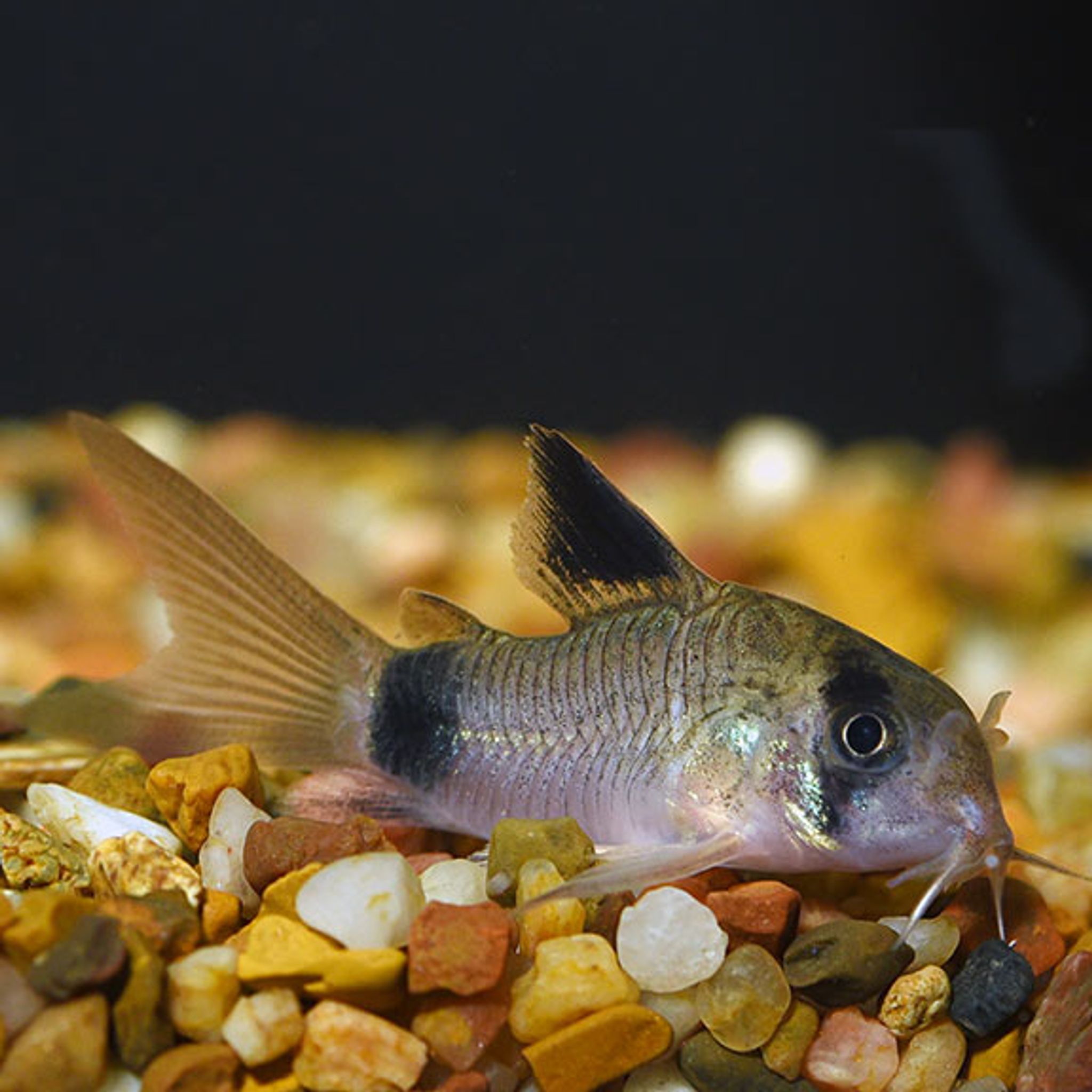

Best Tank Mates for Panda Cory: Compatible Fish and Species to Avoid
The best tank mates for panda cory are small, peaceful fish that stay mostly in the middle or top of the tank and are happy at 72–76°F (22–24°C): think ember or neon tetras, harlequin rasboras, cherry barbs, honey gouramis, otocinclus and dwarf shrimp. Avoid goldfish, big cichlids, bottom-territorial sharks, fin-nippers, crayfish and anything that needs water above 80°F. The piece most lists leave out is temperature overlap. Panda corys like cooler water than most community fish, so that's the first filter we use below.
Panda Cory Basics That Decide Compatibility
Corydoras panda comes from clear, cool tributaries of the upper Amazon in Peru. Adults reach about 1.5–2 inches (4–5 cm). They're peaceful, active during the day, and they shoal along the bottom. With good care they can live 10 years or more, so the fish you add now may share the tank with them for a long time.
Water parameters
| Parameter | Panda cory target |
|---|---|
| Temperature | 68–77°F (20–25°C) ideal; up to about 79°F (26°C) short term |
| pH | 6.0–7.5 (corys in general tolerate up to about 7.8) |
| Hardness | Soft to moderately hard, roughly 2–12 dGH |
| Ammonia / nitrite | 0 ppm |
| Nitrate | Under 20 ppm |
Corys react to nitrate and to dirty substrate, so a light stocking and regular maintenance protect them more than any particular tank mate does.
A note on US tap water: much of the country has fairly hard tap water. Pandas adapt to moderately hard water well. Stable water helps them more than chasing a precise pH number with chemicals. If your tap sits near the top of the hardness range, lean toward companions that tolerate harder water and keep your water changes consistent.
Group size, tank size and substrate
- Group: at least 6 panda corys, and 8–10 or more is better. A lone cory or a pair tends to hide and stay pale.
- Tank: 20 gallons (76 L) minimum for a panda group plus mid-water fish. A 20 long (30 x 12 in / 76 x 30 cm) beats a 20 high because bottom fish use floor space, not height. A 10-gallon (38 L) only suits dwarf corys such as pygmy or habrosus.
- Substrate: smooth sand or fine, rounded gravel protects the barbels. Leave open sandy areas for foraging, and add cover with plants, driftwood and leaf litter.
How to Judge a Panda Cory Tank Mate
Run every candidate through these five checks:
- Peaceful – no chasing, nipping or bullying.
- Small – its mouth can't fit a 2-inch cory.
- Comfortable at 72–76°F – the overlap zone with pandas.
- Uses the middle or top of the tank – so it doesn't crowd the floor.
- Doesn't guard territory on the bottom – no fish that claims caves or patrols the substrate.
Most online lists only check the first two. Plenty of "peaceful community fish" really want 78–82°F, and keeping pandas that warm all the time shortens their lives.
Best Tank Mates by Tank Level
Top and middle swimmers
These are the ideal partners because they leave the floor to your corys.
- Neon tetra, black neon, green neon, ember tetra, pristella tetra – small, peaceful schoolers that do well in cooler community water. You can browse tetras on FishyHub.
- Harlequin rasbora and other small rasboras – calm and hardy. Chili rasboras work too, but keep a bigger group so they feel secure.
- Zebra danio – handles cool water well. It's active, though, so give it swimming room.
- White cloud minnow – only if you run the tank at the cool end, around 68–72°F.
- Cherry barb – one of the gentler barbs.
- Endlers – small, colorful livebearers.
- Honey gourami and sparkling gourami – quiet centerpiece fish for a 20 gallon.
Bottom dwellers that share the floor
- Pygmy, habrosus and other small corys – each species needs its own group of 5–6 or more.
- Kuhli loach – nocturnal and gentle, so it uses the floor at different hours.
- Otocinclus – grazes on surfaces, not the sand.
- Bristlenose pleco – one only, in 20 gallons or more.
You don't need a pleco or loach at all. Add one only if there's floor space to spare.
Quick compatibility table
| Tank mate | Level | Comfortable temp | Adult size | Rating |
|---|---|---|---|---|
| Ember tetra | Middle | Fits the 72–76°F overlap | Under 1 in | Excellent |
| Neon tetra | Middle | Fits the 72–76°F overlap | About 1.5 in | Excellent |
| Harlequin rasbora | Middle | Fits the 72–76°F overlap | About 2 in | Excellent |
| Zebra danio | Top | Tolerates cool water | About 2 in | Good (active) |
| White cloud minnow | Top/middle | 68–72°F | About 1.5 in | Good at cool end only |
| Honey gourami | Top | Fits the 72–76°F overlap | About 2 in | Excellent |
| Kuhli loach | Bottom | Fits the 72–76°F overlap | 3–4 in | Good |
| Otocinclus | Glass/plants | Fits the 72–76°F overlap | About 1.5 in | Good |
| Cardinal tetra | Middle | 76–80°F+ | About 2 in | Caution (warm) |
| Betta | Top | 78–80°F | About 2.5 in | Caution (warm) |
| Discus | Middle | 82–86°F | Large | Avoid |
Sizes are approximate. The temperature column is the useful part: anything that needs 78°F or more is a compromise.
Workable With Caveats
These fish are peaceful but differ from pandas in temperature, hardness or health:
- Cardinal tetra, rummy nose tetra, Bolivian ram – all prefer 76–80°F or warmer. If you keep them, run the tank at the top of the panda range, around 76–77°F, and don't go higher. Ratings for the Bolivian ram vary from "excellent" to "cautious" mostly because of this temperature gap.
- Platies and mollies – both like harder, more alkaline water. Platies are the better livebearer pick. Mollies also want warmth and can get boisterous, so treat them as acceptable only in moderately hard water.
- Betta – usually fine with pandas in a 10–20 gallon tank, but it wants 78–80°F. Aim near 76–78°F as a compromise and watch for a territorial individual.
- Dwarf gourami – peaceful by nature but prone to disease, and some males get pushy. This is why ratings range widely; a honey gourami is the safer choice.
Fish and Animals to Avoid
- Goldfish – they grow large, will eat small fish and produce a heavy waste load. They also prefer different conditions altogether.
- Large or aggressive cichlids – oscar, Jack Dempsey, convict, most African cichlids, and big angelfish in small tanks.
- Bottom-territorial fish – red-tail and rainbow sharks and some botias will chase corys off the floor.
- Large predators – arowana, big catfish, and adult clown loaches in cramped tanks.
- Fin-nippers and bullies – tiger barbs kept in small groups, serpae tetras.
- Crayfish and large crabs – they pinch and can catch corys while they rest at night.
- Very warm-water fish – discus need 82–86°F, far above what pandas handle long term.
Shrimp and Snail Compatibility
Panda corys are safe with adult shrimp. Amano, cherry and ghost shrimp all work, and a cory may occasionally eat a tiny shrimplet it stumbles on. If you want to breed shrimp, dense plants or moss give the babies cover. Nerite snails are also a good fit and graze algae without competing much for sinking food. Browse freshwater shrimp on FishyHub if you plan to add a few.
Feeding: The Hidden Compatibility Problem
Corys are not a cleanup crew. They can't live on leftovers that fall past fast mid-water fish. A tank full of quick eaters, or a second bottom species that hogs food, can slowly starve them even when nobody is aggressive.
- Target-feed sinking wafers, pellets, gel foods, and frozen or live worms such as bloodworms and blackworms.
- Feed the corys around lights-out, when the tetras and rasboras settle down.
- Feed the mid-water fish first at the surface to keep them busy while the sinking food reaches the floor.
- Watch the bellies. Thin or sunken bellies mean the corys aren't getting enough.
Stocking Plans for 20, 29 and 40 Gallon Tanks
These plans assume a mature, cycled tank at 72–76°F with good filtration.
| Tank | Corys | Mid/top fish | Extras |
|---|---|---|---|
| 20 long (76 L) | 8 panda corys | 10–12 ember or neon tetras, plus 1 honey gourami (or 6–8 harlequin rasboras instead of the gourami) | A few Amano shrimp and nerite snails |
| 29 gallon (110 L) | 8–10 panda corys | A tetra school plus a small rasbora group or 1–2 honey gouramis | Shrimp, nerites, a few otocinclus |
| 40 gallon (150 L) | 10+ panda corys, or pandas plus a group of another small cory | Two schools of small tetras or rasboras, or a cherry barb group | Kuhli loach group or one bristlenose pleco |
In a 20 gallon, about 8–10 pandas with a modest mid-water school is the right balance. Larger tanks add floor space first, which is what lets you add a second bottom group.
Adding New Fish Safely
- Quarantine new arrivals for 2–4 weeks before they go in the main tank.
- Add corys only to a mature, fully cycled tank.
- Acclimate slowly. Corys react badly to sudden changes in water parameters.
- Know about cory stress toxin. Stressed corys can release a toxin that harms other fish, especially in a shipping bag. Don't bag corys with other species, and move them gently.
Common Mistakes and Troubleshooting
- Keeping only 1–3 corys. They hide, look stressed and stay pale. Build the group to 6 or more.
- Running a warm tropical setup over 80°F. It stresses pandas and shortens their lives.
- Sharp gravel or a dirty substrate. This leads to eroded barbels and infection. Switch to sand or smooth gravel and vacuum weekly.
- Relying on leftovers. Target-feed to avoid thin, sunken bellies.
- Misreading surface trips. A quick dart to the surface is normal air-gulping. Constant gasping means low oxygen or bad water, so test right away.
- Full-dose salt or copper treatments. Corys are sensitive to both. Use half doses or move the corys out before treating.
- Adding corys to a new tank before the nitrogen cycle is done.
Frequently Asked Questions
Can panda corys live with bettas?
Usually yes, in a tank of 10 gallons or more kept around 76–78°F. That's a compromise, since bettas like it a little warmer than pandas. Watch for a betta that turns territorial and chases the corys.
Can panda corys live with guppies?
Yes, their temperaments match. Guppies prefer warmer, harder water, so settle near 76°F and keep parameters stable rather than pushing to either extreme.
Will panda corys eat shrimp?
Not adult shrimp. At most they'll eat a few baby shrimp they find on the substrate, and moss or dense plants give shrimplets plenty of places to hide.
Can panda corys live with other cory species?
Yes. Different cory species often mingle, but each species still needs its own group of 5–6 or more to feel secure.
Are angelfish safe with panda corys?
Only with adult corys in a large tank of 40 gallons or more, and angelfish often prefer water warmer than pandas like. For most setups it's best to skip them.
Can panda corys live with goldfish?
No. Goldfish grow large, can eat small fish and produce far more waste than a cory tank should carry.
Build Your Panda Cory Community
Start with the corys and a cool-water community: a 20 long, 8 or more pandas, a school of small tetras or rasboras, and a few shrimp. When you're ready to stock up, browse corydoras, plecos and other bottom dwellers on FishyHub and pick companions that fit your tank's temperature and hardness.


