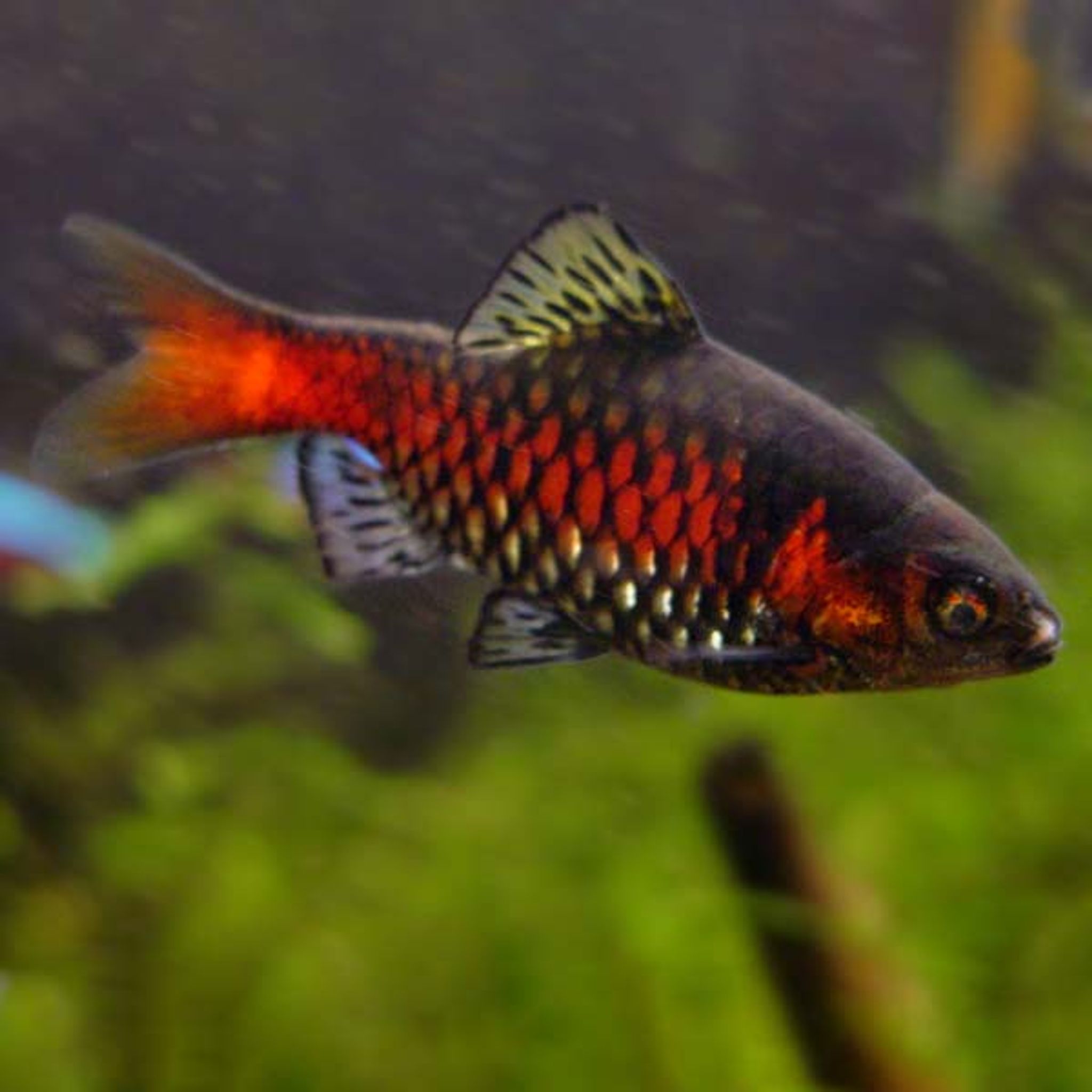
Best Tank Mates for Odessa Barb: Compatible Fish and Species to Avoid
The best Odessa barb tank mates are peaceful, fast fish about 1.5 inches (4 cm) or larger that are comfortable at 70–77 °F (21–25 °C). Good examples are rasboras, danios, cherry barbs, larger tetras, and bottom dwellers like corydoras, kuhli loaches and bristlenose plecos. Skip long-finned, slow, predatory or heat-loving species, and always keep the barbs in a proper group so they stay calm and colorful.
Odessa Barb Care Quick Facts
The Odessa barb (Pethia padamya) is a small cyprinid from the Irrawaddy basin in central Myanmar. Mature males develop a deep red stripe along the flank, strongest when they're displaying. Females are plainer, in gold to olive. Both sexes have black spots near the tail and behind the gill cover.
| Trait | Details |
|---|---|
| Adult size | 2.5–3 in (6–7.5 cm) |
| Temperament | Mostly peaceful, very active, occasionally nippy |
| Swimming zone | Mid-water |
| Group size | 5 minimum; 6–10 is ideal |
| Minimum tank | 30 gal (114 L), long footprint preferred |
| Temperature | 64–79 °F (18–26 °C) |
| pH | About 6.0–7.5 (stability matters more than the exact number) |
| Hardness | Soft to moderately hard, roughly 4–10 dKH |
| Flow | Light current, well filtered and oxygenated |
Temperament and Why Group Size Matters
Odessa barbs are energetic mid-water swimmers that spend the day patrolling the open part of the tank. With only two or three of them, they get skittish, lose color and are more likely to nip their tank mates. Keep at least 5, and 6–8 or more is better. A bigger group spreads the chasing around, and the males show their best red when they're competing with each other.
Tank Size and Layout
Plan on 30 gallons (114 L) minimum for a group. Length matters more than height, so a 30 long, 40 breeder or 55 gallon (208 L) tank beats a tall tank with the same volume. Leave open swimming lanes through the middle.
Water Parameters and the Cooler-Water Advantage
Their range reaches down to 64 °F (18 °C), so Odessa barbs handle cooler water better than many tropical community fish. In a lot of US homes they can live in an unheated room. That flexibility has a catch: every tank mate has to share your actual temperature, not just the barb's range. A fish that needs 80 °F (27 °C) and a barb that's happiest at 72 °F (22 °C) overlap on paper but won't both thrive.
About pH, some care sheets cap it at 7.0. Hobby experience shows they do fine up to about 7.5–7.8 when conditions are stable. Keep your water steady rather than chasing an exact reading.
What Makes a Good Odessa Barb Tank Mate
Run each candidate through these checks:
- Peaceful temperament. Nothing that will bully or hunt the barbs.
- Similar or slightly smaller size, but not so small it looks like food. A good rule is 1.5 inches (4 cm) or larger as adults.
- Fast and confident enough that a busy barb group won't stress it out.
- Comfortable at 70–77 °F (21–25 °C), the range where most compatible species overlap.
- Different swimming zone, ideally. Top and bottom dwellers compete less for space.
- Short fins. Odessa barbs are low-risk nippers, but not zero-risk.
Bottom dwellers are the easiest wins because they stay out of the barbs' lane entirely.
Best Tank Mates for Odessa Barbs
| Tank mate | Zone | Why it works | Notes |
|---|---|---|---|
| Cherry barb | Mid/lower | Peaceful, similar needs | Keep a group |
| Gold or checker barb | Mid | Matches the barbs' energy | Good barb-only community |
| Harlequin, lambchop, scissortail rasbora | Mid/upper | Fast, peaceful schoolers | Scissortails need room |
| Zebra or leopard danio | Upper | Quick and hardy, tolerate cooler water | Very active, which suits barbs |
| White Cloud minnow | Upper | Strong overlap at cooler temps | Good pick for unheated tanks |
| Black skirt, lemon, rummy-nose tetra | Mid | Big enough and fast enough | Rummy-noses prefer the warmer end |
| Serpae tetra | Mid | Tough and fast | Use caution, since serpaes can nip too |
| Corydoras | Bottom | Stay out of the barbs' way | Keep 6+ on soft substrate |
| Bristlenose pleco | Bottom/glass | Peaceful algae grazer | One per tank is typical |
| Kuhli loach | Bottom | Shy, stays in the substrate | Needs hiding spots |
| Hillstream loach | Glass/rocks | Likes cooler, oxygenated water | Needs flow and clean rocks |
| Honey or dwarf gourami | Upper | Peaceful surface dwellers | Some caution; watch for nipping |
| Neon Dwarf or Praecox rainbowfish | Mid/upper | Active, similar size | Best in larger tanks |
| Bolivian ram, apistogramma | Bottom/mid | Peaceful dwarf cichlids | Only in larger, well-planted tanks |
Can Odessa Barbs Live With Other Barbs?
Yes. Cherry, gold and checker barbs all make good companions. Tiger barbs are risky. They're more aggressive, and when you put two nippy, high-energy groups together, you can end up with a nipping war that neither group started alone.
Dwarf Cichlids: Bolivian Rams Over German Blues
Peaceful dwarf cichlids can work in bigger, well-planted aquariums with territories on the bottom. Bolivian rams fit the barbs' temperature range. German blue rams don't, because they want 82–86 °F (28–30 °C). Apistogrammas are another option, as long as there's plenty of cover.
Nano Fish, Shrimp and Snails: The Gray Areas
Nano Fish
Some lists call chili rasboras, ember tetras and neon tetras ideal companions. Adult 3-inch barbs racing around can stress fish under 1 inch (2.5 cm) and outcompete them at feeding time, and juvenile chilis can get eaten. Only consider nano species in a large, heavily planted tank with a big group of the tiny fish. Otherwise, stick to the 1.5-inch rule.
Shrimp
- Adult Amano shrimp are generally fine.
- Cherry shrimp are at risk. Shrimplets and small adults will be eaten. Add them only to a densely planted tank, and only if you can afford to lose part of the colony.
Snails
- Nerite and mystery snails are generally safe because they're too big or too hard-shelled to bother.
- Small pest snails may get picked at, which some keepers see as a bonus.
Species to Avoid
- Long-finned or slow fish: bettas, fancy guppies, angelfish and long-fin varieties of otherwise suitable fish.
- Large or predatory fish: oscars, larger cichlids, big catfish and arowana. If its mouth can fit a 3-inch barb, it's a no.
- Aggressive or territorial fish: convict cichlids, most African cichlids, and red-tail sharks in smaller tanks.
- Warm-water specialists: discus and German blue rams.
- Goldfish: fancy goldfish are poor temperature partners, too slow, and produce heavy waste.
- Tiny shrimp, unless you accept losses (see above).
Sample Stocking Lists by Tank Size
These are starting points for a well-filtered tank with regular water changes. Add fish in stages, and adjust based on your filtration and how the tank behaves.
| Tank | Odessa barbs | Companions |
|---|---|---|
| 30 gal long (114 L), cool/unheated | 6–7 | 8 White Cloud minnows, 2–3 hillstream loaches, nerite snails |
| 30 gal (114 L), heated | 6–7 | 6 corydoras, 1 bristlenose pleco, Amano shrimp |
| 40 gal breeder (151 L) | 8 | 8 harlequin rasboras, 6 corydoras, 1 bristlenose pleco |
| 55 gal (208 L) | 10 | 8 lemon or black skirt tetras, 6 kuhli loaches, 6 corydoras, a pair of Bolivian rams or a honey gourami |
For the unheated 30, confirm your room holds steady in a range the White Clouds and hillstream loaches like. If you're planning the heated lists, you can browse barbs and plecos, corys and bottom dwellers on FishyHub.
Feeding a Mixed Community
- Staple: a quality flake or micro-pellet.
- Extras: frozen or live bloodworms, brine shrimp and daphnia a few times a week, plus some vegetable matter.
- Schedule: twice a day, only as much as the fish finish in a few minutes.
- Bottom dwellers: drop sinking wafers so fast barbs don't grab everything before corys and loaches get a turn.
Aquascape That Brings Out the Red
Plant the edges densely and keep the middle open. A dark substrate and background makes the males' red stand out, and floating plants soften the light so shy tank mates feel secure. Rocks and wood that break up sight lines also give bullied fish somewhere to go.
How to Introduce Tank Mates
- Quarantine all new fish for 2–4 weeks.
- Add the barbs as one full group, not a few at a time.
- Add calmer species before or with the more boisterous ones so they can settle in first.
- Rearrange the decor when new fish arrive to reset territories.
Common Mistakes and Troubleshooting
- Buying only 2–3 barbs. Expect skittishness, faded color and nipping. The fix is a bigger group.
- Crowding them into 10–20 gallons (38–76 L). These fish need length.
- Mixing them with nano fish in a bare tank. The small fish have nowhere to escape.
- Pale color. Look for stress, too few males, a bright bare tank or a poor diet.
- One male bullying the rest. Add females and decor to break up sight lines.
- Torn fins on tank mates. Separate the fish, or rehome the species being targeted.
Sex Ratio and Color Display
Keep both sexes. Males color up by displaying to each other, so a few males help. Extra females spread out the chasing and lower tension in the group.
Frequently Asked Questions
Are Odessa barbs fin nippers?
Sometimes, mainly when they're kept in small groups. Keep 6 or more and avoid long-finned tank mates, and nipping is rarely a problem. Still, check your other fish's fins now and then.
Can Odessa barbs live with bettas?
It's not recommended. A betta's long fins and slow swimming don't mix well with an active barb group, and the barbs' constant movement can stress it even if they don't nip.
Can Odessa barbs live with neon tetras?
It's possible in a large, heavily planted tank with a big school of neons, but neons are a borderline size for this pairing. In a smaller or sparser tank, pick lemon, black skirt or rummy-nose tetras.
Can Odessa barbs live with shrimp?
Adult Amano shrimp are generally safe. Cherry shrimp are at risk, because the barbs will eat shrimplets and small adults. Only try cherries in a densely planted tank with a colony you can afford to lose.
How many Odessa barbs should be kept together?
At least 5, and 6–10 is ideal. Larger groups are calmer and more colorful, and less likely to harass their tank mates. Mix males and females, leaning toward more females to spread out the chasing.
Do Odessa barbs need a heater?
Often not, if the room stays around 68–75 °F (20–24 °C). A heater still helps keep the temperature stable, and you'll need one if you keep tropical tank mates that want steady warmth.
Ready to build a community around your Odessa barbs? Browse peaceful, well-sized companions in FishyHub's small community fishes collection.

