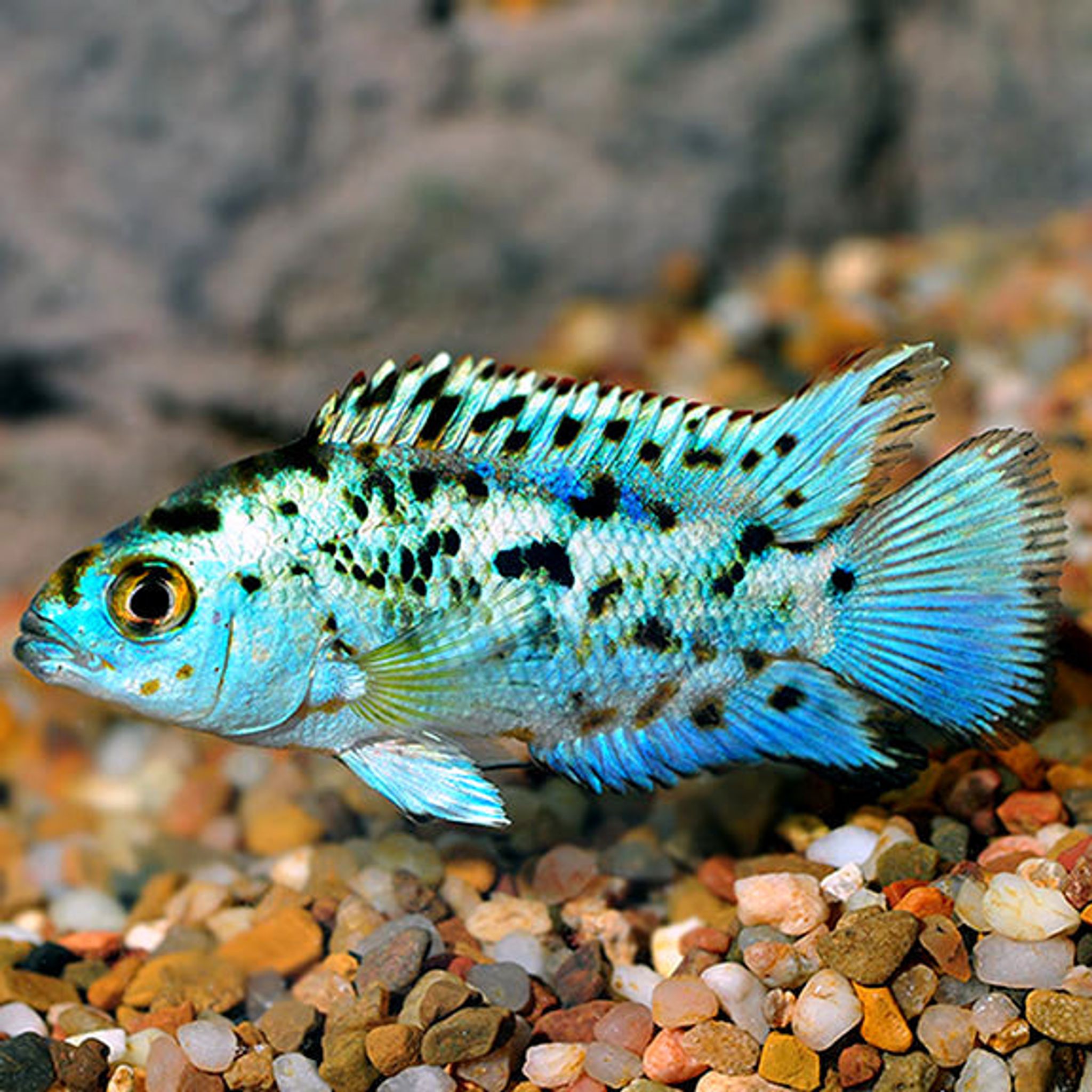
Best Tank Mates for Jack Dempsey: Compatible Fish and Species to Avoid
The best Jack Dempsey tank mates are sturdy fish at least half its adult size that like the same warm, hard water. That covers firemouths, blue acaras, green terrors, large plecos, hoplo and Raphael catfish, and fast schoolers like silver dollars and giant danios. Leave out anything that fits in its mouth, slow long-finned fish, invertebrates, and heavyweight bullies like red devils. The rest of this guide covers tank size, stocking order, and backup plans so the community still works once your fish are adults.
Know the Fish Before You Pick Its Neighbors
The Jack Dempsey (Rocio octofasciata) is a Central American cichlid from southern Mexico to Honduras. In home aquariums, males usually reach 8–10 inches (20–25 cm) and females about 6–7 inches (15–18 cm). Wild fish sometimes top 10 inches, and a few care sheets quote 10–15 inches, but 8–10 inches is the realistic number to plan around. With good care they live 10–15 years, so whatever you add should be something you're happy to keep for a decade.
Its temperament runs from semi-aggressive to aggressive, and it gets worse:
- with age: a calm 2-inch juvenile says little about the 8-inch adult
- during spawning, when a pair will claim a big chunk of the tank
- in cramped tanks, where every fish is in someone's territory
Sex matters too. Males have longer, pointed dorsal and anal fins and more blue spangling, and they are usually the pushier fish. Personalities also vary a lot between individuals, so keep a spare tank or a tank divider available no matter which mates you choose.
Tank Size and Water: The Foundation of Compatibility
Most failed Jack Dempsey communities come down to too little space. Sources disagree on the minimum (55, 75–90, or 80 gallons for one fish), and a practical middle ground is:
| Setup | Minimum tank | Notes |
|---|---|---|
| Single juvenile or young adult, no mates | 55 gal (208 L) | Easiest, lowest-risk setup |
| One adult plus tank mates | 75–90 gal (284–341 L) | Realistic community minimum |
| Bonded pair or breeding | 120 gal (454 L)+ | Pairs defend large areas |
| Adult with oscars | 100–125 gal (379–473 L)+ | Introduce at similar sizes |
| With very large, aggressive cichlids (jaguar, etc.) | 180 gal (681 L)+ | For experienced keepers |
A long footprint of 4–6 feet (120–180 cm) is worth more than height, because floor space is where territories are drawn.
Water targets: 72–86°F (22–30°C), ideally 76–80°F (24–27°C); pH 6.5–8.0; moderate to hard water around 9–20 dGH. Sources quote pH ranges anywhere from 6.0–7.0 to 7.0–8.0. Aiming for roughly 7.0–7.8 suits the Dempsey and also the Central American hard-water fish that make the best companions. Soft-water species such as angelfish and most tetras are a poor chemical match.
Core Rules for Choosing Jack Dempsey Tank Mates
- Size: adult mates should be at least half the Dempsey's adult length. If it fits in the mouth, it will eventually be eaten.
- Build: choose robust bodies or armor (plecos, armored catfish) over delicate fish.
- Attitude: mates need to hold their ground without being a bigger bully than the Dempsey.
- Water zone: fish that live in a different level of the tank (surface and midwater schoolers, bottom catfish) cross paths with a bottom-and-cave-focused cichlid far less often.
- Chemistry: they must share the warm, moderately hard water described above.
The Best Tank Mates, by Group
Cichlid Companions
- Firemouth cichlid: smaller but spirited, from the same region and water type. A classic pairing in 75 gal+.
- Convict cichlid: small but tough. Be careful with a breeding convict pair, which guards its fry fiercely.
- Green terror: similar size and temper; needs space and plenty of décor.
- Blue acara / electric blue acara: similar size, a bit milder, and a good match in hard water.
- Midas or red-headed type large cichlids: only in big tanks, since these can outmuscle a Dempsey.
- Jaguar cichlid: only at 180 gal+.
- Oscar: workable in 100–125 gal+ when both are similar in size at introduction.
You can browse American cichlids on FishyHub to find Central American species that share the Dempsey's water needs.
Bottom Dwellers and Cleanup Crew
- Plecos: armored and ignored by most cichlids. Give each one its own cave. A common pleco reaches roughly 18–24 inches (45–60 cm) and really needs 180 gal+, so in normal tanks choose a bristlenose (smaller setups) or a sailfin or mid-size L-number pleco.
- Hoplo catfish: heavily armored and unbothered by cichlid behavior.
- Striped Raphael catfish: spiny, nocturnal, and very hard to hurt.
- Featherfin synodontis: a large, confident catfish that handles itself well.
- Clown loaches: keep in groups, and only in a large tank, since they grow big and slowly.
The plecos, corys and bottom dwellers section is the place to look for armored catfish. Skip small corydoras, which are bite-sized to an adult Dempsey.
Dither and Midwater Fish
Fast schoolers do more than fill space. Kept in groups of 5–6 or more, they spread aggression across many targets and give the Dempsey a sense that the coast is clear, which usually makes it bolder and less edgy. Good choices:
- Silver dollars
- Tinfoil barbs (they grow large, so plan for it)
- Giant danios
- Larger rainbowfish species
- Blind cave tetras
The iridescent shark is sometimes suggested, but it reaches 3–4 feet (90–120 cm) and outgrows nearly every home aquarium. Treat it as a 180 gal+ fish at minimum, or pick silver dollars instead.
Species to Avoid
| Avoid | Why |
|---|---|
| Neon tetras, guppies, small danios, small rasboras, dwarf gouramis | Small enough to be eaten |
| Cherry shrimp, other shrimp, most snails | Food (large nerites occasionally survive) |
| Bettas, fancy goldfish | Slow, long-finned; goldfish also need cooler water |
| Red devils, adult flowerhorns, Texas cichlids (in normal tanks) | Bigger and meaner; the Dempsey becomes the victim |
| African mbuna | Different water chemistry and nonstop aggression of their own |
| A second Jack Dempsey | Fights unless it's a bonded pair or the tank is 120 gal+ |
| Angelfish (most cases) | Slow, tall-finned, soft-water; see below |
Angelfish show up on some compatibility lists, and they can work, but it's a gamble. Only try it with adult-sized angels, a mellow Dempsey (often an electric blue), and a large tank with lots of cover.
Electric Blue Jack Dempsey Tank Mates
The electric blue form is smaller (about 6–8 inches, 15–20 cm) and calmer than the standard fish. It is also more fragile. It comes from an inbred line and tends toward weaker immunity and irregular growth. A 30-gallon tank is sometimes mentioned for it, but 55 gal+ still applies.
Because it gets bullied more easily, choose gentler mates:
- blue acaras and firemouths
- bristlenose or medium-size plecos
- silver dollars, larger rainbowfish, and other larger peaceful schoolers
Avoid rough large cichlids like green terrors in tight quarters, Texas cichlids, or red devils. An electric blue that keeps getting chased will often get sick. It is calmer, but it's still a cichlid, so tiny fish are off the list.
Can a Texas Cichlid Live With a Jack Dempsey?
Texas cichlids reach about 12 inches (30 cm) and are generally more aggressive than Dempseys. They prefer hard, alkaline water (pH 7–8, 68–82°F / 20–28°C) and do best kept singly or with large, robust fish (big plecos, large catfish, silver dollars, and some larger cichlids) in 125 gal (473 L)+. A Texas and a Dempsey together only makes sense in a very large tank with lots of separate territory, run by an experienced keeper. In an ordinary tank, don't do it.
Aquascaping to Keep the Peace
- Build rock caves and stack driftwood to create several separate territories.
- Break sightlines so fish can get out of view of each other.
- Use hardy plants (anubias, java fern) attached to wood or rock, or floating plants. Rooted, delicate plants will be dug up.
- Set rockwork directly on the bottom glass before adding substrate. Dempseys dig and can undermine stacks.
Stocking Order and Introduction
- Quarantine every newcomer for 2–4 weeks.
- Add the tank mates first, or add everyone at once as juveniles.
- Add the Jack Dempsey last so it doesn't already own the tank.
- Rearrange the décor every time you add fish, which resets territories.
- Feed a quality cichlid pellet plus frozen and meaty foods (color-enhancing foods are fine). A well-fed Dempsey is less likely to hunt its tank mates.
Example Stocking Plans
- 75 gal: 1 Jack Dempsey, 1 firemouth or blue acara, 1 bristlenose pleco, 6 giant danios.
- 125 gal: 1 Jack Dempsey, 1 green terror or blue acara, 1 sailfin pleco, 2 hoplo catfish, 6–8 silver dollars.
- 180 gal: a Jack Dempsey pair or 1 Dempsey with an oscar or jaguar cichlid, 1 striped Raphael catfish, 1 featherfin synodontis, a group of clown loaches, and 8+ silver dollars or tinfoil barbs.
These are starting points. Watch behavior closely and adjust.
Filtration and Maintenance
A meaty diet means a heavy bioload. Use filtration rated for about twice your tank volume, change 25–30% of the water weekly, and keep ammonia and nitrite at 0 with nitrate under 20–40 ppm. Poor water quality makes cichlids more stressed and more aggressive.
Common Mistakes and Troubleshooting
- Assuming juvenile harmony will last. Plan every choice around adult size.
- Undersized tank. Constant chasing usually means too little space. The fix is a bigger tank or rehoming.
- Small dither fish. They become food.
- Too few dithers. One or two fish get singled out, so keep proper groups.
- Ignoring spawning. A pair can turn violent overnight. Remove other fish or install a divider.
- Mismatched chemistry. Soft-water or cool-water species are stressed by cichlid conditions.
Signs of trouble: torn fins, fish hanging at the surface or hiding behind the heater, dark stress coloration, or fish that go missing. Respond in order: rearrange décor, add more sight-breaks, divide the tank, then remove the aggressor or the victim.
Frequently Asked Questions
Can two Jack Dempseys live together?
Yes, as a bonded pair, or in a tank of 120 gallons or more with plenty of territory. Two males in a smaller tank will usually fight. Have a divider ready if you try it.
Can a Jack Dempsey live with an oscar?
Often, yes, in 100–125 gallons or more. Introduce them at similar sizes and give both room to set up separate zones. In a smaller tank the stronger fish will dominate.
Will a Jack Dempsey eat shrimp or snails?
Very likely. Shrimp and most snails get treated as food, though large nerite snails occasionally survive. Plan an invertebrate-free tank.
Are electric blue Jack Dempseys less aggressive?
Generally, yes. They are smaller and calmer than the standard form, but individuals vary. They still eat tiny fish and still need at least 55 gallons.
What is the best cleanup crew for a Jack Dempsey tank?
Plecos, hoplo catfish, striped Raphael catfish, and synodontis. They are armored or spiny enough to live alongside a cichlid. Skip snails and shrimp.
Can a Jack Dempsey be kept alone?
Yes. A single Dempsey in 55 gallons is the easiest, lowest-risk setup, and the fish will do perfectly well without company.
Ready to build your community? Start by browsing American cichlids on FishyHub and pick companions that match your tank size and your Jack Dempsey's temperament.

