Best Tank Mates for Frontosa: Compatible Fish and Species to Avoid
The best frontosa tank mates are fish that stay too big to swallow and like the same hard, alkaline water. In practice that means larger Lake Tanganyika cichlids, Tanganyikan Synodontis catfish and a few calm Malawi haps and peacocks. Small fish, aggressive mbuna and South or Central American cichlids don't belong. Below you'll find a size cutoff table, stocking templates for 125, 180 and 220 gallon tanks, and the pairings you should skip even though they show up on a lot of lists.
Know the Fish First: Frontosa Basics
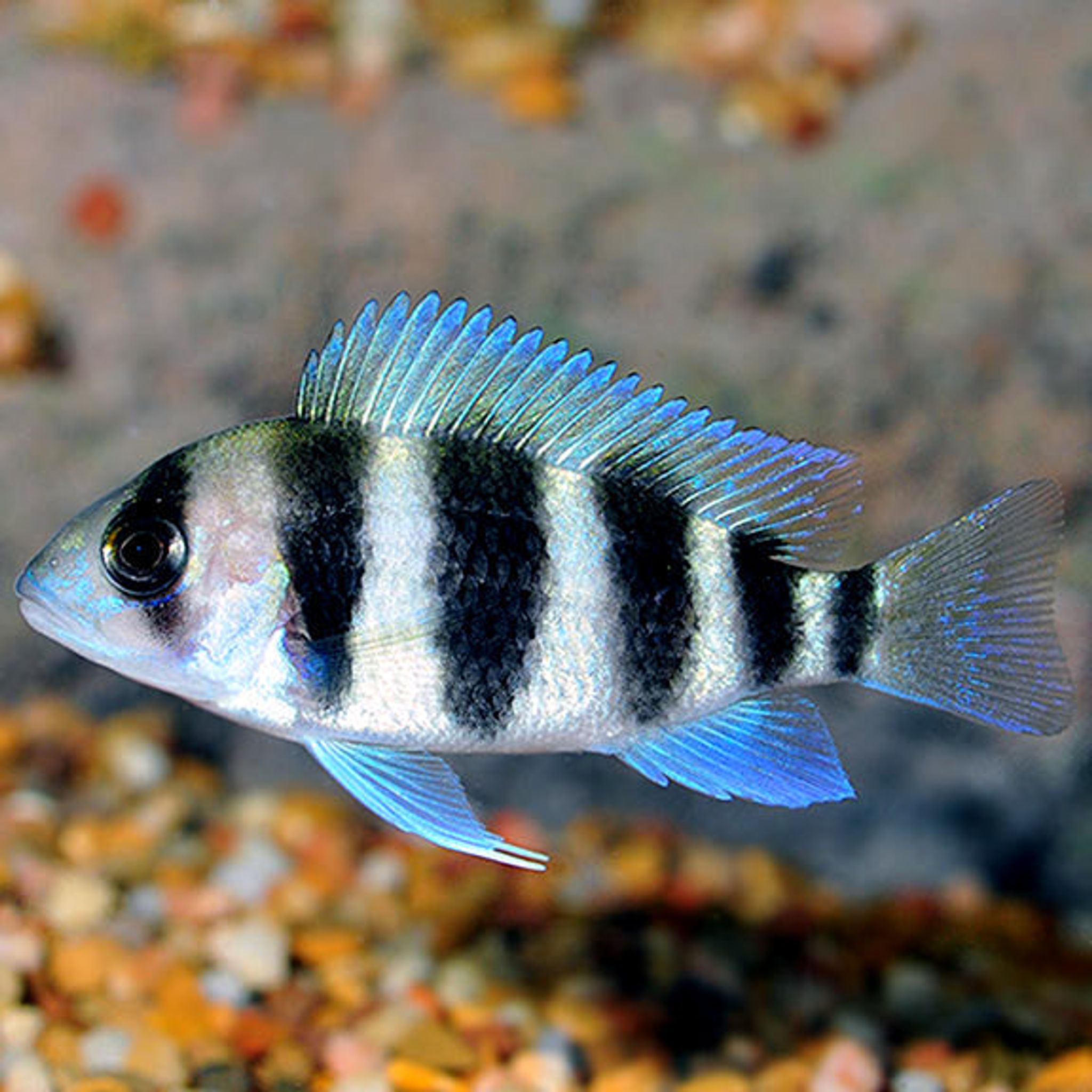
Frontosa (Cyphotilapia frontosa, and the closely related C. gibberosa) are slow-growing predators. Males reach 12–14 in (30–36 cm) and grow a pronounced nuchal hump. Females top out around 10–12 in (25–30 cm). They take 2–3 years or more to mature and can live 20+ years, so what you put in the tank today has to work for a long time.
They move slowly and deliberately and are most active at dawn and dusk. That calm look can fool you. A frontosa will swallow anything that fits in its mouth, and much of that eating happens at night. If a fish "vanishes" overnight, it was almost always eaten.
The Golden Rule: Swallow-Proof Adults Only
Every tank mate has to be too big to swallow as an adult, and it needs to stay that way as the frontosa keeps growing.
- Aim for tank mates that reach at least 4–5 in (10–13 cm).
- Go bigger once your frontosa pass about 8 in (20 cm).
- Deep-bodied fish are safer than slender ones of the same length, because width is what actually stops a fish from going down.
- Plan around growth timing. Tiny frontosa sold alongside tiny tank mates will outgrow them and eat them within 1–2 years.
Minimum Adult Size Cutoff Table
| Tank mate | Adult size or build | Verdict with adult frontosa | Notes |
|---|---|---|---|
| Cyprichromis (school) | Slender open-water fish | Good in large tanks | Open-water dither; needs a big school and long footprint |
| Paracyprichromis | Slender open-water fish | Good in large tanks | Similar role to Cyprichromis |
| Altolamprologus calvus / compressiceps (large) | Buy large adults | Good | Spiny, flat bodies; hide in rock |
| Featherfins (Cyathopharynx, Ophthalmotilapia) | Large; need space | Good in big tanks | Need room to display |
| Tropheus / Petrochromis | Robust, deep-bodied | Experts, very large tanks only | Herbivores; diet conflict |
| Neolamprologus leleupi / cylindricus | Borderline | Only if full-grown | Risky with big males |
| Synodontis multipunctatus (cuckoo) | Mid-size catfish | Good for display tanks | Egg parasite of mouthbrooders |
| S. petricola complex | 4–5 in | Good | Buy known adult size |
| S. lucipinnis | Under 4 in | Risky | Too small for adult frontosa |
| Bristlenose pleco | Mid-size | Good | Handles hard water |
| Calm peacocks / haps | Medium to large | Workable | Skip aggressive types |
| Shell dwellers, tetras, shrimp | Under 3–4 in | Avoid | Will be eaten |
Tank Size and Water Requirements
How big a tank?
Recommendations range widely. A 75 gallon (284 L) tank is the bare minimum for one adult or a group of juveniles. For adults with tank mates, treat 125 gallons (473 L) as the practical floor. A 6 ft (183 cm) footprint, usually a 180 or 220 gallon (681–833 L) tank, is ideal for a real colony plus dither fish. Footprint matters more than height, since frontosa and their companions use the bottom and middle of the tank.
Water parameters
- Temperature: 75–80°F (24–27°C), range 72–82°F (22–28°C)
- pH: 7.8–9.0
- Hardness: hard, roughly 10–20 dGH
- Nitrate: under 20 ppm
- Buffering: aragonite or crushed-coral sand helps hold pH
- Filtration: turnover of 4–6 times the tank volume per hour, with strong aeration
- Maintenance: 25–40% weekly water changes
Frontosa are very sensitive to swings in pH and temperature. Any tank mate you pick must thrive in the same hard, alkaline water, which is why soft-water species are out from the start.
Group Structure: How Many Frontosa?
The classic setup is a colony of 6–12 with one dominant male. Frontosa spawn harem-style and females brood the eggs in their mouths. Keepers disagree here: some say a single frontosa is fine, while others insist on 8–12. A reasonable middle ground:
- 6 or more if the tank allows it.
- One fish is acceptable.
- Avoid 2–3 adults. Small groups often end with one fish bullying another nonstop.
Best Tank Mates for Frontosa
Tanganyikan cichlids (best water match)
- Cyprichromis and Paracyprichromis: schooling, open-water fish that act as dither fish. Their movement in the upper water tells frontosa the coast is clear. Best in large tanks with a long footprint.
- Large Altolamprologus calvus and A. compressiceps: spiny and laterally compressed, so they're hard to swallow. They spend most of their time in the rockwork.
- Featherfins (Cyathopharynx, Ophthalmotilapia): attractive and a good fit in big tanks.
- Tropheus or Petrochromis: possible only in very large tanks with experienced keepers, because of their aggression and herbivorous diet.
- Adult Neolamprologus leleupi or N. cylindricus: only if they're already big enough to escape being eaten.
Catfish and bottom dwellers
Synodontis are the standard bottom companion. Cuckoo catfish (S. multipunctatus) and the S. petricola complex (4–5 in) come from the lake itself. S. lucipinnis stays under 4 in, which makes it risky with adult frontosa.
Bristlenose plecos do fine in hard water. Common plecos get too big and produce too much waste for a tank already carrying heavy fish. You can browse suitable catfish and plecos on FishyHub. Check the adult size before you buy.
Tanganyikan Synodontis: what to know before buying
- Names in stores are unreliable. The group was recently revised, and the S. petricola complex is especially confused. Many fish labeled "petricola" are hybrids or actually S. lucipinnis.
- Know the adult size first. That tells you whether the fish will stay swallow-proof.
- Keep groups of 3–5 or more. They're nocturnal, so give them caves to use during the day.
- The cuckoo habit: S. multipunctatus sneaks its eggs into spawning mouthbrooders. This doesn't matter in a display tank but is a real problem if you want to breed frontosa.
Calm Malawi haps and peacocks
Malawi water is close enough that peaceful haps and peacocks make a workable mix: Aulonocara peacocks, Placidochromis "Phenochilus" and Cyrtocara moorii (blue dolphin). Tanganyika purists reject all Malawi fish, while some lists add yellow labs and even electric yellows. The sensible position is that calm haps and peacocks are fine, and any mbuna, labs included, is a last resort.
Species to Avoid
- Anything under about 3–4 in as an adult: Lamprologus shell dwellers, small Julidochromis, Neolamprologus multifasciatus, tetras.
- Aggressive mbuna: they harass and nip constantly. The frontosa hides, its fins fray and it can stop eating.
- Central and South American cichlids: oscar, Jack Dempsey, Texas and green terror need different water and are often more aggressive.
- Fin nippers such as tiger barbs.
- Soft-water fish of any kind.
- Shrimp and snails: they'll be eaten.
Commonly recommended pairings to reject
| Often suggested | Why it doesn't work |
|---|---|
| Jack Dempsey | Water mismatch and different aggression |
| Starry night cichlid | Soft-water Madagascar species |
| Red Irian rainbowfish | Water and size mismatch |
| Common pleco | Size and bioload |
| Mbu puffer | Needs 300+ gallons (1,136+ L) and bites |
Duboisi (Tropheus duboisi)
Duboisi are aggressive herbivores that don't tolerate each other well. On a frontosa's high-protein diet they're at risk of bloat. They do best with other Tropheus and Petrochromis-type vegetarians. Mixing them with frontosa only works in a huge tank with careful separate feeding.
Fairy cichlids (Neolamprologus pulcher / brichardi)
These cooperative breeders reach about 3–4 in, form large colonies and defend them hard. They're too small and breed too much for an adult frontosa tank. Frontosa eat the fry, and some keepers treat that as live feeding, but it isn't a stable community and isn't recommended.
Lamprologus ocellatus
One of the smallest and boldest shell dwellers at about 2 in (5 cm). A frontosa will eat it. Give it its own tank of 20 gallons (76 L) or more with shells.
Stocking Templates for Common US Tank Sizes
| Tank | Frontosa | Suggested companions |
|---|---|---|
| 125 gal (473 L) | 1 fish, or a group of juveniles you plan to thin | 3–5 Synodontis (petricola complex or cuckoo), 1 bristlenose, a few large Altolamprologus or 3–4 calm peacocks |
| 180 gal (681 L), 6 ft | 6–8 (1 male, rest females) | School of Cyprichromis, 4–5 Synodontis, 1–2 bristlenose, 2–3 A. calvus |
| 220 gal (833 L), 6 ft | 8–12 (1 male) | Larger Cyprichromis school, featherfins, 5+ Synodontis, bristlenose; experienced keepers may add a Tropheus group with separate feeding |
These are starting points. Stock lightly, then watch behavior and nitrate before adding more.
Feeding a Mixed Frontosa Tank
- Offer sinking carnivore foods: quality pellets, krill, mysis, shrimp or prawn, and mussel.
- Feed smaller amounts 1–2 times a day and fast one day a week.
- Skip bloodworms. Some keepers use them as a treat, but they've been linked to bloat and parasites in African cichlids.
- If you keep herbivores such as Tropheus, plan for their vegetable-based diet separately.
Aquascape: Rock, Light and Safety at Night
- Build stacked rock caves, with a separate cave for each frontosa.
- Set rockwork directly on the glass before adding sand so digging fish can't collapse it.
- Leave open swimming lanes for frontosa and dithers.
- Plants are optional. Anubias and java fern tolerate the conditions.
- Keep lighting dim to moderate. Bright light and busy, frantic tank mates keep frontosa on edge, and stressed fish hide and eat poorly.
- Give small-to-mid tank mates tight crevices the frontosa can't reach into. That matters most after lights-out, when most predation happens.
Introducing New Fish
- Quarantine every new fish for 3–4 weeks.
- Add tank mates while the frontosa are juveniles, or add companions at a similar size.
- Rearrange the rockwork when adding fish so old territories reset.
Common Mistakes and Troubleshooting
- Buying small frontosa with small tank mates: the frontosa outgrows and eats them within 1–2 years.
- A heavy mbuna mix: the result is a hiding, frayed frontosa that stops eating.
- Missing night predation: a fish that disappeared usually got eaten.
- Letting pH drop or water go soft: no buffering leads to stress and hole-in-the-head type problems.
- Frontosa chasing each other: add more females or more caves, rearrange the rocks, or move out a fish that's being bullied.
- A tank mate gasping at the surface: check aeration first. Big fish use a lot of oxygen.
Frequently Asked Questions
Can frontosa live with Malawi cichlids?
Yes, if you choose calm haps and peacocks and keep them in a large tank. The water needs are close enough. Avoid aggressive mbuna, which harass frontosa and nip their fins.
How many frontosa should I keep?
A group of 6–12 with one male is ideal. A single frontosa works fine. Avoid keeping 2–3 adults, because one fish often ends up bullied.
What size tank do frontosa need with tank mates?
Plan on 125 gallons (473 L) at minimum. A 180 gallon (681 L) or larger tank with a 6 ft footprint is ideal for a colony plus companions.
Can frontosa live with plecos?
Yes. A bristlenose or another mid-size pleco suits hard water well. Skip common plecos, which grow too large and add too much waste.
Are cuckoo catfish safe with frontosa?
With the frontosa themselves, yes. They're peaceful and match the water. The only problem comes if you want to breed frontosa, since cuckoos slip their eggs into brooding females.
Can frontosa live with oscars, Jack Dempseys or duboisi?
It's not recommended. Oscars and Jack Dempseys need different water and bring a different level of aggression. Duboisi are herbivores that can bloat on a frontosa diet.
Build Your Frontosa Community
A frontosa tank works when every companion stays swallow-proof, likes hard alkaline water and stays calm. Start with the frontosa colony, add Synodontis and a dither school, and build plenty of rock caves. When you're ready to stock, browse African cichlids on FishyHub and check adult sizes against the table above.

