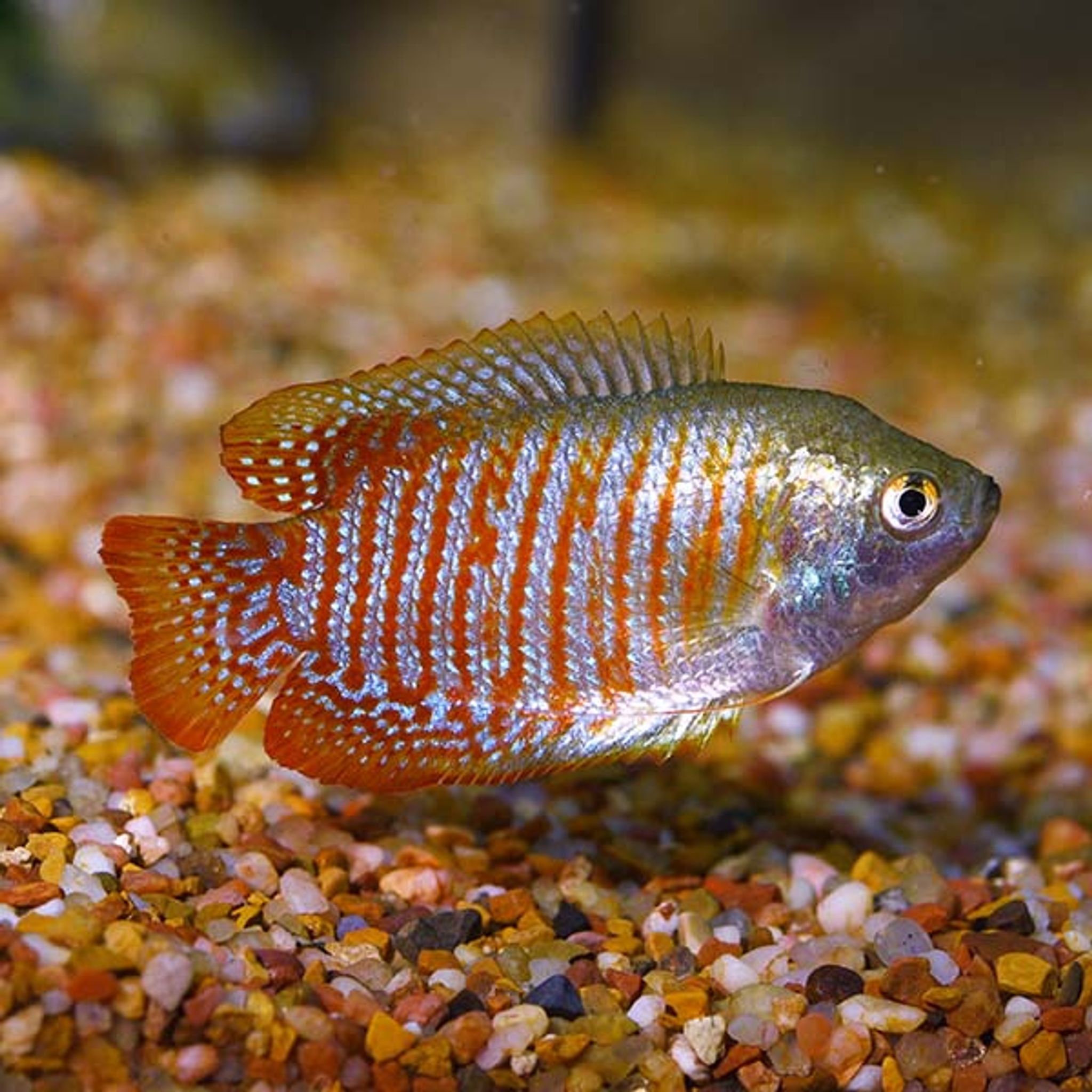
Best Tank Mates for Dwarf Gourami: Compatible Fish and Species to Avoid
The best tank mates for a dwarf gourami are small, peaceful fish that stay out of its way: corydoras, kuhli loaches, otocinclus, small rasboras and tetras, cherry barbs, platies, snails and Amano shrimp. Keep only one male per tank, and skip bettas, other male gouramis, fin-nippers, cichlids and anything big enough to eat or bully it. Below you'll find a ranked list, ready-made stocking plans by tank size, and the health issues that decide whether your community makes it.
Dwarf Gourami at a Glance
The dwarf gourami (Trichogaster lalius) includes the wild-type red-and-blue fish plus the powder blue, flame and neon blue color morphs. Knowing how it lives tells you what it can share a tank with.
- Size: roughly 3–3.5 inches (7.5–9 cm) as an adult.
- Temperament: peaceful to semi-aggressive, and it varies a lot from fish to fish.
- Swimming zone: upper and middle water column, moving slowly and deliberately.
- Labyrinth breather: it gulps air at the surface, so keep the surface open, keep a lid on (they jump), and avoid strong surface current.
- Diet: omnivore.
Water Parameters
| Parameter | Target |
|---|---|
| Temperature | 75–82°F (24–28°C); sweet spot 77–80°F (25–27°C) |
| pH | about 6.0–7.5 |
| Hardness | soft to moderately hard, roughly 2–10 dGH (50–150 ppm) |
| Ammonia / nitrite | 0 ppm |
| Nitrate | ideally under 20 ppm |
| Flow | low |
Some keepers cite an acidic 5.5–7.0 pH, others 6.8–7.8. Captive-bred fish adapt well, so aim for 6.0–7.5 and prioritize stability over hitting an exact number.
How Big a Tank Do You Need?
Recommendations range from 10 to 20+ gallons. Our take: a 10-gallon (38 L) tank works for a single gourami with a nano school only. A 20-gallon (76 L), ideally a 20 long, is the practical minimum for a real community. Go 29 gallons (110 L) or more for a male-female pair plus several tank-mate groups.
Rules for Choosing Compatible Tank Mates
- Similar size or slightly smaller, but not bite-sized.
- Peaceful and non-nipping. The gourami's long, thread-like pelvic fins are an easy target.
- Calm swimmers. Hyper, fast fish stress a slow gourami and beat it to food.
- Different water zone. Bottom dwellers are ideal because they never compete for the surface.
- Same water. Warm, soft-to-neutral conditions.
- Not look-alikes. Color-bred males often react to fish with similar red or blue coloring, such as male platies or fancy guppies, because they read them as rival males. Choose contrasting colors where you can.
Tank Mates Ranked by Risk
| Species | Group size | Rating | Notes |
|---|---|---|---|
| Corydoras (pygmy cories for small tanks) | 6+ | Safe | Bottom zone, peaceful |
| Kuhli loaches | 5+ | Safe | Needs sand, lots of cover |
| Otocinclus | 6+ | Safe | Mature planted tanks only |
| Bristlenose pleco | 1 per 20–30 gal | Safe | Stays small, eats algae |
| Harlequin / lambchop rasboras | 6–10+ | Safe | Calm midwater school |
| Chili rasboras, ember tetras | 8–10+ | Safe | Great in 10–20 gal tanks |
| Neon, cardinal, glowlight, rummynose tetras | 6–10+ | Safe | Soft-water schoolers |
| Cherry barbs | 6+ | Safe | Peaceful barb, unlike tigers |
| Platies | 3+ | Safe | Prefer slightly harder water |
| Nerite and mystery snails | Any | Safe | Cleanup crew |
| Amano shrimp | 3+ | Safe-ish | Large enough to avoid being eaten |
| Mollies | 3+ | Conditional | Harder water, 30 gal+ |
| Honey or sparkling gourami | Small group | Conditional | Lower-risk labyrinth option |
| Guppies | Small group | Conditional | 29 gal+; watch fin-picking |
| Zebra danios | 6+ | Conditional | 29 gal+; fast, can harass |
| Cherry shrimp | Colony | Conditional | Expect losses of shrimplets |
| Angelfish, rams | — | Advanced only | Large tanks, experienced keepers |
| Bettas, other male dwarf gouramis | — | Avoid | Surface territory fights |
Bottom Dwellers
Corydoras are the easiest win: they sift the substrate in groups, ignore the gourami entirely and clean up leftovers. Kuhli loaches want sand and hiding spots, and you'll see more of them in a group of five or more. Otocinclus belong only in established planted tanks with biofilm to graze. One bristlenose pleco per 20–30 gallons handles algae without outgrowing the tank. You can browse plecos, corys and other bottom dwellers on FishyHub.
Midwater Schoolers
Schools of 6–10 or more give the tank movement and act as dither fish, which makes a gourami feel safe enough to come out. Harlequin and lambchop rasboras, chili rasboras, ember, neon, cardinal, glowlight and rummynose tetras, and cherry barbs are all good choices. Pick the tiniest species (chilis, embers) for smaller tanks. See the small community fishes range for options.
Livebearers
Platies are hardy and peaceful. Mollies do better in harder water and need 30 gallons or more. Mixing livebearers with soft-water tetras means meeting in the middle, around 6.8–7.4 pH and moderate hardness. If you can't hold that range steady, build around one group or the other.
Invertebrates
Nerite and mystery snails are ignored. Adult Amano shrimp are usually big enough to be safe. Small dwarf shrimp are a different story (more below).
Honey and Sparkling Gouramis
For a small tank where you want a labyrinth fish without the dwarf gourami's temper, a honey gourami or a few sparkling gouramis are the lower-risk alternative. Keeping one alongside a dwarf gourami works only in larger, heavily planted tanks, and you should watch closely.
Conditional Picks: Guppies, Danios, Angelfish and Rams
Guppies With Dwarf Gourami
Guppies tolerate the same temperatures but prefer harder water than the gourami. The bigger issue is behavior: showy male guppies with long, colorful tails can draw a gourami's attention and get picked at. Choose a 29-gallon or larger tank, add plenty of plants, and consider females or more modestly finned males.
Zebra Danios
Danios are hardy but fast. In a small tank they can harass a slow gourami and eat everything before it reaches the food. In 29 gallons or more, with a big enough school, they're workable.
Angelfish and Rams
Angelfish can bully a dwarf gourami and will eat small schooling fish, while rams need water of 80°F (27°C) or higher. Treat both as advanced, large-tank only combinations.
Species to Avoid
- Other male dwarf gouramis. Males fight, sometimes to the death.
- Bettas. Both are territorial surface-dwelling labyrinth fish (see the sidebar below).
- Paradise fish and larger gouramis such as three-spot (blue), pearl in small tanks, and kissing gouramis.
- Nippy fish: tiger barbs, serpae tetras and black skirt tetras. Black skirts sometimes appear on "compatible" lists, but they're known nippers and a poor match for long-finned fish.
- Cichlids beyond dwarf species: convicts, jewels, oscars and most African cichlids.
- Large predators that can swallow a 3-inch fish.
- Red-tail sharks and other territorial shark-type fish.
- Goldfish, which need cooler water.
- Cherry and other dwarf shrimp if you want a breeding colony. Gouramis eat shrimplets and small adults.
What About Other Gouramis?
Larger gouramis like pearl, blue/three-spot and kissing gouramis need 30–55+ gallons and tougher companions. Dwarf species do best with smaller, gentler tank mates, so the two groups rarely belong in the same tank.
Sidebar: Why Bettas and Gouramis Clash
Bettas and gouramis are both anabantoids, the labyrinth-fish family that breathes air from the surface. That shared niche is the problem. Both claim surface territory, build bubble nests and react to similar body shapes and bright colors, which leads to flaring, fin damage and fights.
A few related points often cause confusion:
- "Alien" bettas are hybrids of wild Betta species, not a separate fish.
- "Paradise betta" is a loose trade name, not a precise species label.
- Wild bettas, such as those from Borneo, come from soft, acidic blackwater streams, the same kind of warm, soft water gouramis like. They compete for the same space rather than splitting it.
- Resting at night: bettas and gouramis often rest motionless near plants or the bottom with their eyes open. That's normal sleep behavior, not illness.
Stocking Plans by Tank Size
These plans assume a cycled, filtered, planted tank and regular water changes. They stay light on bioload so the gourami has room.
| Tank | Gourami | Schoolers | Bottom / cleanup |
|---|---|---|---|
| 10 gal (38 L) | 1 male | 8–10 chili rasboras or ember tetras | 2–3 nerite snails |
| 20 long (76 L) | 1 male | 8–10 harlequin rasboras or neon tetras | 6 pygmy cories, snails |
| 29 gal (110 L) | 1 male + 1–2 females | 10 cardinal or rummynose tetras, 6 cherry barbs | 6 corydoras or 5 kuhli loaches, 1 bristlenose, Amano shrimp |
In the 29-gallon plan, swap a school for 3–4 platies if your water leans harder. Don't max out every column at once.
Setting Up to Reduce Aggression
- Dense planting, especially floating plants. They dim the light, give the male a place to anchor a bubble nest, and make the fish feel secure.
- Sight-line breaks with driftwood, tall stems and rock so no fish can see the whole tank at once.
- Gentle filtration, such as a sponge filter or a baffled outflow, to keep the surface calm.
The Right Adding Order
- Fully cycle the tank.
- Add peaceful schoolers and bottom dwellers first.
- Add the gourami last, so it doesn't claim the whole tank as its territory.
- Quarantine every new fish for 2–4 weeks before it joins the display.
Feeding a Slow Fish Among Fast Ones
Feed quality flakes or micro-pellets plus frozen bloodworms, brine shrimp and daphnia. Fast schoolers can empty the surface before the gourami gets a bite, so feed at two spots: scatter food on one side for the school, then target-feed the gourami on the other. Sinking foods for the cories keep them from competing at the top.
Health Warnings Before You Buy
Dwarf Gourami Iridovirus (DGIV)
DGIV is widespread in mass-farmed dwarf gouramis. It's incurable and often fatal. Signs include lethargy, color loss, bloating and sores. A practical sourcing checklist:
- Ask the seller how long the fish have been held. Stock kept for several weeks is a safer bet.
- Look at the whole store tank, not just the fish you want. Any sick or dead tank mates are a red flag.
- Choose alert, well-colored fish that eat in front of you.
- Quarantine at home, and never add a new gourami straight into an established tank of valuable fish.
Fish Tuberculosis (Mycobacteriosis)
Gouramis are notably susceptible. Look for wasting, scale loss, lesions and a curved spine. It's contagious and essentially untreatable, and it can cause skin infections in people, so wear gloves if you have cuts on your hands when working in the tank.
Fin and Tail Rot
Fin rot shows as ragged, whitening fin edges. It starts with poor water and stress, often from nippy tank mates. Fix water quality first, then use an antibacterial treatment, and remove carbon from the filter while dosing.
Common Mistakes and Troubleshooting
- Buying two males. The colorful fish in stores are usually males. If they fight, rehome one or divide the tank.
- Adding the gourami first. New arrivals get chased. Rearrange decor before adding fish to reset territories.
- Pairing with fin-nippers. Torn fins turn into fin rot.
- Bare tank, no floating plants. The result is a pale, stressed, hiding gourami.
- Skipping quarantine. With farmed gouramis, that's how DGIV and TB get in.
- Sudden aggression. Often breeding behavior around a bubble nest. Add cover, clear crowding near the nest area and rearrange the decor.
- Gourami not eating. Swarming schoolers are beating it to food. Target-feed or use two feeding spots.
Build Your Dwarf Gourami Community
Start with a calm, planted tank, a single healthy male, and a couple of peaceful groups that stay out of the surface zone. When you're ready to choose your centerpiece fish, browse the gourami selection on FishyHub and plan your tank mates around it.
Frequently Asked Questions
Can two dwarf gouramis live together?
A male with one or more females works well, and females are the drabber, silver-blue fish that can be hard to find in stores. Two males usually fight. It can sometimes work in a large, heavily planted tank, but it's still risky.
Can a dwarf gourami live with a betta?
It isn't recommended. Both are labyrinth fish that claim surface territory, so flaring, fin damage and fights are common. Keep them in separate tanks.
How many tank mates can go in a 20-gallon tank?
A good 20-gallon setup is one dwarf gourami, 8–10 small rasboras or tetras, 6 pygmy cories and a few snails. That leaves enough bioload headroom for stable water and gives the gourami space.
Will dwarf gouramis eat shrimp?
Yes, they eat shrimplets and often small cherry shrimp. Adult Amano shrimp are usually large enough to be safe. If you want cherry shrimp too, give them heavy cover and accept some losses.
Are dwarf gouramis aggressive?
Most are peaceful, but temperament varies by individual. Some turn into bullies, especially males in small tanks or males guarding a bubble nest. More space, plants and broken sight lines help.
Why is my dwarf gourami hiding or pale?
Common causes are stress, bullying by tank mates, poor water quality or early illness. Test your water, watch for chasing or nipping, and add floating plants. If it keeps losing color, isolate it and watch for signs of DGIV or TB.

