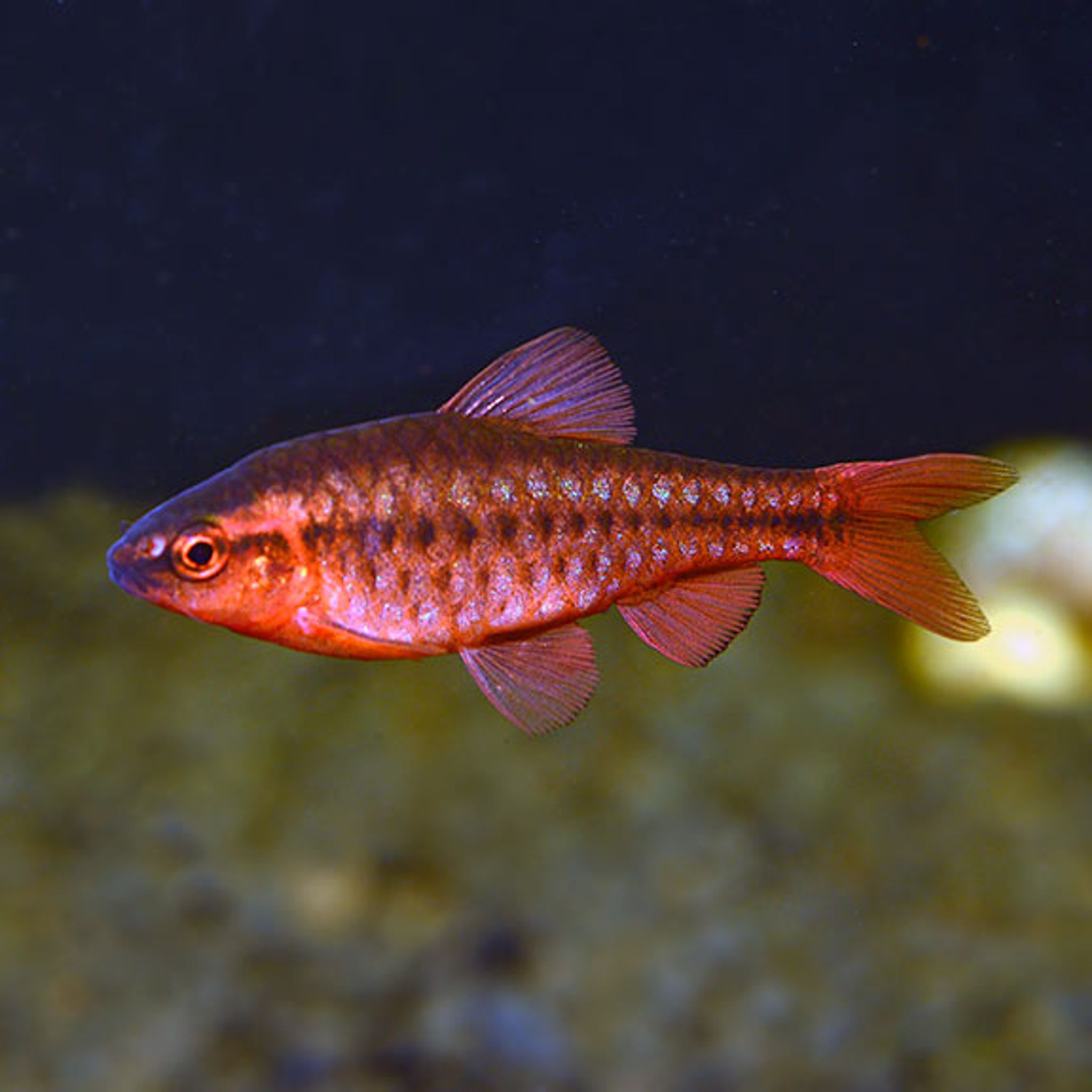
Best Tank Mates for Cherry Barb: Compatible Fish and Species to Avoid
The best cherry barb tank mates are small, peaceful fish of 1–3 inches that like the same soft, slightly acidic water: rasboras, small tetras, peaceful danios, honey gouramis, platies, corydoras, otocinclus and kuhli loaches. Leave out fin nippers like tiger barbs, anything big enough to swallow a 2-inch fish, and territorial or coldwater species. Below you'll find a compatibility table, stocking plans for 20 and 29 gallon tanks, and the mistakes that most often end in pale, hiding barbs.
Cherry Barb Basics That Shape Compatibility
The cherry barb, Rohanella titteya (formerly Puntius titteya), comes from shaded, slow-moving, heavily planted streams in Sri Lanka with soft, acidic water. It is listed as threatened in the wild, so nearly every fish sold in the US is farm-raised. Adults reach about 2 inches (5 cm) and live roughly 4–6 years.
It is one of the most peaceful barbs you can buy. The fin-nipping reputation comes from relatives like tiger and tinfoil barbs. Cherry barb males spar and chase each other, but they rarely bother other species.
Water Parameters
| Parameter | Cherry barb range | Community sweet spot |
|---|---|---|
| Temperature | 73–79°F (23–26°C); tolerates about 72–81°F (22–27°C) | 74–78°F (23–26°C) |
| pH | 6.0–7.5 | 6.0–7.0 |
| Hardness | about 4–15 dGH | soft to moderate |
| Ammonia / nitrite | 0 ppm | 0 ppm |
| Nitrate | under 20–40 ppm | as low as practical |
Some guides quote broad 68–86°F "community" ranges. Aim for 74–78°F instead, because most of the mates below overlap comfortably there. Cherry barbs are hardy and forgive beginner slip-ups, but that doesn't excuse skipping water changes.
Group Size and Sex Ratio
Keep at least 6, ideally 8–10. Cherry barbs are loose shoalers, not tight schoolers, so they drift around the tank and regroup when startled. Aim for about two females per male so the males' displays and chasing get spread across several fish.
- Males: slimmer, deep cherry red when settled.
- Females: plumper, tan to orange, with a dark stripe along the side.
Tank Size and Setup
- 10 gallons (38 L): a small group of about 6 on their own, no tank mates.
- 20 gallon long (76 L): the realistic minimum for a group plus companions.
- 29–30 gallons (110–114 L): comfortable for a mixed community.
Plant heavily, add floating plants to dim the light, and use a dark substrate and driftwood. Males only color up fully when they feel secure, so a washed-out barb is usually a stressed barb.
How to Choose Cherry Barb Tank Mates
Check every candidate against five rules:
- Similar size, roughly 1–3 inches.
- Peaceful temperament, no nipping or chasing.
- Overlapping water needs, especially temperature and pH.
- A mouth too small to swallow a 2-inch fish, now or when fully grown.
- Not so fast or greedy that the barbs go hungry at feeding time.
Cherry Barb Compatibility Table
| Species | Adult size | Temp overlap | pH overlap | Verdict |
|---|---|---|---|---|
| Harlequin and other rasboras | 1–2 in (2.5–5 cm) | Yes | Yes, prefers soft | Excellent |
| Neon, black neon, cardinal tetras | 1–2 in | Yes | Yes | Excellent |
| Ember tetras | under 1 in | Yes | Yes | Excellent |
| Rummynose, penguin, diamond tetras | 2–2.5 in | Yes | Yes | Excellent |
| Zebra danio | 2 in | Yes, likes cooler end | Yes | Good; fast feeder |
| Celestial pearl danio | 1 in | Yes | Yes | Excellent |
| Honey gourami | 2 in | Yes | Yes | Excellent |
| Platy | 2–3 in | Yes | Prefers neutral to hard | Good |
| Corydoras | 1–3 in | Yes | Yes | Excellent |
| Otocinclus | 1.5–2 in | Yes | Yes | Excellent (mature tank) |
| Kuhli loach | 3–4 in, very slim | Yes | Yes | Excellent |
| Bristlenose pleco | 4–5 in | Yes | Yes | Good in 29 gal+ |
| Dwarf gourami | 3 in | Yes | Yes | Conditional |
| Guppies, mollies | 2–4 in | Yes | Mollies want harder water | Conditional |
| Rosy barb | 4–6 in | Yes | Yes | 30 gal+ only |
| Tiger barb, serpae tetra | 2–3 in | Yes | Yes | Avoid |
| Goldfish | 6 in+ | No (coldwater) | Partly | Avoid |
Top-Tier Tank Mates
These are easy to keep and easy to find in US stores.
Midwater Schoolers
- Rasboras (harlequin, lambchop and similar) come from the same kind of soft, planted water and are just as calm as cherry barbs.
- Small tetras such as neon, black neon, cardinal, ember, rummynose, penguin and diamond tetras. Neons and cardinals are a classic pairing: red barbs against blue stripes, with nearly identical water needs. You can browse tetras on FishyHub to compare options.
- Zebra and celestial pearl danios. Zebras are fast and eat quickly, so spread food around. Celestial pearls are shy and do best in dense planting.
Centerpiece Fish
- Honey gourami: gentle, small, and a good single focal fish in a 20–29 gallon tank.
- Platies: hardy and peaceful, but they breed readily (more on that below).
Bottom Dwellers and Cleaners
- Corydoras in groups of 6+; pygmy and panda corys suit smaller tanks. See the corydoras selection for species that fit your footprint.
- Otocinclus for soft algae, added only to an established tank.
- Kuhli loaches for a group that sifts through the substrate after dark.
- Bristlenose pleco, one per tank, 29 gallons or more.
Good Tank Mates With Conditions
- Dwarf gourami: attractive but prone to health problems, including a widely reported iridovirus in commercial stock. Buy from a source whose fish look healthy, quarantine them, and remember males can get territorial.
- Guppies and mollies: peaceful, but mollies prefer harder water than cherry barbs, and both multiply fast.
- Rosy and golden barbs: larger and more boisterous. Some keepers call rosy barbs ideal mates, others call them semi-aggressive. Add them only in 30 gallons or more, each species in its own group of 6+.
- Blue and Bolivian rams: workable when water is soft and warm and there is room to claim territory.
- Kribensis or keyhole cichlids: only in a larger tank with caves, since they get defensive around spawning sites.
- Chocolate gourami: needs very soft, acidic water; for experienced keepers only.
What About Bettas?
Opinions split here. One camp says cherry barbs quickly lose interest in a betta, while the other says barb activity stresses long-finned fish. The safe call: skip fancy long-finned bettas in a community. A short-finned plakat male in a roomy, heavily planted tank is a maybe, at your own risk, with a backup tank ready.
What About Angelfish?
Some lists include angelfish, but a grown angel can eat small fish. Avoid them unless the tank is 55 gallons or more and the angels are raised from small juveniles alongside adult barbs.
Invertebrates
- Nerite and mystery snails: safe.
- Amano and bamboo shrimp: safe; large enough to be ignored.
- Cherry and other neocaridina shrimp: adults are usually left alone, but shrimplets will be eaten. Thick moss and dense plants let enough babies survive to keep a colony going.
Golden Barb Tank Mates and Keeping Cherry and Golden Barbs Together
The golden barb (Barbodes semifasciolatus, about 3 inches / 7.5 cm) shares the cherry barb's peaceful nature, and the two pair well in a 29–30 gallon tank. Both suit tetras, danios, rasboras, corydoras, kuhli loaches, otocinclus, platies, swordtails and rainbowfish.
Golden barbs tolerate cooler water, down to about 64°F (18°C), so run a shared tank at 72–76°F (22–24°C). Keep each species in its own group of 6+, and avoid adding rosy barbs to a cramped setup with them.
Species to Avoid
- Tiger barbs, serpae tetras and other nippers. They harass the slower barbs and shred fins.
- Large or aggressive cichlids such as convicts, oscars and jack Dempseys.
- Grown angelfish in anything smaller than the conditions above.
- Any fish big enough to swallow a 2-inch barb.
- Red-tail and rainbow sharks in small tanks; they defend territory hard.
- Goldfish, which want cold water and produce heavy waste.
Sample Stocking Plans
20 Gallon Long (76 L)
- 8 cherry barbs (about 3 males, 5 females)
- 8 ember tetras
- 6 pygmy or panda corydoras
- 2–3 nerite snails
29 Gallon (110 L)
- 8 cherry barbs
- 10 harlequin rasboras
- 1 honey gourami
- 6 corydoras
- 3–4 otocinclus (once the tank is mature)
Adding Tank Mates in the Right Order
- Quarantine every new fish for 2–4 weeks in a separate tank. New arrivals are a common source of ich and columnaris.
- Start with the cherry barbs and peaceful schoolers once the tank is cycled.
- Add bottom dwellers next, after the tank has settled and algae has started forming for otos.
- Add any territorial species last, such as a gourami or ram, so it cannot claim the whole tank before others arrive.
- Acclimate slowly, floating the bag to match temperature, then adding small amounts of tank water over 20–30 minutes before netting the fish in.
Feeding a Mixed Community
Cherry barbs are omnivores and polite midwater eaters. Offer quality flakes or micro-pellets, frozen or live bloodworms, daphnia and brine shrimp, plus some plant matter. Feed in two or three spots so danios and livebearers can't take everything, and drop sinking food for corys and loaches.
Signs a Pairing Is Failing
Watch the first few weeks for:
- Clamped fins or constant hiding
- Torn or split fins
- Missed meals or thinning bellies
- Barbs that stay pale long after acclimation
If you see these, identify the bully, move it to another tank or rehome it, and add cover. Rearranging decor can also reset territories.
Common Mistakes and Fixes
- Buying 1–3 fish or a single pair. The male harasses the female and both hide. Buy 6+.
- Too many males. Constant sparring; add females.
- Mixing with nippers or predators. Check adult size and temperament before buying.
- A bare tank. Add plants and floaters for color and calm.
- Barbs losing out at feeding. Spread food and add sinking foods.
- Livebearer population boom. Keep a single sex or plan for fry.
- Skipping quarantine. Two to four weeks saves the main tank.
- Blaming diet for pale barbs. Check nitrate, lighting, cover and bullying first.
Frequently Asked Questions
Are cherry barbs fin nippers?
Rarely. They are among the gentlest barbs in the hobby. Males do chase and spar with each other, which is why a female-heavy group of 6 or more matters.
Can cherry barbs live with bettas?
It can work with a short-finned betta in a roomy, well-planted tank, but results vary. Avoid long-finned bettas, since their fins make them easy targets for stress.
How many cherry barbs can go in a 10 or 20 gallon tank?
About 6 cherry barbs on their own suits a 10 gallon. In a 20 gallon long, keep 6–8 plus a few small, peaceful mates such as ember tetras and pygmy corydoras.
Can cherry barbs live with shrimp and neon tetras?
Yes to both. Adult shrimp are usually safe, though shrimplets get eaten without dense moss. Neon tetras are an excellent match in similar soft, slightly acidic water.
Can cherry barbs and tiger barbs be kept together?
It is not advised. Tiger barbs are fast, pushy and nippy, and they tend to bully the calmer cherry barbs.
Will cherry barbs breed in a community tank?
They scatter eggs among plants but eat them, and other fish join in. To raise fry, use a separate tank with plenty of moss and remove the adults after spawning.
Build Your Cherry Barb Community
Pick the plan that fits your tank, quarantine new arrivals, and add fish in stages so each group settles. When you're ready to stock, browse small community fishes on FishyHub for rasboras, tetras, danios and other peaceful companions for your cherry barbs.

