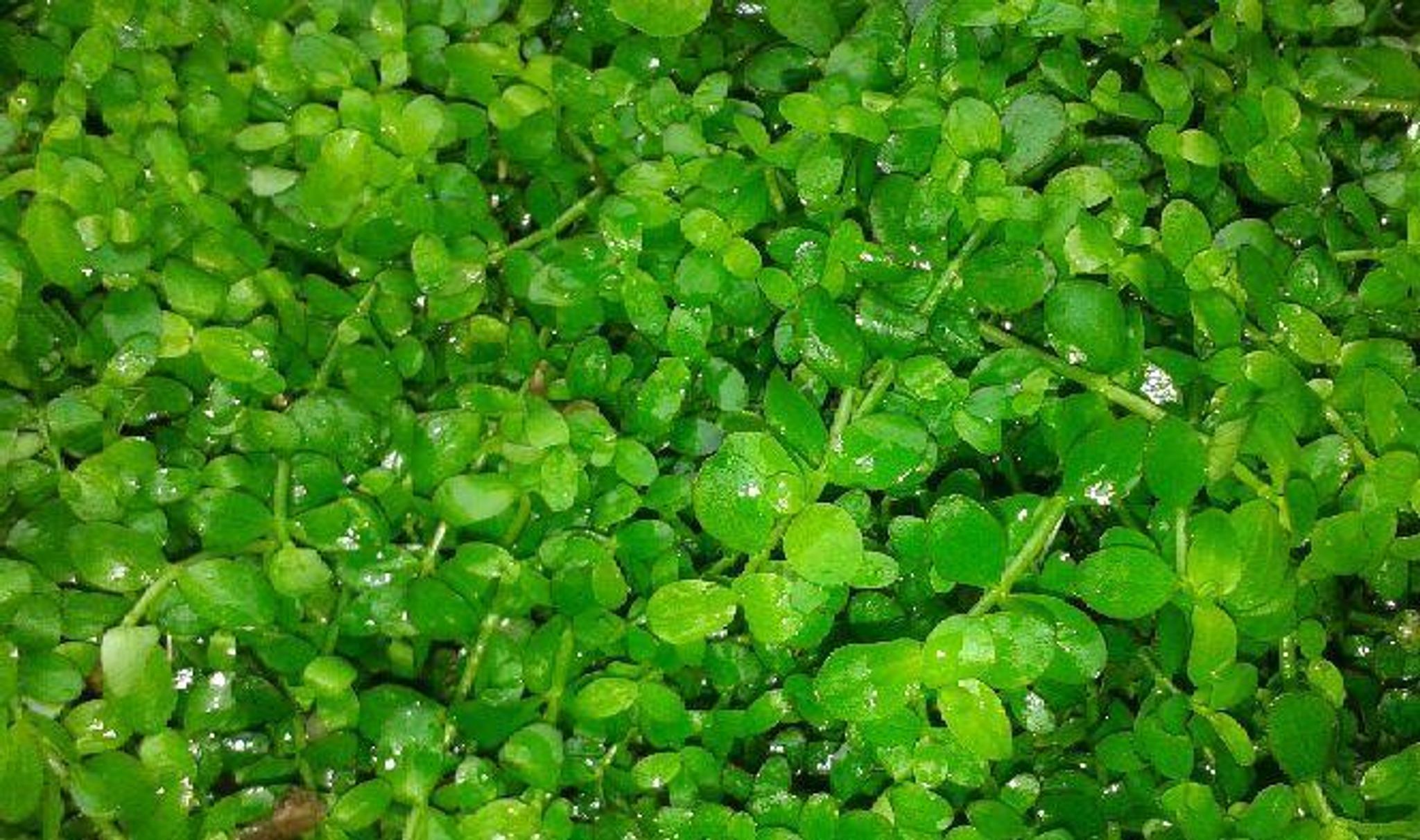
Best Tank Mates and Aquascaping Uses for Monte Carlo
Monte Carlo (Micranthemum tweediei) is one of the most forgiving true carpet plants, but a dense mat only stays intact if the fish and invertebrates sharing the tank leave the substrate alone. This guide covers which tank mates work with a Monte Carlo carpet, the water parameters they need to share, and several aquascaping layouts that go beyond a flat green lawn.
What Makes Monte Carlo Different From a Standard Carpet Plant
Monte Carlo grows low — about 1 to 2 inches (2.5 to 5 cm) tall — with rounded, bright-green leaves that spread across the substrate via runners and stolons. It's frequently used as a sturdier alternative to Dwarf Baby Tears (HC), since its slightly larger leaves and thicker stems tolerate light bioload and occasional substrate disturbance better than HC's more delicate growth.
Because the plant roots into the top layer of substrate and relies on unobstructed light reaching a flat mat, tank mate selection matters more here than with stem plants or floating species. Fish or invertebrates that dig, uproot, or graze aggressively can undo months of carpet growth in days.
Care Basics at a Glance
| Factor | Requirement |
|---|---|
| Lighting | Medium to high, roughly 30-50+ PAR |
| CO2 | Not mandatory but strongly recommended for a dense carpet |
| Substrate | Nutrient-rich substrate, or root tabs under inert substrate |
| Fertilizer | Liquid all-in-one with iron/micros to prevent yellowing |
| Temperature | 72-82°F (22-28°C) |
| pH | 6.0-7.5 |
| Water hardness | Soft to moderately hard |
Tank Mate Criteria for a Monte Carlo Carpet
The core rule is simple: choose species that swim over or graze lightly on the carpet rather than digging into it. Before adding anything, ask whether a species sifts substrate for food, burrows to spawn, or rips at plant matter as part of its normal feeding behavior. If yes, it needs either a different tank or a delayed introduction until the carpet is well established.
Good Tank Mates
- Small tetras — neon, ember, and chili tetras stay in the water column and rarely interact with the substrate.
- Rasboras — harlequin and chili rasboras are similarly surface- and mid-water-oriented; some rasboras also pick biofilm off carpet leaves, which is a mild benefit rather than damage.
- Dwarf livebearers — small, peaceful, and light on the substrate.
- Corydoras — light substrate sifters are fine once the carpet is fully rooted and spreading; avoid adding them to a freshly planted tank.
- Otocinclus — graze algae off leaves and hardscape without uprooting anything.
- Nerite snails — excellent algae control and too slow-moving to disturb runners.
- Amano and cherry shrimp — arguably the best possible tank mates for a carpet. They graze biofilm and algae directly off the leaves, pick through debris caught in runners, and give baby shrimp cover to hide in.
- Bettas — workable in a calm, otherwise peaceful setup, since bettas don't dig.
Shrimp and fish differ meaningfully here: shrimp bioturbation (light foraging with tiny legs) barely disturbs an establishing carpet, while fish bioturbation (digging with fins or mouths) can dislodge runners before they've anchored. That's why shrimp are usually safe from day one, but digging fish need a waiting period.
Tank Mates to Avoid or Use Cautiously
- Goldfish — cold-water, heavy grazers that will strip a planted carpet.
- Larger cichlids and geophagus — dig and rearrange substrate as normal behavior.
- Silver dollars and other heavy plant-eaters — will eat the carpet outright.
- Crayfish — dig, cut runners, and can uproot large sections overnight.
- Larger loaches — many species burrow or plow through substrate looking for food.
- Common plecos and similar bottom feeders — rasp on surfaces, including a soft-leaved carpet, and grow far too large for most planted setups.
Tank Mates and Water Parameter Fit
Any tank mate should also share Monte Carlo's comfortable range: 72-82°F (22-28°C), pH 6.0-7.5, soft to moderately hard water. Most community tropicals fall inside this window, which is one reason Monte Carlo pairs so easily with standard nano and community setups. Browse options suited to this range in Small Community Fishes or Shrimps.
Planting and Establishing the Carpet
Getting Monte Carlo to root well is what determines how soon it can handle tank mates at all.
- Separate portions into small clumps. Divide tissue-culture cups or potted portions into pea-sized clumps, keeping a bit of rockwool attached as an anchor point.
- Plant close together. Use tweezers to place clumps a finger-width apart across the substrate — spacing too widely slows carpet fill significantly.
- Keep it shallow. Crowns should sit at the substrate surface, not buried; planting too deep smothers the growth point.
- Expect melt. A die-back of some leaves during the emersed-to-submersed transition is normal. It typically resolves within a few weeks, though it can take up to about 4 months in slower-growing setups. Keep parameters stable rather than replanting or dosing extra fertilizer in response.
- Trim once established. Once the mat fills in, keep it low with scissors. Trimmed clippings can be replanted elsewhere in the tank to speed up coverage in bare patches.
Five Aquascaping Uses Beyond a Flat Carpet
Monte Carlo doesn't have to cover the whole floor. Its low, creeping habit works in several distinct layouts.
1. Classic Iwagumi Foreground
Paired with stone hardscape, Monte Carlo's rounded leaf texture contrasts nicely against angular rock edges. This is the most common use and the one most tank mate advice assumes.
2. Gap-Filling Around Driftwood Roots
Planted into the pockets between root branches, Monte Carlo fills negative space without competing visually with the wood's structure.
3. A Bare-Substrate "Path"
Leaving a winding strip of open substrate through an otherwise carpeted floor creates depth and a sense of scale, mimicking a trail through a lawn.
4. Softening and Blending Hardscape Edges
Because Monte Carlo will creep onto and root along rock and wood surfaces, it can be encouraged to grow over the base of stones or driftwood, blurring the line between hardscape and substrate rather than leaving a hard boundary.
5. Nano Tank and Shrimp Bowl Foregrounds
In small footprints, a thin strip or patch of Monte Carlo gives shrimp grazing surface and juvenile cover without dominating the scape the way a full carpet would in a larger tank.
Tying Monte Carlo Onto Hardscape
To accelerate a "carpeted rock" look distinct from substrate planting, young portions can be tied onto rock or wood with cotton thread or a small dab of aquarium-safe glue in the early stages. The plant roots into the surface over the following weeks, after which the thread can be removed. This technique works best on textured or porous stone where tiny roots have something to grip.
Non-Carpet Accent Roles
Monte Carlo also works outside a wall-to-wall carpet: as a low border along a path, cascading over a hardscape ledge, or as an isolated groundcover patch rather than covering the entire floor.
The 3 Main Types of Planted Aquariums
Where Monte Carlo fits depends on which style of planted tank you're running:
- Low-tech / low-light — no CO2 injection, slow-growing plants, minimal maintenance. Monte Carlo can survive here but carpets slowly and patchily.
- High-tech — CO2 injection, strong light, fast growth and frequent trimming. This is the setup most likely to produce a dense, fast Monte Carlo carpet.
- Hybrid / medium-tech — liquid carbon or moderate light without full CO2 injection. Many hobbyists growing carpet plants for the first time land here as a middle ground between simplicity and carpet density.
Maintaining the Hardscape in a Planted Aquascape
A creeping carpet plant will eventually try to take over the rock and wood it's meant to accent. A few habits keep the original layout visible:
- Trim encroaching growth periodically so stone or wood edges stay defined rather than disappearing under leaves.
- Clean algae off hardscape with a soft brush, or lean on algae-eating shrimp and snails, rather than scraping in ways that disturb the surrounding carpet.
- Re-secure loosened hardscape. Spreading roots can gradually shift small stones or lightweight wood pieces; check stability during routine maintenance.
- Clear debris from wood crevices during water changes, since dead moss or plant matter caught in crevices can trap detritus and feed algae.
Common Mistakes and Troubleshooting
| Mistake | What Happens | Fix |
|---|---|---|
| Planting too sparsely or too deep | Buries growth points, slows fill | Plant small, shallow clumps close together |
| Panicking during melt | Unnecessary replanting or over-dosing | Keep parameters stable and wait it out |
| Low light with no CO2/carbon | Leggy, vertical growth instead of a flat mat | Increase PAR or add liquid carbon |
| Letting the carpet overgrow | Climbs hardscape, chokes smaller plants, blocks flow | Trim on a regular schedule once mature |
| Adding diggers too early | Uproots runners before they've anchored | Wait until visible spreading before adding corydoras or similar species |
| Poor flow across the carpet | Detritus traps under the mat, causing localized algae or rot | Aim filter output across the carpet surface, not just above it |
Ideas for the Intermediate Freshwater Hobbyist
If a basic livebearer or community tank has run smoothly for a while, a Monte Carlo carpet is a natural next project. Other ways to build on that experience:
- Stepping up from a simple community setup into a full planted aquascape.
- Trying a species-only shrimp or nano tank where a carpet plant can be the visual centerpiece.
- Experimenting with CO2 injection or liquid carbon for the first time on a lower-stakes tank.
- Building a themed biotope around a specific region or habitat.
- Upgrading lighting and substrate specifically to support demanding carpet plants.
Aquascaping Tools Worth Having
A few tools make carpet planting and upkeep considerably easier:
- Curved and straight tweezers for precise, shallow placement of small clumps.
- Spring or wave scissors for trimming a low carpet without pulling it up by accident.
- A substrate spatula or scraper for shaping slopes and terraces before planting.
- A soft cleaning pad or algae scraper safe for glass and low-iron panels.
Best Rimless Aquariums for Aquascaping
A carpet foreground shows best in a tank built for unobstructed viewing. Look for:
- Low-iron ("clear" or "ultra clear") glass so plant greens render accurately instead of taking on a green tint.
- Consistent silicone seams and clean corners.
- Full bottom support, not a hollow-center stand, since a planted tank with substrate and hardscape is heavy.
- Mitered or beveled edges for an unobstructed view straight down onto the foreground.
Both budget and premium rimless lines work well as long as these structural basics are covered; explore current options in Glass Tanks.
Frequently Asked Questions
Will Monte Carlo grow without CO2?
Yes, but slower and less dense than with CO2 injection. Medium-to-high light plus root tabs and liquid fertilizer are the minimum for low-tech success, and liquid carbon can help close some of the gap.
How long until Monte Carlo carpets a tank?
Typically 1 to 3 months under good light and CO2, starting from small planted portions. Low-tech setups can take longer, sometimes up to 4-6 months.
Is Monte Carlo shrimp-safe?
Yes — it's a favorite choice for shrimp tanks. It provides a grazing surface for biofilm and algae and gives shrimp, especially babies, places to hide among the runners.
Can Monte Carlo grow on rocks or wood, not just substrate?
Yes. It will creep onto and root along hardscape surfaces on its own, and can be tied on early with thread or glue to speed up a carpeted-rock look.
What fish will destroy a Monte Carlo carpet?
Heavy diggers and large plant-eaters are the main risk: goldfish, large cichlids, crayfish, and aggressive loaches. Small schooling fish and shrimp are generally safe.
Monte Carlo vs. Dwarf Baby Tears (HC) — which is more forgiving with tank mates?
Monte Carlo has slightly larger leaves and establishes a bit faster and hardier than HC, making it more tolerant of moderate bioload and light substrate disturbance. HC is more delicate and better suited to tanks with fewer bottom-dwelling species.
Does Monte Carlo need root tabs if planted in a nutrient-rich substrate?
Often not essential right away, but adding light root tabs alongside a liquid fertilizer speeds up runner production and helps prevent yellowing as the substrate's initial nutrients deplete over time.
Can Monte Carlo be used for something other than a full carpet?
Yes. It works well as a low border along a substrate path, cascading over a hardscape ledge, or as an isolated groundcover patch rather than covering the entire tank floor.
Once the layout and tank mates are settled, you can browse compatible community fish and shrimp for a Monte Carlo setup in Freshwater Livestock on FishyHub.

