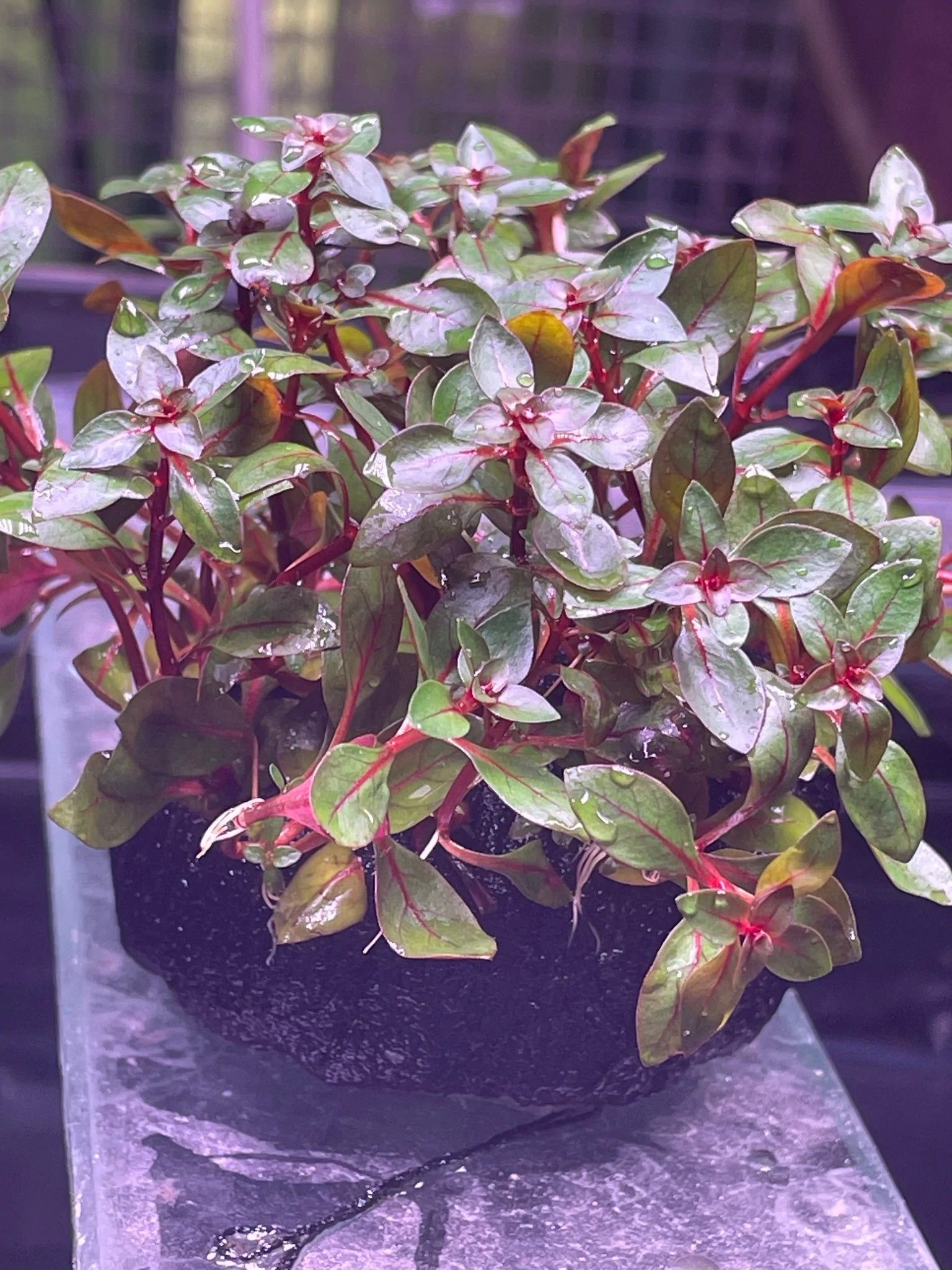
Best Tank Mates and Aquascaping Uses for Ludwigia Super Red
Ludwigia Super Red only earns its name when two things go right: the plant gets enough light and nutrients to actually turn red, and the fish sharing the tank leave it alone long enough to grow. This guide covers both halves — which tank mates are safe around it, and how to place, trim, and color it up so it becomes the focal point of your layout rather than a shredded green stick.
What Exactly Is Ludwigia Super Red?
"Super Red" isn't a single species — it's a cultivar or hybrid line most often sold as Ludwigia repens 'Super Red' or a Ludwigia glandulosa x repens cross. It's a true stem plant (not a rosette like a sword or crypt), meaning it grows upward from a single point and gets planted, trimmed, and replanted along its length.
Because sellers use "Super Red" loosely, you'll also see similarly reddish plants labeled Ludwigia 'Rubin', Ludwigia glandulosa, or Ludwigia 'Mini Super Red' (a dwarf variant meant for foreground-to-midground use, not the tall background form). If a listing photo shows a compact, low-growing red plant but the name says "Super Red," check the growth habit before buying — the standard Super Red is a tall background stem, while the "Mini" version stays short and is used very differently in a layout.
At-a-Glance Care Snapshot
| Parameter | Range |
|---|---|
| Tank size | 10-gallon (38 L) minimum; 20+ gallons (75+ L) for full height |
| Water temperature | 68–82°F (20–28°C), sweet spot mid-70s°F (~24°C) |
| pH | 6.0–7.5, tolerates up to ~8.0 |
| Water hardness | Soft to moderately hard, KH 3–8 |
| Lighting | Medium-high to high (roughly 3+ watts/gallon equivalent, 30–50+ PAR at the leaf) |
| CO2 | Not required, but strongly recommended for color and density |
| Growth rate | Fast — multiple inches per week under good light |
| Mature height | 12–20+ inches (30–50+ cm) |
| Difficulty | Beginner to intermediate |
Getting the Light Right — the Real Limiting Factor
Light intensity is the single biggest driver of whether this plant looks red or just looks like a green stem plant with a red name tag. Under low to medium light, Ludwigia Super Red will survive and even grow, but it typically reverts to green or olive and stretches into leggy, widely spaced growth as it reaches for more light. If the goal is the deep red-to-pink coloration the plant is bought for, treat medium-high to high light as the actual requirement, not an optional upgrade.
A few levers work together here:
- Light intensity and spectrum: full-spectrum LED fixtures with a decent PAR output at substrate-to-midwater height (roughly 30–50+ PAR at the leaves) push more red pigment production than dim or aging bulbs.
- Photoperiod: 8–10 hours of consistent light per day is usually enough; longer periods without more intensity won't substitute for brightness.
- Iron dosing: iron is a direct driver of red pigment in Ludwigia. An iron-rich liquid fertilizer dosed on a regular schedule noticeably deepens color, especially paired with root tabs or a nutrient-rich substrate.
- Nitrate levels: keeping nitrate on the moderate-to-low side (rather than consistently high) tends to intensify red coloration in Ludwigia and similar red-leaf stem plants — a detail that's easy to miss if you're only thinking about nitrate as a nuisance to remove.
Does It Need CO2?
No — it will grow without injected or liquid CO2. But CO2 is the single most effective upgrade if compact, vividly red growth is the goal, since it lets the plant put energy into pigment and density instead of just reaching for light. Think of it as "recommended for best results, not mandatory."
Does Substrate Matter?
Either a plain substrate with dosed liquid fertilizer or a nutrient-rich aqua soil will grow this plant. The practical difference is maintenance: Ludwigia feeds through both its roots and its leaves, so root tabs or a nutrient substrate reduce how often you need to dose the water column. A substrate with some nutrient capacity is a reasonable default for a stem-plant-heavy tank.
Compatible Tank Mates
Dense, healthy stems double as cover for shy fish and a hiding spot for fry from mid-tank up — which makes Ludwigia Super Red a genuinely useful plant, not just a decorative one, in a community tank.
Fish that do well with it:
- Tetras — neon, ember, cardinal
- Rasboras
- Guppies, mollies, platies
- Danios
- Small rainbowfish
- Angelfish (in tanks large enough for both, generally 29+ gallons)
- Corydoras and other calm bottom-dwellers
- Otocinclus
- Kuhli loaches
Invertebrates that do well with it:
- Cherry shrimp and other neocaridina/caridina shrimp
- Mystery snails
- Nerite snails
These species graze around the foliage or shelter in it without damaging the plant, making Ludwigia one of the better stem-plant choices for a shrimp-focused tank specifically.
Fish and Inverts to Avoid
- Large or destructive cichlids — oscars and larger New World cichlids will dig up or shred stem plantings
- Goldfish — reliably eat and uproot soft-leaved stems
- Silver dollars and other plant-eating fish — will strip leaves quickly
- Crayfish and larger crabs — uproot plants while foraging
- Very fast or large fish in dense clusters — even non-plant-eaters can snap thin stems by bumping through tightly packed groups
If you're stocking a tank built around this plant, a peaceful community setup is the safer bet over anything with strong digging, grazing, or bulldozing tendencies. Browsing options in small community fishes is a reasonable starting point for stocking a Ludwigia-forward layout.
Planting and Starting a New Stem
- Rinse the stem to remove any transport gel or debris, especially if it arrived shipped or in a nursery pot.
- Strip the lower 1–2 inches (2.5–5 cm) of leaves from the base of the stem — buried leaves will just rot.
- Insert the stem into the substrate deep enough that it stays anchored, angling slightly if planting near the front of a cluster.
- Space stems 1–2 inches (2.5–5 cm) apart within a cluster so they read as one mass rather than individual sprigs once grown in.
Expect some yellowing or melting of the lower leaves in the first one to two weeks. Most Ludwigia sold in nursery pots was grown emersed (above water, in humid greenhouse conditions), and the transition to fully submerged growth causes predictable stress. As long as water quality stays stable, new submerged growth typically looks noticeably healthier within a couple of weeks — this is normal transition shock, not a sign of failure.
Trimming and Pruning
Because this plant grows fast and tall, regular trimming isn't optional maintenance — it's what keeps it bushy instead of leggy and stops it from shading out everything beneath it.
- Top the stems once they approach your target height, cutting just above a node.
- Replant the cut tops directly into the substrate to form new, denser stands — this is also the easiest propagation method: cut below a node, strip the lower leaves, and replant the top.
- Leave the original base in place; it will often branch and resprout into a bushier plant on its own. If a base gets too leggy or bare after repeated cuttings, it's fine to discard it and rely on the replanted tops instead.
- Trim on a schedule rather than waiting for obvious overgrowth — under strong light this plant can add multiple inches per week.
Aquascaping Placement and Style
Given its height, Ludwigia Super Red belongs in the background or back-midground of a layout. Plant it in groups of at least 5–7 stems rather than as isolated sprigs — single stems read as clutter, while clusters read as a deliberate mass of color. Stagger stem heights so the cluster slopes down toward the front of the tank, which reads as more natural than a flat wall of identical height.
Scaling the cluster to tank size matters:
- In a 20-gallon (75 L) tank, a single cluster of 6–8 stems is usually enough to anchor one back corner without dominating the whole aquascape.
- In a 55–75-gallon (200–280 L) tank, multiple clusters of 10+ stems each, spaced along the background, create the "stem wall" effect without looking sparse.
Color Contrast and Style Pairings
The red-to-pink-to-orange coloration is most effective used deliberately as a contrast, not scattered randomly:
- Against green plants like Java fern, Anubias, Amazon sword, Rotala, or Bucephalandra, Ludwigia acts as a focal color break — a classic "red accent" role in both Dutch-style stem walls and looser jungle/nature-style layouts.
- Against dark hardscape — dark driftwood or dark stone — the red tones read more vividly than against light substrate or pale rock, since the contrast in value (not just hue) makes the color pop visually.
- As a color echo near red-toned fish, such as rummy-nose tetras, the plant's coloration can visually tie the livestock and the scape together rather than treating them as separate elements.
Companion Plants
| Layout role | Plants that pair well |
|---|---|
| Foreground carpet | Dwarf hairgrass, Monte Carlo |
| Midground | Bucephalandra, Anubias nana |
| Background (non-competing) | Rotala species, Amazon sword |
| Background (textural contrast) | Java fern |
Choose midground and background companions that won't out-compete Ludwigia for light — planting it directly behind a taller, fast-growing stem plant will shade it out and undo your color efforts.
Common Mistakes and Troubleshooting
| Problem | Likely cause | Fix |
|---|---|---|
| Plant turns green, loses red color | Insufficient light intensity/duration or low iron/micronutrients | Increase light intensity, dose iron-rich fertilizer, check photoperiod |
| Leggy stems, big gaps between leaves | Too little light or self-shading from overcrowding | Raise light output, trim tops regularly |
| Yellowing or melting lower leaves after planting | Normal emersed-to-submerged transition shock | Keep water quality stable; new growth improves within 1–2 weeks |
| Algae growing on leaves | Excess light without matching CO2/nutrients, or an uncycled tank | Balance light with fertilization rather than only cutting light |
| Stems uprooted or floating | Bottom-digging or plant-eating tank mates, or shallow planting | Check stocking list; strip lower leaves and plant deeper |
| Snapped or messy-looking stands | Overcrowding by active fish unable to move through dense clusters | Leave swim lanes; avoid planting a solid wall in high-traffic tanks |
Frequently Asked Questions
Does Ludwigia Super Red need CO2 to survive?
No. It grows fine without injected or liquid CO2, but CO2 markedly improves color intensity, compactness, and growth speed if you want the fullest "Super Red" look.
Will it stay red without special lighting?
No. Color intensity is directly tied to light strength — under weak, old, or low-spectrum bulbs, the plant fades toward green and gets leggy rather than staying compact and red.
Is it safe with shrimp?
Yes. It's one of the better stem plant choices for a shrimp tank, offering cover and a grazing surface with no known toxicity to shrimp.
Can goldfish or cichlids keep it?
Not reliably. Many goldfish and larger or more destructive cichlids will eat, dig up, or shred the stems. It's better suited to peaceful community tanks than to fish known for digging or grazing on plants.
How tall does it get and where should it go in the tank?
It commonly reaches 12–20+ inches (30–50+ cm). Place it in the back or back-midground depending on tank height, and trim regularly to keep it proportionate to the rest of the layout.
Why did my Ludwigia melt after I bought it?
Most nursery-grown Ludwigia is raised emersed (above water), so the shift to fully submerged growth causes predictable melt or yellowing in the first couple of weeks. Keep water parameters stable and expect healthier regrowth to appear within a few weeks.
How do I propagate it to fill in a scape?
Cut healthy stem tops below a node, remove the lower leaves, and replant the cuttings directly in the substrate. The original base often rebranches on its own, giving you two growing points from one stem.
Does it compete with other plants for nutrients?
Yes — it's a fast-growing, relatively heavy feeder that draws nutrients through both roots and leaves. In a densely planted tank, make sure root tabs or liquid fertilizer keep pace, particularly iron and nitrogen, or neighboring plants may fall behind.
Once you've settled on tank mates and a placement plan, you can browse peaceful community fish and shrimp options in freshwater livestock on FishyHub to round out a Ludwigia-friendly stocking list.

