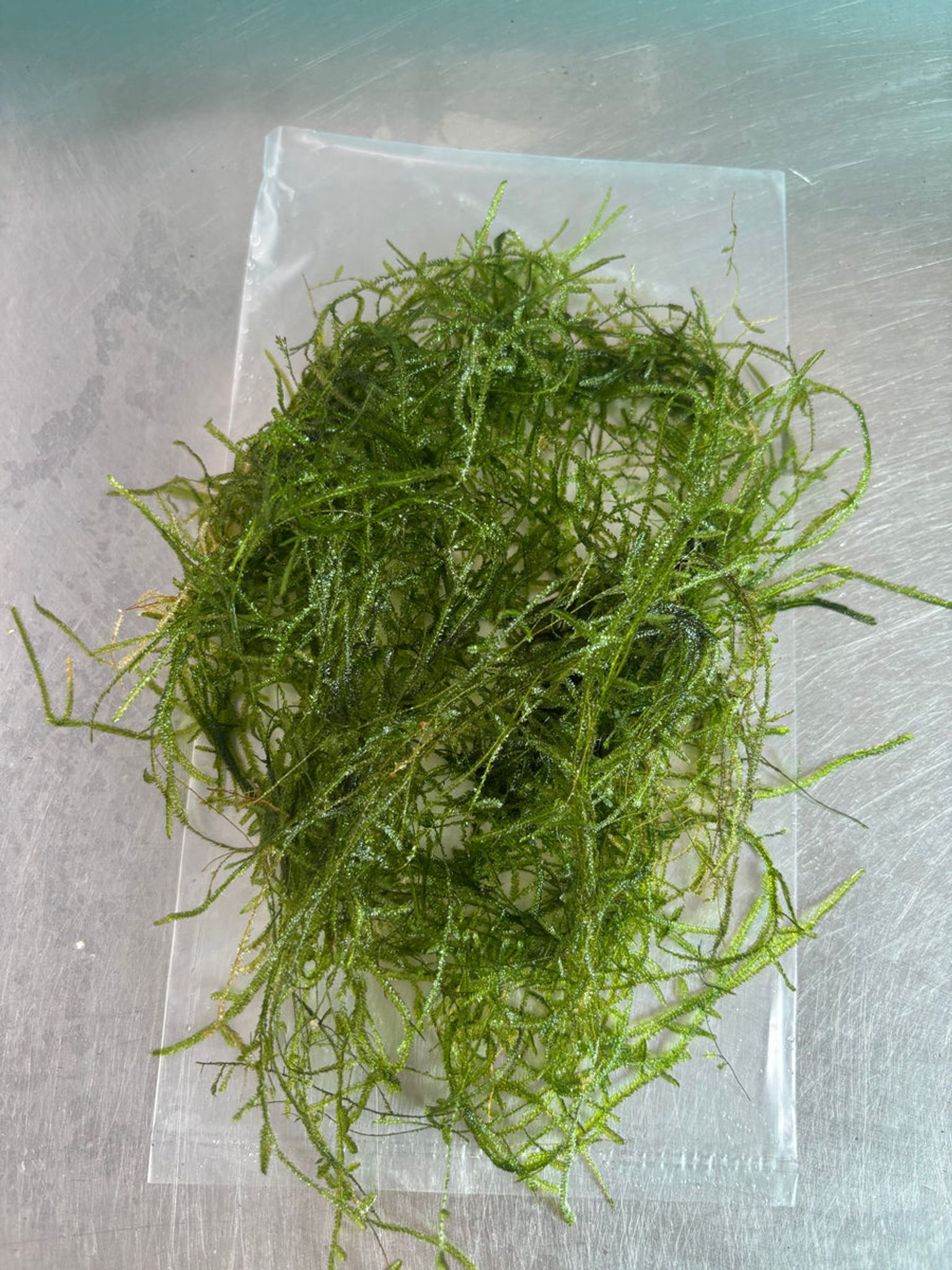
Best Tank Mates and Aquascaping Uses for Java Moss
Java moss is one of the few plants that tolerates near-zero light, skips CO2 entirely, and still gives a tank real texture. This guide covers which fish and invertebrates actually benefit from it, which ones will shred it, and four concrete ways to build it into your layout instead of just letting it float in a corner.
What You're Actually Buying
Java moss sold in the trade is usually Vesicularia dubyana, identified by irregular, bushy branching fronds rather than a neat, symmetrical shape. That distinction matters because java moss is frequently mislabeled or mixed in with visually similar species like Christmas moss and Singapore moss.
Christmas moss grows in flatter, more triangular, fern-like fronds, while java moss looks messier and more randomly branched. Since a bag label at purchase time isn't reliable, the best check is to grow a small clump out for a few weeks and compare its growth pattern before assuming you have true java moss.
Tolerances at a Glance
| Parameter | Range |
|---|---|
| Temperature | 59–86°F (15–30°C) |
| pH | ~5.5–8.0 |
| Water hardness | Soft to hard |
| Light | Very low to moderate; grows under minimal or no dedicated light |
| CO2 | Not required; speeds growth and density if added |
This wide range is why java moss shows up in everything from unheated betta bowls to high-tech CO2-injected showpiece tanks.
Is It Really "Indestructible"?
Some hobbyists treat java moss as nearly indestructible — it can survive weeks out of water and needs no attention at all. Others point out that it still yellows, thins out, or melts under poor conditions. Both are partly right: java moss is extremely forgiving compared to almost any other aquarium plant, but it isn't zero-maintenance if you want a dense, green mat rather than a sparse, brownish one.
The same split shows up around CO2 and fertilizer. Some treat it as a true no-CO2, no-fert plant; others dose lightly for a fuller mat. A reasonable middle ground: skip CO2 injection unless you're already running a high-tech tank for other plants, but consider light liquid fertilization optional rather than pointless — it noticeably improves density and color.
Best Tank Mates for Java Moss
Java moss works best with animals that use it rather than destroy it. The dense fronds host biofilm and microfauna that grazers pick at constantly, and the structure itself doubles as shelter.
Strong matches:
- Shrimp — cherry (neocaridina) and Amano shrimp graze biofilm and algae out of the moss without damaging it, making them close to ideal companions. Browse shrimp suited to a moss-heavy setup.
- Snails — similar grazing benefit, minimal risk to the plant.
- Small peaceful community fish — tetras, rasboras, guppies, endlers, danios, and other small livebearers use moss for cover and pick at trapped food particles. See options among small community fish.
- Bettas — java moss is one of the most commonly recommended plants for betta tanks, giving resting spots near the surface.
- Dwarf gouramis — appreciate the same cover as bettas.
- Corydoras — bottom-dwelling and peaceful, they won't uproot moss tied to hardscape; see corydoras.
Avoid or manage carefully:
- Large or digging cichlids — will uproot or shred loosely attached moss.
- Goldfish — notorious plant-eaters that treat soft moss as a snack.
- Crayfish — often shred moss while foraging.
- Very messy, heavy-bioload fish — their waste fouls a dense moss mat faster than it can be filtered out.
Java Moss for Breeding and Fry Rearing
Dense moss is a classic spawning substrate and refuge. Egg-scattering fish drop eggs directly into the fronds, where they're harder for other tank occupants to find and eat. The same density shelters newly hatched fry and shrimplets, giving them cover from predation while they grow large enough to hold their own. A moss clump is also a practical hiding spot for stressed or bullied fish, or for new shrimp still acclimating to a tank.
Why Not Just Use Artificial Plants?
Fake plants are maintenance-free, but they don't do anything for the tank. They can't be trimmed and replanted to reshape a layout, they don't oxygenate the water or take up excess nitrate, and they don't host the beneficial bacteria that a living moss mat does. There's also a manufacturing and disposal footprint to plastic decor that a live plant simply doesn't carry. Java moss delivers actual biological function along with the look.
Water Quality Role — And Its Limits
A well-grown moss mat takes up some excess nitrate and ammonia and adds surface area for beneficial bacteria, which contributes modestly to biological filtration. That said, it's a supplement, not a substitute — regular water changes and a properly sized filter still do the heavy lifting.
Four Aquascaping Techniques
Java moss earns its reputation as a utility plant because it doesn't root in substrate at all — it clings to hard surfaces using rhizoids. Left loose, it either floats or forms a shapeless mat on the substrate, so deliberate attachment is what turns it into an aquascaping tool rather than a stray clump.
1. Wrapping Driftwood or Rock
Tying moss onto driftwood or rock gives hardscape an "aged," naturally colonized look almost immediately, with the moss filling in the gaps over the following weeks. This is the single most common technique and works in nearly any tank style.
2. Moss Carpets
Pin or loosely tie moss across a sheet of mesh or netting weighted to the substrate to grow a low, spreading carpet. Because java moss spreads by fragmentation — any torn-off piece can reattach and grow into a new patch — a carpet fills in gradually as fronds knit together across the mesh.
3. Moss Walls
Sandwich a layer of moss between two panels of plastic mesh and mount it against the back or side glass. This creates a solid green background panel that also hides equipment like heaters or filter intakes.
4. Moss Trees
Training moss onto a branching piece of driftwood positioned vertically mimics a miniature tree, a popular centerpiece technique in smaller aquascapes.
Bonus: Free-Floating Clumps
A loose clump of moss left to drift in a low-flow corner works as a low-effort nutrient sponge and fry shelter, with no attachment required — useful in a breeding or grow-out tank where speed matters more than aesthetics.
Attachment Methods Compared
| Method | Pros | Cons |
|---|---|---|
| Cotton thread or fishing line | Reversible, cheap, doesn't mark decor | Slower initial hold; visible until moss fills in |
| Fine plastic mesh | Good for flat surfaces and walls; even coverage | Bulkier setup; more visible short-term |
| Aquarium-safe cyanoacrylate gel | Fast, precise placement | Can leave a visible dab or mark on decor |
Whichever method you use, moss typically anchors itself to the surface within 2 to 4 weeks, after which thread or mesh can be trimmed away or simply left to biodegrade.
Nature Aquarium Style Basics
Java moss fits naturally into the Japanese-inspired Nature Aquarium approach, which favors an open midground, asymmetrical stone or driftwood placement, and plants graded from short at the front to tall at the back. In this style, moss is typically used as a texture and aging element directly on hardscape rather than as a standalone feature. Fine-tipped tweezers and scissors make a real difference here, since precise placement and trimming are what separate a deliberate Nature Aquarium look from a messy one.
Aquascaping Trends Worth Noting
Current trends in planted tanks lean toward higher-tech setups: strong LED lighting, CO2 injection, nutrient-rich substrates, and app-connected equipment that automates lighting schedules and dosing. Java moss is unusual in that it adapts to both ends of that spectrum — it holds up fine in a bare, low-tech tank with ambient light, and it also fills a texture role in a fully automated, high-tech showpiece scape.
Fun Decor Pairings
Java moss softens the hard edges of novelty ornaments — sunken ships, ruins, skulls, treasure chests — by adding a natural, mossy patina over time. It's a low-effort way to make a themed tank look aged rather than freshly unboxed, and it works whether the ornament is a purchased piece or a DIY build.
DIY Hardscape and Paludarium Uses
Many hobbyists build their own hardscape from driftwood, rock, or 3D-printed and resin ornaments rather than buying pre-mossed decor, using moss afterward to blend the piece into the tank naturally. It's a cheap, fully customizable finishing step.
Java moss also grows well emersed — out of water, in high humidity — which makes it useful in paludariums and terrariums for covering the land section or transition zone. In that setting it pairs well with other easy semi-aquatic plants and helps keep the roots of neighboring plants like anubias moist.
Maintenance and Common Mistakes
Trim moss with scissors every few weeks to keep its shape and prevent detritus from building up inside the mat. Always rinse or shake out trimmings in a separate container rather than letting them drift, since any stray fragment can attach and grow wherever it lands — including inside filter intakes.
Mistakes to avoid:
- Burying moss in substrate instead of tying it to a hard surface — buried moss rots rather than roots.
- Letting trimmed fragments drift and take hold in filter intakes or unwanted spots.
- Placing moss in high-flow areas, which shreds fine fronds and scatters them elsewhere; moderate flow is best.
- Assuming zero maintenance — a mat left untouched for months traps detritus and grows algae; occasional light flushing and manual removal keeps it clean.
- Overstocking a moss carpet or wall with heavy waste producers, which causes decay odor and poor water quality trapped inside the mat.
- Trusting the label — verify growth pattern after a few weeks rather than assuming a bag marked "java moss" is genuinely Vesicularia dubyana.
Realistically, expect a moss wall or carpet to take several weeks to a couple of months to visibly fill in, depending on light and trimming frequency — faster with light fertilization, slower in a bare low-tech tank.
Troubleshooting Yellowing or Browning Moss
Yellowing or browning moss is usually a sign of nutrient deficiency — nitrate in particular — or insufficient light. Dosing a balanced liquid fertilizer and ensuring at least some light, even ambient room light, typically restores green color over a few weeks. Melting or die-back that happens suddenly is more often tied to a big shift in water parameters, or to moving moss from emersed, in-store bagged conditions into fully submersed tank water — a shock the plant needs time to adjust to.
Frequently Asked Questions
Does java moss need a heater or specific temperature?
No strict requirement — java moss tolerates a wide range, roughly 59–86°F (15–30°C), so normal community tank temperatures work fine without any special equipment.
Can java moss live in a betta tank?
Yes. It's one of the most commonly recommended plants for betta tanks, giving resting spots near the surface and reducing the risk of fin damage compared to hard decor.
Will shrimp destroy java moss?
No. Shrimp graze on biofilm and algae within the moss without harming the plant itself, which is why they're considered close to ideal tank mates for keeping a moss mat clean.
How do you attach java moss to driftwood without gluing it?
Tie it on with cotton thread, fishing line, or a fine mesh wrap. The moss anchors itself with rhizoids within about 2 to 4 weeks, after which the tie can be trimmed away or left to biodegrade.
Why is my java moss turning brown or falling apart?
Usually a nutrient deficiency, insufficient light, or a large, sudden change in water parameters. Improve lighting, add a balanced liquid fertilizer, and avoid abrupt parameter swings when moving or re-scaping the plant.
Can java moss grow without CO2 or special lighting?
Yes — it's one of the few plants that thrives under low light with no CO2 supplementation, though growth will be denser and greener with more light and occasional fertilization.
Is java moss good for a fry or shrimp breeding tank?
Yes. Its dense fronds are a classic nursery and refuge, trapping food particles for grazing and hiding newborn fish or shrimplets from predation.
How fast does java moss grow and spread?
Growth is moderate but steady, and any broken-off fragment can reattach and grow into a new patch. That makes it easy to propagate to new spots, but trimmings need to be netted out or it can spread further than intended.
Ready to build a tank around it? Browse bettas and other moss-friendly livestock on FishyHub to plan out tank mates before your next re-scape.

