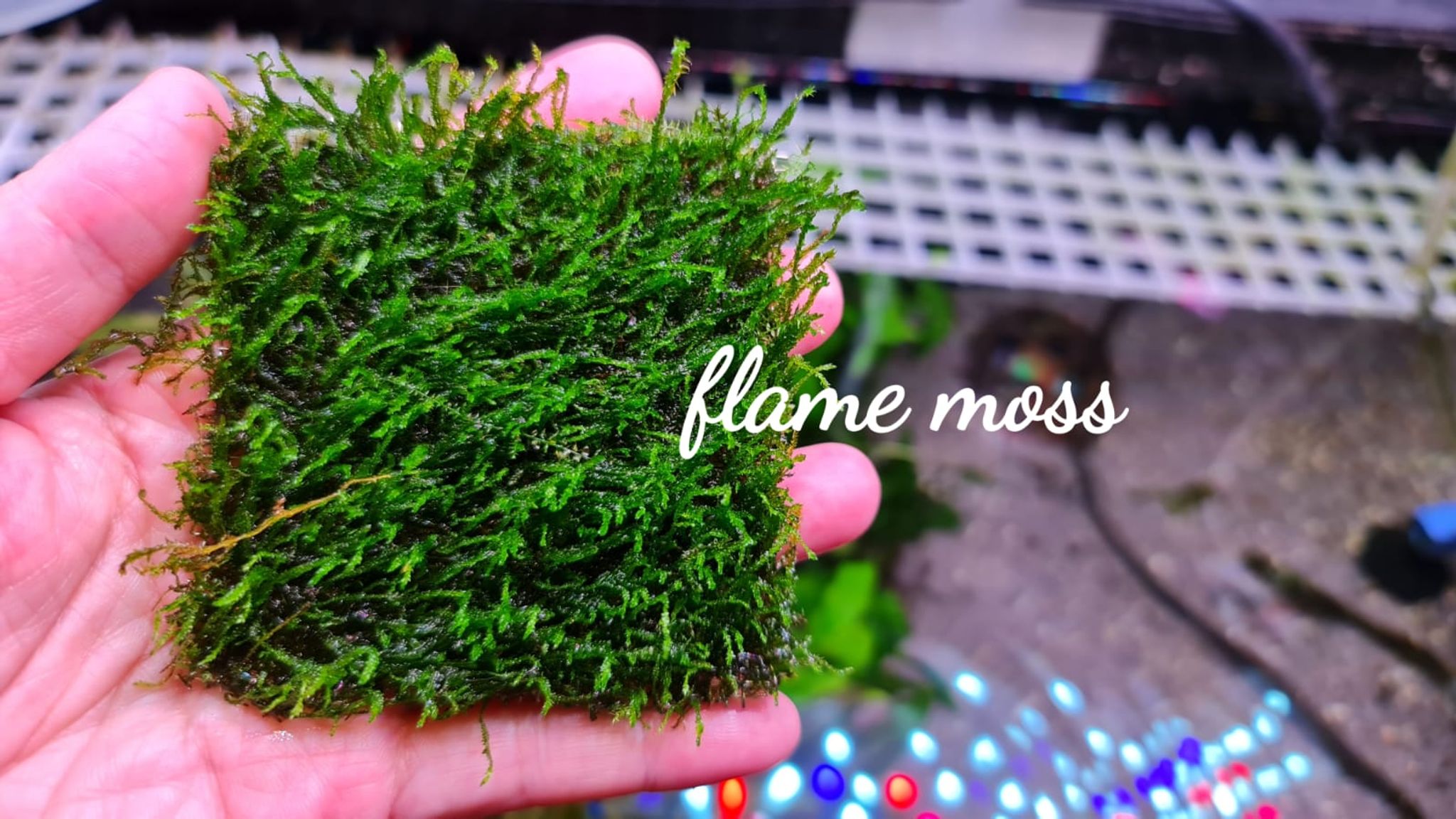
Best Tank Mates and Aquascaping Uses for Flame Moss
Flame Moss is one of the easiest aquarium mosses to keep, but its upright, spiraling growth habit means it works differently in a layout than flatter mosses do. This guide covers which fish, shrimp, and snails actually leave it alone, plus specific ways to use its shape for height, texture, and structure in a planted tank.
What Makes Flame Moss Different
Flame Moss (Taxiphyllum sp.) gets its name from its spiral, upright growth pattern that twists as strands lengthen, giving it a flickering, flame-like silhouette. This sets it apart from two commonly confused relatives:
- Java Moss grows flat and creeping, forming a loose, irregular mat that spreads in whatever direction it finds support.
- Christmas Moss grows feathery and triangular, with a soft, layered look similar to a small fir branch.
- Flame Moss grows vertically in tight, twisting columns, making it the better choice when a design calls for height rather than horizontal coverage.
The plant is dark green and dense once established, and it's genuinely low-tech friendly — a big part of why it shows up in nano tanks, shrimp tanks, and beginner planted setups.
Care Basics at a Glance
Flame Moss tolerates a wide range of conditions, which is part of its appeal for mixed community setups.
| Parameter | Range | Notes |
|---|---|---|
| Temperature | 60–86°F (16–30°C) | Comfortable range is 68–78°F (20–26°C) |
| pH | 5.5–8.0 | Very tolerant of hard or soft water |
| Lighting | Low to moderate | Denser, more compact growth under moderate-to-high light |
| CO2 | Optional | Speeds growth and tightens the spiral pattern but isn't required |
Because it tolerates low light and a broad pH range, Flame Moss is often the plant that survives in tanks where pickier stem plants struggle.
Best Tank Mates for Flame Moss
The goal is pairing Flame Moss with fish and invertebrates that either ignore it entirely or actively benefit from its structure, without species that graze it down or rip it loose.
Fish and Inverts That Do Well With It
- Small tetras — neon tetras, ember tetras, and various rasboras swim through and around moss without bothering it.
- Livebearers — guppies and endlers are peaceful and browse biofilm on the moss surface rather than the moss itself.
- Corydoras and small loaches — bottom-dwellers that stay off plants entirely and appreciate mossy cover for security.
- Otocinclus — algae grazers that clean surfaces near the moss without damaging it.
- Dwarf shrimp — cherry shrimp and amano shrimp are arguably the best-matched livestock for Flame Moss (more on this below).
- Nerite snails — reliably safe, graze algae film, and rarely disturb rooted or tied-down moss.
- Bettas — generally peaceful toward plants and often use dense moss as a resting perch near the surface.
- Mystery and apple snails — usually fine, but larger individuals can occasionally uproot or graze loose moss that isn't well-attached, so monitor bigger specimens rather than assuming they're always safe.
Community fish and shrimp are widely available and easy to stock alongside a moss-heavy layout; you can browse small community fish or freshwater shrimp directly on FishyHub.
Species to Avoid or Watch Closely
- Goldfish — cold-water fish that graze and uproot most soft plants, moss included.
- Large cichlids — many species dig, uproot, and eat plant matter as part of normal behavior.
- Silver dollars and other large herbivorous fish — will strip moss along with softer plants.
- Crayfish — shred moss strands for food and bedding material; not compatible with a moss display.
- Larger plecos — some species rasp on driftwood, which can loosen moss tied to the same wood even if they aren't eating the plant directly.
Flame Moss in Shrimp Breeding Tanks
Dense Flame Moss is one of the top choices for a dedicated shrimp breeding setup. The tightly packed, upright strands provide:
- A large surface area for biofilm and microorganism grazing, which shrimp feed on constantly.
- Hiding cover for berried females, who often retreat into moss to molt and release shrimplets safely.
- A refuge for shrimplets from fish in mixed shrimp-and-fish tanks, since the tight structure is hard for larger animals to forage through.
If shrimp are the priority, letting a Flame Moss wall or mound grow thick and largely untrimmed in one corner works better than keeping it neatly shaped everywhere.
Aquascaping Uses for Flame Moss
Because Flame Moss grows upright rather than creeping, it functions differently from carpeting mosses. Its vertical habit is best treated as a structural and textural tool, not a foreground filler.
Moss Trees and Branch Accents
Tying Flame Moss onto a spider wood branch or a Y-shaped piece of driftwood and letting it fill in creates a "moss tree" — a classic technique for forest-style layouts. The spiraling growth reads as foliage on the branch, giving a miniature tree silhouette that's hard to replicate with flatter mosses.
Background Walls and Mid-Ground Fans
Attached to mesh or flat rock along the back or sides of a tank, Flame Moss fills in as a textured green wall that adds depth without competing with foreground plants for light. Its column-like growth also works well as a mid-ground "fan" behind shorter plants.
Covering Equipment
Wrapping moss-covered mesh or rock around a filter intake or heater hides hardware while still allowing water flow, turning a utilitarian element into part of the scene.
Nano Tanks and Bowls
In small-format tanks, Flame Moss scales down well because its dense, compact growth fills space efficiently without needing much footprint.
Wabi-Kusa Balls
Flame Moss is a common choice for wabi-kusa — moss and plant balls grown emersed (above water) rather than submerged. Because they draw CO2 from the air, wabi-kusa need no CO2 injection and no submerged aquarium lighting, making them a low-maintenance display option for a desk or shelf.
Why It's Not a True Carpet
Because Flame Moss grows upward instead of spreading flat, using it densely across the true foreground can block sightlines to fish and other livestock. It's better suited to mid-ground or background placement, or elevated on hardscape, than as a carpet substitute in iwagumi-style layouts.
Attaching Flame Moss the Right Way
- Tie it on with cotton thread, fishing line, or aquarium-safe cyanoacrylate glue to driftwood, lava rock, or mesh.
- Never bury the rhizome or moss mat in substrate — it will rot instead of attaching.
- Expect 3–6 weeks for the moss to grip its surface on its own; ties can be removed once it has visibly attached.
Hardscaping Guidelines That Apply Here
Flame Moss looks best when the hardscape around it follows a few general aquascaping principles:
- Use an odd number of focal hardscape pieces (one dominant piece plus smaller supporting ones reads more natural than an even, symmetrical set).
- Place the focal point using the rule of thirds or golden ratio rather than dead center.
- Leave negative space — open water areas that let the eye rest and fish swim freely.
- Keep front-of-tank plantings low so fish and shrimp stay visible; save taller moss trees and background walls for the back and sides.
- Avoid overcrowding decor, since too much clutter reduces visibility of livestock and makes maintenance harder.
- Any collected natural rock or wood should be inert and aquarium-safe, and pre-soaked or boiled before use to avoid contaminating the tank.
Backgrounds and Lighting for a Moss-Heavy Layout
Choosing a Background
A background scaled to the tank's footprint adds depth and hides cords and hardware behind a moss-and-driftwood scene. Three common types:
| Type | Removable? | Notes |
|---|---|---|
| Laminated/taped sheet | Yes | Simple, budget option |
| Static-cling vinyl | Yes | Easy to reposition or swap |
| Self-adhesive sticker | No (permanent) | Best long-term hold |
Clean the glass thoroughly before applying, and use a squeegee from the center outward to push out air bubbles. Backgrounds always go on the outside of the tank, never inside.
Lighting for Nano and Wabi-Kusa Setups
- Submerged nano tanks generally do well with moderate-intensity light for about 6–8 hours a day — a conservative range that limits algae risk compared with older advice suggesting 10–12 hours.
- Wabi-kusa needs no submerged aquarium light at all, since it's grown emersed and pulls CO2 from the air.
- More powerful lighting without matching nutrients doesn't improve growth — it mostly just feeds algae, which is especially hard to remove once it takes hold in fine moss strands.
Cleaning a Moss-Heavy Nature Aquarium
- Perform routine water changes as normal.
- Gently remove debris trapped in the moss with a turkey baster or fine siphon tip rather than pulling at the strands directly.
- Control algae proactively — once it attaches to moss's fine structure, it's very difficult to remove manually, so balanced light and nutrients from the start matter more than after-the-fact scrubbing.
- Rinse new hardscape and plants before adding them to an established tank to avoid introducing algae spores or pests.
Common Mistakes and Troubleshooting
- Burying the rhizome in substrate instead of tying it to hardscape — it rots rather than growing.
- Too much or too little flow — strong flow can rip strands loose, while stagnant flow lets detritus build up inside the moss mat.
- Letting algae establish — because of the fine structure, algae is nearly impossible to remove by hand once it takes hold.
- Skipping trims — untrimmed moss grows leggy and shades its own lower portions, leading to die-off and browning at the base.
- Stocking incompatible fish — goldfish, large cichlids, and crayfish will graze or shred the moss, and it's easy to mistakenly blame the plant for "not attaching."
- Treating it as a carpet plant — its upright habit makes dense foreground placement a visibility problem, not a design win.
Maintenance and Propagation
Trim Flame Moss regularly with scissors to maintain its flame shape and prevent the lower portions from being shaded out and browning. Detached clippings will regrow wherever they settle and get trapped — a useful, budget-friendly way to start a second moss tree or expand a wall, though it can also cause unwanted spread if fragments drift into areas you didn't intend to plant.
Frequently Asked Questions
Is Flame Moss the same as Java Moss?
No. Both belong to the genus Taxiphyllum, but Flame Moss has a distinct upright, spiraling growth pattern, while Java Moss grows flat and forms a looser, less structured mat.
Do I need CO2 or special lighting for Flame Moss?
No. It's low-tech friendly and grows fine under low to moderate light without CO2. Adding CO2 and moderate light simply speeds growth and produces denser, more compact color.
What fish will eat or destroy Flame Moss?
Goldfish, large cichlids, silver dollars, and crayfish are the main culprits, along with some larger plecos that disturb the wood it's attached to. Most community fish, tetras, and shrimp leave it alone entirely.
Can Flame Moss go in a shrimp tank?
Yes — it's one of the best moss choices for shrimp breeding tanks. Its dense structure offers a grazing surface for biofilm and safe cover for berried females and shrimplets.
How do I attach Flame Moss to driftwood or rock?
Tie it on with cotton thread or fishing line, or use an aquarium-safe cyanoacrylate glue. It typically self-attaches within 3–6 weeks, after which any ties can be removed.
Can Flame Moss be used in a wabi-kusa or vase?
Yes. It's a common wabi-kusa plant, grown emersed with no CO2 injection and no dedicated aquarium lighting required.
Why is my Flame Moss turning brown or dying at the base?
This is usually caused by insufficient light reaching the lower portions, poor flow trapping detritus, or algae smothering the strands. Trim back leggy growth and rebalance flow and light to fix it.
How fast does Flame Moss grow and how often should I trim it?
It has a moderate growth rate. Trimming every few weeks is enough to maintain the flame shape and prevent the moss from shading out its own base.
Ready to stock a moss-friendly community? Browse dwarf shrimp, corydoras, and other compatible freshwater livestock on FishyHub to build out a Flame Moss layout from the ground up.

