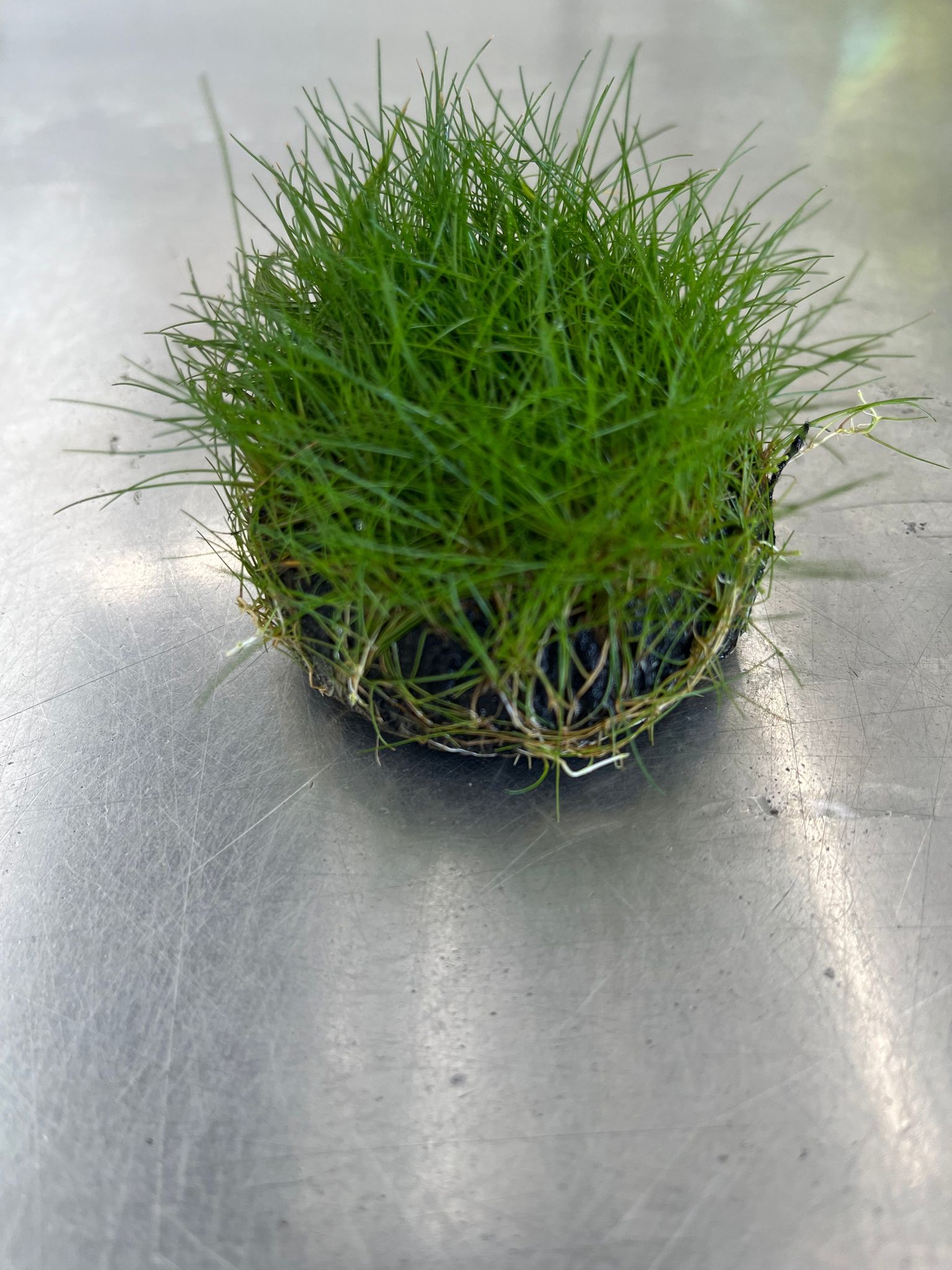
Best Tank Mates and Aquascaping Uses for Dwarf Hairgrass
Dwarf hairgrass makes a striking green carpet, but a wrong choice of tank mate can uproot it before it ever fills in. This guide covers which fish, shrimp, and snails work with a hairgrass carpet, which to avoid, and how the plant is actually used in iwagumi, nature-style, and Dutch aquascapes.
What Dwarf Hairgrass Actually Is
Dwarf hairgrass (Eleocharis parvula and Eleocharis acicularis) is a true aquatic grass-like sedge, not a true grass, that spreads through underground runners and rhizomes rather than seed. Left alone, it forms a dense, self-propagating lawn across the substrate.
A few cultivars are worth knowing before you buy:
| Cultivar | Typical height | Best use | Trimming needs |
|---|---|---|---|
| Standard dwarf hairgrass | 4–6 in (10–15 cm) | General carpets, background meadows | Moderate, every 1–2 weeks |
| "Mini" dwarf hairgrass | Under 2 in (5 cm) | Iwagumi, tight foreground lawns | Low; naturally short |
| Belem hairgrass | 2–4 in (5–10 cm) | Transitional foreground-to-midground | Moderate |
Shorter cultivars need less frequent trimming and suit iwagumi layouts where a tight "plain" is the goal, while standard hairgrass fills a similar role but grows a bit taller between cuts.
Core Requirements for a Healthy Carpet
Before stocking mates or designing a layout, the carpet itself needs the right foundation:
- Light: Moderate to high intensity is needed to push lateral, carpet-forming growth instead of tall, thin blades.
- Substrate: A nutrient-rich aquasoil, ideally capped with a thin layer of fine sand or gravel, gives the roots something to feed on and anchor into.
- CO2: Injected CO2 produces a denser, faster-filling lawn. It is not strictly required — hairgrass can carpet under strong light alone — but growth will be slower and patchier without it.
- Fertilization: Root tabs or a liquid fertilizer supplying iron and potassium keep blades from yellowing, especially in sand or inert gravel.
Planting Method
Separate the plant into very small clumps of fewer than 10 blades each rather than a few large tufts. Plant these small bundles roughly 1–2 in (2.5–5 cm) apart, pressing each one down just enough to anchor the roots without burying the crown. Dense small-clump planting fills in noticeably faster than sparse large clumps, because each clump only has to send runners a short distance to meet its neighbors.
Best Tank Mates for a Dwarf Hairgrass Carpet
The safest tank mates are calm swimmers that stay in the mid-to-upper water column and are too light-bodied to dig or compact the substrate. Bottom feeders are fine as long as they sift gently rather than plow.
| Tank mate | Why it works |
|---|---|
| Nano schooling fish (rasboras, small tetras) | Stay mid-water, add movement without disturbing substrate |
| Livebearers (guppies) | Light-bodied, peaceful, browse algae film off blades |
| Corydoras and other small bottom feeders | Sift sand gently instead of digging into runners |
| Otocinclus | Graze algae directly off hairgrass blades |
| Nerite snails | Excellent algae control, don't damage healthy shoots |
| Cherry and amano shrimp | Graze biofilm, keep the carpet clean, use it as cover |
A hairgrass carpet also does double duty as cover for shrimp and fry: newly molted shrimp and fish fry can hide low in the blades where larger tank mates can't easily reach them, making it a practical nursery habitat as well as a design feature. You can browse compatible options in Small Community Fishes and Shrimps when planning a stocking list around a carpet build.
Species to Avoid
Some fish and invertebrates will actively work against the carpet:
- Goldfish, large or burrowing cichlids, large plecos, and crayfish — all dig or uproot runners as a matter of habit.
- Loaches and large barbs — can be too rough on tender, newly-planted clumps, even if they don't dig on purpose.
- Heavy bioload species in general — cloud the water and block the light the carpet depends on.
Pond snails and ramshorn snails deserve a note rather than a ban: in some tanks they nibble tender new shoots, while in others they're neutral or even helpful algae grazers. Treat this as a minor, tank-dependent risk. If it becomes a real problem, manual removal or adding a predatory species such as assassin snails usually resolves it without banning snails outright.
Stocking Order Matters
Timing your stocking to the carpet's growth stage reduces losses considerably. Add fish and inverts in this order:
- Plant the carpet and let it establish for several weeks before adding any active bottom-dwellers.
- Introduce shrimp and light grazers (otocinclus, nerite snails) once new growth is visible, since they help keep early growth clean of algae.
- Add corydoras or other bottom feeders only after runners have spread and rooted in, so they're sifting an established mat rather than uprooting isolated clumps.
Most US community setups running hairgrass sit comfortably around 72–82°F (22–28°C) and pH 6.5–7.5 with moderate hardness, which happens to match the fish and shrimp listed above without extra adjustment.
Aquascaping Uses for Dwarf Hairgrass
Nature-Inspired Aquascaping Philosophy
Aquascaping styles borrow directly from real landscapes — mountains, plains, streambeds — and hairgrass's job in most of them is to stand in for meadow or grassland terrain, framing rockwork or driftwood the way real turf frames boulders in a valley. Understanding that reference point makes layout decisions (where to trim short, where to let it grow) much more intuitive.
Foreground Carpets and Contouring
In nature-style and Dutch layouts, hairgrass is most often used as a foreground carpet, providing a low "lawn" that contrasts against taller stem plants or driftwood behind it. A simple contouring trick adds depth: mound the substrate slightly before planting so the carpet is trimmed shortest near the front glass and left a bit taller toward the back or midground. That subtle slope reads as distance and makes a small tank feel larger.
Hairgrass doesn't have to stay short. Left untrimmed, it can be grown as a taller accent "meadow" instead of a lawn, or used simply to soften the hard edges where hardscape meets substrate.
Iwagumi Aquascaping
Iwagumi is a minimalist Japanese style built around odd-numbered rock groupings — typically 3, 5, or 7 stones, with the 3-stone version called Sanzon. The layout hinges on:
- One dominant main stone, placed off-center, often near a golden-ratio point in the tank rather than dead center.
- Supporting stones roughly 1/3 and 2/3 the size of the main stone.
- Stones from a single source or type for visual consistency, often tilted slightly to mimic natural weathering rather than sitting perfectly upright.
Dwarf hairgrass is planted as the "plain" around the stones, echoing open grassland around outcrops. Most iwagumi layouts keep to just 1–3 plant species total and a sparse, small schooling nano fish load so nothing competes visually with the rockwork itself. This is one of the reasons Mini dwarf hairgrass is so popular for the style — its short natural height needs minimal trimming to stay in scale with the stones.
Other Layout Styles
Hairgrass isn't exclusive to iwagumi. It also fits:
- Nature/Amano-style layouts — mixed hardscape and plants mimicking a real landscape, where hairgrass often works as foreground alongside driftwood and moss rather than covering the whole floor.
- Dutch style — plant-only layouts with no hardscape, arranged in terraced beds of contrasting color and texture; hairgrass can serve as a low terrace at the front of the bed.
Combining hairgrass with driftwood and a moss species is a straightforward way to build a nature-style scape without committing to full iwagumi rules, bridging the gap between a strict rock garden and a busier planted tank.
Hardscape Selection
Enthusiasts who take aquascaping seriously often treat rock and wood selection almost like a geology hobby, learning the texture, hardness, and water-chemistry effects of materials like dragon stone, seiryu stone, lava rock, slate, and ohko stone. Some of these rocks raise hardness and pH as they slowly weather, which matters for hairgrass's preferred water parameters. The general workflow is to build the hardscape "skeleton" first and add hairgrass and other plants afterward, once the stone or wood arrangement is finalized.
A Note on Botanicals
Leaves, wood pieces, and seed pods are sometimes added alongside hairgrass in naturalistic layouts for texture. These botanicals leach tannins and humic acids that can lower pH and tint the water, and the effect varies by tank size and existing water chemistry. Source botanicals from a reputable, contaminant-free supplier and monitor parameters for a week or two after adding them, since a sudden pH swing can stress both fish and plants.
Iwagumi as a Mindfulness Practice
Beyond the technical rules, many hobbyists approach iwagumi as a deliberately calming pursuit. The spare, restrained composition and the maintenance ritual — regular trimming, consistent water changes, careful stone placement — get compared to gardening or bonsai for the same reason: the process rewards patience and attention rather than constant change.
Choosing a Tank for a Planted Layout
Tank shape affects how well any aquascape reads visually. Wider, shallower footprints — proportions close to 24 in wide by 14 in tall (roughly the classic "60 cm" ratio) — show off a carpet and hardscape far better than a tall, narrow tank, since more of the layout is visible from a normal seated viewing angle. Rimless glass tanks are generally preferred for aquascaping because they remove the visual break a rim creates along the top edge. Extra-shallow tanks work well for emersed or marsh-style hairgrass displays, where part of the carpet grows above the waterline.
Trimming and Maintenance
Regular trimming with curved aquascaping scissors encourages hairgrass to spread laterally through runners instead of growing tall. The general rule is trim little and often rather than waiting for an infrequent deep cut — a light trim every 1–2 weeks once the carpet is established keeps growth low and dense, while infrequent deep trims risk shocking or uprooting entire patches.
Expect anywhere from a few weeks to a few months for a full carpet fill, depending on light intensity, whether CO2 is running, and how densely you planted the initial clumps.
Rescaping a Hairgrass Carpet
Even well-maintained carpets eventually need a reset as growth becomes uneven or runners spread past their intended boundary. A typical rescape:
- Drain roughly half the tank's water and shut off the filter first, to keep debris from clogging it during the work.
- Trim and uproot overgrown sections, keeping healthy trimmings aside for replanting.
- Top off with fresh substrate where the old carpet has thinned.
- Replant healthy trimmings using fine tweezers for precision placement.
- Keep water changes, fertilization, and CO2 consistent afterward so the reset carpet re-establishes at the same pace as the original planting.
Common Mistakes and Troubleshooting
| Problem | Likely cause | Fix |
|---|---|---|
| Slow, uneven fill | Planted in a few large clumps | Separate into small clumps of under 10 blades before planting |
| Yellowing or stalled growth | No root tabs or nutrient-poor substrate | Add root tabs or switch to an enriched aquasoil |
| Leggy, sparse, flopping growth | Insufficient light or no CO2 while expecting a fast carpet | Increase light intensity, add CO2, or adjust expectations for a slower low-tech carpet |
| Uprooted patches | Bottom-dwelling diggers or large fish added too early | Stock gentle species only, and wait until the carpet has taken hold |
| Tall, thin blades instead of a lawn | Carpet allowed to grow too long before the first trim | Trim early and often to force lateral runner growth |
| Blades dying back after planting | Transplant melt (normal transition shock) | Leave it alone; new growth typically emerges within a few weeks |
| Algae film on blades | Light, CO2, or nutrient imbalance | Adjust dosing and photoperiod rather than relying only on algae eaters |
Frequently Asked Questions
Will dwarf hairgrass carpet without CO2?
Yes. Growth is slower and less dense without CO2, so expect a groundcover effect that takes months rather than weeks to fill in fully. Strong lighting and consistent fertilization become more important to compensate.
What fish will not harm my hairgrass carpet?
Small schooling fish, livebearers, corydoras, and otocinclus are all safe choices. As a general rule, anything under a few inches that doesn't dig aggressively is unlikely to disturb an established carpet.
Can shrimp live with dwarf hairgrass?
Yes, and they're one of the best pairings available. Cherry and amano shrimp thrive in hairgrass carpets, graze biofilm off the blades, and use the dense growth as cover while molting or as juveniles.
Is dwarf hairgrass good for an iwagumi tank?
Yes, it's one of the most commonly used iwagumi foreground plants, alongside a small number of similar low carpeting species. Its short growth habit, especially in the Mini cultivar, suits the minimalist scale of the style.
How often should I trim dwarf hairgrass?
Roughly every 1–2 weeks once the carpet is established. Keeping trims light and frequent encourages runners to spread sideways rather than letting the plant grow tall between cuts.
Do snails harm dwarf hairgrass?
Occasionally certain snails nibble tender new shoots, but most common aquarium snails, including nerite and mystery snails, are safe or even beneficial as algae grazers. Treat any nibbling as a tank-specific issue to manage rather than a reason to avoid snails altogether.
Whether you're planning a full iwagumi rock garden or a simple foreground lawn, browse Freshwater Livestock on FishyHub to find tank mates sized and tempered for a dwarf hairgrass carpet.

