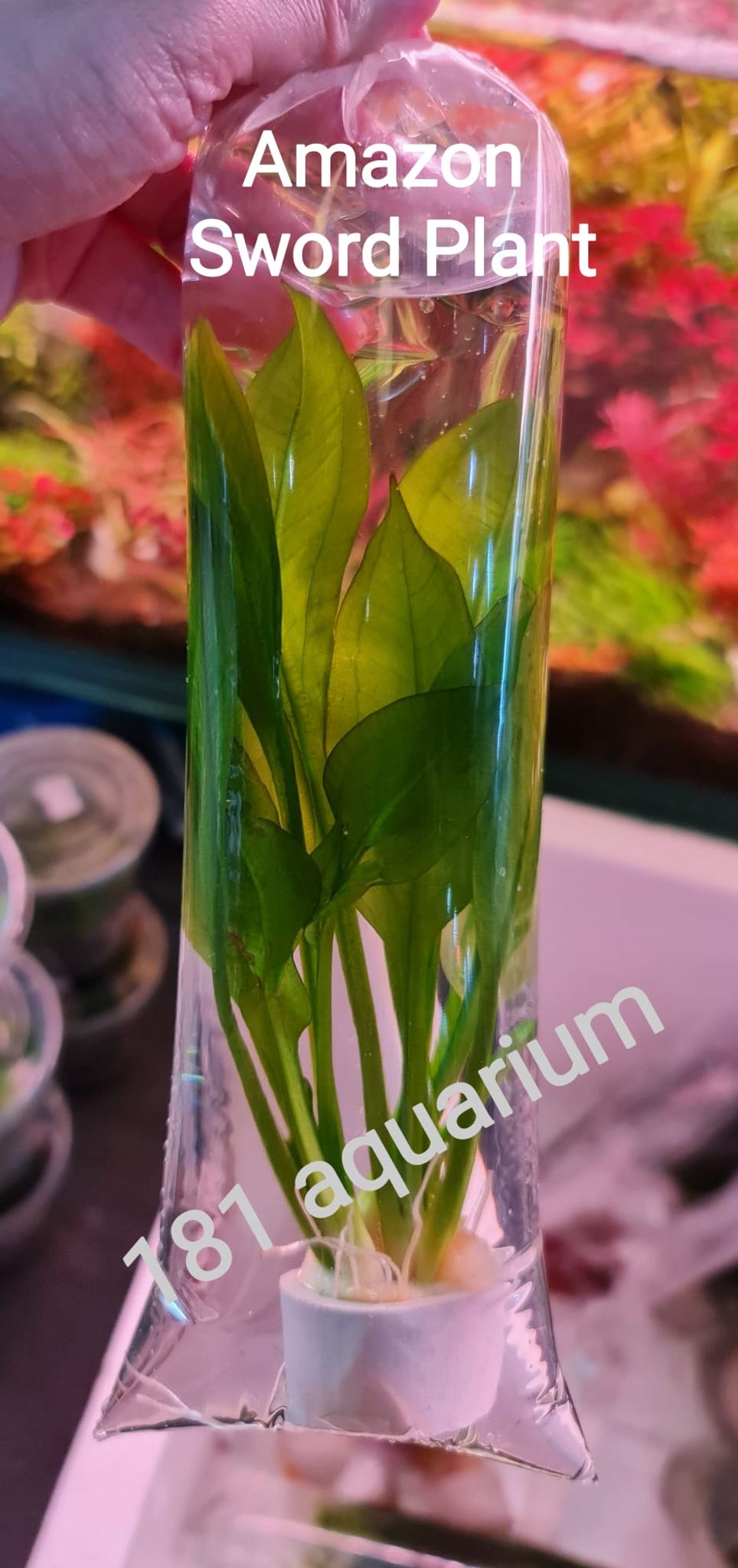
Best Tank Mates and Aquascaping Uses for Amazon Sword
An Amazon sword can anchor an entire aquascape, but only if the fish sharing the tank leave it alone and the layout gives it room to grow. This guide covers which tank mates actually work with an Amazon sword, which ones will shred it, and how to build a layout — background wall, centerpiece, or biotope — around it.
What "Amazon Sword" Actually Means
"Amazon sword" is a trade name applied loosely to several similar Echinodorus species and hybrids — most commonly Echinodorus bleheri and Echinodorus amazonicus — sold under one common label. Their care requirements are nearly identical, so the buying and stocking advice below applies regardless of which specific plant ends up in your bag. What matters more than the exact species name is understanding the size this plant reaches and planning your tank and tank mates around it.
Size, Tank, and Water Parameters at a Glance
A mature Amazon sword is a large plant. Expect a rosette of broad, strap-like leaves that can reach 12–24+ inches (30–60+ cm) tall and nearly as wide once established.
| Factor | Range | Notes |
|---|---|---|
| Tank size | 10–20 gal to start; 29–30+ gal long-term | Small tanks work for a young plant but get outgrown fast |
| Temperature | 72–83°F (22–28°C) | Wide, forgiving range |
| pH | 6.0–7.5 | Tolerates mildly acidic to mildly alkaline water |
| GH (hardness) | ~2–12 dGH | Handles harder water better than many stem plants |
| Lighting | Low to medium, ~20–50 PAR | More light plus ferts/CO2 speeds growth, but isn't required |
| Substrate depth | At least 2.5–3 in (6–8 cm) | Nutrient-rich substrate strongly recommended |
A young Amazon sword can technically live in a 10-gallon tank, but plan ahead: once it matures and spans 18–24 inches, a 10- or 15-gallon tank simply doesn't have the footprint. Starting in 10–20 gallons is fine, but budget for a 29-gallon-or-larger tank if you want this plant to reach full size without constant hacking back.
One practical note for US hobbyists: many municipal water supplies run on the harder, more alkaline side. Because Amazon sword tolerates GH up to roughly 12 dGH and pH up to 7.5, it's a far more forgiving choice for hard-tap-water households than pickier stem plants that demand soft, acidic conditions.
Best Tank Mates for Amazon Sword
Amazon sword pairs well with peaceful fish and invertebrates that treat the leaves as scenery rather than food or excavation targets.
Good fish tank mates:
- Tetras, rasboras, and danios
- Livebearers — guppies, platies, and swordtails
- Gouramis
- Corydoras catfish and other peaceful bottom dwellers
- Dwarf or peaceful cichlids such as rams and apistogramma
- Angelfish, if the tank is large enough for both the fish and the plant's mature spread
Good invertebrate tank mates:
- Amano shrimp and cherry shrimp
- Mystery snails and other algae-grazing snails
These species graze algae off the broad leaf surfaces without damaging the plant tissue, and several of them — small community fishes like tetras and livebearers, plus shrimp — are common starting points for a planted community tank built around an Amazon sword.
Tank Mates to Avoid
Some popular fish are simply incompatible with live sword plants:
- Goldfish — cold-water fish that constantly nibble on and uproot soft-leaved plants
- Large or aggressive cichlids (Oscars and other large New World cichlids) — dig, rearrange substrate, and snap leaves
- Silver dollars — known for stripping broad-leaved plants down to stems
- Common plecos — rasp on leaf surfaces and can uproot plants while foraging
If you already keep any of these, treat live plants as optional decor rather than a centerpiece investment, or stick to tougher, less palatable species instead.
Companion Plants for a Layered Aquascape
An Amazon sword works best as part of a layered layout rather than as the only plant in the tank. Good companions include:
- Java fern and Anubias (nana or barteri) — low-light midground plants that attach to hardscape
- Java moss — foreground or hardscape cover
- Anacharis/waterweed — fast-growing background filler
- Cryptocoryne species — low-light midground texture
- Vallisneria — tall, grass-like contrast to the sword's broad leaves
- Floating plants — diffuse light and add cover
Pair the sword's broad leaves with fine-leaved foreground plants for contrast, and keep in mind that as the sword's canopy fills in, it will shade shorter plants beneath and around it — plan your low-light species accordingly or trim outer leaves back to let light through.
Aquascaping Roles: How to Actually Use It
1. Background "wall" plant. In a standard community tank, plant several Amazon swords along the back glass to form a dense green backdrop, with smaller plants layered in front.
2. Solo centerpiece. In a 40-gallon-or-larger tank, a single Amazon sword given 8–12+ inches of open space on all sides can serve as the entire focal point, rather than background filler.
3. Jungle or Amazon-biotope layout. Combine the sword with driftwood, leaf litter, and wild-type South American tetras or dwarf cichlids for an authentic biotope feel — soft, tannin-tinted water and a loosely "overgrown" look rather than a manicured aquascape.
4. Texture contrast. Pair the sword's broad leaves with fine, grassy, or moss-textured foreground plants to create visual layering and depth.
Placement Tips
- Give the plant 8–12+ inches of clearance in every direction to allow full leaf spread.
- Plant the crown at substrate level — never bury it, since a buried crown is prone to rot.
- Push root tabs into the substrate near the root zone, a few inches out from the crown rather than directly beneath it, so roots grow toward the nutrient source without disturbing the base.
Feeding, Trimming, and Propagation
Amazon sword is a heavy root feeder. It benefits strongly from:
- Root tabs placed near the root zone every 3–4 months
- Iron and potassium supplementation, especially in low-tech tanks without regular liquid fertilizing
- Liquid fertilizer as a supplement in higher-light, CO2-supplemented setups
CO2 is optional — it accelerates growth but isn't required for a healthy plant. Think of this species as low-tech-friendly but fertilizer-responsive: skip CO2 if you want, but don't skip root tabs.
Propagation
Mature plants send out long runners that produce adventitious plantlets — small plants with their own roots and leaves growing along the runner. Once a plantlet has developed several leaves and visible roots, snip it free from the runner and replant it elsewhere in the tank or in a new setup. Occasionally, a very mature plant can also be propagated by dividing the crown itself.
Trimming
Trim yellowing, melting, or dying outer leaves regularly at the base of the stem. This keeps the tank clean and redirects the plant's energy into new growth rather than maintaining dying tissue.
Reading Deficiency Signs
| Symptom | Likely Cause | Fix |
|---|---|---|
| Yellowing leaves | Iron deficiency | Dose liquid iron or use iron-containing root tabs |
| Pinholes or leaf holes | Potassium deficiency | Dose potassium supplement or potassium-rich root tabs |
| New leaves melting after purchase | Transition from emersed (nursery-grown) to submersed form | Trim melted leaves; normal, not a sign of failure |
Live vs. Artificial Plants
Live Amazon sword offers real water-quality benefits: it absorbs ammonia, nitrite, nitrate, phosphate, and some heavy metals, adds oxygenation, provides natural stress-reducing cover, and competes with algae for nutrients. The tradeoff is that it needs adequate light, periodic fertilizing, and pruning, and it can rot if badly neglected.
Artificial (plastic or silk) plants cost less upfront, need zero maintenance, and can't die, rot, or carry pests or parasites — but they provide none of the filtration or oxygenation benefits, aren't grazed as a food source by algae eaters, and cheap plastic can fray at the edges and injure delicate fish (silk is a safer artificial option). A common practical middle ground is a real Amazon sword as the centerpiece plant, filled out with artificial background plants for bulk and color without the added maintenance load.
Planted vs. Unplanted Tank Tradeoffs
A planted tank built around an Amazon sword looks more natural, contributes to water quality, and lets you propagate and share plantlets over time — but it demands more knowledge of lighting, dosing, and algae management. An unplanted, hardscape-only tank is lower maintenance and gives you total freedom with decor placement, but it loses the filtration and stress-reduction benefits live plants provide, and typically needs more frequent water changes to keep nitrates in check.
Avoiding Decoration Overload
A mature Amazon sword already claims a large footprint. Piling rockwork, driftwood, and ornaments around it can block water flow, create stagnant dead zones with poor oxygenation, and stress fish that need open swimming lanes. Before adding hardscape, sketch out where the sword's mature canopy will sit and leave clear flow paths around it. Also avoid painted or adhesive-coated household items as makeshift decor — coatings can leach substances into the water over time.
Common Mistakes to Avoid
- Planting in low-nutrient gravel with no root tabs — leads to stunted, pale growth.
- Burying the crown too deep — causes crown rot.
- Overcrowding the tank with hardscape or other plants so the sword has no room to reach its mature size, or letting it shade out lower-light neighbors once it fills in.
- Panicking over post-purchase melt — trim melted leaves and give the plant a few weeks to re-root and push new submersed growth.
- Pairing it with goldfish, large cichlids, or plecos and being surprised when the plant gets shredded.
- Ignoring yellowing or pinholed leaves instead of dosing iron and potassium.
- Letting dead leaves rot in the tank instead of trimming them, which fouls water quality.
Frequently Asked Questions
How big does an Amazon sword actually get, and how much space does it need?
A mature Amazon sword can reach 12–24+ inches (30–60+ cm) tall and nearly as wide. Plan for a 20–30-gallon-or-larger tank and leave 8–12+ inches of clear space around the plant for full leaf spread.
Does Amazon sword need CO2 or special fertilizer?
No — CO2 is optional and mainly speeds up growth rather than being required. Root tabs every 3–4 months along with iron and potassium supplementation are strongly recommended for healthy, non-stunted growth.
What fish will eat or destroy my Amazon sword?
Goldfish, large cichlids like Oscars, silver dollars, and common plecos are the main culprits — they either uproot the plant while digging or physically shred and rasp the leaves.
Can shrimp and snails live safely with Amazon sword?
Yes. Amano shrimp, cherry shrimp, mystery snails, and other algae-grazing snails feed on algae film on the leaves without harming the plant tissue itself.
Why is my new Amazon sword melting or turning yellow?
New melt is usually a normal transition from the plant's emersed (above-water, nursery-grown) form to submersed tank growth — trim the melted leaves and give it a few weeks to recover. Persistent yellowing on older leaves, however, points to an iron deficiency that needs root tab or liquid iron dosing.
Can Amazon sword be a centerpiece plant instead of just background?
Yes. In a large enough tank — generally 40 gallons or more — a single Amazon sword given ample open space can work as a standalone focal point rather than background filler.
What plants pair well with Amazon sword in an aquascape?
Java fern, Anubias, Java moss, Cryptocoryne, Vallisneria, and floating plants all pair well, giving the layout layered texture around the sword's broad-leaved background or centerpiece role.
How often should I trim or replant Amazon sword runners?
Trim dead or yellowing leaves as soon as you notice them for tank hygiene. Check runners every few months, and once a plantlet has developed its own roots and several leaves, separate it from the runner and replant it.
Ready to build a stocking list around your Amazon sword? Browse freshwater livestock on FishyHub for compatible tank mates, from peaceful community fish to algae-grazing shrimp and snails.

