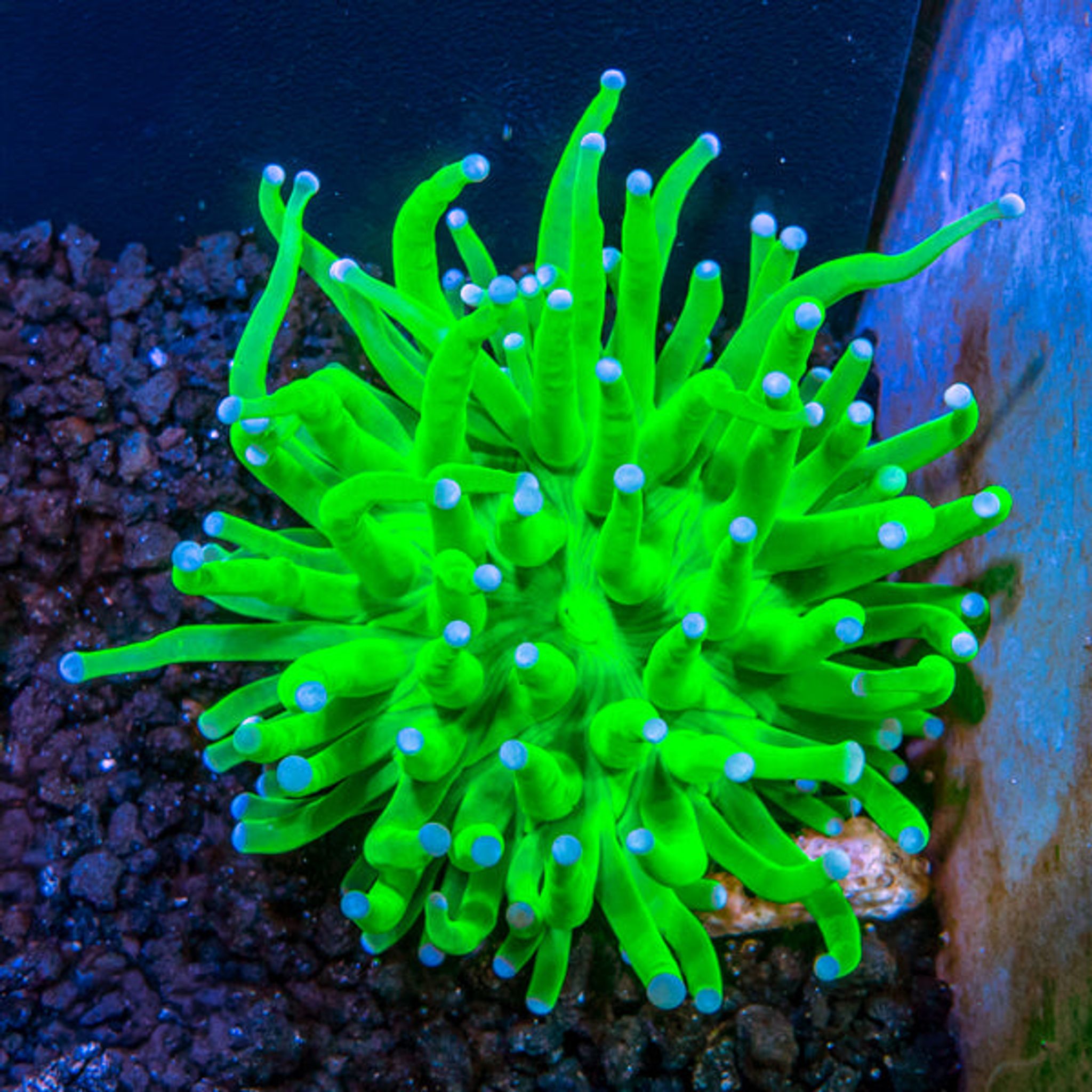
Best Placement for Torch Coral: PAR, Flow and Space Requirements
A torch coral that won't fully open is almost always telling you something about where it sits, not what it's fed. The short answer: start low-to-mid on stable rockwork under 150–250 PAR, give it gentle indirect flow, and leave 6–8 inches of open water on every side. The rest of this guide explains why those numbers work and how to adjust them for your specific setup.
What Torch Coral Is and Why Placement Matters
Torch coral (Euphyllia glabrescens, sometimes reclassified as Fimbriaphyllia glabrescens) is a large-polyp stony (LPS) coral that grows on a branching skeleton. Each head produces long, flowing tentacles tipped in colored "torch" globes that sway with tank current. Because those tentacles extend and retract in response to light, flow, and water quality, a torch coral's appearance is a running readout of whether its placement is working.
Unlike small-polyp stony (SPS) corals that demand intense light and strong flow, torch coral evolved on lower-energy reef slopes. That biology is the reason its placement rules differ from what works for Acropora or even from what works for some other LPS.
PAR Requirements: Finding the Sweet Spot
PAR (Photosynthetically Active Radiation) measures the light intensity actually reaching the coral's tissue, and it matters more than the wattage or model of your fixture.
- Safe working range: roughly 100–250 PAR
- Reliable sweet spot: 150–250 PAR for full polyp extension and rich color
- Lower tolerance: some colonies do fine as low as 75–100 PAR in shadier lower-tank spots
- Upper tolerance: acclimated colonies can handle 350–450 PAR near the top of high-output tanks, but this isn't necessary for a healthy coral
Retailer and care-guide sources tend to cap recommendations around 200–250 PAR, while some hobbyist reports describe thriving torches at 400+ PAR. Both can be true: 150–250 PAR is the reliable target for nearly any tank, and higher numbers are only safe with slow acclimation and close monitoring, not a starting point.
Measuring PAR Without a Meter
Not everyone owns a PAR meter, and that's fine for a first placement. Useful proxies include:
- Fixture height and intensity setting — most LED reef fixtures publish approximate PAR-at-depth charts; a fixture running at 60–70% intensity, 16–20 inches above the water, commonly lands a torch in the 150–250 PAR range on rock 6–12 inches below the surface.
- Borrowing or renting a meter for a one-time reading — worth it if you're stocking multiple light-sensitive corals.
- Watching the coral itself over the first 1–2 weeks — full tentacle extension and steady color are a better real-world signal than any number.
Tank Depth Changes the Math
The same fixture setting can deliver very different PAR depending on tank depth. Water and glass attenuate light, so a torch sitting 10 inches below the surface in a 24-inch-deep tank receives noticeably more PAR than a torch at the same fixture setting in a 30-inch-deep tank. As a rule of thumb, expect PAR to drop by roughly half for every 8–10 inches of additional water depth at a given light setting — plan your rockwork height accordingly rather than copying someone else's fixture percentage from a different tank.
Where to Place It Vertically
Positioning in the lower-to-middle third of the tank, on stable rockwork about 6–12 inches below the light source (adjusted to fixture strength), is the standard starting recommendation. Hobbyist forum threads often place torches mid-tank or even upper-mid, while care-guide sources favor the bottom third or open sand, reflecting the coral's lower-flow, lower-light reef-slope origin. The practical resolution: start low and shaded, then move the coral up gradually, watching for full extension and steady color rather than assuming it needs top-tank placement the way an SPS colony would.
A Step-by-Step Acclimation Approach
- Mount or place the torch on the lowest usable rock ledge, in a spot shaded from direct beam.
- Leave it there for 48 hours and observe extension, color, and mouth closure.
- If tentacles stay fully extended and color looks good after a week, move it up one rock ledge.
- Wait another 48 hours before judging the response, and repeat only if the coral continues to look healthy.
- Never change light intensity or position size in one large jump — treat every move as a small experiment.
Any PAR or light-intensity change must be introduced gradually, over 1–2 or more weeks. Torch coral tolerates a wide range of light, but not a fast change within that range. Sudden increases cause bleaching or tissue recession; sudden decreases cause dulling color and slow starvation as photosynthetic energy input drops.
Flow Requirements: More Important Than PAR
Flow is arguably the harder variable to get right, and mistakes here show up faster than lighting mistakes. The target is moderate, indirect, randomized or turbulent flow — never a direct, steady laminar jet aimed at the coral.
| Flow condition | What you'll see | Fix |
|---|---|---|
| Too strong / direct | Tentacles stay retracted, tissue looks torn or thin, polyps never fully extend | Redirect the pump to bounce off rock or glass; switch to alternating/wave mode |
| Too weak / stagnant | Detritus and film settle on the flesh; polyps stay puffy but the coral is prone to brown jelly disease and algae on the skeleton | Add a small powerhead or reposition an existing one to introduce gentle movement |
| Moderate, indirect | Tentacles sway and billow, fully extended most of the day | This is the target — no action needed |
Torch coral tolerates more flow than most LPS but still far less than SPS corals, so avoid placing it directly in a powerhead's current path even if that path looks moderate at the pump. Alternating or pulsing pumps, or flow bounced off rockwork, consistently outperform a single steady jet pointed at the colony.
Hiding Powerheads Near the Coral
Getting randomized flow near a torch without an eyesore of exposed equipment is mostly an aquascaping problem:
- Leave a gap in the rock stack sized for the powerhead body so it sits recessed rather than proud of the rockwork.
- Mount a thin rock "faceplate" with a hole for the outflow nozzle — it can be repositioned as the aquascape matures.
- Lightly roughen the powerhead's housing so algae colonizes it faster and it blends into the rock over a few weeks.
- Use suction cups on the back glass, low in the tank, rather than mounting on a side wall in clear view.
This lets you aim flow at nearby rock — bouncing and randomizing it near the torch — instead of pointing a device directly at the coral.
Space and Aggression: Planning the Footprint
Torch coral has some of the longest sweeper tentacles among common LPS. They extend several inches beyond the coral's visible daytime reach, especially at night when tentacles reach maximum extension — a very different picture from the tidier daytime polyp display most people judge spacing by.
Leave at least 6 inches, and ideally 8 inches (20 cm) or more, of clear space to any other coral species in every direction — including corals on rock shelves directly above or below it. Measure for the worst case (nighttime reach), not the daytime look, or you'll underestimate the danger zone.
Torch coral also releases allelopathic (chemical) compounds into the water in addition to physically stinging neighbors, so crowding several LPS colonies together can suppress growth even without any tentacle contact.
The Euphyllia Exception
Other Euphyllia species — torch, hammer, and frogspawn — are relatively tolerant of each other and can sometimes be kept within 2 inches. This is a risk, not a guarantee: aggression varies colony to colony, and it's still safest to give each head or colony its own footprint.
Plan for Growth, Not Just the Frag's Current Size
A torch head will multiply and widen over 1–2 or more years as the colony matures. Spacing that looks generous around a single-head frag today can become a crowded conflict zone once it branches into four or five heads — plan the initial footprint around the colony's eventual size, not its current one.
Mounting Options
On rock with cyanoacrylate (superglue) gel is the standard method: apply a small dab to the skeleton base, dip briefly in tank water to let it skin over, then hold the coral in place for about 30–60 seconds until it sets. Epoxy putty works as an alternative or as a base-builder for larger colonies, but it needs several hours to fully cure and doesn't grip a wet surface directly the way gel cyanoacrylate does.
Open sandbed placement is a valid, popular alternative for a colony you want to let spread freely. It gives the torch room to grow without threatening neighboring rockwork corals, but the base is less stable — it can tip over in strong flow or from fish disturbance, so this option pairs best with the gentler flow a torch already prefers.
Whichever method you use, sourcing a healthy frag matters as much as placement — browse LPS hard corals to compare torch coral colonies before adding one to your system.
Feeding to Support Placement
Torches benefit from direct feeding — mysis, brine shrimp, or other meaty reef foods — target-fed or pipetted near open polyps a few times a week. This supplements what the coral gets from lighting and can improve growth and color, though it isn't required for survival at proper PAR. Feeding won't fix a placement problem, but it does help a well-placed coral thrive faster.
Reef Tank Basics That Affect Placement
If you're placing your first torch, a few setup fundamentals shape how much room you actually have to work with:
- A stable, sturdy, level stand with enough front-to-back depth to aquascape properly gives corals like torch the room to spread without crowding.
- A new system should complete a full nitrogen cycle — commonly 6–8 weeks — and show stable parameters before corals go in.
- Reef tanks need tighter water-parameter control than fish-only setups because of the added biological load and coral sensitivity, which brings us to the most commonly misdiagnosed placement issue.
Common Mistakes and Troubleshooting
- Placing a new torch high under a strong LED, expecting fast acclimation — this causes bleaching or tissue recession. Always start lower and shadier, then move up slowly.
- Aiming a powerhead directly at the coral for "good flow" — this tears tissue and keeps polyps retracted. Redirect flow to bounce off rock, or use wave-mode pumps instead.
- Under-spacing based on daytime tentacle length — nighttime sweeper reach is what matters. Measure for the worst case, not the daytime look.
- Gluing frags wherever there's an open spot rather than planning a dedicated torch zone — a common cause of coral-war casualties within weeks of aquascaping.
- Blaming light or flow when a torch won't open, when the real cause is unstable alkalinity, calcium, or a nitrate/phosphate crash. Water chemistry stability matters as much as physical placement, and unstable parameters are a common root cause of "won't open" problems that get misdiagnosed as a lighting or flow issue.
- Confusing pest damage with a placement problem — Euphyllia-eating flatworms, nudibranchs, or brown jelly infection can all cause recession that looks like a lighting or flow issue. Inspect the coral closely for pests and tissue lesions before assuming placement is at fault, and quarantine or dip new frags before introducing them to prevent these problems in the first place.
Frequently Asked Questions
What PAR does a torch coral need?
Roughly 100–250 PAR, with 150–250 being the reliable target for good color and full extension. Torches can adapt to higher or lower levels over time, but only if the change is introduced gradually.
Does torch coral like high or low flow?
Neither extreme — it wants moderate, indirect, randomized flow, not a direct blast and not stagnant water. Alternating or turbulent flow from a wave-mode pump consistently beats a steady jet pointed at the coral.
Where should I put a torch coral in my tank?
Start it in the lower-to-middle third of the tank on stable rockwork, or in an open sandbed, in a shadier and lower-flow spot. Move it up only if the coral's extension and color suggest it wants more light.
How much space does a torch coral need from other corals?
At least 6–8 inches (15–20 cm) in every direction, including rock shelves above and below it, because of its long nighttime sweeper tentacles that extend well beyond the daytime polyp display.
Can I keep torch coral near hammer or frogspawn coral?
Other Euphyllia species tolerate each other better than most coral pairings and can sometimes sit within 2 inches of one another. It's still safer to give each colony its own footprint, since aggression varies from colony to colony.
Why won't my torch coral open?
The most common causes are flow that's too strong or direct, a recent unacclimated light change, unstable alkalinity or calcium, or a pest and infection issue. Check water parameters and inspect the tissue closely before assuming the placement itself is the problem.
Should I glue torch coral to rock or put it in the sand?
Either works. Rock mounting with cyanoacrylate gel is more stable and controls how the colony spreads, while sand placement is easier for a colony you want to expand freely but is less secure against tipping in strong flow.
How often should I feed a torch coral?
A few times a week with meaty foods like mysis or brine shrimp, target-fed near open polyps, is enough to supplement what the coral gets from lighting and support better growth and color.
Once you've settled on a spot with the right PAR, flow, and clearance, browse marine invertebrates and corals on FishyHub to find a torch coral colony sized to fit your planned footprint.

