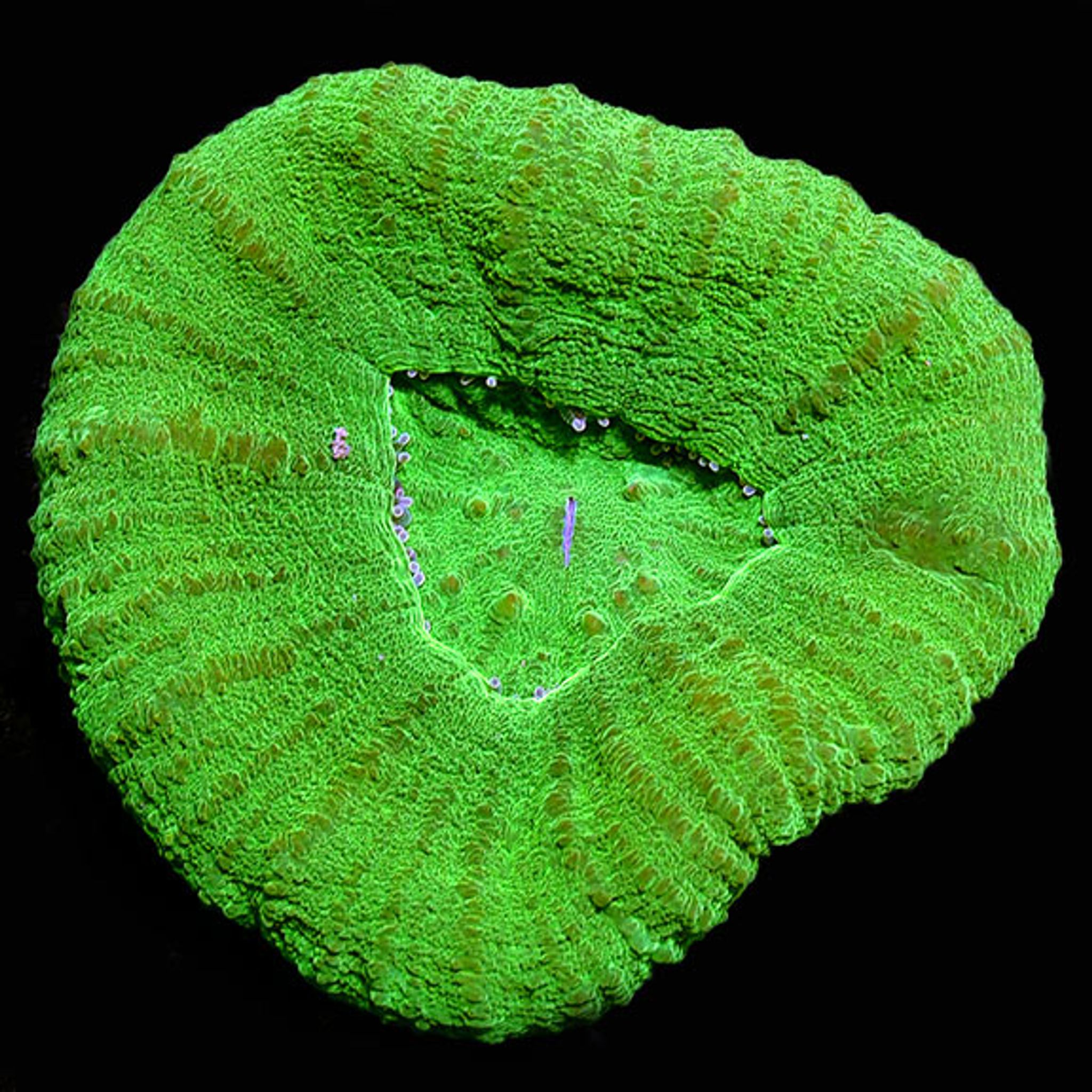
Best Placement for Scolymia: PAR, Flow and Space Requirements
Scolymia is one of the easiest large-polyp corals to kill with good intentions, since most losses trace back to too much light or a direct flow blast rather than water chemistry. This guide translates the vague "low light, gentle flow" advice into actual PAR numbers, inches from the light, and spacing distances you can apply the day the coral arrives.
A Quick Note on the Name
Most corals sold in the US trade as "Scolymia" are now classified as Homophyllia (the Australian and Indo-Pacific "doughboys" or "war corals") or as Micromussa/Acanthastrea lookalikes. Taxonomists have reshuffled the genus more than once, but husbandry hasn't changed — light, flow, feeding, and spacing needs are essentially identical across the group. This article uses "Scolymia" as the common trade name that covers all of them.
PAR: How Much Light Does Scolymia Need
Scolymia belongs to the deepwater large-polyp stony (LPS) group, alongside corals like Acanthophyllia, Trachyphyllia, and Cynarina. All of them evolved on dim, deep reef faces and carry zooxanthellae adapted to low light.
Target PAR range: roughly 50–100. That's the safe default for most home aquariums. General LPS guidance in circulation ranges from 30–50 PAR on the conservative end up to about 150 PAR for well-acclimated, aquacultured frags — the wide spread exists because trade-grown Scolymia has often already been raised under moderate reef lighting, while a wild-collected deepwater import is far more light-sensitive. Rather than chase one "correct" number, treat 50–100 PAR as your target zone and adjust based on how the specific specimen responds.
Too much light shows up gradually, not instantly. Overlit Scolymia doesn't crash overnight — it bleaches or pales and starts losing tissue over the course of days to weeks, which is exactly why it's easy to overlook until damage is advanced.
Translating PAR Into Fixture Position
Most hobbyists don't own a PAR meter, so here's a rough, general translation for a standard reef LED fixture running a typical reef program:
| Light Position | Approx. PAR at Water Surface Setup | Suitable For |
|---|---|---|
| Top of a shallow tank (under 12 in / 30 cm of water), high intensity | 150–300+ | Too bright for Scolymia |
| Mid-water column, moderate intensity | 100–150 | Upper edge of tolerance for well-acclimated frags |
| Lower third of tank, reduced intensity (40–60% on most fixtures) | 50–100 | Ideal Scolymia zone |
| Sand bed or bottom shelf, standard height fixture | 30–60 | Safe starting point, especially for new imports |
These numbers vary by fixture brand, tank depth, and water clarity, so use a PAR meter to confirm if precision matters to your setup — but as a rule of thumb, if a fixture is mounted at standard height above a 20–24 inch (50–60 cm) deep tank, running Scolymia on the sand bed or a low rock ledge at 40–60% intensity lands it in range.
Placement Depth and Orientation
Depth: Put Scolymia in the lower third of the tank — on the sand bed or a low rock ledge — not near the top under intense LEDs or T5s. This is the single most common placement mistake: a new frag goes straight to a high shelf because that's where there's open space, and it bleaches within days.
Orientation: The coral needs a flat, stable surface so its mouth faces straight up. A frag disc, a piece of rubble, or bare sand all work. A tilted or unstable specimen collects detritus in the mouth, which can lead to tissue recession or infection if it isn't manually cleared.
Substrate stability matters more than substrate type. Fine, loose sand that shifts easily can bury a Scolymia over time — that's a bigger risk than which substrate you choose. If your sand bed is soft and mobile, a low rock shelf or a wide frag rack is the safer bet.
Flow: Moderate and Indirect, Not Direct
The standard advice for Scolymia is "gentle, indirect flow," but that phrase gets misread as "low light means no flow" — and that's a mistake. In the wild, these corals are frequently collected from deep reef walls at 20–30+ meters, where strong ambient current is constant. They tolerate real movement; what they don't tolerate is a fixed jet aimed directly at exposed flesh.
The practical target is moderate, turbulent, multidirectional flow:
- Enough movement to keep detritus and fine sand off the flesh
- Enough movement to carry food particles across the polyp during feeding
- Not so much that the tissue stays constantly rippled, deformed, or retracted
- Not a laminar point-source blast from a powerhead aimed straight at the coral
A coral sitting in genuinely stagnant water will develop film algae and detritus on its surface and can develop necrotic spots — so "low flow" should never mean "still water." Random, broken-up flow from multiple powerheads (rather than one strong single source) is a better match for how this coral actually lives on the reef.
Space and Spacing Requirements
Scolymia looks harmless during the day — a puffy, still, single-mouthed polyp — but after dark it extends long sweeper and feeder tentacles well beyond its skeletal footprint. This makes it moderately aggressive for spacing purposes even though it never moves.
Give it at least 4–6 inches (10–15 cm) of clearance on all sides from any other coral. This applies to SPS and other LPS alike. Nighttime stings from an unnoticed sweeper tentacle cause slow tissue damage to neighbors that often isn't spotted until it's already advanced — so measure clearance from where the flesh could reach when fully inflated, not from the resting skeletal size.
Placement Style: Sand Island vs. Rock Shelf
Both approaches work, and the choice comes down to your tank layout:
- Bare-sand "island" placement: Set the coral directly on open sand, spaced away from rockwork and other corals. Works well for single specimens or loose "Scoly garden" groupings and makes repositioning trivial.
- Low rock shelf: A dedicated ledge low in the rockscape keeps the coral elevated slightly off the sand, which helps in tanks with sand-sifting fish, burrowing gobies, or crabs that could disturb a resting specimen.
Since Scolymia doesn't need to be cemented down, it can be moved freely to fine-tune light and flow exposure — this is one of its biggest practical advantages over encrusting corals.
The Optimal Light Spectrum for Scolymia
PAR intensity is only half the lighting picture — spectrum matters too, and it's often overlooked.
Kelvin and spectrum basics: Reef LED fixtures commonly run blue-shifted spectra in the 10,000–20,000K range because these wavelengths boost coral fluorescence and mimic the blue-filtered light found at depth.
PAR vs. PUR: PAR measures total photosynthetically active radiation across the visible spectrum, but coral zooxanthellae don't use every wavelength equally. Photosynthetically Usable Radiation (PUR) — the fraction of that light the algae can actually absorb, concentrated in the blue and red bands — is arguably more relevant than raw PAR. Two fixtures reading the same PAR number can produce very different results depending on how much of that output falls in usable bands.
For Scolymia specifically: a blue-heavy, lower-intensity spectrum suits its low-PAR, deepwater-adapted zooxanthellae far better than a bright, white-heavy daylight spectrum. Pair a moderate-to-high Kelvin setting with reduced intensity rather than a bright, balanced-white setting at the same PAR reading — the color rendering will also bring out more of the coral's fluorescent pigments.
Water Parameters and Feeding
Stable water chemistry matters more than hitting an exact number. Standard reef reference ranges apply:
| Parameter | Target Range |
|---|---|
| Temperature | 76–78°F (24–26°C) |
| Salinity (SG) | 1.025–1.026 |
| Alkalinity | 8–12 dKH |
| Calcium | 400–450 ppm |
| Magnesium | 1250–1350 ppm |
Feeding: Scolymia is a nocturnal predator that fully extends its stomach and tentacles after dark. Spot-feed meaty foods — mysis, brine shrimp, chopped seafood, or a pellet food — 2–3 times per week, with lights and flow off during feeding so the extended tissue isn't disturbed or the food swept away. It can survive on photosynthesis and passive capture alone, but regular feeding improves growth and color noticeably. If you're stocking a new specimen or a broader LPS collection, browse current options in LPS hard corals.
Acclimating a New Frag or Colony
Always assume a new arrival is more light-sensitive than it will eventually be:
- Place it in the lower third of the tank at reduced intensity from day one.
- Hold that position for at least a week and watch for paling or unusual browning.
- If the coral looks stable and fully expanded, increase light gradually over 2–4 weeks rather than jumping straight to your target position.
- Wild-collected or deepwater-import specimens need a slower, more conservative step-up than aquacultured frags, which are often already adapted to moderate light in a grow-out system.
Skipping this step — moving a coral straight from a low-light holding tank into a bright display — is one of the most common causes of early bleaching.
DIY Height Adjustment Without Gluing
Because Scolymia doesn't need to be cemented, egg-crate platforms or frag racks set at different heights in the rockwork let you fine-tune its light exposure without any permanent placement. This is a simple way to dial in PAR gradually during acclimation, or to drop a specimen lower if it starts to pale, without disturbing surrounding corals.
Choosing a Healthy Specimen
Look for:
- Puffy, fully expanded flesh with no visible skeleton showing through
- No gaping or receding mouth, which signals stress or infection
- Deep, saturated color when the polyp is relaxed and open
A specimen that looks deflated or pale in a display tank isn't automatically unhealthy — that can be normal daytime behavior for a coral about to feed at night — but gaping, receding tissue, or visible skeleton are consistent warning signs regardless of time of day.
Common Placement Mistakes
| Mistake | Result |
|---|---|
| New frag placed near the top under full-intensity light | Bleaching or brown jelly-like tissue loss within days to weeks |
| Powerhead aimed directly at the coral | Tissue stays retracted, uneven feeding, flesh can tear over time |
| Placed within sting range of SPS/LPS | Slow, often unnoticed tissue damage to neighbors from nighttime sweepers |
| No acclimation step from a dim holding tank | Bleaching or tissue loss from lighting shock |
| Detritus left sitting in the mouth | Infection or tissue recession |
| "Low light" mistaken for "no flow" | Film algae and detritus buildup, potential necrotic spots |
A Simple Visual Troubleshooting Guide
If you don't own a PAR meter, use these visual cues to diagnose a problem:
- Pale or bleached tissue → too much light; move lower or reduce intensity
- Tissue retracted or deflated for extended periods → too much direct flow, or the coral isn't being fed enough
- Brown or dull color with normal expansion → too little light; consider a small increase or checking spectrum
- Recurring detritus in the mouth → flow too weak in that spot, or placement too exposed to falling debris
Frequently Asked Questions
Can Scolymia go in a nano tank?
Yes. Tank size isn't the limiting factor for this coral — light and flow control are. As long as you can dial in 50–100 PAR and gentle, indirect flow somewhere in a nano tank, Scolymia can do well even in smaller volumes.
Does Scolymia need to be glued down?
No. It's typically kept loose on sand or a flat rock shelf so it can be relocated whenever you need to adjust lighting or flow exposure. This is one of its main advantages for hobbyists who like to fine-tune placement over time.
Why is my Scolymia not opening or puffing up?
The most common causes are too much light, too much direct flow, detritus buildup from insufficient water movement, or recent transport and acclimation stress. Check your parameters first, then try repositioning the coral lower in the tank and out of any direct flow.
Can Scolymia be kept with SPS-dominant tanks?
Yes, but only in the lowest-light, lowest-flow zone of that system, and only with generous clearance — at least 4–6 inches — from its sweeper-tentacle range. SPS corals are typically kept at much higher PAR than Scolymia tolerates, so placement has to be deliberate.
How often should I feed Scolymia?
Two to three times a week is typical, offered at night with meaty foods like mysis, brine shrimp, or chopped seafood. It can survive on photosynthesis and passive feeding alone, but regular target feeding noticeably improves growth and coloration.
Is Scolymia aggressive?
It's not mobile or aggressive in the way some LPS corals are, since it never moves and has no long-range stinging sweepers during the day. But its nocturnal sweeper tentacles can sting sessile neighbors, so for spacing purposes it should be treated as moderately aggressive.
What color light brings out the best coloration?
A blue-shifted, actinic-leaning spectrum tends to enhance fluorescent pigments more than a white-heavy daylight spectrum at the same PAR level. Pairing that spectrum with the coral's low-PAR requirement generally produces better color than simply running a bright, balanced-white setting.
Ready to add a Scolymia or expand an LPS collection? Browse available specimens and compatible reef gear in Marine Livestock, including current corals and LED lighting suited to low-to-moderate PAR reef setups.

