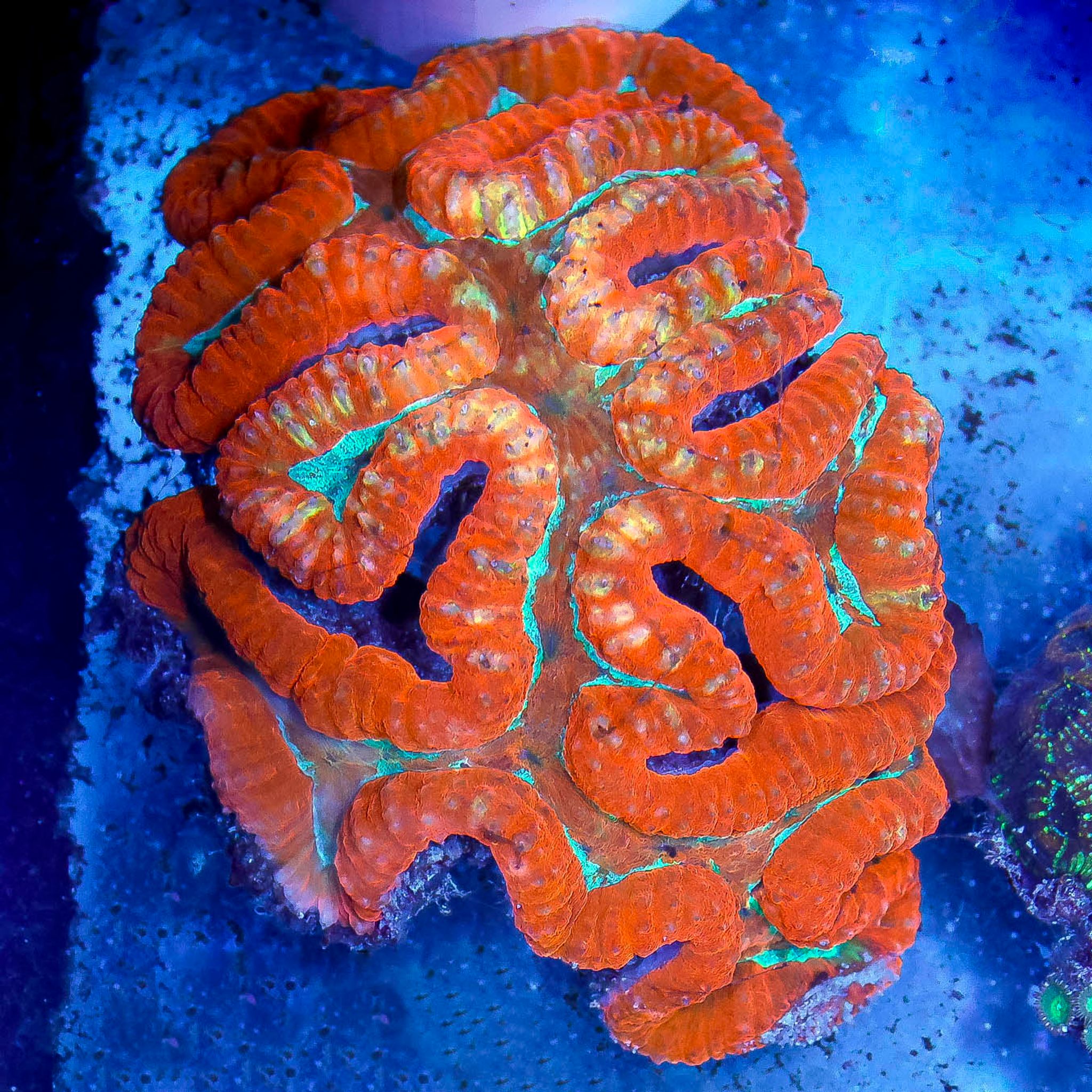
Best Placement for Lobophyllia: PAR, Flow and Space Requirements
Lobophyllia, often called brain, meat, or lobed brain coral, wants low-to-moderate light, gentle indirect flow, and more elbow room than its calm appearance suggests. Get those three variables right — plus a placement that accounts for how large the mantle inflates over time — and this large-polyp stony (LPS) coral becomes one of the easiest, most colorful pieces in a reef tank.
What Kind of Coral Is Lobophyllia
Lobophyllia is an LPS coral known for a thick, fleshy, folded mantle that can look dramatically different depending on the time of day. During daylight hours the tissue inflates into rounded, gelatinous lobes that can nearly cover the underlying skeleton. At night, or when the coral is stressed, that same mantle can look almost deflated, with the skeletal ridges showing through.
This day/night difference matters for placement decisions: a Lobophyllia measured while shrunken from shipping stress will look like it needs far less room than it actually does once fully inflated.
Tank Placement Zones: Where Lobophyllia Fits
Most reef tanks naturally divide into rough light-and-flow zones, and understanding them makes the "lower third, shaded pocket" recommendation for Lobophyllia easier to apply in a real aquascape.
| Zone | Typical PAR | Typical Flow | Corals commonly kept there |
|---|---|---|---|
| Upper third / open sandbed under lights | 250–450+ | Moderate to high, direct | SPS (Acropora, Montipora), some clams |
| Mid-tank rock, exposed ledges | 120–250 | Moderate | Many LPS, zoanthids, some softies |
| Lower third, shaded pockets, under overhangs | 30–120 | Low, indirect/turbulent | Lobophyllia, Acanthastrea, Micromussa, mushrooms |
Lobophyllia belongs firmly in that bottom row. It is photosynthetic and does need light, but it evolved on reef slopes and in turbid, shaded crevices rather than on sun-blasted shallow tops, so it tolerates — and often prefers — considerably less light than SPS corals kept in the same aquarium.
PAR Target for Lobophyllia
The reliable target zone is 50–100 PAR, with many specimens coloring up and thriving even toward the low end of that range (30–80 PAR). Treat this as the number to design around, especially for anyone newer to LPS keeping.
- Above roughly 120–150 PAR, risk rises noticeably — bleaching, browning, or tissue recession can follow, particularly under blue-heavy LED spectra tuned for SPS.
- Some keepers do run Lobophyllia successfully up to ~150 PAR, but only with slow acclimation and close, ongoing observation of coloration.
- When in doubt, default to the lower end of the range rather than pushing intensity to "see what it can handle."
Translating PAR Into Light Settings
Exact numbers vary by fixture, mounting height, and coverage angle, but as a rough starting point for a reef LED mounted 12–18 inches (30–46 cm) above the water:
- If your full-intensity setting produces roughly 250–350 PAR at the sandbed, Lobophyllia typically needs the equivalent of 30–50% of that maximum intensity, or physical shading, to land in the 50–100 PAR window.
- Placing the coral low and behind rockwork or a taller coral canopy often gets you there without touching the controller at all — shading is frequently more reliable than dialing down an entire fixture, since one setting has to serve every coral in the tank.
- A PAR meter takes the guesswork out of this step and is worth using once if you keep a mix of light-hungry SPS and shade-tolerant LPS in the same system.
Flow Requirements
Flow guidance for Lobophyllia is best described qualitatively rather than as a precise number, since most home aquarists don't measure flow in gallons-per-hour at the coral's exact position anyway. The consistent theme across keepers is:
- Gentle, indirect, and turbulent flow — the kind that moves the water around the coral without hitting it in a straight line.
- Never a direct laminar jet. A powerhead or return nozzle aimed straight at the mantle keeps the fleshy tissue "sucked in," prevents proper polyp extension, and can eventually cause tissue recession or infection at the base.
- Good positions are tucked behind rockwork, in a low-flow pocket, or off to the side of the main circulation path — anywhere the water reaches the coral only after bouncing off rock or other flow.
Avoid placing Lobophyllia directly under or across from a powerhead, even if the flow reading at that spot seems moderate on paper — direct impact matters more than raw velocity.
Best Physical Placement
The classic, low-risk placement for Lobophyllia is:
- Directly on the sandbed, or
- A flat rock ledge or frag plug near the bottom of the tank, slightly elevated above the substrate.
Elevating the coral slightly — a small rock riser or an inch of frag plug — helps prevent a maintenance issue that's easy to overlook: sand and detritus piling against the base of a sandbed-placed specimen can irritate the tissue at the point of contact over time. Keeping the base clear of accumulated sand is a simple, ongoing habit worth building into routine tank maintenance.
Either way, tuck the coral slightly out of the tank's main flow path — behind a rock outcrop, in a natural dip, or on the shaded side of an aquascape rather than the side facing the return pump.
Space and Spacing Requirements
This is the part of Lobophyllia placement that catches people off guard. Despite looking like a slow, peaceful LPS, Lobophyllia is one of the more aggressive corals toward neighboring coral tissue. It doesn't rely on the long sweeper tentacles that Euphyllia (torch, hammer, frogspawn) corals use — instead, it extends mesenterial filaments, thread-like digestive filaments released mostly at night, to sting and digest tissue on contact with a neighboring coral.
Recommended Clearance
- Minimum 4–6 inches (10–15 cm) between the fully expanded mantle edge and any neighboring coral.
- 8–12 inches (20–30 cm) or more for large, mature colonies, since mesenterial reach scales with colony size.
- Always measure clearance against the coral's expected full daytime inflation, not its shrunken, just-arrived, or nighttime-feeding-tentacle state. A frag that looks tiny on a plug can double or triple its mantle diameter within a year or two.
Riskiest Neighbors
- Fast-growing Montipora and other SPS that can creep into range before anyone notices
- Other LPS with their own sweeper tentacles or long reach, which can trigger a two-way sting war
- Any coral placed based on its current small size rather than its mature footprint
Safer, Compatible Neighbors
Corals with similar low-light, low-flow preferences and comparable growth habits tend to coexist well at sensible spacing, including Micromussa, Acanthastrea, Blastomussa, and Chalice/Echinophyllia species. Even with compatible neighbors, still apply the spacing guidance above — "similar needs" doesn't mean "safe to crowd together."
A Simple Stocking Rule
Because aggression makes crowding a bigger issue with Lobophyllia than with soft corals, treat each colony as needing its own dedicated real estate rather than filling every open inch. As a starting rule of thumb, budget roughly one Lobophyllia colony per 10–15 gallons (38–57 L) of low-flow, low-light rock space you can dedicate to LPS — more for tanks that are also housing other LPS with similar reach requirements. Shoppers comparing options can browse current LPS hard corals to see typical frag and colony sizes before planning spacing.
Water Parameters
Lobophyllia is more forgiving of nutrient levels than most SPS, and can even benefit from mild nutrient levels rather than an ultra-lean system. Standard reef targets apply:
| Parameter | Target Range |
|---|---|
| Temperature | 74–78°F (23–26°C) |
| Salinity | 1.024–1.026 (32–35 ppt) |
| pH | 8.1–8.4 |
| Alkalinity | 8–12 dKH |
| Calcium | 380–450 ppm |
| Magnesium | 1250–1350 ppm |
| Nitrate | 1–10 ppm |
| Phosphate | 0.01–0.03 ppm |
Feeding
Lobophyllia is photosynthetic and draws most of its energy from zooxanthellae, so feeding isn't strictly required. That said, target-feeding 1–3 times per week at night — using a meaty frozen food, a pellet, or a coral-specific food — noticeably improves growth rate and coloration over time. The coral extends feeding tentacles and mesenterial filaments after lights-out, which is the best window for target feeding.
Acclimating New Frags and Colonies
New Lobophyllia specimens frequently come from a shop's high-light frag rack, and moving straight into a shaded display spot (or the reverse) can shock the tissue. A step-wise approach works better:
- Start the coral at lower light and gentler flow than its final intended spot, even if that spot is already on the low end of the target range.
- Increase intensity and flow gradually over 2–4 weeks, watching daily for browning, paling, or reduced extension.
- If any stress sign appears, hold or step back the intensity for a few more days before continuing.
- After any relocation — including simply moving the coral to a different rock in the same tank — expect a settling period of 1–2 weeks and avoid judging the coral's needs during that window.
Signs of Improper Placement
| Symptom | Usual Cause |
|---|---|
| Mantle stays "sucked in," poor daytime extension | Flow too strong or too direct |
| Pale or bleached mantle | Light too intense for the current acclimation level |
| Brown jelly-like tissue | Infection, often following prolonged tissue retraction or physical damage |
| Tissue receding, exposing skeleton | Chronic stress from flow, light, or a base irritation (sand buildup) |
| Reduced polyp extension at night specifically | Possible sting from a neighboring coral, or insufficient recovery time after relocation |
Common Mistakes to Avoid
- Placing it high in the tank near lighting tuned for SPS — leads to bleaching or a slow browning-out over several weeks.
- Positioning it in a powerhead's direct flow path — causes chronic retraction and eventual base recession.
- Underestimating growth and placing frags too close together while small; stings often don't show up until months later when the mantle has expanded.
- Judging spacing from a shrunken or shipping-stressed specimen instead of its expected full daytime size.
- Skipping acclimation after a light or flow change — sudden shifts cause shock, bleaching, or the coral simply refusing to open in its new spot.
- Assuming "peaceful LPS" behavior and packing the tank tightly — Lobophyllia's calm look hides real aggression toward neighboring tissue.
Anyone building out a low-light LPS section can start by browsing the current selection of corals available, and pairing a new specimen with a dimmable LED lamp makes it much easier to hold intensity in the 50–100 PAR range without constantly repositioning rock.
Frequently Asked Questions
What PAR does Lobophyllia need?
Roughly 50–100 PAR, which counts as low-to-moderate light for a reef tank. Many specimens do fine even at 30–80 PAR, while pushing much above 120–150 PAR raises the risk of bleaching or browning unless the coral has been acclimated very gradually.
How much flow does Lobophyllia like?
Low to moderate, indirect and turbulent flow rather than a direct jet. A powerhead or return nozzle aimed straight at the coral causes the fleshy tissue to stay retracted and can eventually lead to tissue recession at the base.
How far apart should Lobophyllia be placed from other corals?
At least 4–6 inches from any neighboring coral's fully expanded edge, and 8–12 inches or more once a colony matures, because Lobophyllia stings neighboring tissue at night using mesenterial digestive filaments rather than visible sweeper tentacles.
Can Lobophyllia go on the sandbed?
Yes — the sandbed, or a low rock ledge or flat frag plug near the bottom, is a classic and safe placement. Slightly elevating the base helps prevent sand from piling against the tissue and causing irritation over time.
Why is my Lobophyllia not opening or inflating?
The most common causes are flow that's too strong, light that's too intense, a recent sting from a neighboring coral, or ordinary acclimation stress after a recent move. Give it 1–2 weeks after any relocation before assuming something is wrong.
Does Lobophyllia need to be fed?
Not strictly — it's photosynthetic and gets most of its energy from zooxanthellae. Occasional target feeding, 1–3 times a week at night with a meaty or coral-specific food, noticeably improves growth and color over time.
Is Lobophyllia reef-safe with other corals?
It won't harm fish, but it's one of the more aggressive corals toward neighboring coral tissue because of its mesenterial filament stings. Plan generous spacing from the start rather than treating it like a typical "peaceful" LPS.
Can Lobophyllia be kept under high-intensity LED reef lights?
Yes, but intensity should be dialed down — often to roughly 30–50% of the setting used for SPS — or the coral should be physically shaded and placed low in the tank. Combining both approaches gives the most consistent results.
Ready to add a Lobophyllia or plan out a low-light LPS section? Browse the full range of LPS hard corals on FishyHub to compare frag sizes and colors before deciding on placement.

