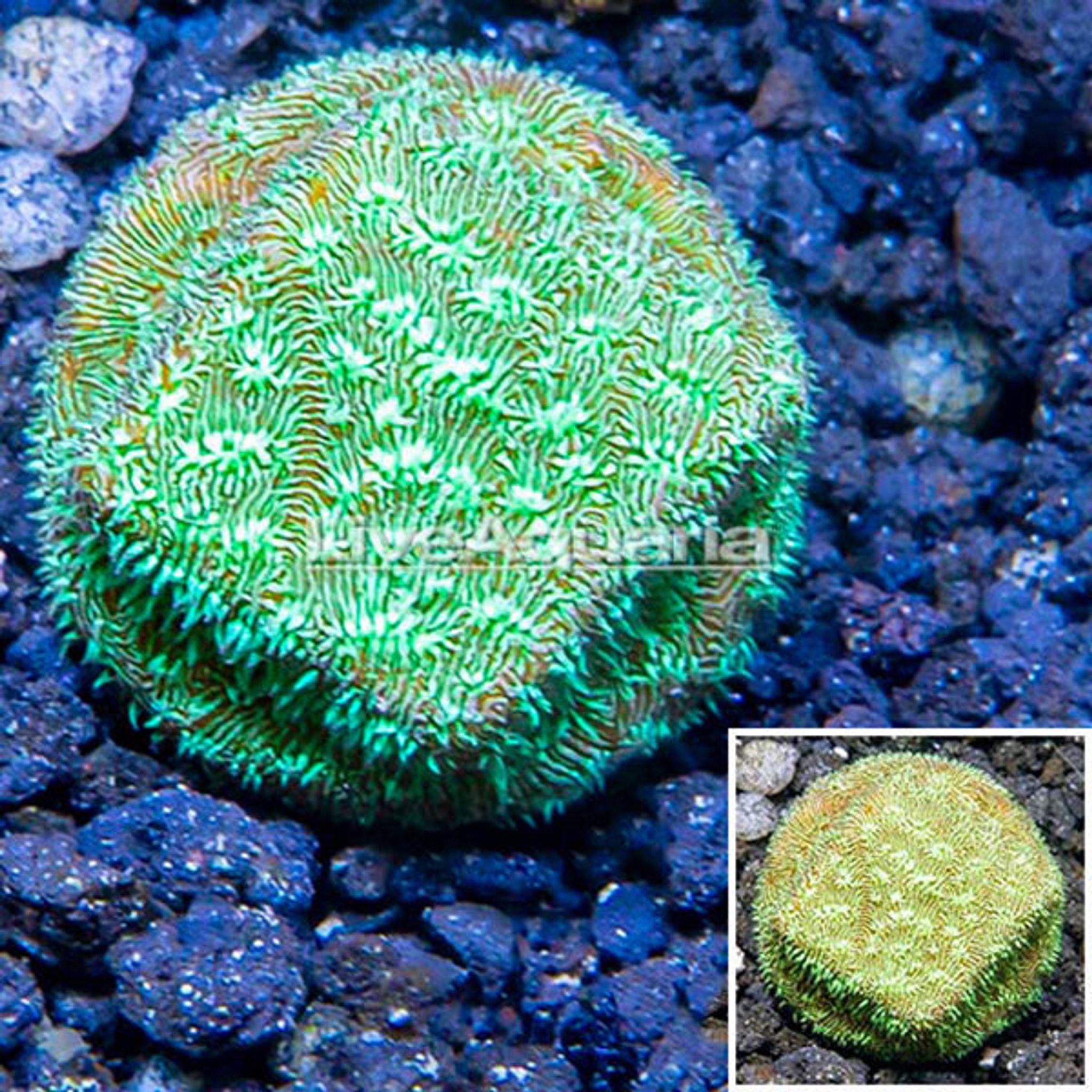
Best Placement for Leptoseris: PAR, Flow and Space Requirements
Leptoseris is a plating stony coral built for shade, not spotlight — get the light and flow wrong and it bleaches or stalls out even in an otherwise healthy reef tank. This guide gives you a straight placement chart (PAR, flow, zone) first, then the reasoning behind those numbers so you can adapt them to your own setup.
Quick Placement Chart
| Factor | Target | Notes |
|---|---|---|
| PAR | 40–125 (sweet spot 75–125) | Below ~40–50 the coral survives but colors mute; above ~150 it commonly bleaches |
| Tank zone | Lower 1/3 to 2/3 | Ledges, overhangs, shaded rockwork |
| Flow | Low to medium, indirect | Turbulent/bouncing, never a direct powerhead blast |
| Spacing | Several inches of buffer | Colonies plate outward, some reaching over a foot across |
| Temperature | 77–79°F (25–26°C) | Standard reef range |
| Salinity | ~1.025 | Standard reef range |
| pH | 8.1–8.3 | Standard reef range |
| Alkalinity | 8–11 dKH | Standard reef range |
| Calcium | ~400–450 ppm | Standard reef range |
| Magnesium | ~1,300–1,400 ppm | Standard reef range |
Why Leptoseris Needs Shade, Not Sun
Leptoseris is a foliose, plate-forming stony coral — LPS-adjacent and facultatively mixotrophic, meaning it photosynthesizes but can also capture food. In the wild it grows on deeper reef slopes and under overhangs where light is naturally filtered and dim. That habitat is the key to every placement decision below: this is a low-light specialist, not a light-hungry SPS that wants to sit at the top of the tank.
Color morphs vary in tolerance. As a rule of thumb, darker-pigmented morphs handle more light than pastel or fluorescent ones. Blue-eyed and other pale morphs do best at the lower end of the PAR range and benefit from extra shading even within an already low-light zone.
PAR: How Much Light Is Actually Right
The workable range is roughly 40–125 PAR, with the best growth and color typically landing at 75–125 PAR. Push much past 150 PAR and most colonies pale or bleach, even if the light is otherwise good quality.
Sources don't fully agree on the exact ceiling — some say problems start under 100 PAR, others report success up to 150. A practical way to split the difference: treat 125 PAR as your safe working ceiling for most morphs, and reserve 150 as a stretch limit only for a well-acclimated colony sitting in diffused, not direct, light.
Translating PAR Into Fixture Settings
Most hobbyists don't have a PAR meter, so here's a rough way to estimate:
- A common reef LED run at 100% intensity, measured 12 inches (30 cm) below the fixture, often reads well over 200 PAR at the substrate — far too bright for Leptoseris.
- Dimming that same fixture to 30–40% intensity, or measuring 20–24 inches (50–60 cm) below it, typically brings the reading down into the 75–125 PAR window.
- A shaded spot under a rock ledge or behind a taller coral colony can drop the effective PAR by half or more compared to open substrate at the same depth — this is usually enough on its own without touching the dimmer.
A PAR meter removes the guesswork entirely and is worth the investment if you're running mixed-light systems with both SPS and shade-loving LPS. Without one, start conservative, watch the coral's tissue extension and color over several weeks, and adjust in small steps.
Placement: Where in the Tank
Put Leptoseris in the lower one-third to two-thirds of the tank, on ledges, overhangs, or shaded rockwork — or tucked behind a taller SPS or LPS colony that casts shade over it. This mimics the under-ledge habitat it evolved in.
This also means Leptoseris can absolutely live in a high-light SPS display — it just can't share the same light zone as the SPS up top. Build (or find) a shaded pocket lower in the aquascape and it will do fine even a few feet below a bright fixture running for tangs and clams.
Building a Shade Pocket
If your current rockwork doesn't have a natural overhang, create one:
- Use a single wide, flat rock propped on two supports to form a ledge, secured with epoxy or a rock-locking method so it's stable before livestock goes in.
- Position a taller SPS or LPS colony on the sunward side so it casts a shadow across the lower zone for part of the day.
- Leave a gap under the ledge for water movement — don't seal the pocket off completely, or detritus will collect.
Flow: Gentle and Indirect, Not Zero
Leptoseris wants low to medium, indirect or turbulent flow rather than a direct laminar blast. The visual cue for correct flow is gentle tissue movement and extension at the colony's edge. If tissue is flattened or retracted, flow is too strong and too direct.
That said, don't cut flow entirely. The coral's plate or bowl shape can trap detritus and film if water movement is too low, and that buildup can cause localized tissue death. Periodic, gentle turbulent flow keeps debris from settling and doubles as a feeding cue that triggers polyp extension.
Sources don't fully agree on the ceiling here either — most care guides recommend gentle, indirect flow, but some anecdotal reports describe individual colonies thriving under moderate-to-higher flow. Treat this as colony-specific: start low-to-medium and indirect, watch how the tissue responds, and only nudge flow up if the coral looks under-fed or algae/film starts collecting on its surface.
Space: Plan for a Plate That Spreads
As an encrusting, plating grower, Leptoseris expands outward over time — mature colonies can reach many inches to over a foot across. Give it open rock real estate with no other coral within a few inches when you first place it, and check back periodically as it grows to catch overshadowing or overgrowth conflicts with neighbors before they become a problem.
Acclimating a New Colony
Introduce any new Leptoseris colony low and shaded, even if the rest of your tank runs high light. Let it settle for 2–4 weeks or longer before considering any move, and use tissue extension and color as your feedback signal rather than repositioning it repeatedly to "test" spots — colonies can take weeks to reveal whether a location actually works.
Before it goes anywhere near the display, run it through a standard quarantine and dip protocol. Leptoseris can be sensitive to shock, and skipping this step is a common way a perfectly fine specimen ends up stressed or diseased in week one.
Feeding and Water Chemistry
Leptoseris gets most of its energy from photosynthesis, but it benefits from occasional broadcast feeding of amino acids and fine zooplankton. Moderate — not ultra-low — nitrate and phosphate levels tend to support faster growth than a scrubbed-clean nutrient-poor system.
Core water parameters are standard reef numbers, nothing exotic: temperature 77–79°F (25–26°C), salinity around 1.025, pH 8.1–8.3, alkalinity 8–11 dKH, calcium 400–450 ppm, and magnesium 1,300–1,400 ppm.
Only dose calcium, alkalinity, and magnesium based on test results, not on a fixed schedule — a reef tank with coral and invertebrates consumes these as the animals grow, while a fish-only tank with regular water changes usually doesn't need supplementation at all. Add small amounts and retest rather than dosing heavily up front.
Why General Reef Lighting Still Matters
Saltwater reef tanks need blue-heavy spectrum lighting — LED, T5 HO fluorescent, or metal halide — unlike the lighting sold for basic freshwater setups. Stony corals as a group generally want more intense light than soft corals, which is exactly why Leptoseris stands out: it's a stony coral that wants the shaded end of that spectrum, not the bright end. A typical photoperiod of 8–10 hours applies whether you're lighting an SPS-dominant tank or a shade-tolerant LPS collection.
Lighting choice also changes how a coral looks, not just how it grows. The same colony can appear dramatically different in color and vibrancy under different spectra and intensities. If a coral looks washed out or overly pale, adjusting the light — spectrum, intensity, or position — is often the actual fix, more so than any dosing change. You can browse LPS hard corals to compare how different specimens and morphs are described before choosing one for a shaded zone.
T5 HO as a Shade-Friendly Option
T5 HO fluorescent lighting remains a solid choice specifically because it produces very even, diffuse, shadow-free light across the tank — helpful for shade-tolerant corals placed low or under overhangs, since there are no harsh hotspots to manage. The tradeoffs: bulbs need replacing roughly every 9–12 months as output degrades, and heat is a bigger factor than with LED. Many reefers run T5 and LED together in a hybrid fixture to get diffuse fill light plus a dimmable, more intense point source. If you're shopping for a dimmable option, an LED lamp gives you the intensity control needed to dial in a shaded zone without swapping bulbs.
Aquascaping for Shade-Loving Corals
Good Leptoseris placement usually starts before any coral goes in the tank, with the rockwork itself:
- Build a stable, open structure first, secured with epoxy or a rock-locking method, before adding any livestock.
- Vary rock height — taller pieces toward the back and sides — so lower shaded pockets exist naturally for corals that need them.
- Leave flow paths open across the tank rather than boxing in the rockwork with dense, solid walls.
- Design crevices, overhangs, and swim-through gaps for both appearance and function; a structure that blocks flow paths creates dead zones and detritus traps.
Supporting Water Quality: Skimmer and Filtration
Because Leptoseris responds better to moderate, stable nutrients than to nutrient extremes, the equipment handling waste matters as much as the light and flow. A protein skimmer removes dissolved organics before they break down into nitrate and phosphate, while mechanical and biological filtration handles particulate debris and the biological nitrogen cycle. Most established reef tanks run both, since together they cut nutrient load more effectively than either alone. You can compare options in filters when planning or upgrading a system that will house shade-loving LPS.
A Note on Raising pH
If pH runs low, the usual fixes are improving gas exchange — pulling skimmer air intake from outside or fresh air, or running a CO2 scrubber — along with a macroalgae or refugium setup to absorb CO2, and switching to kalkwasser instead of pH-lowering buffers. Most tanks need a combination of these rather than one single fix, and a stubborn pH problem is often really a CO2 or ventilation issue in the room housing the tank, not a coral or dosing problem.
Common Mistakes to Avoid
- Placing a new colony near high-output lights "to be safe from flow." This is backwards — Leptoseris bleaches and pales from too much light, not too little.
- Aiming a powerhead directly at the coral for "good flow." This tears or bleaches tissue at the point of impact; redirect flow so it bounces indirectly instead.
- Moving the coral repeatedly to "test" a spot. Colonies take weeks to show whether a placement works — patience plus visual cues beats guessing.
- Letting flow drop too low. Detritus collecting in the coral's folds causes localized tissue necrosis; increase intermittent flow slightly rather than removing it.
- Crowding neighboring corals too close. The plating growth habit means today's gap is next year's overgrowth conflict.
- Skipping acclimation on a mail-order specimen. Dropping a new colony straight into the display's brightest zone causes shock or bleaching even if that zone matches the long-term light target.
Frequently Asked Questions
What PAR does Leptoseris need?
Roughly 40–125 PAR overall, with the best growth and color around 75–125 PAR. Keep it under about 150 PAR, and treat 125 as your practical safe ceiling for most morphs.
Where in the tank should I put Leptoseris?
In the lower one-third to two-thirds of the tank, on shaded ledges, overhangs, or rockwork, or tucked behind taller corals that cast shade over it.
Does Leptoseris need high flow?
No. It wants low to medium, indirect flow — a direct powerhead blast damages tissue. It still needs some gentle turbulence, though, to keep detritus and film from settling into its folds.
Can Leptoseris go in a high-light SPS tank?
Yes, as long as it's placed in a low, shaded pocket within that system. It just can't occupy the same bright zone as SPS colonies higher in the tank.
How much space does Leptoseris need to grow?
Give it open rock space with a buffer of several inches from neighboring corals, since mature colonies plate outward and can reach over a foot across.
Why is my Leptoseris bleaching or losing color?
Usually too much light or flow that's too direct. Move it to a lower, more shaded spot with gentler current, then give it several weeks before judging the result.
Does Leptoseris need to be fed?
Feeding isn't mandatory since it gets most of its nutrition from photosynthesis, but occasional feeding of amino acids or fine zooplankton can boost growth.
What water parameters does it need?
Standard reef parameters: temperature 77–79°F (25–26°C), salinity around 1.025, pH 8.1–8.3, alkalinity 8–11 dKH, calcium 400–450 ppm, and magnesium 1,300–1,400 ppm.
Ready to find a colony for that shaded ledge? Browse the full range of corals on FishyHub to compare morphs and plan your placement before you buy.

