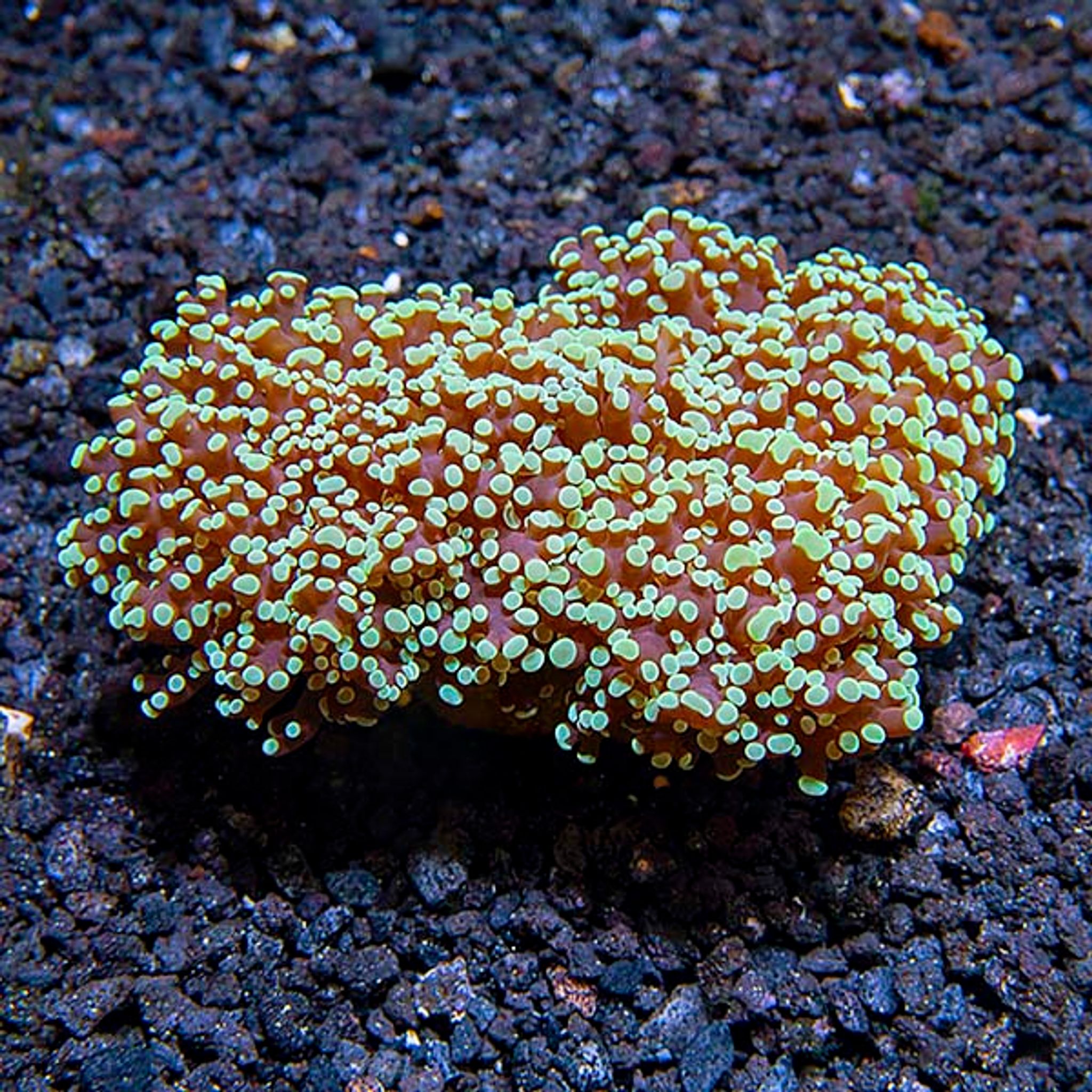
Best Placement for Frogspawn Coral: PAR, Flow and Space Requirements
Frogspawn coral (Euphyllia divisa, sometimes sold as E. paradivisa) needs low-to-moderate light, gentle turbulent flow, and real space from its neighbors to thrive. This guide gives you the actual PAR numbers, a plain-language flow scale, and inch-by-inch spacing rules so you can place a frag once and leave it alone.
Why Frogspawn Is Different From High-Light SPS Corals
Frogspawn is a large-polyp stony (LPS) coral native to reef zones with filtered, lower-intensity light and gentle water movement. It is not built like an SPS coral that wants to sit high in the tank under blasting light and strong flow. Treating frogspawn like an Acropora is one of the most common reasons new hobbyists see retracted polyps and dull color within the first week.
That difference drives every placement decision below: how high in the water column it sits, how hard the flow hits it, and how it's mounted on the rockwork.
PAR: How Much Light Does Frogspawn Actually Need
PAR (Photosynthetically Active Radiation) measures the light energy available for photosynthesis — it's a far more useful number than a fixture's wattage or lumens rating, since two lights with identical wattage can produce very different PAR at the same depth.
For frogspawn, aim for a working range of roughly 50–150 PAR, with many successful reef tanks landing closer to 75–120 PAR at the coral's exact position. Because tank depth, bulb spectrum, and how long a frag has been acclimated all shift the ideal number, treat this as a starting point to fine-tune, not a fixed target. If you own a PAR meter, use it; if not, judge by the coral's behavior (more on that below).
Saturation Point and Photoinhibition, in Plain Terms
Every coral's zooxanthellae (the symbiotic algae living in its tissue) have a saturation point — a light intensity past which more light adds no extra energy. Push light beyond that point and you risk photoinhibition, where the tissue is stressed by excess energy it can't use, sometimes leading to bleaching.
Frogspawn has a lower saturation point than high-light SPS species, which is exactly why it belongs lower in the water column or in partial shade from rockwork — closer to the sand bed or a mid-tank ledge rather than a shelf a few inches from the fixture. Matching a coral's light classification (low, medium, or high) to a depth-based PAR reading is more useful than comparing two fixtures' spec sheets.
Flow: Gentle, Indirect, and Turbulent — Not Blasting
Frogspawn wants flow that keeps its polyps swaying and fully extended, never flattened. Think of flow needs on a simple scale:
| Flow Type | Effect on Frogspawn | Verdict |
|---|---|---|
| Direct laminar jet (powerhead aimed straight at the coral) | Polyps stay retracted, tissue can irritate at contact points | Avoid |
| Gentle, indirect, alternating/turbulent flow | Polyps sway fully, tentacles extend, no detritus settling | Ideal |
| Dead flow zone (tucked behind rock, no movement) | Detritus builds up on and around the tissue, irritation follows | Avoid |
The goal is turbulence bouncing off rockwork and glass, not a single current hitting the coral head-on. If polyps stay pinned down on one side, redirect a pump or add a baffle rather than removing flow altogether — some circulation is necessary to prevent waste buildup around the base.
Placement Mechanics: Mounting the Frag
- Mount frogspawn on a rock ledge low-to-mid in the tank, or let it rest directly on the sand bed — both are natural, appropriate placements for this species.
- Avoid wedging the frag plug or skeleton into a tight crevice. The polyps need room to fully inflate outward in every direction; a cramped mount causes chronic partial extension and washed-out color even when light and flow are otherwise correct.
- Leave open space around the frag for the skeleton to branch outward as it grows — a colony that looks appropriately spaced at frag size will fill in over months to years.
Space and Clearance: How Far Apart Should Frogspawn Be?
This is where frogspawn placement most often goes wrong, because the visible daytime footprint is not the real footprint.
- Minimum 6–8 inches from any non-Euphyllia coral is a reasonable floor.
- 8–10 inches is the more reliable practical minimum once you account for both future colony growth and nighttime sweeper tentacle reach.
- For high-value SPS neighbors, err toward 10+ inches, since a lost SPS colony from an unnoticed sting is a bigger setback than losing a few inches of aquascape space.
- Frogspawn generally tolerates sitting closer to other Euphyllia species (hammer, other frogspawn), which is how hobbyists build a "Euphyllia garden" of LPS in one zone. Torch coral is the exception — it's more prone to conflict even with related species, so give it extra room.
Sweeper Tentacles: The Reach You Can't See During the Day
Frogspawn extends long, thin sweeper tentacles — distinct from its normal daytime polyps — primarily at night, to sting anything encroaching on its space. These can reach several inches beyond where the visible daytime polyp sits. A gap that looks safe at noon can still be within stinging range at 2 a.m.
Because the damage happens overnight and out of sight, losses often show up days later as unexplained tissue recession or a bleached patch on a neighboring coral with no other obvious cause.
Coral Aggression: Understanding the Three Mechanisms
Frogspawn and its neighbors compete for space using three main tactics:
- Sweeper tentacles — direct, physical stinging contact, as described above, mostly nocturnal.
- Mesenterial filaments — some corals can extrude digestive filaments to attack neighbors at very close range, distinct from sweeper tentacles.
- Allelopathic (chemical) warfare — mostly a soft-coral trait, where chemical compounds released into the water suppress or damage nearby coral tissue rather than direct contact.
To check for aggression, do a nighttime inspection with a red or actinic-only light a few days after introducing any new coral — sweeper tentacles are far more visible after dark than during the day. If you spot stinging, options include physically separating the corals with more rock or a divider, or trimming/relocating whichever coral is the aggressor. Corals that grow up together from small frags tend to negotiate stable buffer zones more peacefully than two adult colonies placed close together for the first time.
Lighting, Algae, and LED Spectrum
Light spectrum affects more than coral color — it also influences nuisance algae growth. Red- and green-heavy spectra tend to fuel algae more readily than blue-shifted "reef spec" spectra tuned for coral photosynthesis. Modern LED fixtures let you dial in intensity and spectrum by zone, so a frogspawn placed lower in the tank can run a different program than a bright SPS shelf above it.
When installing a new light or introducing a fresh frag to an established light, use an acclimation ramp-up — starting at reduced intensity and gradually increasing over one to two weeks — to avoid shocking tissue that isn't yet used to the new PAR level. Browsing options in LED lighting built for zone-based intensity control makes this kind of ramp-up easier to manage than a single fixed-output fixture.
Tank Size and Zoning
Frogspawn can be kept successfully in a nano tank, but larger systems — roughly 40 gallons (150 L) and up — make placement considerably easier. More water volume means:
- More thermal and chemical stability, which reduces the stress that can trigger increased sweeper-tentacle aggression.
- Enough physical space to build a distinct lower-flow, lower-PAR LPS zone for frogspawn, kept separate from a higher-flow, higher-light SPS zone up top.
The trade-off is response time: a larger tank buffers day-to-day swings but takes longer to correct in an emergency, while a smaller tank swings faster in both directions. Nano frogspawn keepers should simply be more attentive to keeping light and flow zones distinct, since there's less physical room to separate an LPS corner from a bright SPS shelf.
How to Know a Placement Is Working
Rather than guessing, check for these signs over the first one to two weeks:
- Full polyp extension within roughly an hour of lights-on, every day.
- Stable or improving color, not fading or browning out.
- No nightly retraction pattern that persists beyond the first few days of acclimation.
- No tissue recession forming at the base of the skeleton.
Give a new placement at least 1–2 weeks before judging it, and expect 2–3 months for the coral to fully settle in and show its best color and extension pattern.
Common Placement Mistakes
- Direct high light or high flow — polyps stay retracted and tissue can bleach or recede over time.
- Wedging the frag into a tight crevice — blocks full polyp inflation, causing chronic stress even under otherwise correct PAR and flow.
- Underestimating sweeper reach — placing a prized SPS frag or zoa colony just outside the daytime gap, only to find sting damage days later.
- Not re-checking spacing as the colony grows — a 2-inch frag today can crowd neighbors within a year without anyone moving anything.
- Skipping acclimation after a move — sudden changes in light or flow cause tentacles to stay retracted or tissue to recede; always dim new lights and ease into new flow.
- Tucking the frag "for safety" in a dead-flow pocket — detritus collects and irritates tissue instead of protecting it.
Frequently Asked Questions
What PAR does frogspawn coral need?
Roughly 50–150 PAR, with many tanks succeeding closer to 75–120 PAR at the coral's exact spot. Place it low-to-mid in the water column rather than directly under an intense top-mounted light, and fine-tune based on polyp extension and color.
How much flow does frogspawn coral need?
Gentle, indirect, turbulent flow that sways the polyps without flattening them. Avoid pointing a powerhead directly at the coral, but don't eliminate flow entirely — some movement prevents detritus from settling on the tissue.
How far apart should frogspawn be from other corals?
At least 6–8 inches from non-Euphyllia corals, with 8–10 inches being the more reliable practical minimum once you factor in colony growth and nighttime sweeper tentacle reach. It can sit closer to other Euphyllia species like hammer coral.
Can frogspawn go near the sand bed or bottom of the tank?
Yes. Frogspawn is naturally a lower-light, lower-flow coral, so mounting it low on rock or letting it rest on the sand bed suits its needs well, as long as flow there isn't stagnant.
Why are my frogspawn's polyps not extending?
The most common causes are too much light or flow, an incomplete acclimation period after a move, or physical stinging contact from a neighboring coral. Check light and flow settings first, then do a nighttime inspection for sweeper tentacle contact.
Can frogspawn sting my other corals?
Yes. Its sweeper tentacles extend mostly at night and can reach several inches beyond the visible daytime polyp, so give real clearance based on potential reach, not just what looks like enough space during the day.
Is a small tank okay for frogspawn coral?
Yes, frogspawn is nano-friendly. The trade-off is that smaller water volumes are less stable and it's harder to physically separate a low-light, low-flow LPS zone from a bright, high-flow SPS zone in the same footprint.
Ready to add a frag to your reef? Browse LPS hard corals on FishyHub to find frogspawn and other Euphyllia species suited to a low-to-moderate light, gentle-flow zone.

