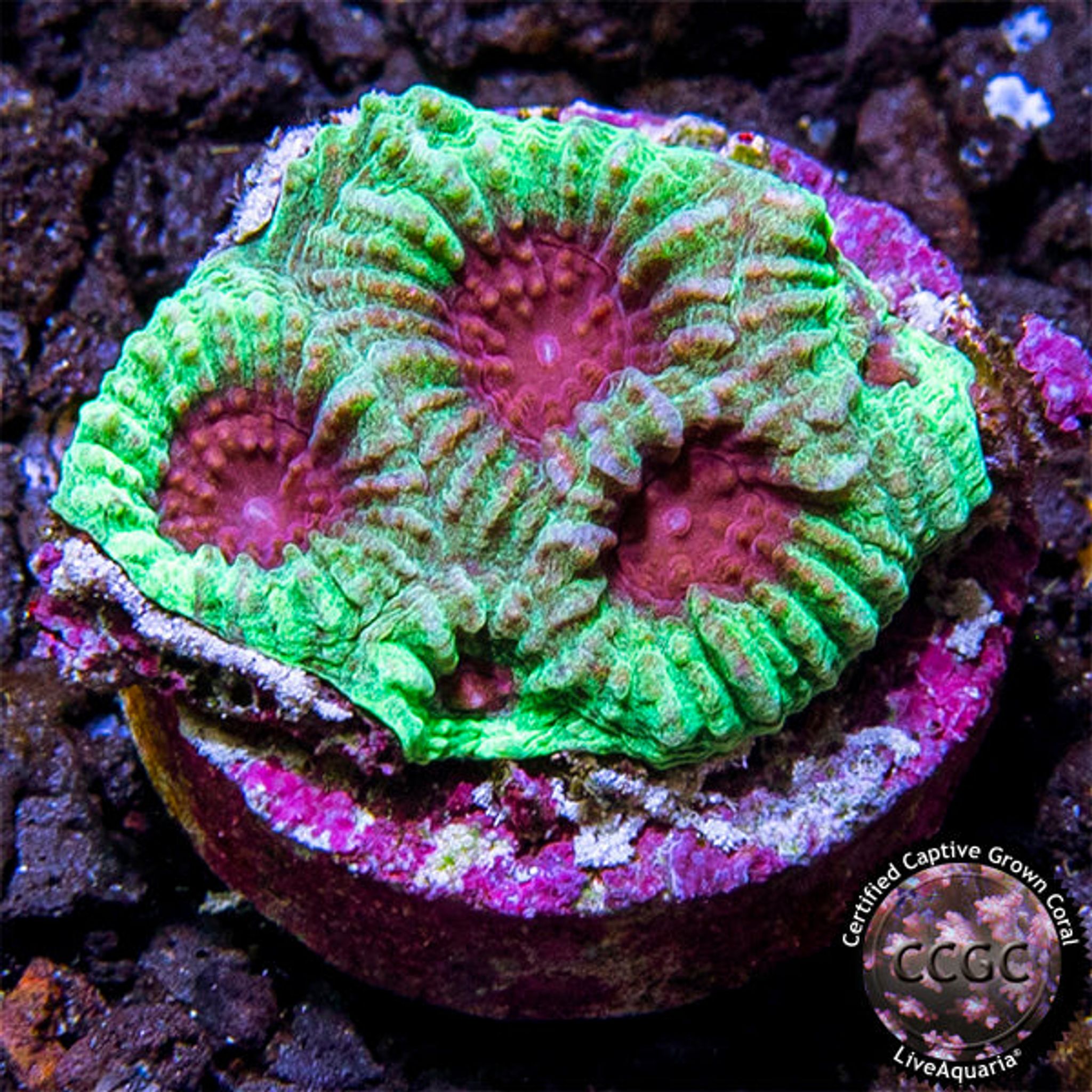
Best Placement for Favia Coral: PAR, Flow and Space Requirements
Favia coral does best on the lower-to-middle third of the rockwork, out of the tank's brightest hotspot, under 50–150 PAR and gentle, indirect flow. Just as important as the light and flow numbers is spacing: this coral fights for territory with sweeper tentacles, so where you place it relative to its neighbors matters as much as where you place it relative to the light.
What "Favia" Actually Means in the Hobby
Taxonomists have split the old genus Favia into several groups, including Dipsastraea, Coelastrea, Favites, and Goniastrea. Most reef keepers still use "favia" as a catch-all term for large-polyp stony (LPS) corals with fleshy, domed colonies and a rounded, brain-like or moon-like surface texture. This guide uses "Favia" the same way — as a hobby shorthand — because the placement principles below apply broadly across these closely related genera, even though growth form and aggression level vary somewhat between them.
Favia is generally considered a beginner-to-intermediate LPS coral: forgiving of parameter swings, slow-growing, and photosynthetic, which makes it a common target for a first LPS purchase.
PAR Targets: How Much Light Favia Needs
PAR (Photosynthetically Active Radiation) measures the light intensity actually usable by the coral's zooxanthellae, and it's the number that matters far more than watts or Kelvin rating.
- Sweet spot: roughly 50–150 PAR, with most colonies thriving at 75–100 PAR.
- Too much light: sustained exposure above ~200 PAR risks bleaching or tissue recession, especially without a gradual acclimation period.
- Too little light: below ~30–50 PAR, expect poor polyp extension, pale coloration, and slow or stalled growth.
There's some disagreement among experienced keepers here — some cap Favia at 100–120 PAR as a hard ceiling, while others report healthy colonies tolerating 150–200 PAR once fully acclimated. The practical middle ground: target 75–150 PAR, increase light gradually, and let the coral's own response — polyp extension, color retention, tissue firmness — guide any adjustments rather than chasing one "correct" number.
Translating PAR Into an Actual Shelf Position
Numbers alone don't tell you where to put the frag. In a standard glass reef tank running a typical LED or T5 fixture, here's how PAR ranges usually map to physical position:
| Tank Zone | Typical Depth Below Surface | Typical PAR (standard reef LED/T5) | Favia Fit |
|---|---|---|---|
| Top shelf, near hotspot | 4–8 in (10–20 cm) | 250–400+ | Too bright — reserve for SPS |
| Upper-middle rockwork | 8–12 in (20–30 cm) | 150–250 | Borderline; only for acclimated colonies |
| Lower-middle rockwork | 12–20 in (30–50 cm) | 75–150 | Best fit for most tanks |
| Low rock ledge, off sandbed | 20–26 in (50–66 cm) | 40–80 | Good in shallower or brighter tanks |
| Sand floor, deep/bright tank | 26+ in (66+ cm) | Under 40 | Too dim; also detritus risk |
These figures assume a moderately powerful reef fixture running at typical intensity settings over a mixed reef; adjust down for a dimmer setup or up for a very high-output fixture. The practical rule: avoid the single brightest cone directly under the fixture's center, and avoid the sand-bed floor of a deep or intensely lit tank. A stable rock ledge on the lower-to-middle third of the aquascape is the reliable default.
Estimating PAR Without a Meter
Not every hobbyist owns a dedicated PAR meter. If you don't have one:
- Compare your fixture's output settings and mounting height against its published PAR chart, if the manufacturer provides one at various depths and intensities.
- Use relative positioning as a proxy: place new LPS one to two shelf levels below where SPS corals are thriving in the same tank, since SPS generally need two to three times the PAR that LPS require.
- Watch coral response over the first two weeks as your real feedback — good polyp extension and stable or improving color mean the spot works; recession or bleaching means move it lower.
A basic PAR meter removes most of the guesswork and is worth the investment once a tank holds more than a couple of light-sensitive corals.
Flow Requirements
Favia prefers low to moderate, indirect or turbulent flow rather than a direct, laminar current. The fleshy tissue needs enough motion to prevent detritus from settling into its folds and to sweep away waste, but too much force causes the polyps to stay retracted or the tissue edges to fray.
As with PAR, opinions differ slightly: some keepers describe established Favia colonies tolerating moderate-to-high flow without issue, while others insist on strictly gentle, randomized movement at all times. A sensible approach is to start on the low-to-moderate end with indirect flow — bounced off rockwork or the glass rather than aimed straight at the colony — and only increase it gradually if the coral shows strong extension and no visible stress.
Signs flow is wrong:
- Polyps stay closed or retracted for hours during the day: flow is likely too strong or too direct.
- Detritus or algae builds up in the folds of the tissue: flow is too weak, or the spot sits in a dead zone.
- Tissue edges look frayed or worn: reposition away from a direct pump outlet.
Running multiple smaller pumps aimed at different angles, rather than one strong pump aimed directly at the aquascape, produces the turbulent, random-pattern flow that large-polyp corals generally prefer.
Spacing and Aggression: The Part Beginners Get Wrong
Light and flow errors are usually forgiving and reversible. Spacing mistakes are not, and they're the single most common reason a Favia frag causes problems in a mixed reef.
Favia and its close relatives extend sweeper tentacles — specialized stinging tentacles that reach out well beyond the coral's visible body to attack neighboring corals for space. Critically, this happens mainly at night, after the display lights go out, so a tank that looks perfectly peaceful during the day can be waging a slow war after dark. Checking on your tank an hour or two after lights-out with a flashlight is the only reliable way to catch this behavior in progress.
Spacing guidelines:
- Minimum recommended distance: 4–6 inches (10–15 cm) from any other coral for a typical frag.
- Large or established colonies: up to 8 inches (20 cm) or more — treat it as a full frag-plug diameter plus a buffer.
- Extra room versus soft corals, which tend to have less defense against LPS stings, and versus other LPS species with their own sweeper tentacles.
Because Favia grows as an encrusting, domed colony that expands outward over months and years, plan spacing for the coral's mature footprint, not the size of the frag you're placing today. A frag that looks comfortably spaced at purchase can become a problem a year later once it triples in diameter.
Signs of Sweeper Tentacle Damage
- Tissue recession, bald patches, or a brownish, jelly-like film on the coral closest to the Favia — usually appearing within days of contact.
- Damage concentrated on the side of the neighboring coral facing the Favia, rather than spread evenly.
If you see this: re-space the corals immediately, dip or treat the affected coral according to standard LPS/SPS dip protocols, and trim away clearly dead or dying tissue if the damage is advanced.
Feeding
Favia is photosynthetic and can survive on light alone, but supplemental feeding measurably improves growth rate and color saturation. Target feedings of meaty foods — mysis shrimp, a coral pellet, or similar — one to two times per week, offered at night or in low light when the polyps are fully extended and able to capture food.
Lighting Spectrum Matters Beyond Just PAR
PAR intensity tells you how much light is reaching the coral, but it doesn't capture color. Spectrum — the mix of wavelengths a fixture produces — has a real effect on how vivid a Favia's fluorescent pigments appear. Bluer-shifted, higher-Kelvin light sources (in the 14,000K+ range, whether metal halide or an LED fixture tuned to a similar actinic-heavy spectrum) tend to emphasize the blue and violet wavelengths that trigger fluorescence in coral pigments, producing more vibrant color than a warmer, more yellow-shifted light at the same PAR reading.
Practically, this means two fixtures reading identical PAR numbers at the same distance can produce noticeably different Favia coloration. If color is a priority, favor a fixture with a strong blue/actinic channel, and don't assume PAR alone tells the full story when comparing LED, T5, and metal halide options over an LPS-dominant tank. All three light sources work fine for Favia as long as intensity and spectrum are both accounted for.
Fixture Aging: A Placement That Drifts Over Time
A shelf position that delivered 100 PAR on installation day won't necessarily deliver 100 PAR a year later. LED diodes and metal halide bulbs both lose intensity gradually with age — often a meaningful percentage over 12–18 months, depending on the fixture. A placement that was correctly dialed in at setup can quietly drift into under-lighting territory, showing up as slower growth or duller color long before anyone thinks to blame the bulb. Re-check PAR at the coral's position every six months to a year, and budget for periodic bulb or fixture replacement rather than assuming day-one settings hold indefinitely.
Placement Stability and Substrate
Favia should sit on a stable rock ledge or flat frag plug, not directly on the sand bed. Sand-bed placement traps detritus against the coral's base and increases the risk of tissue irritation. If a colony must sit low in the tank, elevate it slightly on a small rock or plug rather than letting it rest flush against the substrate.
Acclimating a New Favia to Light
When introducing a new frag or colony, start at the low end of the target PAR range — even below 75 PAR — and let it settle for several days before increasing intensity. Drift it upward toward the target range over one to two weeks, watching for warning signs at each step:
- Place low and dim relative to the eventual target position.
- After 3–5 days, check polyp extension and color; if both look healthy, move slightly brighter or shift up one shelf level.
- Repeat over 1–2 weeks until reaching the target zone.
- If bleaching, paling, or recession appears at any point, move back down immediately and hold there longer before trying again.
This same gradual approach applies to flow — introduce a new specimen to gentler current than its final spot and increase only once it shows strong, consistent extension.
Water Parameters for Context
Favia tolerates the same general reef parameter ranges as most LPS corals. Stability matters more than hitting an exact number:
| Parameter | Target Range |
|---|---|
| Temperature | 76–80°F (24–27°C) |
| Salinity | 1.024–1.026 SG |
| Alkalinity | 8–12 dKH |
| Calcium | 380–450 ppm |
| Magnesium | 1,250–1,350 ppm |
General Setup Tips That Affect Favia Placement
A few broader reef-tank practices directly support good Favia placement outcomes:
- Cycle fully before adding livestock — an uncycled tank stresses any coral regardless of correct PAR and flow.
- Use quality live rock and sand to establish a stable microbiome before stocking.
- Test parameters and change water regularly — stability protects LPS more than any single "ideal" number.
- Acclimate corals gradually to both light and flow, as outlined above.
- Quarantine or dip new corals before adding them to the display, which also helps catch pests before they reach an established colony.
- Use multiple smaller pumps for varied, turbulent flow rather than one strong point source.
- Plan the aquascape layout in advance — low-light, low-flow species toward the bottom, higher-light, higher-flow species toward the top — and factor in LPS-specific spacing (the 4–6+ inch buffer above) at the planning stage, not after a sweeper-tentacle conflict has already started.
Livestock and coral options for building out that layout, including LPS specimens, can be browsed in FishyHub's LPS hard corals selection, alongside broader marine invertebrates for rounding out a mixed reef.
Frequently Asked Questions
What PAR does Favia coral need?
Favia does well across roughly 50–150 PAR, with most colonies thriving at 75–100 PAR. Aim for the middle of that range for stable growth and consistent color rather than pushing toward either extreme.
Where should I place Favia in my tank — top, middle, or bottom?
Lower-to-middle rockwork is the best default. Avoid the top shelf directly under the fixture's brightest hotspot, and avoid resting it on the bare sand floor, especially in a deep or intensely lit tank.
How much flow does Favia coral need?
Low to moderate, indirect or turbulent flow works best. Direct, high-velocity current aimed straight at the colony tends to keep polyps retracted and can fray tissue edges over time.
How far apart should Favia corals be from other corals?
At least 4–6 inches (10–15 cm) for a typical frag, and up to 8 inches (20 cm) or more for a large, established colony. Sweeper tentacles reach further than the coral's visible body, so err generous.
Does Favia coral sting other corals?
Yes. Favia and its close relatives extend aggressive sweeper tentacles, mainly at night, to sting and damage neighboring corals encroaching on their space. Nighttime checks with a flashlight are the best way to catch this behavior, since it's easy to miss during a normal daytime inspection.
Can Favia coral go under LED lighting?
Yes — LED, T5, and metal halide fixtures all work well as long as PAR intensity and spectrum are matched to Favia's needs. Spectrum (particularly bluer, higher-Kelvin light) affects coloration more than it affects basic survival.
How do I acclimate a new Favia frag to lighting?
Start at the low end of the PAR range, well below the eventual target, and increase gradually over one to two weeks. Watch polyp extension and color at each step, and move back to a dimmer spot if you see bleaching or recession.
Does Favia need to be fed?
Not strictly — it gets most of its energy from photosynthesis via zooxanthellae. That said, occasional feedings of a meaty food once or twice a week, offered when polyps are extended, noticeably improve growth rate and coloration over time.
Ready to add a Favia to your reef layout? Browse current stock in FishyHub's LPS hard corals category to find a specimen suited to your tank's light and flow profile.

