Best Placement for Elegance Coral: PAR, Flow and Space Requirements
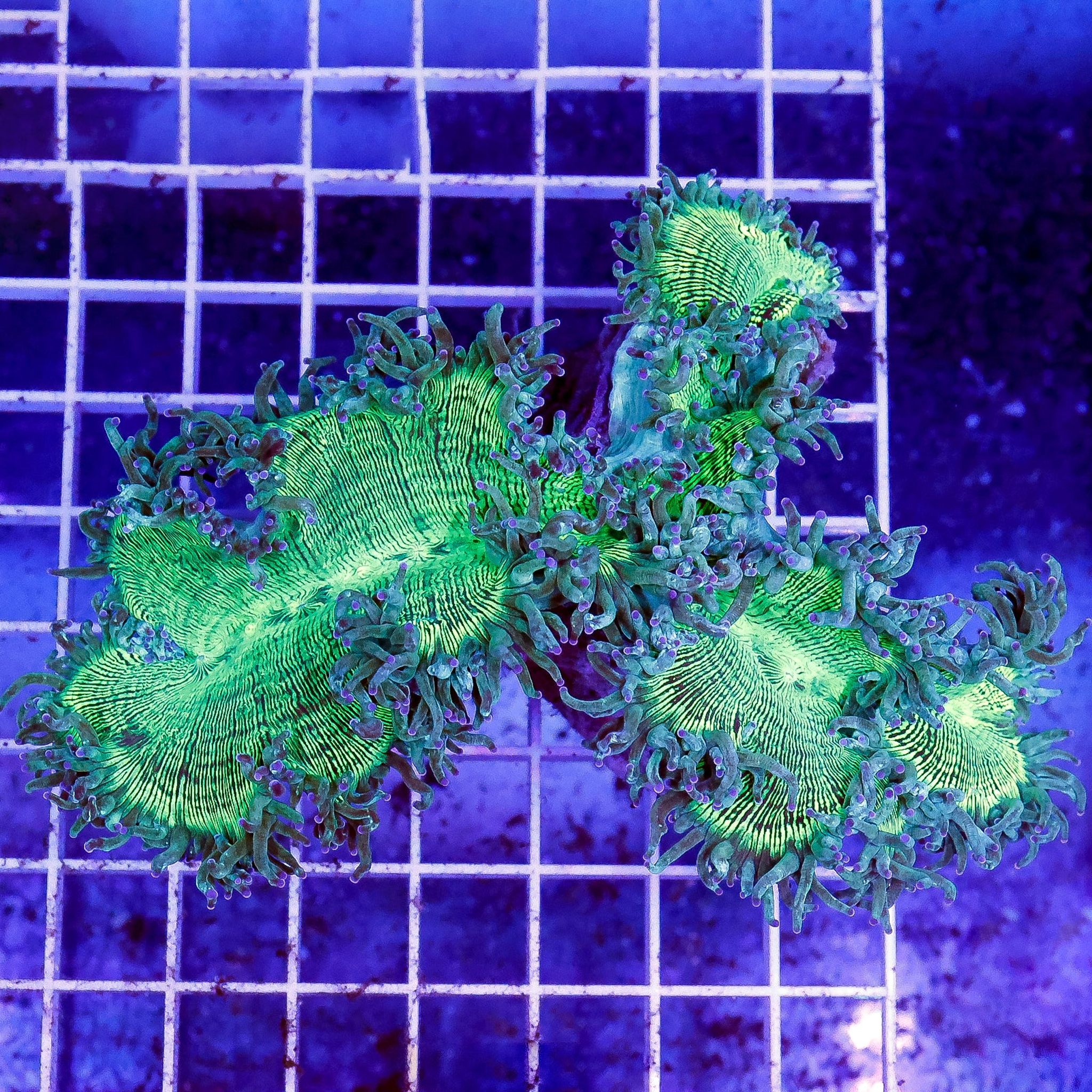
Elegance Coral (Catalaphyllia jardinei) is one of the few large-polyp stony corals that does better on the sand bed than mounted on rockwork, which trips up hobbyists used to placing LPS on a ledge. Get the light moderate, the flow indirect, and the clearance generous, and this coral will reward you with full daily extension; get any one of those wrong and it stays contracted or, worse, starts to recede.
Know What You're Placing
Catalaphyllia jardinei is a large-polyp stony (LPS) coral, occasionally still filed under Fungiidae or Euphylliidae in older references. Its most recognizable feature is a set of long, fleshy sweeper tentacles tipped in green, gold, or pink, which extend well beyond the skeleton when the coral is happy. Those same tentacles are the reason placement matters so much — they carry a potent sting used to claim space from neighboring corals.
Before deciding where a piece will live, it helps to know its origin:
- Wild-collected specimens tend to be less forgiving of placement mistakes and are more prone to unexplained tissue recession.
- Aquacultured or maricultured frags are generally hardier and more placement-forgiving, making them the better choice for a beginner's first Elegance.
Where to Place Elegance Coral in the Tank
Sand Bed First, Rock Ledge as a Fallback
Unlike most LPS, Elegance does best sitting directly on, or partly nestled into, a flat or gently sloped sand patch. This mirrors its natural habitat on sandy or muddy substrate at the base of reef slopes, and it lets the polyp inflate and spread in every direction without rubbing against rock or glass.
Give it a clear patch of sand at least 6–8 inches (15–20 cm) across. If your tank doesn't have a deep sand bed, a rock crevice or depression with sand packed around the base is an acceptable fallback — just avoid setting it directly on bare rock with no substrate cushioning the skeleton.
Depth in the Water Column
Aim for the lower third of the water column in most home tanks — roughly 12–24 inches (30–60 cm) below the surface, depending on overall tank height. That depth naturally puts the coral in moderate rather than peak light, without any extra shading.
Understanding PAR Values
PAR stands for Photosynthetically Active Radiation, measured in μmol/m²/s — it's the actual light intensity available for photosynthesis, and it is a different measurement than the lumens or watts printed on a fixture's box. Two LEDs rated at the same wattage can deliver very different PAR at the same depth, so wattage alone is not a reliable placement guide.
The most accurate way to check light at coral level is a dedicated PAR meter, though some lighting apps and fixture-specific PAR charts can give a rough estimate if you don't own one. To use a chart without a meter: find your fixture's published PAR-at-depth table, match it to your actual water depth at the placement spot, and adjust intensity or height until the estimated number falls in range.
For context, here's roughly where different coral groups sit on the PAR ladder:
| Coral group | Typical PAR range |
|---|---|
| Soft corals / low-light LPS | ~50–100 |
| Elegance Coral | ~80–150 |
| Mixed reef (general LPS/soft) | ~100–200 |
| SPS (high-light) | ~200–400+ |
The Target Range for Elegance
Sources disagree on exact numbers — some report success as low as 50 PAR, others push 200+ — but 80–150 PAR is the safest working target for most tanks. Treat it as a starting point, not a rule: watch polyp extension and color rather than chasing a single "correct" figure. Full, fleshy extension and stable coloration mean the light is right; persistent contraction or bleaching-out means it's too intense.
Avoid placing a new Elegance directly under an intense SPS-level fixture (300+ PAR), especially in the first few weeks. Whether it's a new frag or a full colony, acclimate light gradually — start it lower or shaded and raise it over 2–4 weeks rather than exposing it to full intensity on day one. You can browse suitable fixtures for a reef setup among LED lighting options sized to your tank's depth.
Flow: Low-to-Moderate and Indirect
Elegance wants low-to-moderate flow that is indirect and randomized — alternating, turbulent movement rather than a straight jet from a powerhead. A direct blast keeps the coral contracted, can tear tissue over time, and prevents the tentacles from fully extending. Too little flow is just as much of a problem: detritus settles on the exposed tissue and invites necrosis.
Practical adjustments:
- Point powerheads at rockwork or the water surface so the flow bounces and diffuses before it reaches the coral.
- Use a flow deflector or baffle if your only option is a nearby pump aimed too directly.
- Watch for full tentacle extension a few hours after adjusting flow — that's your feedback signal.
Spacing From Other Corals
Elegance has some of the longest sweeper tentacles of any common LPS, and it will sting or kill adjacent coral tissue on contact — this happens more often at night, when tentacles extend farther than they do during the day. A daytime-only clearance check can miss a colony that reaches much further after lights-out.
Minimum clearance: 6–8 inches (15–20 cm) in every direction, and more once the colony matures. A simple rule of thumb: multiply the coral's current tentacle-extension diameter by two to estimate the clearance radius you actually need.
Two more things that catch people off guard:
- Elegance can slowly "walk" across the sand bed over a period of weeks. Placement isn't a one-time decision — recheck clearance every few months as the coral relocates or grows.
- Nano tanks under 40 gallons (150 L) often can't offer 6–8 inches of clearance on every side. In that situation, treat Elegance as a single showpiece specimen rather than one piece in a mixed LPS garden, and skip crowding it with other stinging corals.
You can browse compatible tankmates and pick a showpiece from the current selection of LPS hard corals.
Substrate and Base Care
Once placed, keep an eye on the base:
- Sand or detritus that accumulates around the mouth or base — usually from weak flow or a depression that traps debris — should be siphoned out periodically.
- A flat, stable sand patch is easier to keep clean than a low spot, so re-level the area if it develops a dip.
A fine, reef-safe sand substrate makes it easier to shape and maintain that flat placement zone.
Feeding and Water Parameters
Elegance benefits from target feeding meaty foods — mysis, chopped shrimp or silverside, or a sinking pellet — 1–2 times per week. Feeding response is a useful health indicator: a coral that reaches for food is generally happy with its current placement, while one that stays closed at feeding time may need a light, flow, or spacing adjustment.
General reef parameters that support stable placement outcomes:
| Parameter | Target range |
|---|---|
| Temperature | 76–80°F (24–27°C) |
| Salinity | ~1.025 SG |
| Alkalinity | 8–11 dKH |
| Calcium | 380–450 ppm |
| Magnesium | 1250–1350 ppm |
Stability across these numbers matters more than hitting an exact figure.
Acclimation and Settling In
Drip acclimate new arrivals rather than a quick float-and-drop. Expect a multi-day settling period with reduced tentacle extension after transport or placement — this is a normal stress response, not necessarily disease. Give a newly placed coral 1–2 weeks in one spot before judging it or moving it again; repeated relocation is itself a stressor that delays recovery.
Understanding "Elegance Coral Disease"
Elegance has a well-documented history of unexplained tissue recession sometimes called "Elegance Coral Disease" — a slow tissue-tearing-necrosis (STN/RTN-like) pattern with no single agreed cause. Proposed explanations include poor water quality or husbandry, genetic weakness in maricultured stock, and bacterial infection, and the honest answer is that it's likely multifactorial.
Placement doesn't cure it, but good placement practices reduce risk:
- Quarantine new specimens before adding them to the display.
- Keep light and flow within the ranges above rather than swinging between extremes.
- Avoid overcrowding that leads to repeated stinging contact with neighbors.
None of this guarantees prevention, but it removes several of the stressors most often linked to onset.
Common Placement Mistakes
| Mistake | What happens | Fix |
|---|---|---|
| Mounting high on rockwork under intense light | Bleaching, tissue recession, permanent contraction | Move to sand bed, lower third of water column |
| Aiming a powerhead directly at the coral | Tentacles stay retracted, tissue tears | Redirect flow or add a deflector |
| Placing too close to neighbors while small | Stinging once tentacles extend at maturity | Reassess spacing every few months |
| Treating normal post-move contraction as disease | Repeated moving adds stress, delays recovery | Wait 1–2 weeks before judging |
| Letting detritus bury the base | Poor flow or a trapping depression, risk of necrosis | Siphon around the base periodically |
| Skipping quarantine | Pest introduction (e.g., burrowing crabs), early disease risk | Quarantine every new specimen first |
Frequently Asked Questions
What PAR level does Elegance Coral need?
Roughly 80–150 PAR is the safe target, treated as moderate rather than intense lighting. Acclimate new pieces gradually over 2–4 weeks rather than placing them under full-intensity light immediately.
Should Elegance Coral go on sand or rock?
A sand bed is the preferred placement, since it mirrors the coral's natural habitat and lets the tissue inflate fully. A rock ledge or crevice with sand packed around the base is an acceptable alternative if a deep sand bed isn't available.
How much space does Elegance Coral need from other corals?
Give it at least 6–8 inches (15–20 cm) of clear space in every direction, increasing that as the colony grows. Its sweeper tentacles are among the longest of any common LPS and will sting neighboring coral tissue on contact, especially at night.
What flow does Elegance Coral like?
Low-to-moderate, indirect, and randomized flow rather than a direct laminar jet. Direct powerhead blast keeps the coral contracted and can tear tissue, while too little flow lets detritus accumulate on the tissue.
Why is my Elegance Coral not opening or extending?
The most common causes are recent transport or placement stress, flow that's too direct, light that's too intense, or a water quality issue. Give it time in the same spot before assuming something is wrong or moving it again.
What is Elegance Coral Disease and can placement prevent it?
It's a poorly understood tissue-recession condition with no single agreed cause — proposed factors include water quality, genetics of maricultured stock, and bacterial infection. Correct placement (moderate light, indirect flow, quarantine, adequate spacing) reduces risk factors but doesn't guarantee prevention.
Can Elegance Coral move on its own?
Yes, it can slowly relocate across the sand bed over a period of weeks. Recheck clearance from neighboring corals periodically rather than assuming the original placement is permanent.
How deep in the tank should Elegance Coral sit?
Most home tanks do best with placement in the lower third of the water column, roughly 12–24 inches (30–60 cm) below the surface depending on tank height. This naturally provides moderate rather than peak light without extra shading.
Ready to add an Elegance Coral to your reef? Browse current stock in LPS hard corals on FishyHub and match a specimen to the sand-bed space you have available.

