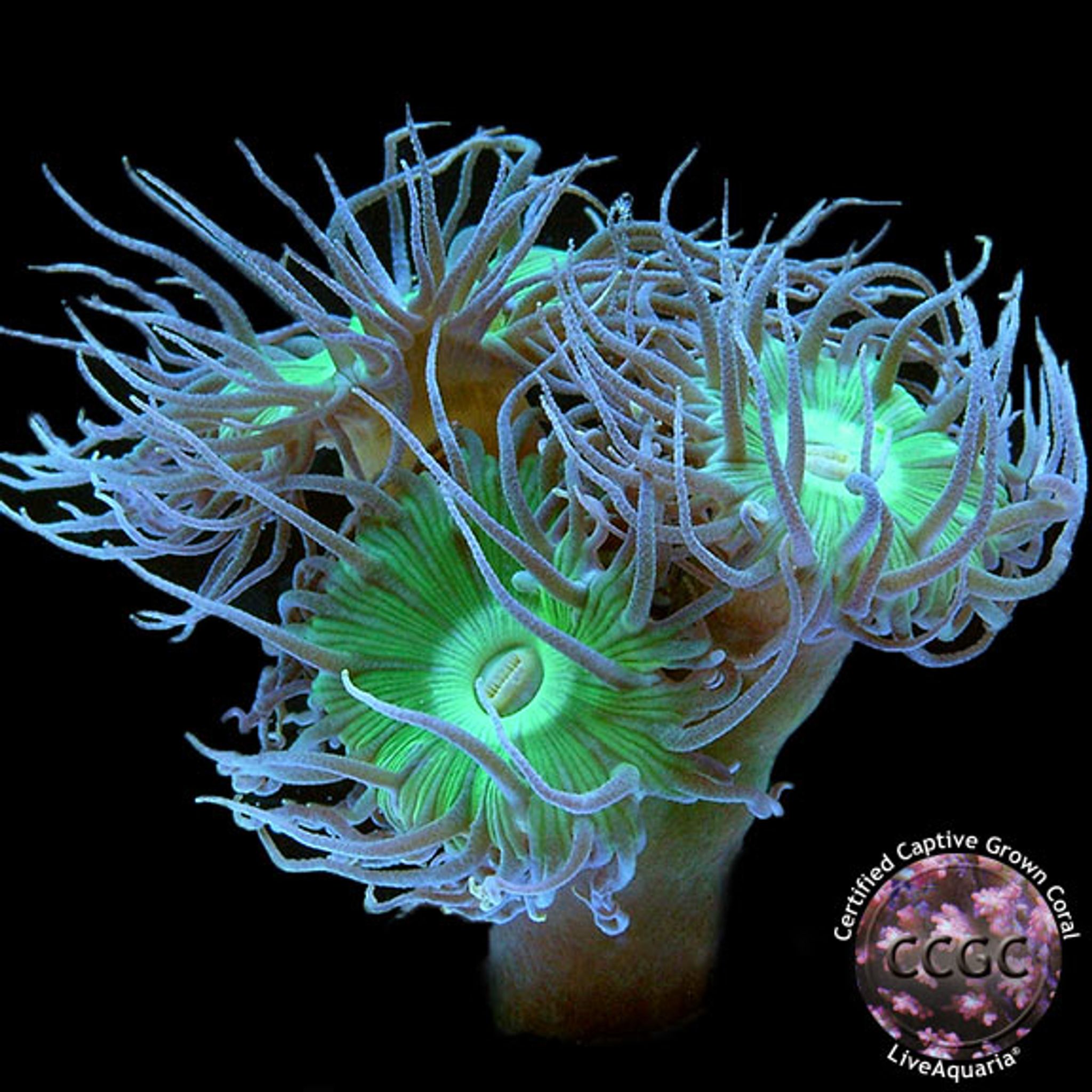
Best Placement for Duncan Coral: PAR, Flow and Space Requirements
Duncan coral (Duncanopsammia axifuga) is one of the most forgiving large-polyp stony corals you can put in a reef tank, but "forgiving" isn't the same as "anywhere." This guide gives you exact PAR and flow numbers, the best vertical zone in the tank, and how much room to leave as your colony spreads.
Why Duncan Coral Is a Beginner-Friendly LPS
Unlike torch, hammer, or frogspawn corals, Duncan coral tolerates a wide range of lighting and current without sulking. It lacks sweeper tentacles, doesn't sting neighbors aggressively, and readily buds new heads to form a colony. That flexibility makes it a good "anchor" LPS for a new mixed reef, but you'll still get better color and faster growth by targeting the ranges below rather than guessing.
PAR and Lighting Requirements
Most reference sources agree Duncan coral does well between 50 and 150 PAR, with a handful reporting tolerance up to 200–250 PAR on well-acclimated colonies. For placement purposes, treat 75–150 PAR as the sweet spot for polyp extension and color, and 150 PAR as a safe practical ceiling — a healthy, established specimen can sometimes handle more, but only after a gradual step-up.
- Below 50 PAR: polyps still open, but growth and coloration slow noticeably.
- 75–150 PAR: the target zone — full extension, strong color response.
- Above 150–200 PAR without acclimation: risk of bleaching or tissue paling, especially under direct metal halide or an intense LED fixture.
Spectrum matters as much as intensity. An actinic-heavy blue spectrum tends to bring out the fluorescent greens and golds in Duncan polyps more than raw white intensity does. If your colony looks dull under a bright, white-heavy light, try shifting the channel mix before assuming it's a PAR problem.
Acclimating to Light
Whether you're moving a Duncan to a brighter spot or introducing it to a new tank, step up light intensity and photoperiod gradually over 2–3 weeks. Jumping straight into a high-PAR zone is the single most common cause of bleaching in an otherwise healthy coral.
Measuring PAR Without a Meter
Not every hobbyist owns a PAR meter, and that's fine — you can approximate placement with proxies:
- Fixture height: raising an LED a few inches drops PAR meaningfully; lowering it raises PAR.
- Dimming percentage: most controllable fixtures let you run at 40–70% intensity for a lower-third placement versus 80–100% near the top.
- Photoperiod: a shorter daily light period (6–8 hours) roughly mimics a lower cumulative light dose even at similar peak PAR.
These aren't precise substitutes for a meter, but they're enough to place a Duncan sensibly and adjust based on how it responds over the following week.
Flow Requirements
Duncan coral wants low-to-medium, indirect, turbulent flow — the kind that bounces off rock and glass rather than blasting straight from a pump. Polyps should sway gently and stay fully extended. If they're flattened, folded over, or staying retracted, the flow is too direct or too strong for that spot.
Flow intensity also shapes how the polyps look:
| Flow Level | Polyp Appearance | Feeding Response |
|---|---|---|
| Low, gentle turbulence | Long, fully extended tentacles | Excellent — food stays near the mouth |
| Medium, indirect | Slightly shorter but still open and swaying | Good |
| Strong or direct | Short, stubby, often retracted | Poor — food gets blown away |
Most sources agree on low-to-medium flow, though a few note mature, well-acclimated colonies can tolerate stronger turbulent current — never a steady laminar jet. When in doubt, aim gentler; you can always increase flow later and watch the response.
Whole-Tank Turnover vs. Local Flow at the Duncan
Whole-tank turnover guidance (from wavemaker sizing) generally calls for roughly 20–40x tank volume per hour of total circulation in a mixed reef. That's a system-wide target, not what should be hitting the coral directly. Translated to the Duncan's actual polyp zone, aim for a gentle, randomized flow — noticeably softer than the output at the pump itself — achieved by pointing wavemakers at rockwork or the glass so the current diffuses before it reaches the colony, rather than by running a single low-output pump aimed straight at it.
Vertical Placement in the Tank
The standard, easiest-to-hit recommendation is the lower-to-middle third of the tank: the base of the rockwork, a mid-tank ledge, or directly on a frag rack near the substrate. This zone naturally pairs shadier light with gentler current in most tank setups, which is exactly what a Duncan wants.
That said, a few sources note Duncans can live anywhere from substrate to the upper reaches of the tank, provided the light and flow at that specific spot fall within range. The real rule is: match the numbers, not the shelf. If your upper rockwork reads 100 PAR with soft, diffused flow (unusual, but possible with a heavily shaded overhang or a dimmed fixture), a Duncan can sit there. For most tanks, though, lower-middle placement is simply the path of least resistance to correct PAR and flow simultaneously.
Avoid Direct Sand Contact
Never rest a Duncan skeleton directly on loose sand — sediment against the tissue causes irritation and can lead to recession. Use a small frag plug, a piece of rubble rock, or an elevated rack instead.
Mounting
Attach the base to solid rock or a ledge with reef-safe cyanoacrylate gel glue or epoxy putty. Avoid gluing to loose rubble that can tip over and stress or crush the polyps.
Building a Ledge for the Right Height and Flow Zone
If your aquascape doesn't already have a shelf in the ideal lower-middle zone, you can build one. Dry, porous aragonite or limestone rock — or homemade cement-and-sand rock — can be seeded with a bit of established substrate and cured into functional live rock at a fraction of the cost of wild live rock. Cure it for roughly 6 weeks to 3 months, running regular water changes until ammonia and nitrite read zero, before adding livestock.
Building the ledge and choosing the coral's spot should be one project, not two: decide the target PAR and flow zone first, then shape or stack rock to create a stable platform at that exact height, angled slightly so detritus doesn't collect on top of the coral.
You can browse specimens ready for a new aquascape under LPS hard corals once your placement plan is set.
Wavemaker Basics for Achieving the Right Flow
A wavemaker (or powerhead) moves water to deliver food and strip waste — no coral survives well in stagnant water, but a Duncan specifically needs that movement delivered indirectly.
- Propeller-style pumps produce a broad, diffused push — often gentler on sensitive LPS.
- Gyre-style pumps create a wide, sweeping laminar current across the tank, good for whole-tank turnover but best aimed away from direct contact with the coral.
- Sizing: start with tens of times tank volume per hour and scale up as bioload and coral count increase.
- Placement: mount high in a rear corner, aimed diagonally across the tank; using two units in opposite corners gives more even, randomized coverage than one strong pump.
- Controllable units let you dial flow down specifically in the zone around a Duncan or other sensitive LPS without weakening circulation everywhere else.
If you're shopping for a fixture to dial in PAR alongside your flow setup, a dimmable LED aquarium light gives you the intensity control needed for gradual acclimation.
Spacing From Other Corals
Duncan coral itself isn't aggressive and has no sweeper tentacles, but its soft, fully exposed polyps are vulnerable to stings from neighbors that do — torch, hammer, and other euphyllia-relative LPS in particular. Leave several inches of clearance from any coral capable of stinging, and recheck that spacing periodically: Duncans bud new heads readily and can widen substantially over a year or more, and a gap that's safe today can close as both colonies grow.
Water Parameters for Healthy Placement
Correct placement only pays off if the surrounding water chemistry is stable. Target ranges:
| Parameter | Target Range |
|---|---|
| Temperature | 75–82°F (24–27°C) |
| pH | 8.0–8.4 |
| Salinity | 1.023–1.026 (~35 ppt) |
| Alkalinity | 8–12 dKH |
| Calcium | 400–450 ppm |
| Magnesium | 1250–1350 ppm |
| Nitrate | 5–10 ppm (low but nonzero is fine, even helpful) |
Consistency matters more than hitting an exact number — swings are harder on a Duncan than a parameter sitting slightly outside the ideal range.
Feeding at the Right Spot
Duncans feed readily and respond with visibly faster growth. Target-feed meaty foods — mysis, krill, chopped seafood, or a coral-specific pellet or powder — 1–3 times per week using a turkey baster or similar tool. Pausing flow briefly during feeding keeps food from being swept away or stolen by fish before the polyps can capture it. Don't overdo it: excess uneaten food fouls the water locally, so feed a modest, controlled amount rather than continuously. A rotating feeding schedule with a freeze-dried food makes it easy to keep portions small and consistent.
Acclimating a New Frag vs. Relocating an Established Colony
A frag shipped to you has already been through transit stress before it ever reaches your light and flow. Give it a lower-PAR, gentler-flow starting spot than you might use for an established colony, and hold off on major placement changes for at least a week or two while it settles. An established colony being relocated within your own tank has less shipping stress to recover from, but still needs the same gradual light step-up if it's moving to a noticeably brighter or higher-flow zone.
Common Mistakes and Troubleshooting
- Direct powerhead blast: polyps stay retracted and tissue can recede. Relocate to turbulent, indirect flow or add a flow deflector.
- Too high under intense light without acclimation: causes bleaching or pale color. Acclimate gradually or move the coral lower or farther from the fixture.
- Sitting on loose sand: sediment irritation and tissue recession. Switch to a plug or elevated perch.
- Crowding stinging LPS neighbors: chronic polyp closure and tissue loss from stings. Maintain generous clearance and recheck as colonies grow.
- Pests near the base: Aiptasia or hydroids can also cause persistent closed polyps. Inspect the rockwork, not just light and flow, if a Duncan won't open.
- Brown jelly infection: rapid tissue disintegration, usually triggered by physical damage or placement stress. Isolate immediately, dip, and trim affected tissue.
- Overfeeding: fouls water locally. Feed modest amounts on a schedule.
- Slow bleaching over months: can signal a fixture aging brighter or an LED upgrade pushing PAR up gradually. Recheck placement periodically, not just at setup.
Frequently Asked Questions
Can Duncan coral go in a low-tech or low-light tank?
Yes. Its wide PAR tolerance — down to around 50 PAR — makes it one of the more forgiving LPS choices for modest lighting setups.
Does Duncan coral need direct flow to feed well?
No. Indirect, turbulent flow that gently sways the polyps works better for both health and feeding response than direct current, which tends to blow food away before it's captured.
How do I know if flow is too strong for my Duncan?
Watch for polyps that stay short and stubby, retract frequently, or look folded and flattened. Any of those signs mean it's time to relocate the coral to a calmer spot.
Can Duncan coral touch or grow near other corals?
It isn't aggressive itself, but avoid contact with stinging or sweeper-tentacle corals like torch or hammer. Leave clearance for its own expanding colony as well.
Where's the best spot in a mixed reef tank for Duncan coral?
Lower-to-middle rockwork on a stable ledge or plug, out of direct powerhead flow, is the easiest way to consistently land in its PAR and flow sweet spot.
Do I need to feed Duncan coral directly?
Not strictly, but target feeding a few times a week noticeably speeds growth and improves coloration compared to relying on passive nutrient uptake alone.
Why did my Duncan coral's polyps stop opening after I moved it?
This is usually a temporary stress response to new light or flow conditions. Give it one to two weeks before assuming a real problem, and watch for other symptoms like recession or discoloration.
How much room does a Duncan coral colony need over time?
Colonies bud new heads and spread steadily, so leave several extra inches of clearance beyond the frag's current size when you first place it.
Ready to plan your placement? Browse available specimens and start building your ledge around one from FishyHub's LPS hard corals selection.

