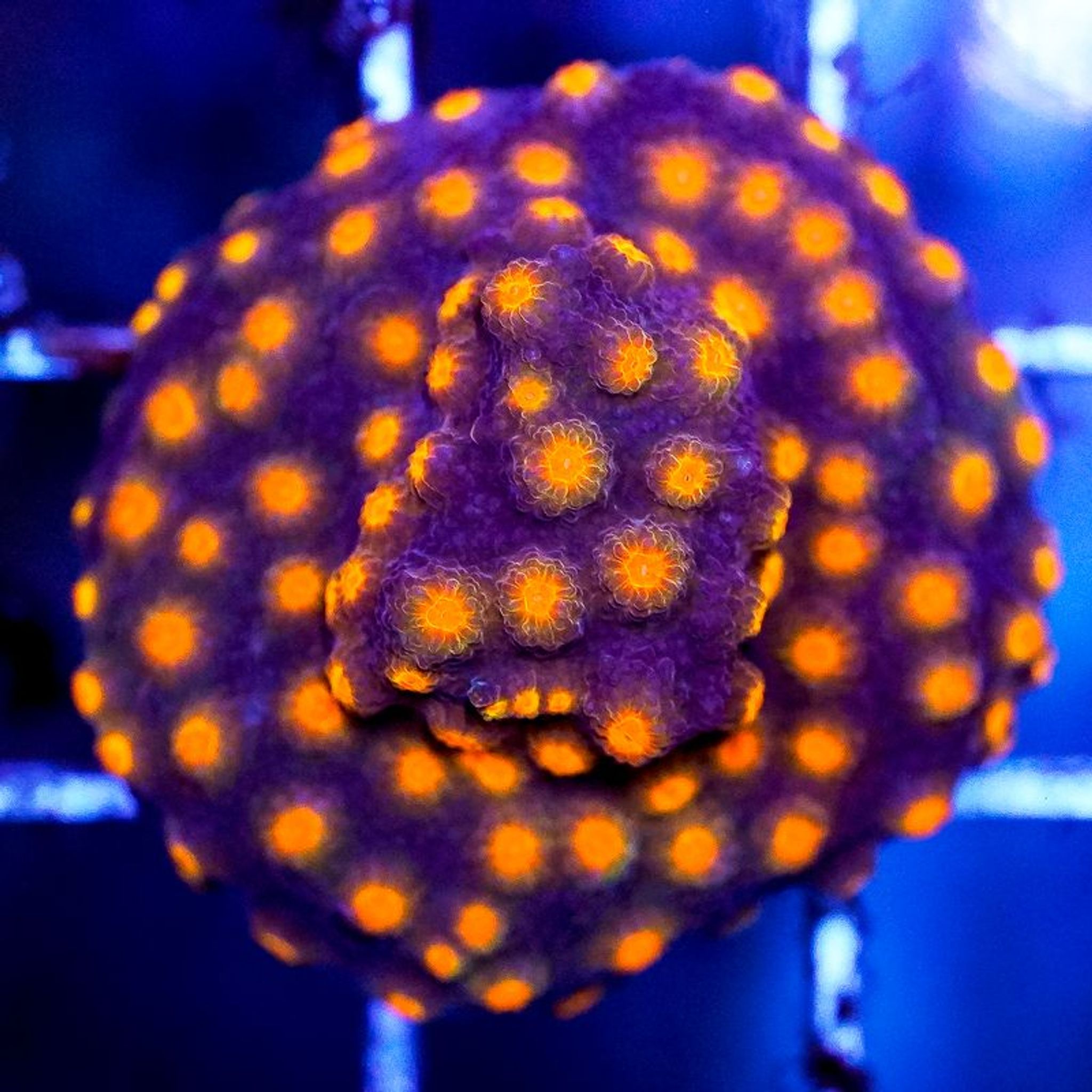
Best Placement for Cyphastrea: PAR, Flow and Space Requirements
Cyphastrea is one of the most forgiving encrusting corals a reef keeper can place, but "forgiving" isn't the same as "anywhere." This guide gives you a defendable PAR range, a flow pattern that keeps its tight polyp structure clean, and a footprint-planning method so it doesn't creep over its neighbors.
What Makes Cyphastrea Different From Branching SPS
Cyphastrea is a colonial stony coral that sits between LPS and SPS in behavior. Instead of reaching upward toward a light source the way Acropora does, it spreads laterally across whatever surface it's attached to — rock, tank glass, or a frag plug. That encrusting growth habit is the single biggest reason its placement rules differ from branching corals: it doesn't need to compete for the brightest real estate near the surface, and it tolerates a wider range of light and flow conditions once established.
Its appeal for US reef keepers comes down to three traits:
- Color variety — morphs range from golds and greens to deep reds and blues, often within the same genus.
- Fast encrusting growth — useful for covering bare rock, unifying aquascape color, or hiding frag plugs.
- Adaptability — it's considered one of the hardier stony corals for tanks that aren't dialed in to SPS-level precision.
PAR Requirements: The Working Range
Sources generally agree on a 50–200 PAR window as safe for Cyphastrea, with most healthy colonies doing well at 75–150 PAR on lower or mid rockwork. Some color morphs tolerate 300+ PAR once fully acclimated, but that's better treated as "possible" than as a placement goal.
| Light zone | Typical PAR | Suitability for Cyphastrea |
|---|---|---|
| Sand bed / deep shade | 20–50 | Survivable, slow growth and muted color |
| Lower rockwork, cave mouths | 50–100 | Good starting point for new frags |
| Mid rockwork | 75–200 | Reliable working range for most tanks |
| Upper rockwork, near lights | 200–300+ | Only for acclimated colonies; not a target |
Start new frags at the low end — roughly 75–100 PAR — and increase gradually. Because sources disagree on the exact ceiling (some cap recommendations near 150–200 PAR, others report thriving specimens above 300), the safest interpretation is to treat 75–200 PAR as the reliable range and anything above it as a slow, optional stretch goal rather than a placement plan.
A Simple Light-Ramp Timeline
Most coverage of this coral skips a repeatable acclimation schedule, so here's a practical one for moving a frag from a shaded spot to brighter rock:
- Week 1–2: Place at the lower end of your target range (75–100 PAR). Watch for polyp extension and color retention.
- Week 3–4: If color and extension look normal, move up one rock tier or shift a few inches closer to the light.
- Week 5 onward: Repeat in small steps, holding each position for at least a week before the next move.
Judge success by the coral's behavior, not the meter. Polyp extension, tissue color, and steady tissue growth are more reliable feedback than chasing a specific PAR number.
Where to Place It on the Rock
Because Cyphastrea encrusts rather than branches, it performs well in spots that would be marginal for light-hungry SPS:
- Lower-to-mid rockwork
- Shaded ledges and overhangs
- Cave mouths and transition zones between bright and shaded rock
- Tank walls and bare-bottom glass
This flexibility also makes it a useful aquascaping tool — encrusting Cyphastrea over bare rock or an unsightly frag plug can visually unify basework color and bridge the transition between a shaded cave and open, brightly lit rock.
Color morph matters as much as species. Different Cyphastrea color morphs can respond differently to the same PAR reading — a deep red morph and a bright green morph on the same rock ledge may not color up identically. Treat the PAR range as a starting point per colony, and adjust based on how that specific frag looks over several weeks.
Flow: Pattern Matters More Than Intensity
Cyphastrea wants moderate to medium-high indirect flow — enough movement to keep detritus off its tight polyp structure without blasting it directly. The disagreement you'll find between "gentle polyp movement" and "medium-high flow" descriptions is really about pattern, not strength: turbulent, indirect flow is good; a direct laminar jet is not, regardless of how strong either one is.
Flow does more than just keep the coral clean. In general reef physiology, adequate flow:
- Suspends detritus so filtration and skimming can remove it
- Aids gas exchange and oxygenation at the tissue surface
- Delivers food particles and dissolved nutrients directly to polyps
- Prevents dead spots where algae gains a foothold
All of this supports steadier skeletal and tissue growth — which is exactly what an encrusting coral like Cyphastrea depends on to spread evenly rather than patchily.
Sizing Flow With Turnover Rate
A useful starting point is total tank turnover — how many times per hour your combined pumps move the entire water volume:
| Tank type | Target turnover | Where Cyphastrea fits |
|---|---|---|
| Soft coral / LPS-leaning | 10–20x volume/hour | Comfortable lower end |
| Mixed reef (LPS + SPS) | 15–30x volume/hour | Comfortable mid-range |
| SPS-heavy | 20–40x volume/hour | Cyphastrea tolerates but doesn't need this much |
Cyphastrea sits comfortably in the lower-to-mid part of the general 10–40x range, closer to the LPS side than the SPS side.
Choosing and Positioning Powerheads
A rough starting multiplier is about 10 GPH per gallon of tank volume, then refine using the turnover targets above. Practical setup tips:
- Use two or more flow sources rather than one, positioned to create alternating or random current instead of a single straight-line stream. This better mimics natural reef surge and avoids one-directional dead zones.
- Choose magnet-mounted, low-noise powerheads so you can reposition them easily as rockwork or coral placement changes.
- Aim pumps at rockwork or the water surface so flow reaches the coral indirectly, not head-on.
If you're shopping for equipment to round out a reef setup that includes encrusting LPS/SPS-adjacent corals, FishyHub's Filters category is a reasonable starting point for filtration gear that complements a well-planned flow setup.
Spacing: Plan for Lateral Growth, Not Just Height
Because Cyphastrea encrusts, it can grow over neighboring corals and rock rather than just up toward the light. Leave at least 2–4 inches (5–10 cm) of buffer between a Cyphastrea frag and any other sessile invertebrate, and reassess as it grows.
Most placement guidance treats spacing as a one-time decision, but it's really an ongoing process:
- Every few months, check whether the colony's edge has closed the gap to a neighbor.
- Frag back or relocate if it's approaching another coral, rather than waiting for contact and stinging.
- Re-evaluate lighting and flow, too — bulbs dim, LEDs age, and pump impellers biofoul over time, gradually shifting the conditions your original placement was based on.
Water Chemistry That Supports Healthy Placement
Good PAR and flow placement only pays off if water chemistry is stable underneath it.
pH: A 7.8–8.4 range is broadly acceptable, with 8.0–8.2 as a tighter stability target. Sources vary on which band to emphasize, but the practical takeaway is the same either way: avoid swings greater than about 0.3 within a single day. A pH that's slightly off but steady is healthier for coral tissue than one that's chasing a perfect number with big daily swings.
Dosing calcium, alkalinity, magnesium, and trace elements:
- Test before you dose — don't dose blind.
- Change one parameter at a time so you can tell what's working.
- Scale dosing to actual bioload. Cyphastrea's calcification demand is moderate — higher than soft corals, but lower than heavy SPS or Acropora. In a tank mixing Cyphastrea with SPS, calcium and alkalinity uptake will be higher overall, so test more frequently; in a lightly stocked tank, it often won't need dedicated dosing at all.
Skimming: A protein skimmer — hang-on-back or in-sump — uses foam fractionation to pull dissolved organics out of the water column before they break down into nutrients that fuel nuisance algae. It's a mechanical process, not a chemical additive, and it's saltwater-only technology. A skimmer isn't strictly required to keep Cyphastrea alive, but in a tank with several fast-encrusting corals producing biomass, it meaningfully supports the clean, well-oxygenated water that helps stony corals color up and encrust evenly. If you're assembling a coral-focused setup, FishyHub's LPS Hard Corals category is worth browsing alongside your equipment list.
Common Placement Mistakes
- Skipping acclimation on a new frag. Dropping a frag straight under high-intensity lighting causes bleaching or paling at the tips and edges. Fix it by relocating to a shadier spot and stepping up light exposure gradually.
- Aiming a pump directly at the colony. Direct blast flow causes tissue recession or a "windswept" look. Redirect flow off adjacent rockwork so it hits the coral indirectly.
- Ignoring footprint growth. An encroaching colony will sting or overgrow neighbors. Frag it back or relocate it with a larger buffer before contact happens.
- Chasing exact pH or alkalinity numbers with large corrective doses. Frequent big swings stress coral more than a stable, slightly imperfect reading. Dose smaller, consistent amounts and test before adjusting.
- Undersizing flow or skipping a skimmer in a tank with multiple fast-growing encrusters. This leads to detritus buildup and nuisance algae at the coral's base — match skimmer and pump capacity to bioload, not just tank volume.
- Judging placement purely by a PAR meter. A number alone doesn't tell you if the coral is thriving. Polyp extension, color retention, and visible growth are better indicators.
Frequently Asked Questions
What PAR does Cyphastrea need?
Roughly 75–200 PAR works for most tanks, with many keepers finding success at 75–150 PAR on mid-to-lower rockwork. Start new frags at the low end and increase gradually rather than placing them at a high PAR target immediately.
Can Cyphastrea go in a low-light tank?
Yes. It's one of the more shade-tolerant stony corals and can encrust well near the sand bed or under overhangs, though growth and coloration will typically be slower than in brighter spots.
How much flow does Cyphastrea like?
Moderate, indirect or turbulent flow that moves the polyps without hitting them with a direct blast. The pattern of the flow matters more than raw strength — turbulent movement off rockwork is preferable to a straight laminar jet.
Does Cyphastrea need to be up near the lights like Acropora?
No. Because it encrusts rather than branches upward toward light, it does well on mid-to-low rockwork and doesn't need to compete for the brightest zone in the tank.
How much space should I leave around a Cyphastrea frag?
Leave at least 2–4 inches (5–10 cm) of buffer from other sessile invertebrates, since it spreads laterally and can overgrow neighbors over time if left unchecked.
Does Cyphastrea need extra dosing?
Its calcium and alkalinity demand is moderate — higher than soft corals but lower than heavy SPS. Test regularly if it's mixed with SPS in the same system, but a lightly stocked tank often won't need dedicated dosing for it alone.
Why is my Cyphastrea losing color after I moved it?
This usually points to a lighting or flow change that outpaced acclimation. Move it back toward its prior conditions and reintroduce any change more slowly, watching polyp extension and color as feedback.
Is a protein skimmer required to keep Cyphastrea successfully?
Not strictly required, but it supports the stable, low-nutrient water quality that helps any stony coral, including Cyphastrea, encrust and color up well — especially in tanks with multiple fast-growing corals.
Once you've settled on a spot with the right light, flow, and space to grow, you can browse FishyHub's Corals category to find frags and colonies that fit your tank's setup.

