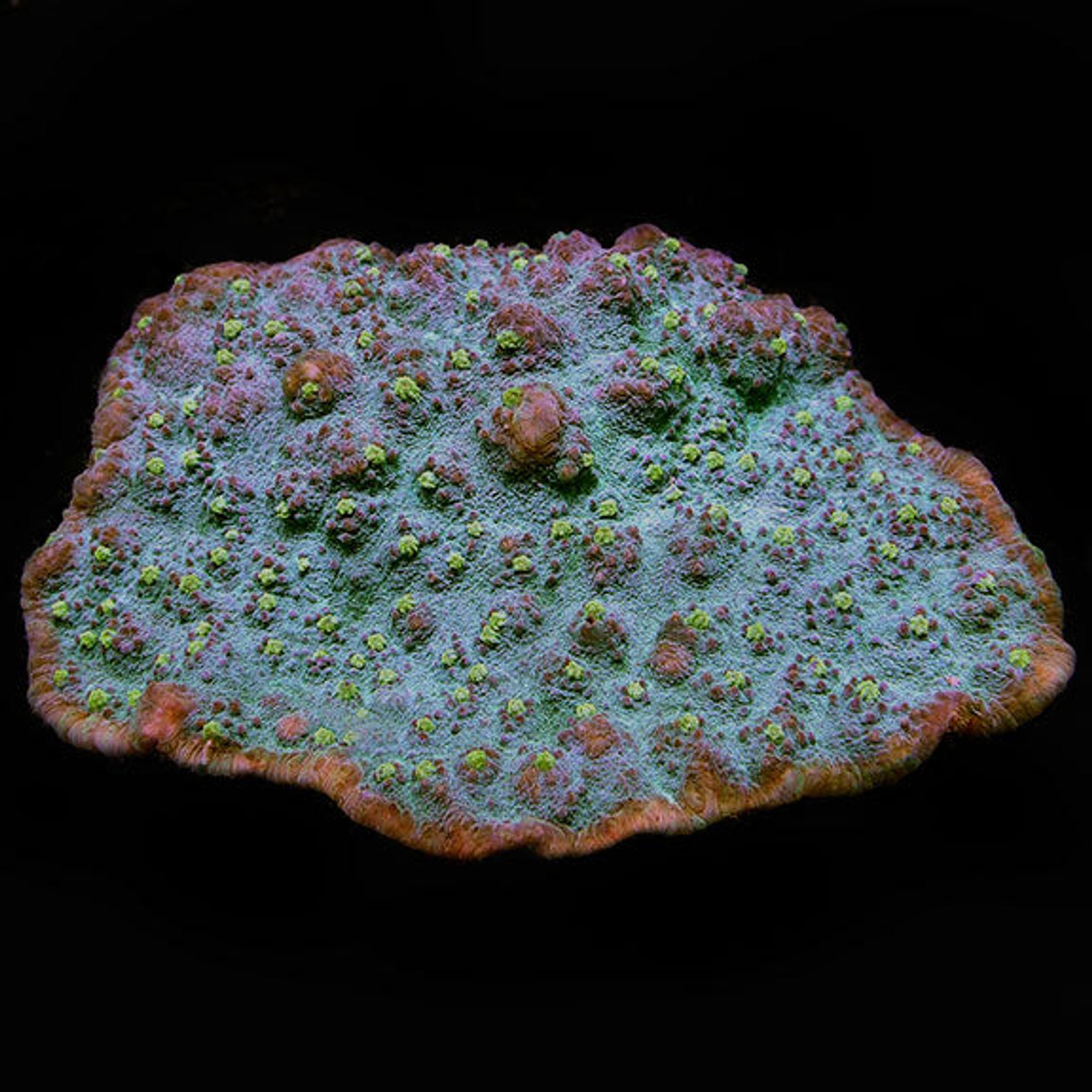
Best Placement for Chalice Coral: PAR, Flow and Space Requirements
Chalice corals reward the right spot with vivid, swirling color and steady encrusting growth, but the wrong spot bleaches or stings out its neighbors within days. This guide gives you real PAR numbers, a flow target, and a spacing rule you can apply in any reef tank, plus a way to fine-tune from there by watching how the coral responds.
What Counts as a "Chalice" Coral
The trade name "chalice" covers several genera sold as encrusting, plating LPS or semi-LPS corals — commonly Echinophyllia, Oxypora, Mycedium, and some Pectinia-adjacent species. What they share matters more than the taxonomy:
- Large, flat feeding tissue that spreads across rock as the colony encrusts and plates outward.
- Long sweeper tentacles that extend at night to catch food and defend territory — often reaching several inches past the visible skeleton.
- A growth habit that favors horizontal or gently sloped surfaces over steep rockwork.
Because they combine LPS-style feeding behavior with SPS-style sensitivity to light shock, chalices sit in their own placement category rather than fitting neatly alongside torches or Acropora.
PAR: The Single Biggest Placement Factor
Light intensity, measured as PAR (Photosynthetically Active Radiation), is the variable most likely to make or break chalice placement.
| PAR Range | What to Expect |
|---|---|
| 50–80 | Shaded low-to-mid tank zones; often intensifies pigmentation on darker morphs |
| 75–125 | The sweet spot for most chalices — strong color and steady growth |
| 125–150 | Workable soft ceiling for many morphs if flow is good and acclimation was gradual |
| 150–200+ | Risk zone; commonly causes bleaching, tissue paling, or recession, especially on purple or darker morphs |
Sources disagree on the exact ceiling — some cap chalices at 100–150 PAR, others report hardier, lighter-colored morphs tolerating 150–200+ PAR without issue. A practical middle ground: treat 150 PAR as a soft ceiling for most chalices, and keep darker or red/purple morphs toward the lower half of the 50–150 range. If you want to push higher, do it slowly and watch the coral's response rather than assuming a number from a care sheet applies to your specimen.
Why Chalices Sit Low-to-Mid Tank
Because chalices are more light-sensitive than many other LPS, they're usually placed low to mid tank, in partial shade — under an overhang, tucked behind rockwork, or on a lower shelf — rather than on the high-light top shelf typically reserved for SPS like Acropora. This isn't a hard rule about tank depth itself; it's a proxy for finding a spot where measured PAR lands in the 50–150 range.
Flow Changes the Light Equation
Light and flow interact. In a higher-flow tank, chalices can sometimes tolerate slightly higher PAR because the extra water movement helps dissipate stress and improves gas exchange at the tissue surface. In a low-flow tank, keep light toward the lower end of the range to compensate. This is one reason two tanks with identical fixtures can need different chalice placements.
Flow: Low-to-Medium, Indirect
Chalices want enough movement to keep detritus and film off their flat surface and support gas exchange, but not so much that tissue flaps or polyps stay retracted.
- Target: low-to-medium, indirect or turbulent (random) flow — not a direct laminar jet.
- Avoid: aiming a powerhead straight at the colony. Direct blast is one of the most common causes of permanently retracted polyps and a "deflated" look.
- Sensible middle ground: some keepers describe chalices as needing low flow only, others say medium indirect flow is fine or even beneficial for keeping the surface clean. Both are right in context — indirect, randomized flow at low-to-medium strength satisfies either camp, while dead-still water invites detritus buildup and film algae.
A sponge filter or a wavemaker set to a randomized, low-intensity pattern positioned to bounce flow off rockwork (rather than hit the coral head-on) works well for most chalice placements.
Placement Mechanics: Mounting and Orientation
When a frag first arrives, mount it on its own plug or a small separated rock rather than cementing it directly into the display rockwork. This isolated placement — sometimes on a frag rack — lets you observe growth direction and sweeper reach before committing to a permanent spot.
Once the coral has settled and you're ready to place it long-term:
- Choose a horizontal or gently sloped surface. Chalices encrust and grow outward across a plane, so flat or plateau-style rock supports that growth habit far better than a steep vertical face.
- Consider mounting orientation early — a frag mounted flat tends to encrust in a wide, even disc, while one mounted at an angle can grow into a more cupped or lopsided shape over time. This is easy to overlook but affects the coral's long-term footprint.
- Leave room in front of the colony for future outward growth, not just its current size — chalices can spread significantly over one to two years.
Space and Aggression: The Sweeper Tentacle Problem
Chalices carry some of the longest sweeper tentacles among LPS, and they're both a threat to neighbors and vulnerable to being stung themselves.
Recommended clearance: at least 4–6 inches (10–15 cm) of open space on all sides from any other coral tissue, with more room for large or fast-growing neighbors.
Placement Relative to Common Tankmates
| Neighbor | Risk Level | Notes |
|---|---|---|
| Acropora and other SPS | Low sting risk, but light mismatch | SPS usually wants brighter light than a chalice tolerates well — place at different heights, not just sideways distance |
| Torch, hammer, frogspawn (Euphyllia) | High | Long sweepers on both sides; keep well beyond 6 inches |
| Zoanthids | Moderate | Zoas can overgrow a chalice's base over time even if sting risk is lower |
| Other chalices / Acan-type flesh corals | High | Among the most common "war zone" pairings; give generous spacing and expect them to need re-spacing as both grow |
Two details that trip up a lot of reef keepers:
- Daytime looks are misleading. A coral that appears fine and non-contacting during the day can still sting a neighbor after lights-out, because sweeper tentacles extend at night. Judge spacing by potential nighttime reach, not daytime polyp extension.
- Under-spacing shows up as damage, not warning signs. Visible sting marks, localized tissue recession, or a band of permanently retracted polyps at the meeting point between two corals are signs the spacing was already too tight — by the time you see them, some damage is done.
Acclimating a Chalice to Its New Spot
Sudden jumps in light intensity are a leading cause of stress bleaching, so acclimate gradually:
- Start the coral lower or shadier than its intended final position.
- Move it up in small steps over 1–2+ weeks, watching color and tissue response after each move.
- If you see paling, unusual translucency, or tissue retraction that doesn't recover within a day or two, dial back and hold at the previous position longer.
This applies whether you're introducing a new frag or relocating an established colony to a new spot in the same tank.
Using a PAR Meter (or Phone App) to Translate Any Fixture
Fixture type and wattage are not reliable placement guides on their own. Older reef tanks commonly ran metal halide (MH) bulbs in the 10,000K–20,000K range, sometimes paired with actinic supplementation, and ballast type shifted both spectrum and intensity. Most tanks today run LED fixtures instead, often with T5 hybrids still in use. Regardless of fixture — LED, T5, MH, or a hybrid — the practical takeaway is the same: what matters is the measured PAR at the coral's exact position, not the fixture family or its rated wattage.
A dedicated PAR meter gives the most accurate reading, but a phone-based light-meter app can offer a rough, low-cost approximation if you don't own one — enough to compare relative brightness between two spots in the same tank, even if it isn't calibrated to true PAR units. If you're shopping for LED lighting for a reef tank, plan on checking actual output at the coral's shelf height rather than relying on the fixture's spec sheet alone.
Feeding Without Disturbing Neighbors
Chalices benefit from occasional target feeding — meaty foods or coral-specific pellets or frozen foods — offered at night when polyps and mesenterial filaments extend fully. When choosing a placement, leave enough clear access in front of the colony that you can target-feed with a turkey baster or feeding tool without brushing against neighboring corals.
General Water Parameters
Chalices aren't especially picky about water chemistry compared to how sensitive they are to placement and lighting. Standard reef parameters apply:
- Temperature: roughly 76–80°F (24–27°C)
- Salinity: around 1.025 specific gravity
- Stable alkalinity, calcium, and magnesium within normal reef ranges
Chemistry swings are rarely the reason a chalice struggles — placement mistakes almost always are.
Common Mistakes to Avoid
- Placing straight into bright light out of the box. Unboxing a new frag and setting it directly under a high-PAR zone is one of the fastest ways to bleach or wash out color within days.
- Aiming a powerhead directly at the coral, leading to chronically retracted polyps.
- Under-spacing next to other LPS or other chalices, causing sting marks or a permanently retracted "war zone" at the contact point.
- Ignoring nighttime sweeper reach when judging how much room is enough.
- Making one large light-position jump instead of stepping up over weeks.
- Assuming slow polyp extension means the coral is dying. New placements often take days to weeks to fully open and show true color — read that as adjustment, not failure, unless you also see genuine tissue loss or bleaching.
- Mounting on loose or unstable rubble, letting the frag rock or tip and abrade tissue against nearby rock.
Is Chalice Coral Beginner-Friendly?
Chalices sit at a moderate difficulty level — not because they're demanding of water chemistry, but because placement mistakes and sudden changes carry real consequences. In stable light and flow, once correctly positioned, they're fairly hardy and low-maintenance. The risk comes from moving them, shocking them with a lighting change, or crowding them too close to aggressive neighbors — not from routine care. Treat the first few weeks after any placement as a watch-and-adjust period rather than a set-and-forget one.
Frequently Asked Questions
What PAR is best for chalice coral?
Aim for roughly 75–125 PAR as a comfortable target, staying within a broader 50–150 PAR window depending on the specific morph and how gradually it was acclimated. Darker or purple morphs generally do better toward the lower end of that range.
Can chalice coral be kept in low light?
Yes. Many morphs tolerate, and even color up well in, lower light around 50–80 PAR when placed low-to-mid tank. Chalices generally do not need SPS-level intensity to thrive.
How much flow does chalice coral need?
Low-to-medium, indirect or randomized flow works best. Avoid pointing a powerhead directly at the coral, since a direct jet commonly causes retracted polyps and stress over time.
How far should chalice coral be from other corals?
Keep at least 4–6 inches (10–15 cm) of clear space from other coral tissue, and more from fast-growing or aggressive neighbors like Euphyllia or other chalices. Account for both current daytime size and nighttime sweeper tentacle reach when judging the gap.
Why is my chalice coral bleaching or losing color?
The most common cause is too much light or too abrupt a light change. Check the actual PAR at its exact spot with a meter or app, and consider moving it lower or shading it temporarily while it recovers.
Where in the tank should I place a chalice coral — top, middle, or bottom?
Typically lower-to-middle, in partially shaded areas rather than the brightest top shelf usually reserved for high-light SPS corals. The exact height matters less than the measured PAR reading at that spot.
Do chalice corals sting other corals?
Yes. Chalices have notably long sweeper tentacles and can both sting and be stung by neighboring corals, so isolation and spacing matter more here than with many soft corals.
How long does it take a chalice coral to acclimate to a new spot?
Often 1–3 weeks for polyps to fully re-extend and color to return. Patience is worth it — slow initial recovery is normal adjustment, not necessarily a sign that the placement failed.
Ready to add a chalice to your setup? Browse current frags and colonies in LPS hard corals on FishyHub and match your pick to the PAR zone and spacing you've already mapped out in your tank.

