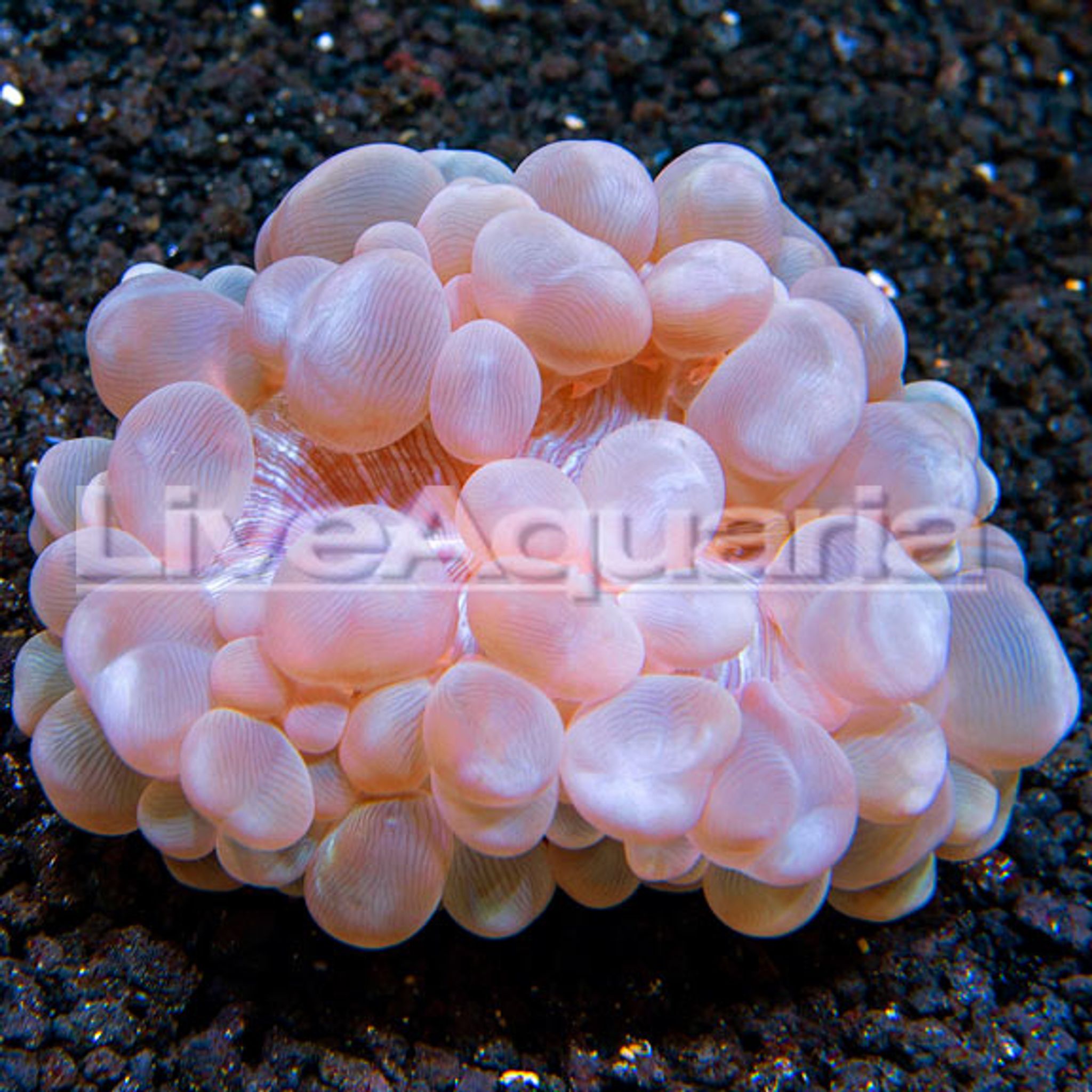
Best Placement for Bubble Coral: PAR, Flow and Space Requirements
Bubble coral (Plerogyra and Physogyra species) needs a specific combination of moderate-to-low light, gentle indirect flow and a wide buffer from neighbors to stay inflated and healthy. Get the placement recipe right — lower-to-mid tank, sheltered current, at least 6 inches (15 cm) of open space — and most of the common problems (shrinking, closed vesicles, stung neighbors) never happen.
What kind of coral is bubble coral
"Bubble coral" is the common name for large-polyp stony (LPS) corals in the genus Plerogyra (grape, bubble and branching/fox bubble forms) and Physogyra (pearl bubble coral), both in family Euphylliidae. That's the same family as hammer, torch and frogspawn coral, so bubble coral shares their care logic and, importantly, their capacity for aggression toward tankmates.
In the wild, these corals grow on reef slopes, walls, caves and overhangs in turbid, current-sheltered water. That habitat is the entire basis for the placement advice below: bubble coral evolved for filtered light and gentle water movement, not the open, high-flow, high-light reef crest where SPS corals thrive.
PAR requirements: how much light does bubble coral need
Bubble coral is one of the more shade-tolerant LPS corals in the hobby. The consensus comfort band is roughly 50–150 PAR, and many keepers get excellent results at the low end (50–100 PAR) on lower rockwork or the sand bed.
Hobbyist sources disagree on the upper limit. Some cap comfortable exposure around 100 PAR; others report success up to 150–200 PAR once a colony is fully acclimated. The practical takeaway for placement decisions:
- Treat 50–150 PAR as the safe working band.
- Treat anything above roughly 150 PAR as "possible, but only with slow acclimation and close monitoring" — not a placement target.
- Under strong direct LED or T5 light with no diffusion, bubble coral can bleach or shrink, even within a nominally "acceptable" PAR number, if the transition was abrupt.
Estimating PAR without a meter
Most home reefers don't own a quantum/PAR meter, so here's how to get a reasonable estimate anyway:
- Use the fixture's PAR-at-distance chart. Most LED and T5 manufacturers publish a graph or table showing PAR output at various distances from the light and at various dimming percentages. Match that to the depth of your intended shelf.
- Apply the shelf heuristic. In a standard mixed reef, low-light LPS like bubble coral generally belongs on lower rock or sand, softies and most other LPS occupy the middle, and SPS corals sit near the top, closest to the fixture.
- Account for what the chart doesn't show. PAR at a given fixture height is reduced further by water depth, surface ripple, a cover glass, and shading from coral growth above the spot you're considering. A fixture reading that looks fine on paper can deliver noticeably less usable light at the actual coral surface.
- Use known thriving corals as a rough proxy. If a coral with a documented PAR requirement is already healthy at a given spot, that spot is a reasonable stand-in reference for a similarly-lit coral.
- Smartphone lux apps are not an accurate substitute for a real PAR meter — lux measures visible light for the human eye, not the photosynthetically active radiation corals actually use. If you plan to keep light-sensitive LPS or SPS long-term, a PAR meter (owned or borrowed) is worth the investment.
Placement by tank depth
| Tank height | Recommended shelf for bubble coral | Notes |
|---|---|---|
| Under 20 in (50 cm) | Reduce fixture intensity or add a diffuser/frag-rack shading even on the sand bed | Shallow tanks put every shelf closer to the light source |
| 20–24 in (50–60 cm) | Lower third of the tank, sand or a low rock ledge | Standard placement for most home reef setups |
| Over 24 in (60 cm) | Lower third to middle | Middle shelf may work if the fixture is dimmed or diffused |
Flow requirements: low, indirect, never direct
Bubble coral wants low to medium, indirect and somewhat turbulent water movement — not a direct jet, and not dead-still water either.
Sources vary on exactly how gentle "low" should be. Some care guides call for near-zero, very gentle current only; others say moderate indirect flow actually helps with gas exchange and keeps detritus from settling. The middle ground works best in practice: aim for gentle, randomized, turbulent movement around the colony rather than either extreme.
- Too much direct flow: a powerhead aimed straight at the colony prevents the vesicles ("bubbles") from inflating properly and can damage tissue over time.
- Too little flow: a true dead spot lets detritus settle on the tissue, which can lead to localized necrosis.
- Just right: flow that moves gently around the coral from a couple of directions, without ever hitting it head-on.
Why bubble coral needs so much space
The vesicles that give bubble coral its name inflate during the day, functioning as a light-gathering aid for photosynthesis. At night they deflate, and long sweeper/feeding tentacles extend outward to capture zooplankton. Those nighttime tentacles are the reason spacing matters so much — and they carry a strong sting, making bubble coral one of the more potent stingers among LPS corals.
Cited sweeper-tentacle reach varies by source: some put it at 2–3 inches for smaller colonies, others report up to 6 inches or more from a large, established colony. The safest approach is to scale the buffer to colony size rather than rely on one fixed number.
| Colony size | Minimum clear buffer on all sides |
|---|---|
| Small frag or young colony | 6 in (15 cm) |
| Medium, established colony | 8–10 in (20–25 cm) |
| Large, mature colony | 12 in (30 cm) or more |
Leave extra room when the neighbor is another Euphylliid (hammer, torch, frogspawn, hydnophora), an anemone, or any sessile coral that can't relocate itself away from a sting. Corals with short or retractable polyps, placed behind a generous moat of open sand or rock, make safer neighbors.
Substrate and mounting
Place bubble coral directly on the sand bed or on a low rock ledge or cave mouth — not high up on exposed rockwork. This mimics its natural sheltered position, keeps it out of the most intense light and flow in the tank, and gives the inflated vesicles room to expand outward without contacting rock or glass.
Avoid setting the bare skeleton against sharp rock or wedging it into a tight crevice; either one restricts how far the vesicles can expand and can damage tissue as the coral inflates.
Acclimating a new bubble coral to its spot
Bubble coral should go into the display under lower light and flow than its final target, then step up gradually over 1–2 or more weeks. Sudden jumps in PAR — even within the generally "acceptable" 50–150 range — are a common cause of bleaching and tissue recession, especially right after a coral goes from a dim shipping bag or holding tank straight into a bright display spot.
A simple step-up schedule:
- Week 1: Place on the lowest shelf or sand, with the fixture dimmed well below target intensity.
- Week 2: Raise intensity partway (or move up one shelf) if the coral shows normal daytime inflation and color.
- After 2 weeks: Move to the final target PAR/flow only if the coral has stayed consistently inflated and hasn't shown recession or bleaching.
Water parameters that support healthy inflation
Placement is the focus of this guide, but stable water chemistry matters too. Standard reef parameters — salinity around 1.025, temperature 76–80°F (24–27°C), and stable calcium, alkalinity and magnesium — support tissue health and normal vesicle inflation. Poor water quality is a common non-lighting cause of chronic deflation, so if a well-placed, well-fed coral still won't inflate, check parameters before assuming a light or flow problem. A reliable sponge filter or hang-on unit paired with regular water changes goes a long way toward keeping those parameters stable.
Common placement mistakes
- Top-shelf placement under full-intensity SPS lighting — leads to shrinking, bleaching, or a coral that stays deflated and closed most of the day.
- Aiming a powerhead directly at the colony — blocks vesicle inflation and can cause tissue damage over time.
- Under-spacing from neighbors — nighttime stings can cause tissue recession on a neighboring coral, and sometimes on the bubble coral itself if it touches something back.
- Sudden light or flow increases after purchase — moving straight from a dim bag or holding tank to a bright display spot is a leading cause of early bleaching.
- Mistaking normal deflation for illness — vesicles can stay deflated for reasons other than disease, including recent relocation, spawning, a water change, or simply retracting after feeding. Give it a day or two before assuming a problem; persistent deflation over many days combined with tissue color loss does indicate real stress.
- Wedging the skeleton into tight rockwork — restricts vesicle expansion and can abrade tissue.
Frequently Asked Questions
What PAR does bubble coral need?
Roughly 50–150 PAR, toward the shade end of the LPS range. A lower-to-middle tank placement under standard reef lighting usually lands naturally within that zone.
Does bubble coral need high flow?
No. Low to medium, indirect flow is ideal. A direct powerhead blast prevents the vesicles from inflating and can damage tissue over time, while a total dead spot risks detritus settling on the coral.
How far should bubble coral be from other corals?
At least 6 inches (15 cm) of open space on all sides for a small colony, and more — up to 12 inches (30 cm) or beyond — for a large, established colony. The buffer exists because of the long nighttime sweeper tentacles and their strong sting.
Can bubble coral go under LED lighting?
Yes, but dim the fixture or place the coral lower in the tank compared to where you'd put an SPS coral, and acclimate it slowly over 1–2 weeks rather than starting it at full target intensity.
Why are the bubbles not inflating?
Usually a recent disturbance, low light, poor flow, or simply nighttime, when the tentacles extend instead of the vesicles. If deflation persists for several days and is paired with tissue color loss, check water parameters for a stress cause.
Is bubble coral aggressive?
Yes, relative to most corals. It's an LPS with a strong sting delivered through long nocturnal tentacles, so it should be spaced like hammer, torch or frogspawn coral rather than treated as a passive neighbor.
Can bubble coral go on the sand bed?
Yes — sand or a low rock perch mimics its natural sheltered reef position and is a commonly recommended placement, provided the light and flow at that spot fall within its comfort range.
How do I know the PAR level at a spot in my tank without a meter?
Use the fixture manufacturer's PAR-at-depth or PAR-at-distance chart as an estimate, or borrow a PAR meter if you're keeping several light-sensitive corals long-term. General shelf-height rules — low-light corals lower in the tank — are a reasonable proxy but not a substitute for an actual measurement.
Ready to add one to your reef? Browse available colonies in FishyHub's LPS hard corals category and match a colony's size to the buffer space you actually have available.

